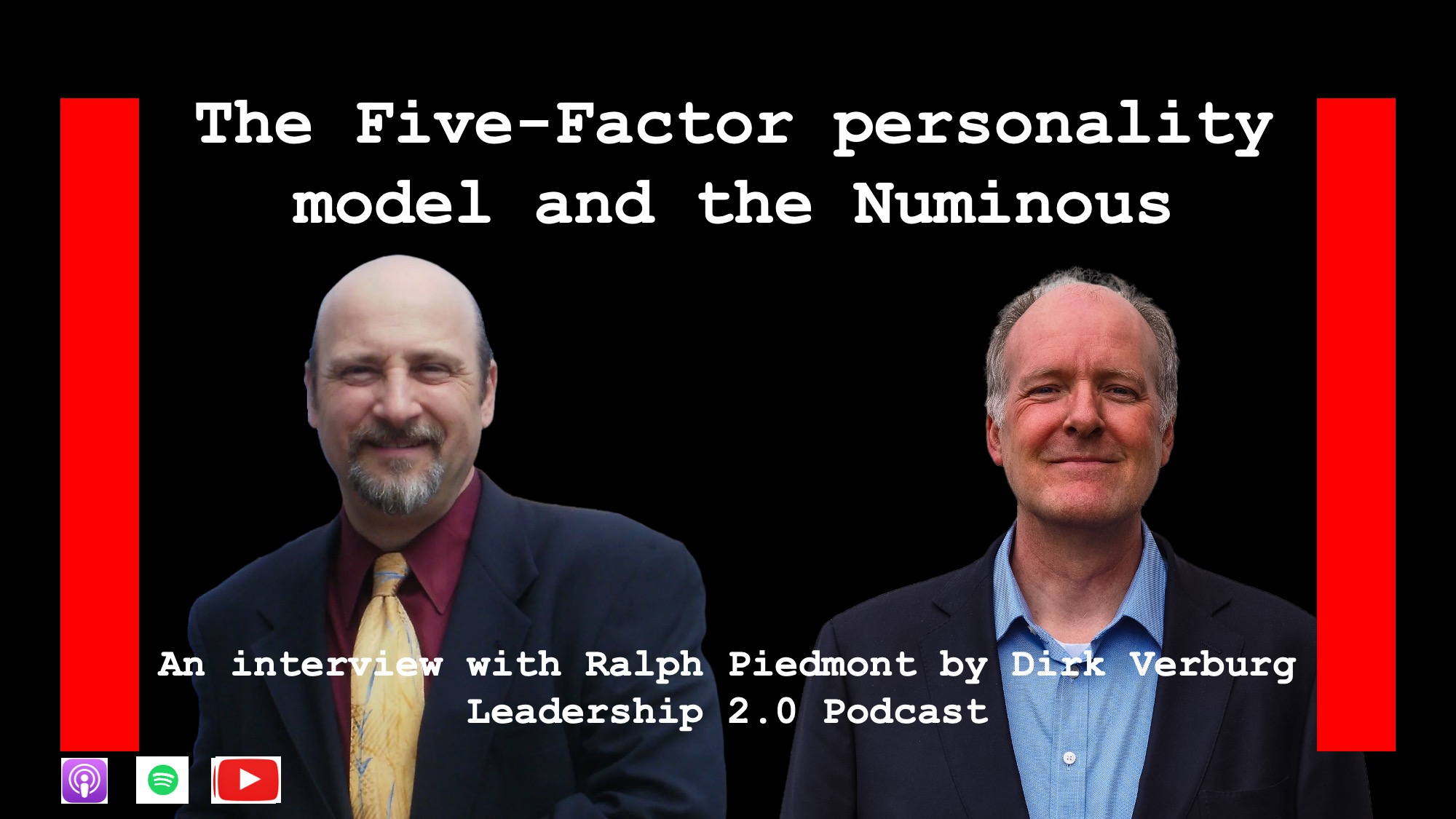
Current thinking in Psychology is that there are five dimensions we can use to describe the most important personality dimensions. Dr. Ralph Piedmont discovered the 6th one: ‘the Numinous’.
The five-factor model of personality (FFM) is a set of five broad trait dimensions or domains, often referred to as the “Big Five”: Extraversion, Agreeableness, Conscientiousness, Neuroticism (sometimes named by its polar opposite, Emotional Stability), and Openness to Experience (sometimes named Intellect). The Big Five/FFM was developed to represent as much of the variability in individuals’ personalities as possible, using only a small set of trait dimensions. Many personality psychologists agree that its five domains capture the most important, basic individual differences in personality traits and that many alternative trait models can be conceptualized in terms of the Big Five/FFM structure (www.oxfordbibliographies.com).
Dr. Ralph Piedmont discovered the 6th factor: the Numinous.
During our conversation, Ralph and I discussed the following topics:
- The origins of the Five-Factor personality model
- The Five-Factor personality model versus adopting a growth mindset
- Dark Triads
- What is the Numinous?
- The relevance of the Numinous for agnostics and atheists
- Practical implications of the Numinous
- Applications of the Numinous in the world of business
- Leadership Development and the Numinous
- Dysfunctional leadership behavior and the Numinous
- From the “Big 5” to the “Big 6”? The future of the Numinous
Watch or listen to the interview
► YouTube.
► Spotify
Summary
► No time to listen to podcast now? Here is a short summary of our conversation ⤵
Dirk Verburg: What are the “Big Five” personality dimensions in psychology, and why are they so important?
Ralph Piedmont: The Big Five emerged from Gordon Allport’s lexical hypothesis, which posits that language encodes important adaptive aspects of human personality crucial for survival. Researchers in the 1930s identified nearly 18,000 adjectives describing personality, which were later reduced to five broad dimensions: Neuroticism (negative affect, stress coping), Extraversion (people-orientedness, energy), Openness to Experience (creativity, flexibility), Agreeableness (compassion vs. cynicism), and Conscientiousness (goal-directedness, reliability). These dimensions are universal across languages, 50% genetically heritable, independent, and offer significant interpretive and predictive value for understanding personality.
Dirk Verburg: How stable are the Big Five dimensions, and to what degree can people develop them?
Ralph Piedmont: Personality exhibits both phenotypic (observable behaviors) and genotypic (underlying traits) change. While our behaviors (phenotype) change lawfully over a lifespan—an extroverted student’s partying evolves into a middle-aged extrovert’s social engagements—the underlying genotype remains remarkably stable. Studies show about 80% of adult personality variance is stable over 10 years, even for those who perceive immense personal change. This stability, contrary to some theories, is adaptive, allowing for long-term commitments in relationships and work. We can develop coping mechanisms but fundamental traits are largely set.
Dirk Verburg: What is your perception of the “Dark Triad” (narcissism, Machiavellianism, psychopathy), and how does it connect to the Big Five?
Ralph Piedmont: The Dark Triad is very much connected to the Big Five, specifically low Agreeableness and high Neuroticism. It stems from clinical psychology and reflects manipulative, selfish, and narcissistic orientations, often driven by distress and a pursuit of emotional security regardless of others. Neuroticism is a major predictor of psychopathology, underpinning over 98% of disorders. However, the numinous can also provide an independent pathway to maladaptiveness, distinct from neuroticism.
Dirk Verburg: Could you explain what you mean by the term “numinous” as a potential sixth dimension in addition to the Big Five?
Ralph Piedmont: The numinous is a uniquely human personality quality, unlike schizophrenia, which also lacks animal models. It originates from our advanced cognitive capacities—our ability to reflect, plan, and conceptualize. This power, when applied to ourselves, leads to self-consciousness and existential questions: Is death the end? Is there meaning in life? Am I good enough? These questions underlie three core numinous dimensions: infinitude, meaning, and worthiness, reflecting humanity’s unique capacity for transcendental thought.
Dirk Verburg: Why is the numinous universal, not constrained to people with religious convictions, even recognized by atheists/agnostics?
Ralph Piedmont: It’s universal because all humans possess the cognitive abilities to ask these fundamental existential questions about death, meaning, and worthiness. Religions provide accessible answers to these complex questions (e.g., immortal soul, divine plan, forgiveness). However, atheists and agnostics, while rejecting religious answers, still confront these same deep questions. They simply find alternative principles or understandings to navigate them, creating their own psychological “diorama” of the world and their place within it, independent of a formal belief system.
Dirk Verburg: What are some practical applications of the numinous, for example, in psychotherapy or coaching?
Ralph Piedmont: The numinous has significant clinical implications, especially for disorders like moral injury, suicide, substance abuse, and body image dysphoria, which are existentially linked. Worthiness and meaning are crucial. People low on worthiness show higher suicide attempts and psychiatric struggles, indicating a flaw in their personhood beyond anxiety or depression. Therapy must address these deeper numinous issues, moving clients towards more durable, socially connected, and ultimately transpersonal meaning-making, fostering resilience beyond just symptom reduction.
Dirk Verburg: Why is the numinous relevant for business leaders, organizations, and HR, and what can they do with this concept? Ralph Piedmont: The traditional transactional business model (like the 996 model) burns people out, leading to inefficiency, low passion, and high turnover, which is costly. There’s a growing recognition that empowering employees and helping them find meaning makes them more productive and successful. This “humanistic paradigm,” integrated into management education, fosters cognitive flexibility, conflict management, and empathy. The numinous helps people create meaning where their job fits their personal purpose, making them feel worthwhile and passionate, contributing to a resilient and successful company.
Dirk Verburg: Your research shows the numinous impacts students’ development. How can these findings apply to leadership development programs in businesses? Ralph Piedmont: Leadership development is complex, requiring the right leader at the right time. For example, early-stage Apple needed an inspirational leader like Steve Jobs, whose impact resonated with employees’ sense of meaning and infinitude. Later, it needed a technocrat like John Sculley. The numinous applies to all leadership styles. My research shows the numinous impacts cognitive flexibility, conflict management, and empathic listening. Cultivating leaders’ sense of meaning and worthiness can drive these positive changes in business, fostering a “humanistic paradigm” for leadership.
Dirk Verburg: You mentioned your meaning-making model, the “Logoplex,” which includes a time frame dimension. How does a longer time perspective impact individuals and organizations? Ralph Piedmont: The Logoplex includes dimensions of transpersonal vs. material focus, self vs. other focus, and crucially, time frame. A longer time perspective, or “Event Horizon,” provides greater stability and resilience. For individuals, an eternal time frame offers maximum psychological freedom to invest passionately in life. For companies, a long-term strategic view, balanced with tactical goals, cultivates a highly committed, proud workforce. Neglecting strategic vision for short-term tactical focus leads to burnout and a “human resources” mentality, losing valuable talent.
Dirk Verburg: You discussed Manfred Kets de Vries’s four dysfunctional leader types: narcissistic, bipolar, psychopathic, and obsessive-compulsive. How do these relate to the numinous? Ralph Piedmont: These types exhibit high neuroticism and specific Big Five profiles (e.g., low agreeableness for narcissism/psychopathy). I’d predict low worthiness across all. This underlying lack of worthiness, combined with negative emotional distress, drives their unproductive behaviors and need for control. Low connectedness is also strongly related to narcissism. While further data is needed, I am confident that a “Big Six” model, including the numinous, could provide precise profiles for each dysfunctional leader type, offering valuable diagnostic tools for coaching and development.
Dirk Verburg: How do you see the future of the numinous concept? Do you think it will gain wider acceptance, perhaps leading to a “Big Six” model? Ralph Piedmont: The numinous is a new idea, and the term itself can be challenging. However, it provides a strong framework for understanding existentialism and is a uniquely human quality. The robust, cross-culturally replicated data supporting the numinous is crucial. I believe its scientific rigor will ultimately lead to wider acceptance, and I’ll continue to advocate for its inclusion as a “Big Six” model, confident that the data will prevail.
Dirk Verburg: Is there anything else about the numinous or your research you’d like to highlight or restate? Ralph Piedmont: The numinous offers a fuller, deeper understanding of human beings. It’s a uniquely human quality, making conversations about it profoundly intimate. When people discuss their numinous experiences, they reveal their heart, soul, and personhood. This engagement is incredibly special and central to understanding our humanity.
About Dr. Ralph Piedmont
Dr. Piedmont received his Ph.D. in Personality Psychology from Boston University. He completed a postdoctoral fellowship at the National Institute on Aging, where he was trained in taxonomic models of personality and their relevance for understanding mental and physical outcomes.
He was a full professor in the Department of Pastoral Counseling at Loyola University Maryland and is now the Managing Director of the Center for Professional Studies.
His current research interests focus on the measurement of Spiritual Transcendence, a construct that represents a broad, nondenominational, motivational measure of spirituality. He has demonstrated the predictive value of this construct in both normal and clinical contexts, using both American and cross-cultural samples.
Dr. Piedmont is extensively published in the scientific literature and is on the editorial boards for Measurement and Evaluation in Counseling and Development, Assessment, and Journal of Personality Assessment.
He was the founding editor of the new APA journal, Psychology of Religion and Spirituality. He is a fellow of the American Psychological Association and a member of the American Counseling Association (ACA). He is also very much involved in Division 36, the Society for the Psychology of Religion and Spirituality for the APA and ACA’s Association for Spiritual, Ethical, and Religious Values in Counseling.
Resources
E-mail Ralph Peidmont: info@thecfps.com
Discover more from Dirk Verburg
Subscribe to get the latest posts sent to your email.
 Dirk Verburg
One thought on “The Five-Factor Personality Model and the Numinous – An interview with Ralph Piedmont”