Everyone is an expert in Leadership Development, or at least has an opinion about it.
However, if that is the case, why do global organizations spend more than $60 billion every year on leadership development programs, but is it so hard to ensure the ROI of these programs?
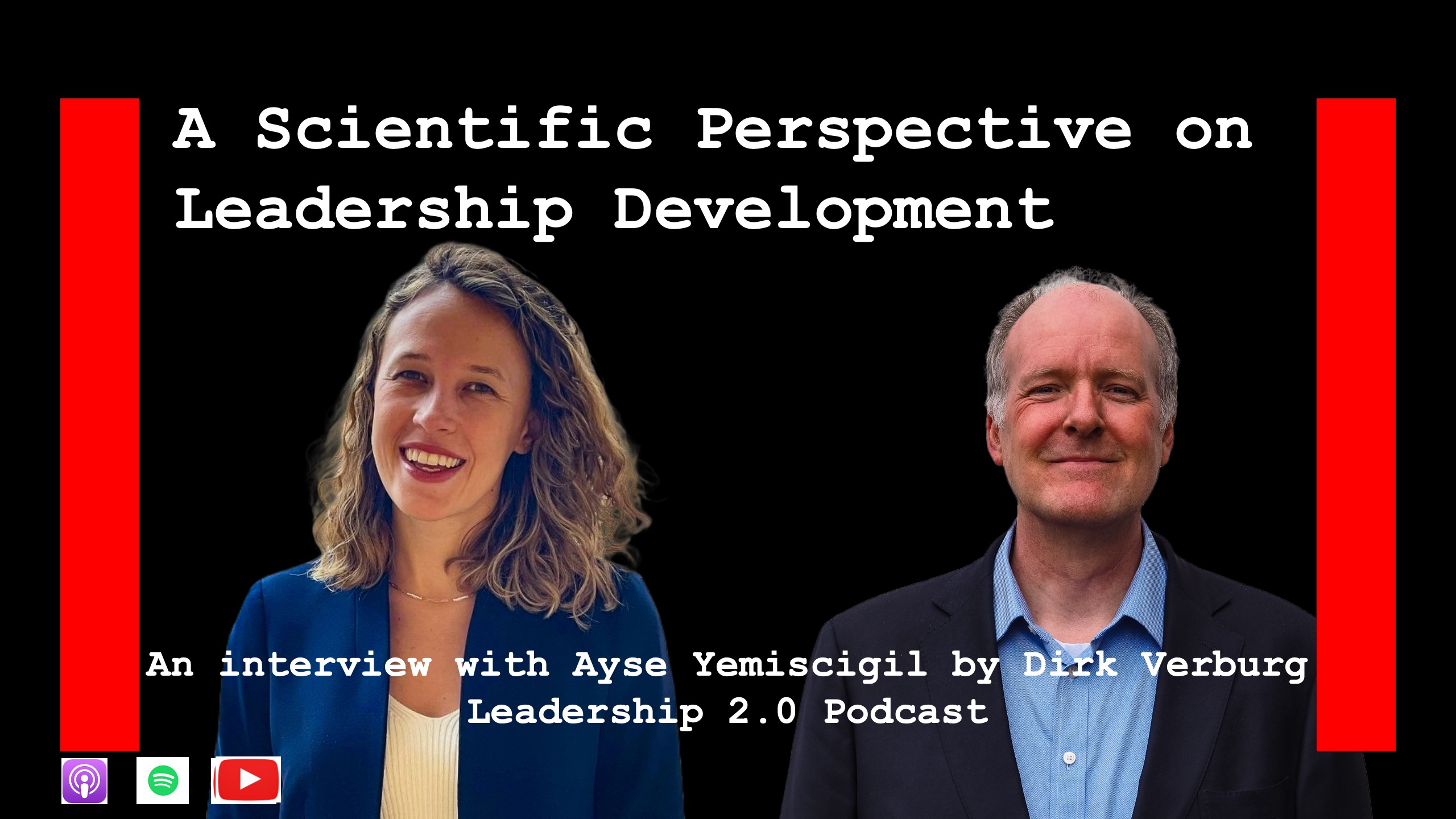
To find the answer to this question, I decided to interview Ayse Yemiscigil for my Podcast Leadership 2.0.
Ayse Yemiscigil is an Assistant Professor of Organizational Behavior at Fordham University’s Gabelli School of Business and a Research Affiliate with the Human Flourishing Program at Harvard University.
In February 2023, she, Dana Born, and Horace Ling, published an article for HBR.org of the Harvard Business Review titled: ‘What Makes Leadership Development Programs Succeed?’
During our conversation, we discussed the following topics:
1️⃣ Why most investments in Leadership Development programs fail
2️⃣ The format of Leadership Development programs
3️⃣ The content of Leadership Development programs
4️⃣ The ‘whole person’ approach
5️⃣ Whether knowledge building on business topics should be included in Leadership Development programs
6️⃣ The long-term impact (or not) of Leadership Development Programs
7️⃣ How to measure the impact of Leadership Development programs
8️⃣ Stimulating the self-reflection of (potential) leaders
Watch or Listen to the Interview
► YouTube
► Spotify
Summary
► No time to listen to podcast now? Here is a short summary of our conversation ⤵
Dirk Verburg: Your article suggest most leadership development investments fail. Why do you think many programs don’t deliver concrete results despite massive investment?
Ayse Yemiscigil: While initial numbers are estimates, the main problem is most programs aren’t evaluated; we don’t measure their impact. Leadership development is a relatively new practice, and we’re still learning how to do it right. Increased collaboration between researchers and practitioners is improving our understanding, but lack of rigorous measurement is a huge hurdle for proving concrete results.
Dirk Verburg: Do you have recommendations for leadership development program formats, like online vs. classroom, or duration?
Ayse Yemiscigil: Our research finds short, intensive online programs can be as effective as longer ones, if designed specifically for online delivery. However, online programs over four weeks tend to show diminishing returns. This is partly because longer online formats create more stress for participants as they struggle to compartmentalize the program with family and work demands, making them less beneficial.
Dirk Verburg: What content recommendations do you have for leadership development programs? Should they focus on technical skills or something broader?
Ayse Yemiscigil: Programs should primarily adopt a “whole person” approach, focusing on holistic development. While technical skills are important, leadership development is fundamentally about a person’s identity. Content should address generalized behavioral skills like resilience, empathy, and self-awareness. This allows individuals to integrate learnings into their broader life goals, shaping behavior across contexts and providing intrinsic motivation, as becoming a great leader is akin to becoming an integrated human being.
Dirk Verburg: Should topics like Big Data, AI, or business strategy also have a place in leadership development programs?
Ayse Yemiscigil: Definitely. Leaders must understand contemporary contexts and business drivers. While technical skills are vital, fundamentally, leadership is about human relationships. Programs should blend conceptual knowledge with practical “doing” and “being.” For example, we provide readings on AI but focus classroom time on how it impacts human relationships and leadership roles. The person’s identity acts as the vessel, holding knowledge and skills, allowing holistic integration.
Dirk Verburg: Leadership development programs are often criticized for providing only temporary motivational boosts. Have you researched this, and what are your thoughts?
Ayse Yemiscigil: Our multi-year research confirms this, with most effects disappearing after six months. This isn’t a “failure,” but part of how personal change works (like the hedonic treadmill). To capitalize on the initial boost, organizations should deliberately establish new habits during the program, and foster ongoing engagement through follow-ups and community building. While individual programs yield marginal behavioral changes, these changes accumulate and compound over time, making continuous development crucial.
Dirk Verburg: What does research suggest about measuring leadership development program impact, and what are best practices?
Ayse Yemiscigil: The “gold standard” for evaluation requires a control group (e.g., waitlist, nominated peers) and pre-post assessments, ideally long-term, using validated psychological scales. This rigorous design needs collaboration between scientists and practitioners. Organizations needn’t do this for every program, but a “proof of concept” validation for core programs helps understand actual impact. Mixed methods, including 360 assessments and objective business outcomes, are important. Journaling can also foster self-reflection and reinforce learning.
Dirk Verburg: Any final thoughts on leadership development you’d like to share?
Ayse Yemiscigil: We must be deliberate about what leadership means and what kind of leaders the world needs. Traditionally, leaders prioritized organizational efficiency, viewing people as resources. We must shift to recognize the inherent dignity of workers and the broader societal impact (both good and harm) of business activities. We must develop “humanistic leaders” who lead effectively, but also champion well-being and flourishing for all. This shift is paramount for tackling complex ethical and societal challenges.
About Ayse Yemiscigil
Ayse Yemiscigil, Ph.D., is an Assistant Professor of Organizational Behavior at Fordham University’s Gabelli School of Business and a Research Affiliate with the Human Flourishing Program at Harvard University. She received her Ph.D. from Warwick Business School and has been a postdoctoral research fellow at The Human Flourishing Program at Harvard University and Harvard Kennedy School’s Center for Public Leadership.
Professor Yemiscigil’s research brings a humanistic lens to leadership development and management. Using an interdisciplinary approach, she studies how leaders cultivate humanistic ideals such as flourishing and well-being, meaning, purpose, and authenticity in themselves, organizations, and the broader society.
Drawing from her interdisciplinary background in behavioral science, economics, and management, Professor Yemiscigil’s research focuses specifically on the social-economic barriers and support factors that are contextual and modifiable which may impact the humanistic development of leaders and organizational communities. She applies advanced quantitative methods to large-scale, longitudinal data and conducts natural field experiments in multi-country settings and organizations.
Her research has been published in leading academic journals, including Psychological Science, Proceedings of the National Academy of Sciences, and Harvard Business Review, and featured in the New York Times, Washington Post, and Wall Street Journal among other media outlets.
Professor Yemiscigil teaches humanistic management and leadership development and has been recognized for distinguished teaching performance by the Harvard Division of Continuing Education. She is a research consultant to multiple organizations including the Core Leadership Institute and Heart Mind Design.
She holds a master’s degree in behavioral and economic sciences from Warwick University, UK, and a bachelor’s degree in economics and business administration from Koc University, Turkey.
Resources
The E-Mail address of Professor Yemiscigil is: ayemiscigil@fordham.edu
The article ‘What Makes Leadership Development Programs Succeed?’
by Ayse Yemiscigil, Dana Born, and Horace Ling’ can be found here
Discover more from Dirk Verburg
Subscribe to get the latest posts sent to your email.
 Dirk Verburg