

Karl Marx famously said, ‘A specter is haunting Europe—the specter of Communism’. Nowadays we can say ‘A specter is haunting the business world – the specter of AI’.
Everyone seems to be riding on the AI bandwagon nowadays, and, as a result, many business leaders are suffering from corporate FOMO.
One thing is clear though, all business leaders need to reflect on the impact AI will have on their organizations. Too many organizations have disappeared because of technological disruptions, including the likes of Kodak, Polaroid, DEC, Motorola, Blackberry, SUN Microsystems, and Blockbuster, to name a few.
Of course, it is tempting to have an intellectual debate about which technologies are disruptive and which ones are not. This is especially the case if technologies are built on other technologies (which is almost often the case). Without the transistor, the modern computer would not have existed, does that mean that microchips are not disruptive?
For this reason, I like this definition in Investopedia:
A disruptive technology is an innovation that significantly alters the way that consumers, industries, or businesses operate. A disruptive technology sweeps away the systems or habits it replaces because it has attributes that are recognizably superior.
Based on this definition, I think AI definitely qualifies as a disruptive technology.
When it comes to dealing with disruptive technologies, business leaders need to ask themselves four questions:
- What is the impact of the new technology on the ecosystem of our company?
- What is the impact of the new technology on our products and services?
- What are our strategic ambitions regarding the new technology?
- How should we manage the adoption of the new technology in our organization?
Let’s now apply these questions to AI.
Question #1- What is the impact of AI on our ecosystem?
Customers
Most companies immediately look at the impact of disruptive technologies on their products or services. However, that is the wrong order. Instead, companies need to ask themselves what the implications are for the market in which they operate, starting with their customers.
The reason is a very simple one. Even if a technology does not impact your company or industry, it might impact the industry of your customers. Say for instance that you are the CEO of an auditing company in 2002, and Kodak is your biggest customer… You might want to think about diversifying your client portfolio.
The key question therefore is to ask yourself how the demand for your products or services from your customers will change in terms of volume (stay the same, increase or decrease), features (content), and/or delivery (format and supply chain).
Ecosystem
However, it is also important to realize that every technological disruption has implications for the entire ecosystem in which your company operates and that all technological disruptions inevitably create winners and losers.
A couple of examples:
- The printing press – The printing press enabled the quick dissemination and adoption of new ideas (e.g. the Reformation and the Enlightenment) but was seen as a threat by established institutions. More than 400 years after the invention of the printing press Lenin said: ‘As to freedom of the press, why should any man be allowed to buy a printing press and disseminate pernicious opinions calculated to embarrass the government?’
- The Industrial Revolution – The Industrial Revolution forced large groups of people to work and live in miserable conditions. However, it also catalyzed the growth and development of the middle class and forced the nobility to start sharing power
- The Internet – The Internet enables consumers to search for the lowest possible price, but poses serious challenges for brick-and-mortar shops. VOIP slashed the prices for voice+ communication for consumers and businesses and provided IT companies like Microsoft and Zoom the opportunity to offer a completely new range of software and services, but it posed serious existential challenges to established telco’s. Social media democratized communication and ended the oligarchy of established newspaper and broadcasting organizations, but also contributed to the devastating effect of ‘fake news’ and ‘polarization’ which we see in our society today
Considering these broader implications, it might be a good idea to not only look at the specific market in which your company operates but also at its total eco-system (ultimately our society).
Cynefin
Of course, not all AI’s potential implications are clear at this stage. However, doing scenario thinking, and listing all the questions, decisions, and ethical dilemmas systemically, might be a good start. In this context, many will find the Cynefin model a great tool.
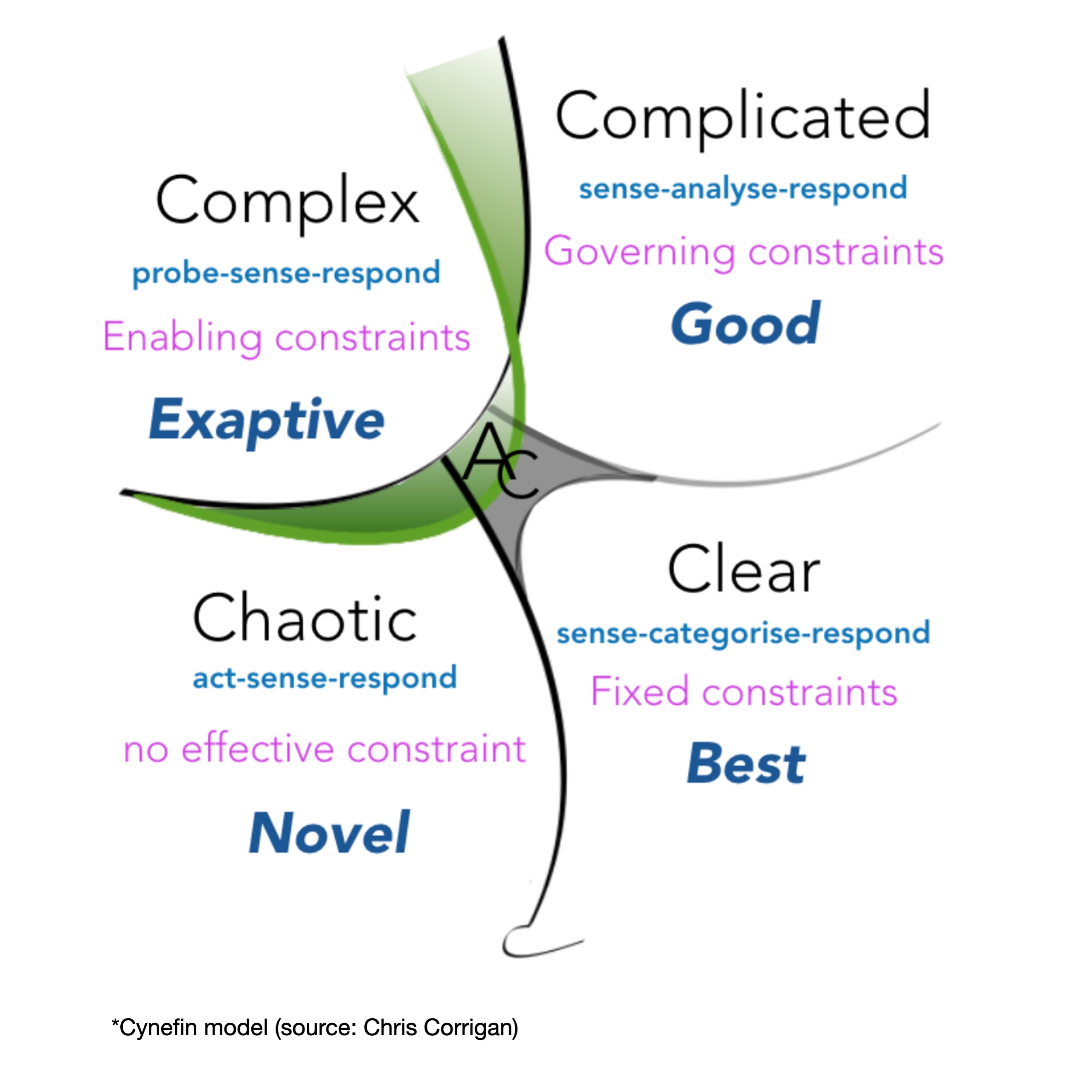
The Cynefin model enables assigning questions in 5 different domains, each with its own action logic. Examples of relevant questions in the AI space in these five domains could be:
- Clear – How much budget should we initially reserve to enter this space? Who should lead the project? Which KPIs shall we apply to measure our success?
- Complicated – With which products and services in our portfolio should we start our innovation process?
- Complex – With which technologies and providers should we start? Generative AI, machine learning (ML), deep learning (DL), Open AI, Gemini (Google), DeepSeek, Microsoft, AlphaSense, NVIDIA, etc.
- Chaotic – What if we, as a European company, face more and different legal and regulatory constraints in the AI space than our US or APAC-based competitors?
- AC (Aporetic or Confused) – This is the space where we are either unaware that we have an issue, or contemplate in which domain the issue we are dealing with belongs.
Question #2 – What is the impact of AI on our products and services?
The second question to ask is what the impact of AI on the products and services your company produces is. Here it is important to separate if AI will impact the way your product is produced (‘enabling’), if AI will impact the product or service itself (‘inherent’), or if AI will impact both.
Examples
Let’s clarify this with an example. If you are operating in the holiday industry, AI is not fundamentally impacting what your clients are looking for. They are still looking for a holiday experience (travel, hotel, excursions, etc). So, the inherent impact will be neglectable.
However, if you look at the way the service is produced, AI definitely has an impact. Identifying client segments and their needs (data mining and machine learning), as well as the communication process with clients (‘bots’), will radically change.
If, on the other hand, you are in the education, automotive, or healthcare industry, the output of your organization (product and services) will need to change
In the education industry for instance, institutions will have to integrate AI in their courses (including the ones on ethics!), as well as provide specific AI curricula and certifications.
In the automotive industry, customers will require advanced driver assistance systems (ADAS), and more accurate and tailored information regarding the status of their car, for instance, to manage predictive maintenance.
In the healthcare industry, AI will enable more accurate diagnostics and offer the possibility to translate these in personalized treatment plans, based on the latest medical insights and data.
A helpful way to think about this is that everything with a sensor attached is likely to be affected by IA.
Question #3 – What are our strategic ambitions with AI?
Once you established where AI might impact your production process, products, and services, the question is how you will embed this in your strategic agenda.
This will require a set of strategic decisions, starting with formulating your vision for AI in your company.
Here your ambitions in combination with the dynamics in your market are important. Do you want (need?) to be a leader in your industry and develop solutions yourselves, or can you afford to monitor developments and adopt the right technology when this is more mature (industry standards, best practices, ‘leading’ providers, etc.)?
In other words – where do you want to step in on the adoption curve?

Becoming the AI leader in your industry can result in an early mover advantage in terms of market share, intellectual property, and/or setting standards.
On the other hand, if you get it wrong, you might have burned a considerable amount of money and have nothing to show for it to your supervisory board, shareholders, and the market.
One thing is for sure though: if your competitors embrace AI faster than your company, they might gain a sustainable competitive advantage.
Question #4 – How do I ensure the adoption of AI in my organization?
Last, but certainly not least, leaders need to think how they will manage the development and adoption of new technologies in their organizations.
This question can be broken down into four components:
1 Accountability
Who will be responsible for managing AI in your company? The answer should be: the person or role that can realize the greatest leverage.
This poses tough questions. Should the accountability for AI be delegated to the CIO (affinity with the technology), should it become part of the portfolio of the department or function that will have to ensure its success for the organization (e.g. R&D, Product Design, or Manufacturing), or is it so crucial that it should become part of the portfolio of the CEO?
Answering this question requires a careful analysis of the pros and cons in the context of the strategic ambitions, structure (business units) and culture of the organization, as well as the political landscape and potential leverage individuals can exert in the organization to make things happen.
PS: Tempting how they might sound, please think twice before delegating this to a committee (you know why).
2 Change management (Adoption)
Successfully Implementing new technologies in organizations is hard.
Especially the adoption is something that needs to be (change) managed. As we have seen, every technological change creates winners and losers. Not only external but also inside the organization (‘Not invented here’).
One thing is certain: every role that includes gathering, reviewing, and analyzing data will be affected.
Since, as we all know, ‘culture eats strategy for breakfast (Peter Drucker), the best way to manage this process is to think of it as an internal marketing campaign. What are the different segments as far as adoption is concerned? Which groups will consider themselves as winners, and which ones as losers (for instance in terms of job content and job security)?
Another part of the analysis is looking for the ‘launching customer’ inside your organization. Which parts of the organization could be best utilized to pilot new solutions?
3 Capability building
Aligned with the first two questions, organizations need to define which groups in the organization will have which capability needs (e.g. ‘develop’ versus ‘use’) regarding AI and how these will be acquired
4 Measure success
A final component is defining a set of KPIs to measure the progress or lack thereof. Often these will be twofold: internal process KPIs to track the development and adoption rate of AI, as well as output indicators to track the success of AI-facilitated services and AI-embedded products on the external market
Not a one-off exercise
it is important to realize that leading the implementation of a disruptive technology like AI is not a one-off exercise.
Although a kick-off workshop to walk through the four questions presented in this post is a great start (and one that many companies unfortunately skip), these questions will need to be regularly revisited as new information about the technology, developments in the ecosystem, and adoption in the organization become available.
Earlier I mentioned the Cynefin model. It might mean that new questions around the implementation of AI in your company popped up, and also that questions have moved to a different domain (e.g. from ‘Chaotic’ to ‘Complex’).
The ultimate test for leadership?
To a certain extent, disruptive technologies are the ultimate test for business leaders. It is the moment that their strategic and analytical skills, as well as their capability to mobilize their entire organization, are tested. AI is no exception.
Discover more from Dirk Verburg
Subscribe to get the latest posts sent to your email.
 Dirk Verburg