
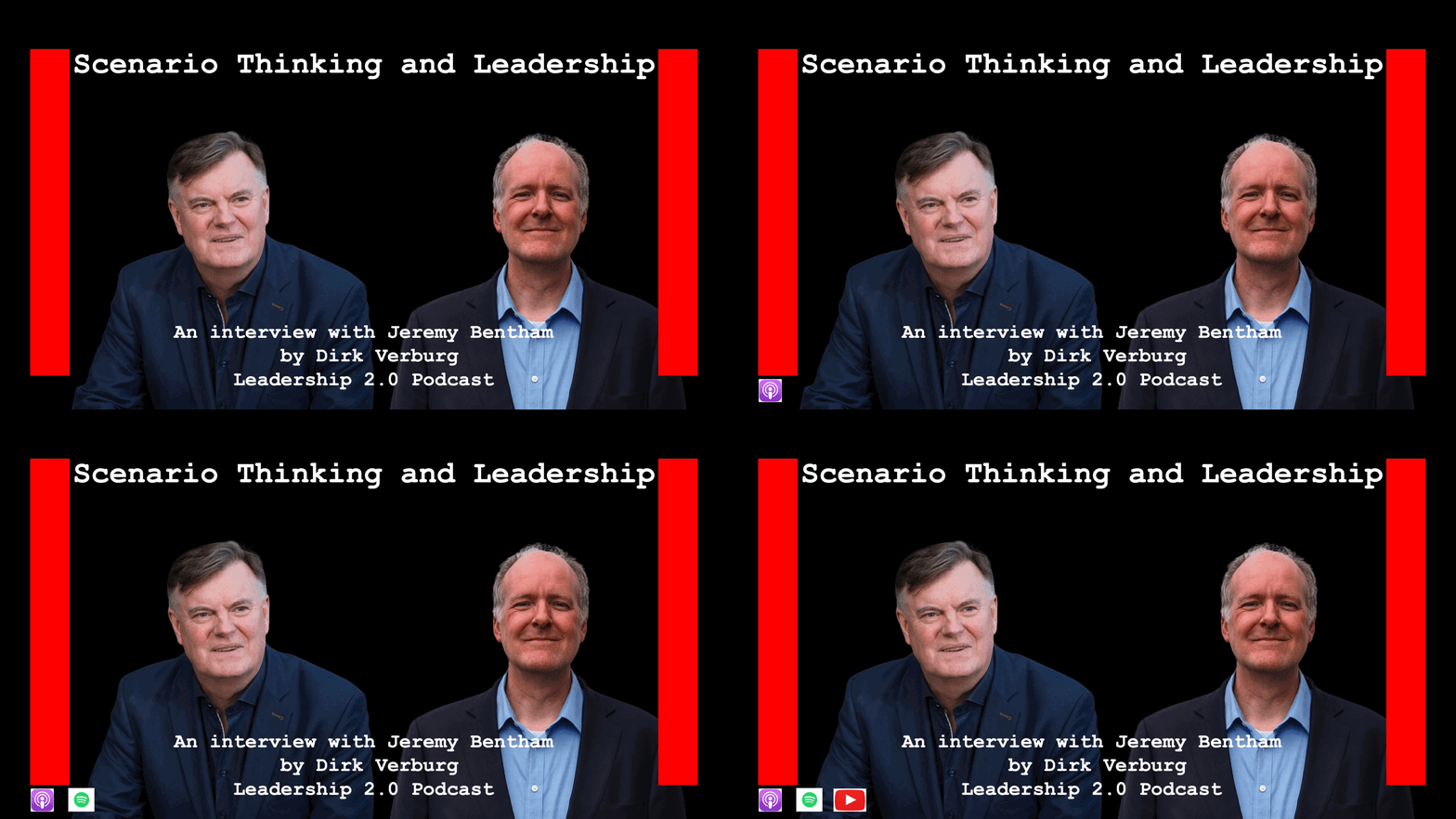
Scenario thinking enables organizations to establish possible visions of the future in the form of scenarios.
These scenarios enable decision-makers to think through the different ways in which the environment of their organizations could evolve, based on different sets of assumptions. It enables leaders to ‘think through ‘a wide range of what if questions’: ‘What if the dollar…’, ‘What if China…’, ‘What if scientific developments make it possible in the near future to…’, etc. This enables them to mentally prepare themselves for possible ‘Black Swans’, and review the ability of their organization to cope with, or, iedeally, benefit from these.
One of the companies that is best known for its scenario-thinking activity is Shell. For decades, Shell’s scenarios have supported the decision-making of Shell leaders, academics, governments, and businesses.
Jeremy Bentham led this activity in Shell between 2006 and his retirement in 2022 as Shell Scenarios & strategy Leader and VP Global Business Environment.
In this episode of the Leadership 2.0 podcast, I am interviewing Jeremy Bentham about scenario thinking and leadership.
During our conversation, Jeremy and I discussed the following topics:
0️⃣1️⃣ What scenario thinking is and what is it not
0️⃣2️⃣ Why organizations should invest in scenario thinking
0️⃣3️⃣ The development of scenario thinking in the past decades
0️⃣4️⃣ Why Shell started to start sharing scenarios with external stakeholders
0️⃣5️⃣ The importance of engagement in scenario thinking
0️⃣6️⃣ Why and how scenario thinking could lead to wiser decisions
0️⃣7️⃣ Strategic character
0️⃣8️⃣ Can scenario thinking contribute to addressing crises our society faces
0️⃣9️⃣ The Dodo club (recently established by Jeremy)
1️⃣0️⃣ Final thoughts on the topic of scenario thinking
Watch or listen to this interview
▶ YouTube https://lnkd.in/dketutAp
▶ Apple Podcasts https://lnkd.in/du5YFBkM
▶ Spotify https://lnkd.in/dFKnaSvP
Summary
► No time to listen to podcast now? Here is a short summary of our conversation ⤵
Dirk Verburg: You’ve worked in leadership for decades. How have demands on leaders changed?
Jeremy: Things have changed due to technology, making communication immediate and democratizing access to information. News cycles are faster. Yet, the world is more complex, requiring deeper thought. Leaders must balance speed with thoughtfulness. They also need to manage their health, as demands intensify, and recognize physiological limitations.
Dirk Verburg: What is scenario thinking, and what is it not?
Jeremy: Scenario thinking is not detailed prediction or forecasting, which is impossible. Instead, it’s an approach to exploring future possibilities by identifying key features and critical uncertainties in the future landscape. This understanding helps make wiser decisions in the present, recognizing that powerful, often conflicting, global currents mean alternative plausible outcomes always exist. Ignoring this leads to “lazy strategy.”
Dirk Verburg: What is the relationship between scenarios and strategic planning?
Jeremy: They are deeply integrated. Scenario thinking is fundamental to all strategic issues, a means to better decisions. It’s about a continuous dialogue that explores how the future might form, then connecting that to strategic choices. The mindset and continuous engagement are more significant than any specific scenarios developed. It’s about seeing beyond current perceptions and putting effort into reflective, “slow thinking.”
Dirk Verburg: What is the value or business case for organizations to invest in scenario thinking?
Jeremy: While it requires effort, its value is proven. Shell has used it for over 50 years, helping them stay “on the front foot” in major developments like the formation of OPEC in the 1970s or preparing for new East European markets after the Soviet Union’s collapse. It informs investments (e.g., natural gas, petrochemicals). Crucially, Shell’s biggest errors occurred when it abandoned scenario thinking for a single world view, demonstrating its protective value against strategic missteps.
Dirk Verburg: Has scenario planning evolved in methodology, format, or technology since its emergence in the 1950s/60s?
Jeremy: Yes and no. The challenges and strong global currents have evolved, changing what’s dealt with (e.g., fiscal vs. monetary policy). How insights are surfaced and brought to life for leaders has also evolved with leadership and organizational changes (e.g., influencing centralized vs. distributed power). However, the fundamental nature of exploring to understand and raise fresh insights remains. Technically, computational power now supports economic and energy modeling as a valuable sub-part, but the core approach is unchanged.
Dirk Verburg: Why did Shell, your former employer, generously share its scenarios with external stakeholders, given their competitive value?
Jeremy: Shell recognized it’s part of a larger ecosystem and contributing to better-informed public and policy dialogue benefits the common good and the company. This thought leadership granted access to otherwise inaccessible areas, like helping the Chinese State Council develop energy thinking, which deepened Shell’s understanding of that market without direct commercial exploitation. While some focused, commercially sensitive scenarios remain private, this broader, “exploratory” thinking still informs them, demonstrating the pervasive influence over percussive impact.
Dirk Verburg: What is ‘strategic character,’ and why is it important for leaders?
Jeremy: Strategic character combines good strategy with good character. General Norman Schwarzkopf highlighted character as paramount. My mnemonic “HEROES can practice PURPOSE” defines it: Scenario and Systems thinking, Humility (to seek alternative perspectives), Collaboration, Courage, Commitment, Patience, Persistence, and Purpose (meaningful contribution). These factors, seen in effective leaders like Nelson Mandela, can be strengthened through focused practice, fostering a mindset resilient to hubris and promoting inclusion.
Dirk Verburg: How can scenario thinking contribute to addressing major crises like climate change or geopolitical conflicts?
Jeremy: Scenario thinking helps in several ways: First, in crisis, it aids in grasping radical uncertainty. For instance, Shell used it to navigate the 2008 financial crisis, avoiding under- or overreaction. Second, it helps avoid future crises by examining past situations where “tinder was building up.” Third, by exploring tragic long-term scenarios (e.g., Gaza, Ukraine), it informs realistic approaches (e.g., humanitarian efforts, brutal honesty combined with hope, learning from past reconciliation efforts like post-apartheid South Africa).
The Dodo club
Recently, Jeremy started a regular newsletter and vehicle for discussion and community building called ‘the Dodo club. The purpose of this club is to help people and organizations make wiser decisions in the face of the radical uncertainties they are facing, including when grappling with issues of decarbonisation and energy transitions.
You can find this club, and sign up for the Newsletter at [https://thedodoclub.beehiiv.com/]
About Jeremy Bentham
Jeremy Bentham has a Degree in Physics from the University of Oxford and a Master’s Degree in Management from the MIT Sloan School of Management.
From 1980 – 2022 he worked for Shell in various roles and functions, including as Chief Executive for Shell Hydrogen, and later as Shell Scenarios & strategy Leader and VP Global Business Environment, in charge of developing forward-looking scenarios to support strategic thinking and direction-setting.
Currently, Jeremy is Co-Chair (scenarios) & Senior Advisor for the World Energy Council, as well as being involved in several other organizations in the climate and sustainable development space, including the World Business Council for Sustainable Development (WBCSD), Illuminem, Pathfinder International, and the Mission Possible Partnership.
Additionally, he is a Senior Advisor for the Boston Consulting Group (BCG).
His interests include theater production, cinema, and art history.
Resources
The E-Mail address of Jeremy Bentham is: jbentham@live.com
Additional resources:
Jeremy Bentham: Decarbonisation Scenarios (youtube.com)
Jeremy Bentham: The energy transition (post Illuminem)
40 Years of Shell Scenarios
Scenarios: An explorers guide
Discover more from Dirk Verburg
Subscribe to get the latest posts sent to your email.
 Dirk Verburg