Why do people want to become CEO in the first place?” That was one of the first questions I posed to Ty Wiggins during our interview for the Leadership 2.0 Podcast.
After all, the statistics are sobering:
- The turnover of CEOs is at an all-time high: from 9.2 years in 2018 to 7.6 years in 2022
- 50% of all CEOs reported feelings of loneliness
- The average workweek of CEOs is more than 60 hours
- Burnout is a reality for 71% of CEOs
Being a CEO comes with immense responsibility because the CEO is ultimately accountable for the company’s entire trajectory, from strategic wins like M&As to major setbacks like corporate scandals.
Every day, CEOs must make tough decisions on issues that can’t be resolved at lower levels. More often than not, these choices are a matter of picking the ‘least unattractive’ option. These decisions have a significant influence on the lives and financial well-being of all stakeholders. This broad group includes employees, investors (e.g., pension funds), consumers, suppliers, and government bodies.
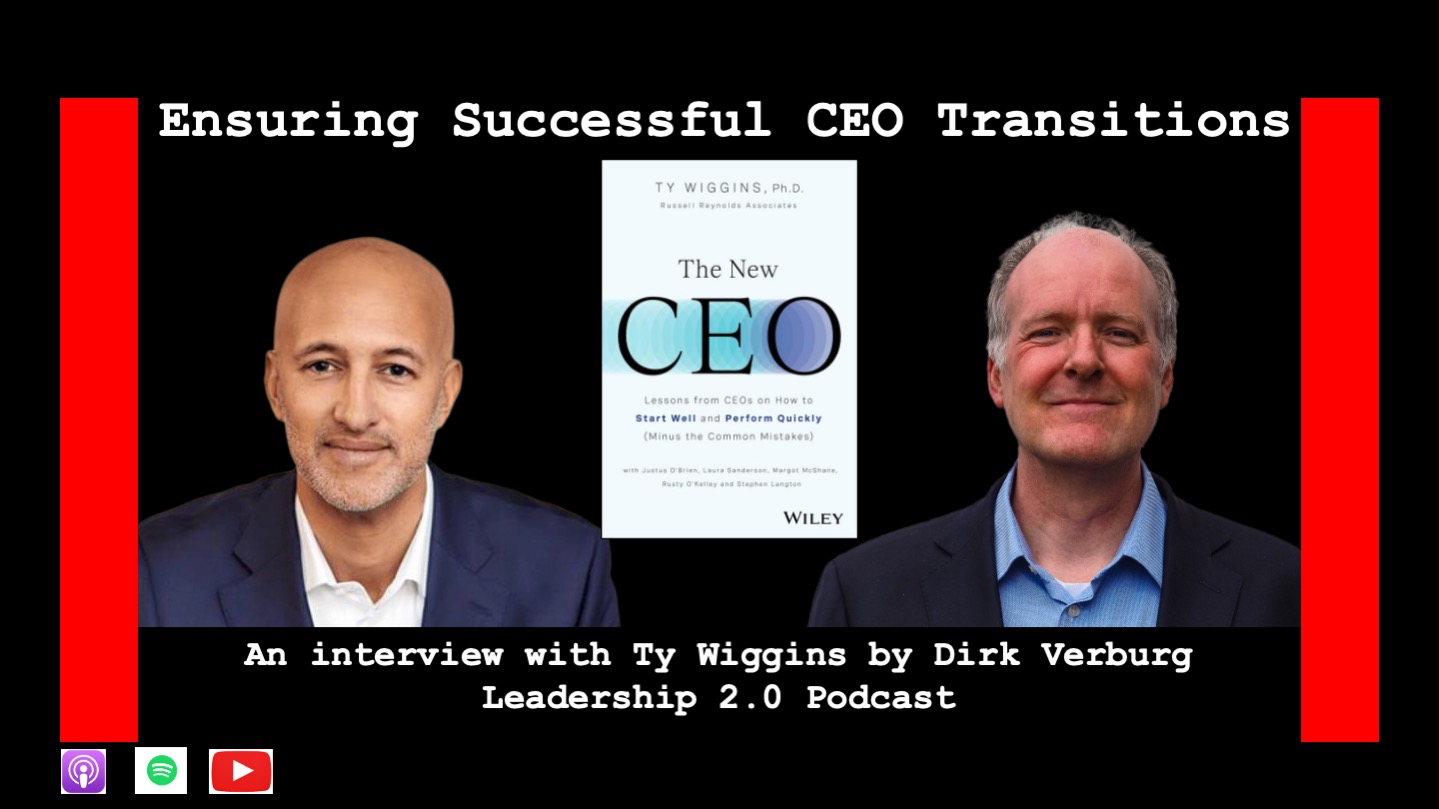
In the 32nd episode of the Leadership 2.0 podcast, I interview Ty Wiggins of Russell Reynolds about his book ‘The New CEO – Lessons from CEOs on How to Start Well and Perform Quickly (Minus the Common Mistakes)’.
During our conversation, we discussed the following topics:
- The CEO and Executive Transition Practice of Russell Reynolds Associates
- The Model on which the book ‘The New CEO’ is based
- Why do people want to become CEO in the first place?
- Why CEOs are never 100% ready before they start
- The big shift from Business Unit leader to CEO
- The nature of decisions CEOs need to make
- Why typical CEO transitions last 12-18 months
- What a Transition Plan for CEO role looks like
- Taking over the CEO role in a ‘Stealth mode’
- The right moment for new CEOs to start making big decisions
- When and how CEOs should select their teams
- How to burst the ‘CEO bubble’
- Should CEOs speak up on political issues?
- Final Thoughts
► You can watch or listen to this podcast episode on:
➡️ Spotify
➡️ YouTube
➡️ No time to watch or listen to podcast now? Here is a short summary of our conversation ⤵
Dirk Verburg: What does your role at Russell Reynolds Associates entail?
Ty Wiggins: Leading the practice around transition means my work is primarily with CEOs and senior executives as they move into new roles, both externally recruited and internally promoted. As a leadership advisory firm that does a lot of senior search work, my role focuses on helping these executives be successful through their first 12 to 18 months.
Dirk Verburg: How did you create your 10-factor model for CEO transition success?
Ty Wiggins: The model actually came out of the book. As I started to group the different topics that came up with my clients, we found they fit into a model. The “preparing to win” component is something the CEO needs to do on their own. There are five areas that talk to the CEO’s learning and understanding of their new situation, and five areas that focus on the actions and approach the CEO takes.
Dirk Verburg: Why do your clients still want to become CEOs, considering you paint a very dark picture of the role?
Ty Wiggins: I don’t intend it to be a dark picture, but a realistic one. The CEO role is the most challenging in business, and it is hard to understand it until you are in the chair. In my research, I found that the best and worst part of being a CEO was often the same: the responsibility. People want the responsibility to make decisions and build long-term value for the organization. However, the negative side is the intense responsibility not only for the financials but also for the people, their families, and the customers. You have to want both sides of that, and not everyone will enjoy or do well at the role.
Dirk Verburg: What does Nancy McKinstry, CEO of Wolters Kluwer, mean when she writes that you can never be 100% ready to be a CEO?
Ty Wiggins: This is a key lesson from my work and from the people I spoke to. We all have a view of the CEO role, and you can be very close to it. For instance, Raman Laguada from PepsiCo had been working right beside the CEO for a long time, but when he became CEO, he said it was “massively different” and “so much more complex and challenging” than he had thought. Being a CEO is a unique position, and it is unlikely that you will understand exactly what is involved before you get there. You should not feel bad if you step into the role and find it is harder or different than you expected, because most people experience that.
Dirk Verburg: Why is it a shift change to move from leading a Business Unit to becoming CEO?
Ty Wiggins: It is a big shift because when you’re in a division, you still have somebody else who ultimately takes responsibility and makes the big decisions. You lose that person who supports what you do and you’re far more in the limelight. When you become CEO, you’re the main attraction. You’re also often dealing directly with the board, and the relationship changes from just presenting your results to being on call to the board and having multiple bosses. This is a big difference from even running large divisions.
Dirk Verburg: Why are the issues a CEO deals with often so hard?
Ty Wiggins: The stuff that comes to a CEO’s desk is always the hard stuff because everything else that can be solved is solved at lower levels. The issues that escalate to the CEO are intrinsically difficult. You have to make those big decisions, which are often judgment calls where there is no clear right or wrong choice. As Lucy McGawan described in the book, you often have a “bad option, worse option, even worse option” and have to choose one. Then you must perform the “alchemy” of telling the organization that it is the best outcome, which is challenging because none of the options are good.
Dirk Verburg: Why does a CEO transition take so long? How does this relate to the grace period granted by boards and investors?
Ty Wiggins: A CEO transition takes time because it takes six to nine months for most CEOs to even put a strategy together for the board. One of the key levers for a CEO is their team. My research shows it takes about 9.2 months to get the full team in place and 11 to 14 months before they are performing at a high level. A CEO cannot be successful if the team is not high-performing. This is why we tend to see more CEOs removed in the second year than the first year. In the first year, you are doing things that look good and making investments, but in the second year, the market and the board get nervous if they don’t see results. You are proving if the bets you made in the first year were the right ones.
Dirk Verburg: What should a transition plan for a CEO look like?
Ty Wiggins: The process of planning is what’s most important. The first transition plan is about preparation, learning, and understanding the information you need before you start. It should include a listening tour and early communication strategies. After three months, CEOs often make a six-month plan to get them through strategy formulation, culture assessment, and team placement, and then a “thousand-day plan” for the three-year window. A plan allows you to test your assumptions with the board and set expectations. It is a great calibration moment. Being explicit about what you plan to do is very helpful, especially since there are things you do not know that you do not know when you first step into the role.
Dirk Verburg: How do you advise CEOs who have to take over in “stealth mode”?
Ty Wiggins: This is one of the worst scenarios, and it usually happens because the business is not performing. When the announcement is made, you must be on the front foot with communication and acknowledge that it is a shock. You must deal with the stress and anxiety you’ve caused and avoid immediately talking about your vision for the next three to five years. You need to quickly shore up key players and reduce the level of anxiety at lower levels. It is also good for the board to provide messaging because they made the decision and need to own some of the process upfront. New CEOs are often excited, but in this situation, you can’t talk about all the exciting things; you must deal with the reality of the situation.
Dirk Verburg: How do CEOs know they are in the sweet spot for balancing patience and action?
Ty Wiggins: It is a real challenge, and every CEO has nuances. Being transparent and open about what you are learning helps so that people are not expecting immediate action. In my book, I talk about the difference between things that are “on fire” and things that are “smoldering”. You need to be careful not to pick something that is interesting but not urgent and miss the opportunity to work on the things that are on fire. Your early actions send a very clear message. If you can fix small pain points that frustrate or demotivate the organization, it tells them where they sit on your priority list and helps you when you want to move the organization in a different direction. More often than not, the pressure to act fast is coming from the CEO themselves. You need to ask what terms like “fast” and “good” mean in that organization, because otherwise you risk damaging credibility and momentum with well-intentioned mistakes.
Dirk Verburg: Why do CEOs need to take action on their team relatively fast? How can they do this given they are still learning the business?
Ty Wiggins: The most common response from CEOs when you ask what they would have done differently is that they would have moved faster on their team. You need to get moving on this quickly. The question I ask is, “Knowing what you know now, would you rehire this person for their role?”. If the answer is no, it doesn’t mean the person is bad; it means the organization you see three years from now needs different capabilities. My research shows it takes about nine months to get people in their chairs and 11 to 14 months before they’re performing. If you do not move quickly, you will be doing a part of every other executive’s job and not the job you were hired for, and if you are not doing it, nobody is doing it.
Dirk Verburg: What would you practically recommend a CEO do if they have doubts about a direct report?
Ty Wiggins: You can go through a number of data points or processes, and one is formal assessment. Hans Vestberg at Verizon did this with 200 leaders to ensure he was not falling victim to his own bias. He wanted to find out if they had the right people in the wrong roles or if people were doing well but were maxed out. This gave him a basis of data to move quickly. Ultimately, the question “Would you rehire?” tends to bring it to a head. If the CEO says no, they can tell the board that the current team is great for now but that they want to build the team for the future, which needs different capabilities.
Dirk Verburg: How can new CEOs burst the “CEO bubble” and ensure they receive all the information they need?
Ty Wiggins: A CEO must accept they will never get all the information. It is the nature of the role for people to manage the information they give you, not out of deceit, but out of respect for the position. The C-suite is the thickest layer of difficulty for information flow. To get around this, CEOs are encouraged to do skip-level meetings or work with a top 50 or 100 leaders without their C-suite. The expression I give to clients is, “When you get to the CEO role, you will see more but you will hear less”. It’s important to keep people close who will tell you the truth. When you are new, people might be more candid initially, so how you respond to early feedback or pushback is critical. Everyone in the organization will hear about your first reaction.
Dirk Verburg: How do you advise CEOs on the growing pressure to speak up on political and social issues?
Ty Wiggins: There are two approaches CEOs take. One is that they should not comment on anything unrelated to their organization because they are not experts in those matters. The other view is that CEOs represent a community and should speak out to help that community. I suggest to clients that they have a conversation with the board to agree on what topics they will talk about as an organization. They can group them into categories like pandemics, wars, and economics. If you comment, you will upset a group of people, and if you wait, you will get just as much negativity as if you said something wrong. You must be clear that commenting is in the best interest of your employees and shareholders. If you start commenting, you can’t stop, and it will be difficult to move on, as you will constantly be asked about your previous statements.
Dirk Verburg: Is there anything else you would like to mention that we have not discussed?
Ty Wiggins: Yes, the board is a significant change for a CEO. It is one thing to present to the board and another to be reporting into a group of individuals. A lot of CEOs in my research spent a lot of time with directors to understand their expectations, their view of the organization’s opportunities, and the board’s dynamics. The second biggest regret I found is that people wished they had engaged the board more effectively early. CEOs spend 25% of their time on board or board-related activities in their first year. Also, when you become CEO, not only is the role different, but the people you need around you are different too. I encourage clients to network with other CEOs because sometimes you just need to sit with someone who understands what you are going through.
► About Ty Wiggins
Ty Wiggins is the CEO & Executive Transition Advisor at Russell Reynolds Associates. He advises leading companies on leadership transitions and executive onboarding to ensure a more expedient path to effectiveness. Based in London, Ty is one of only a handful of people globally with a Ph.D. in senior leadership transitions. He harnesses his deep academic, consulting and coaching background to provide CEOs, boards, and senior leaders across industries with the advice, support, challenge and insight needed to start well and perform quickly. Ty holds a BS in social sciences from the University of South Wales. He also holds a Master of Business Coaching, MBA, with honors, and PhD in leadership transitions from Sydney Business School at the University of Wollongong.
Discover more from Dirk Verburg
Subscribe to get the latest posts sent to your email.
 Dirk Verburg