In many recruitment processes, human beings are reduced to commodities, and human dignity has become an afterthought.
More often than not, recruitment has become a volume-driven exercise, where metrics like ‘time to fill’ have replaced the craftsmanship essential for identifying the best candidate for the role. As a result, candidates often find these processes unsatisfactory, as their potential unique contributions and value to organizations are not adequately recognized.
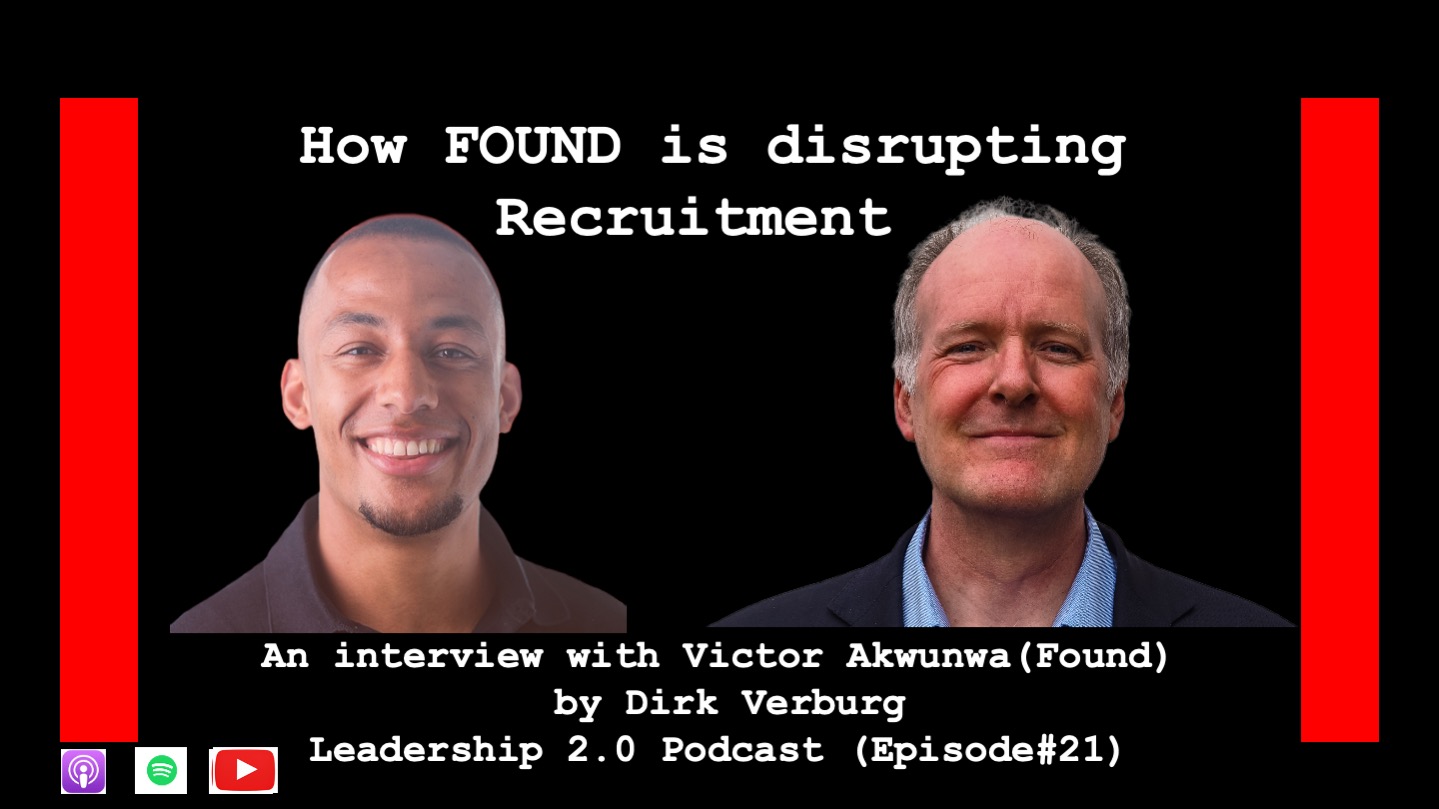
FOUND, a Swiss-based start-up company, wants to disrupt this traditional approach to recruitment. I recently interviewed Victor Akwunwa, the Chief Sales Officer of FOUND for my Leadership 2.0 podcast.
During our conversation, we discussed the following topics:
I coach several people who are looking for another role, and it seems that the user satisfaction with the average recruitment process is even worse than in 2018, when I wrote a blog post with the title: ‘Recruiters should stop spraying and praying’.
In this post I wrote ‘We should therefore not be surprised if, in the near future, recruitment will become an AI-fuelled war between recruiting bots used by corporate recruiters, and application bots used by candidates.’
Today it looks like my predictions have become reality.
A ’sub-optimal’ candidate experience
What are the frustrations on the supply side of the market i.e. from the candidates? Here are the things I hear from my coachees:
Karl Marx famously said, ‘A specter is haunting Europe—the specter of Communism’. Nowadays we can say ‘A specter is haunting the business world – the specter of AI’.
Everyone seems to be riding on the AI bandwagon nowadays, and, as a result, many business leaders are suffering from corporate FOMO.
One thing is clear though, all business leaders need to reflect on the impact AI will have on their organizations. Too many organizations have disappeared because of technological disruptions, including the likes of Kodak, Polaroid, DEC, Motorola, Blackberry, SUN Microsystems, and Blockbuster, to name a few.
Of course, it is tempting to have an intellectual debate about which technologies are disruptive and which ones are not. This is especially the case if technologies are built on other technologies (which is almost often the case). Without the transistor, the modern computer would not have existed, does that mean that microchips are not disruptive?
For this reason, I like this definition in Investopedia:
A disruptive technology is an innovation that significantly alters the way that consumers, industries, or businesses operate. A disruptive technology sweeps away the systems or habits it replaces because it has attributes that are recognizably superior.
Based on this definition, I think AI definitely qualifies as a disruptive technology.
When it comes to dealing with disruptive technologies, business leaders need to ask themselves four questions:



 Dirk Verburg