
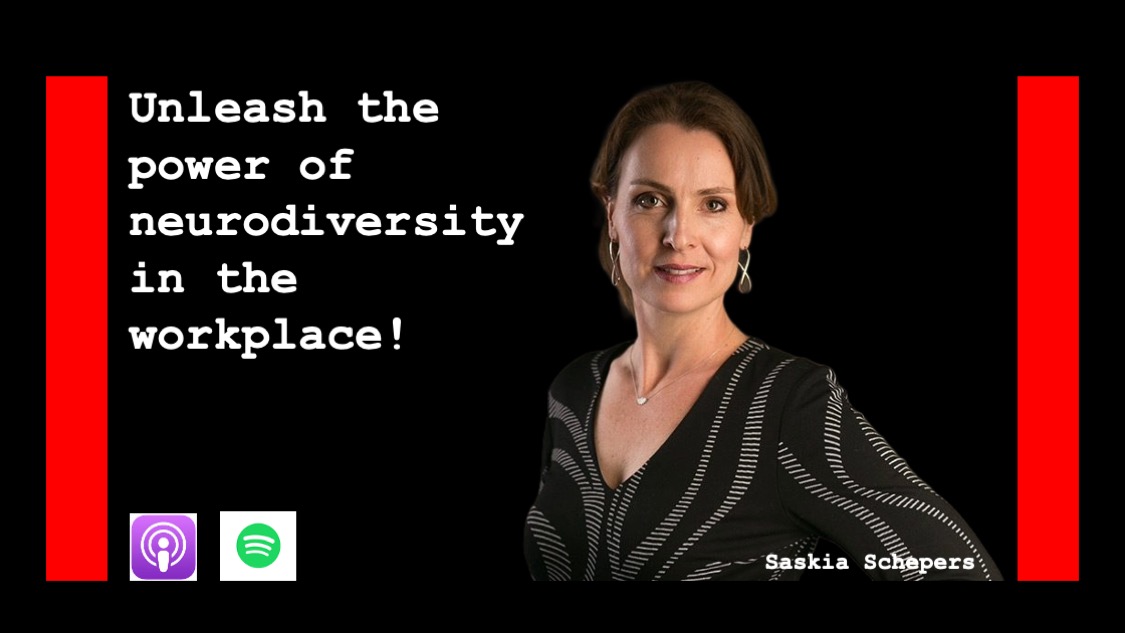
Recently I had a conversation with Saskia Schepers about her book on Neurodiversity in the workplace with the title ‘Als alle breinen werken – Waarom ruimte voor neurodiversiteit op het werk goed is voor iedereen’ (‘When all brains are switched on – Why space for neurodiversity in the workplace benefits everyone’).
Around 80% of mankind is neurotypical, and 20% is neurodivergent. We tend to ‘equip’ people in the latter category with labels like ADD, DHD, bipolar, autistic, etc.
Most leaders find it hard to integrate neurodivergent people in their teams.
The reason is that most of us have preconceived ideas about the way people in the workplace should behave. For instance, we expect people to like attending and participating in meetings, do their work in teams, be productive in open-plan offices, and socialize with their colleagues after work.
People who do not fit this mold are seen as bad ‘team players’, and are often criticized for this behavior, e.g. during annual performance review meetings.
In her book, Saskia Schepers describes what neurodiversity is, what the strong points of different types of neurodivergent people are, and how, as an organization, you can integrate neurodivergent people and capitalize on their strengths.
The book almost immediately reached the number 1 position in the Dutch bestseller list of management books, was quickly sold out, and is now in its third printed edition.
An English translation is in the making and will be published in 2024.
During our conversation, we discussed the following topics:
- During our conversation, we discussed, amongst others, the following topics:
- What neurodiversity is
- Why neurodiversity is a leadership issue
- Why leaders find it hard to deal with neurodiversity
- Recommendations for leaders struggling with neurodiverse people in their teams
- How to start a conversation about neurodiversity as a leader
- Accepting Neurodiversity versus adopting a ‘growth mindset’
- Why working in teams can pose challenges for neurodiverse people and how leaders can accommodate this
- To stimulate innovation, more and more businesses start to ‘encourage’ staff to return to the office. Is this necessary, and which special challenges does this pose for neurodiverse people
- The special challenges working in an agile manner can pose for neurodiverse people
- The application of ‘strength-based management’ beyond neurodiversity in organizations
- The role Saskia’s neurodiverse profile played in the way she wrote this book (‘The creative process’)
I really enjoyed our conversation, and if you are interested, you can listen to a podcast of our conversation on
► Spotify
► No time to listen to podcast now? Here is a short summary of our conversation ⤵
Dirk Verburg: Did you expect the success of your book, “If all brains are switched on,” as a #1 bestseller in the Netherlands?
Saskia Schepers: I knew the neurodiversity topic was timely, especially post-pandemic, as people seek contexts to thrive. I hoped neurodivergent individuals would buy it to give language to their experiences for managers. This happened; managers call me, impressed, wanting to help their employees. So, it turned out as I expected.
Dirk Verburg: How do you define neurodiversity, and what “labels” or neurotypes identify neurodivergent people?
Saskia Schepers: Neurodiversity is natural brain variety, like biodiversity. There’s no standard brain, just common and less common types. Medical “disorders” like ADHD or autism are just neurotypes. Historically, hyperactive brains were hunters, and autistic brains spotted threats. These brains always had functions. We need this natural variety, but must create the right context.
Dirk Verburg: Why is neurodiversity a leadership issue, not just the neurodivergent individual’s responsibility to adapt?
Saskia Schepers: Neurodivergent people, like everyone, have self-responsibility, but they need psychological safety. Often raised with disqualifying feedback, leaders must create a safe context to utilize their talents like hyperfocus and creativity. Neurodiverse teams are more productive. Leaders must understand and challenge the “norm” they fit into. It’s a leadership issue because leaders provide the environment, and many neurodivergent people are already in companies, often masking.
Dirk Verburg: What common challenges do leaders face when managing neurodivergent people in their teams?
Saskia Schepers: Main challenges include contradictory needs among team members. Also, neurodivergent individuals may not respect hierarchy for its own sake, requiring leaders to provide strong, rational arguments. They have a “BS radar.” Another issue is the “black box” phenomenon: managers can get nervous not knowing what’s happening in an employee’s mind, making status updates difficult.
Dirk Verburg: What practical tips do you have for managers struggling with neurodivergent people in their teams?
Saskia Schepers: Be curious and trusting; not all behavior is what it seems. Ask questions, share observations. Neurodivergent people often have high intrinsic motivation. Focus on strengths, not weaknesses, as fixing weaknesses drains energy and won’t lead to excellence. Embrace “spiky profiles” by organizing around their strengths. This saves time, prevents burnout, and retains talent, ultimately benefiting the company.
Dirk Verburg: Should leaders openly discuss a neurodiverse profile or avoid labels?
Saskia Schepers: Never ask if someone has a diagnosis. Focus on concrete, observable behaviors, like “I noticed you’re distracted in meetings, what do you need?” People might not have a diagnosis or prefer privacy due to stigma. It’s about understanding brain needs, not labels. My “brain manual” concept lets individuals share what they need to thrive without disclosing a diagnosis.
Dirk Verburg: Given the emphasis on growth mindset, shouldn’t neurodivergent people just adopt it and step out of their comfort zone to address challenges?
Saskia Schepers: While everyone can work on weaknesses, forcing neurodivergent brains to optimize for areas they’re not naturally wired for demands immense energy for minimal gain. It’s like forcing left-handed writing; possible, but suboptimal. They can cope, but won’t excel. Focus on their “spiky profiles” where they shine. This ensures energy goes to where they can truly contribute.
Dirk Verburg: What issues can working in teams pose for neurodivergent people, and how can leaders accommodate this?
Saskia Schepers: Constant team interaction is problematic. Many neurodivergent (and introverted) individuals need quiet time for reflection and energy, preferring one-on-one connections. Leaders can accommodate this by structuring meetings: dedicate 15-30 minutes for social chitchat, then proceed with a structured, content-focused agenda. This respects diverse needs without negatively judging those who prefer less social interaction.
Dirk Verburg: Many companies encourage staff back to the office for innovation. What’s the relationship between innovation and physical proximity, especially for neurodivergent individuals?
Saskia Schepers: The idea that innovation solely comes from physical interaction is a “fairy tale.” Great ideas often strike during quiet, solitary moments. While interaction can refine ideas, initial creativity needs diverse environments. Forcing everyone into an office doesn’t optimize all brains. People experienced new energy and flexibility working remotely; we won’t fully revert. Innovation thrives from diverse thinking, not just proximity.
Dirk Verburg: What potential issues do neurodivergent people face when working in agile environments like scrum teams and stand-ups?
Saskia Schepers: Agile methods, while suitable for some, can be detrimental. For me, endless scrum meetings were exhausting. For dyslexic individuals, translating visual thinking into rigid procedures demands immense energy, threatening their creativity and identity. Agile’s focus on small, structured parts isn’t universally suitable, making people unhappy and impacting their work pleasure and sense of self.
Dirk Verburg: Your book advocates for focusing on strengths. Is this a broader plea for a strength-based approach in workplaces, beyond just neurodiversity?
Saskia Schepers: Yes, absolutely. Companies claim to be strength-based, but often acknowledge strengths with a “yes, but…” then focus on weaknesses. My book pushes for re-evaluating talent development and recruitment through a truly strength-based lens. It’s about organizing around “spiky profiles” where individuals excel in certain areas. Embracing this approach leads to happier, thriving employees and significantly benefits the company.
Dirk Verburg: You’re open about your neurodiverse profile. How did it influence your book’s creative process and writing?
Saskia Schepers: My hyperfocus was crucial. I wrote the book in a few months, completely immersed, connecting dots and being highly productive. The humorous part was when the publisher requested “more structure” after I submitted the manuscript, as my brain’s natural structure differed from their expectations. So, my neurotype directly fueled the intense focus and creative burst required for the massive undertaking.
► Resources:
Discover more from Dirk Verburg
Subscribe to get the latest posts sent to your email.
 Dirk Verburg