In many recruitment processes, human beings are reduced to commodities, and human dignity has become an afterthought.
More often than not, recruitment has become a volume-driven exercise, where metrics like ‘time to fill’ have replaced the craftsmanship essential for identifying the best candidate for the role. As a result, candidates often find these processes unsatisfactory, as their potential unique contributions and value to organizations are not adequately recognized.
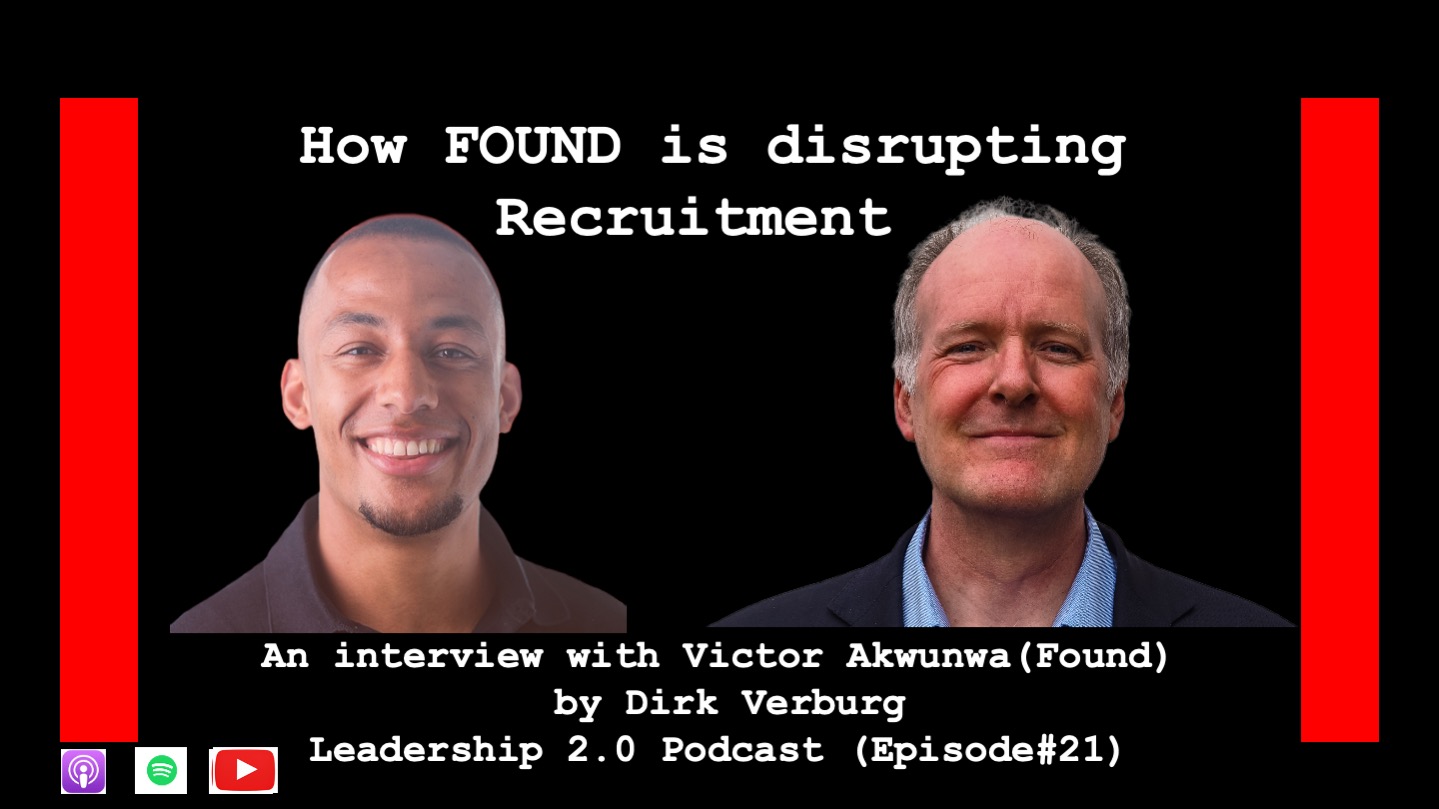
FOUND, a Swiss-based start-up company, wants to disrupt this traditional approach to recruitment. I recently interviewed Victor Akwunwa, the Chief Sales Officer of FOUND for my Leadership 2.0 podcast.
During our conversation, we discussed the following topics:
1️⃣ What FOUND is
2️⃣ Why recruitment is ready for disruption
3️⃣ The operating model of FOUND
4️⃣ The Technology FOUND uses
5️⃣ Identifying the culture of the client
6️⃣ The target markets of FOUND
7️⃣ The long-term goals of FOUND
8️⃣ The (dis)advantages of being a Swiss Based Start-Up
9️⃣ Giving up a blossoming corporate career to join a start-up
👇 You can watch or listen to this podcast episode on:
➡️ YouTube
➡️ Apple Podcasts
➡️ Spotify
➡️ No time to watch or listen to podcast now? Here is a short summary of our conversation ⤵
Dirk Verburg: Victor, thank you so much for being a guest on our podcast. My first question would be, can you explain to our viewers and listeners what Found actually is for a company?
Viktor Akwunwa: First of all, Dirk, thanks for having me today. A short synopsis of what Found is: we’re a Zurich-based startup in one of the beating hearts of the European tech scene. What we’re doing is revolutionizing the world of hiring. Our founders are two industry veterans who have built both corporate ventures and startups. They are marrying HR services with technology. The main driver for Found was simple: hiring hasn’t really changed over the course of 200 years, resulting in many people ending up in a job that they don’t really like and many companies hiring talent that doesn’t really fit the things that they aspire to. That’s the problem we’re solving.
Dirk Verburg: What is wrong with classic recruitment?
Viktor Akwunwa: I’m not sure if there is anything “wrong” in the sense that people are intentionally doing something wrong. I think if we look at the way that recruitment functions, as I already alluded to, it hasn’t really changed for 200 years. If you look at both sides of the marketplace, there is quite a lot of over-commodification. AI is layered on top of that, which only increases the over-commodification. The first step is that a company posts a job advertisement. In today’s market, that means maybe 500 people will apply. The result is that over 70% of the people in a job are simply not happy or not performing to their best capabilities.
Dirk Verburg: You once told me that the reason why Found exists is that it is a company that wants to move individuals from good to great jobs based on the personal preferences of the candidate. How have you implemented that?
Viktor Akwunwa: We basically implemented that over three axes. The first principle we used is community-based hiring. The second is driving immediate value for talent, and the third is highly accurate matching. We build communities around certain talent segments: people that design, build, and sell products. We attract them while they are still in a job they like. We attract them by driving immediate value, and this does not always have to be a new job. This value can be represented in the form of career coaching, peer mentoring, learning, networking, and assessments. Finally, we have implemented a highly accurate matching algorithm. Our acceptance rate is currently 88%, which we are tremendously proud of.
Dirk Verburg: Is the high acceptance rate of 88% partly due to the technology you’re using?
Viktor Akwunwa: Technology is one of the major drivers for how we are able to serve both sides of the marketplace, but it’s also the right technology and a human touch. I can elaborate a bit more on how we use technology at Found.
Dirk Verburg: Could you tell us something about the underlying technology that Found uses?
Viktor Akwunwa: If we look at the underlying technology that we use at Found, the main backbone of what we do in our technical core is called building a neural network. A neural network is a machine learning model that starts making all sorts of associations and connections based on sets of training data that we feed the algorithm. We feed the algorithm two kinds of main pieces of data: data about employers and data about talent. At the very start, we, as humans, have an influence on what the model is going to produce, but at a certain point in time, the model starts associating and seeing patterns that we can’t even see.
Dirk Verburg: How do you operationalize culture? What type of information do you feed to the system?
Viktor Akwunwa: We basically use two sources. One is interviewing with the company and conversations with talent acquisition as well as the hiring manager. The other is the wonders of the internet. There are a lot of publicly available sources such as Glassdoor that will feed you tremendous amounts of data on what company culture is like. By combining the data that we actively collect by engaging with the company and the publicly available data, you get a fairly accurate insight into what a company culture looks like.
Dirk Verburg: Can you give an example of a cultural parameter that you feed the system?
Viktor Akwunwa: One thing that we also look at is company size and company stage. We work with both large corporates as well as early-stage startups. If you’re joining a large corporate, you often need to be good at operating the machine. If you join an early-stage company, you need to be someone who can build a machine and operate a machine at the same time. Looking at those, it’s a profoundly different type of person who will fit in those environments. We can overlay that with the behavioral assessments. For instance, is someone very intuitive in how they make decisions or is someone very structured?
Dirk Verburg: What is your current target market in terms of functions and also in terms of geography?
Viktor Akwunwa: We’re almost celebrating our two-year anniversary, and as an early-stage venture, it’s very important to be super focused. We are going to market in the digital axis of an organization, which has three major profile categories: people that design software, people that build digital products, and people that sell software-based products. We basically do almost the full seniority stack. We don’t really do entry-level roles. If we look at the geography, we’re a proud Swiss-based startup, so that has also been the initial focus of our go-to-market. Six months ago, we also penetrated the US.
Dirk Verburg: Do you have any long-term goals in terms of market expansion beyond the functions you mentioned and beyond the US or Switzerland?
Viktor Akwunwa: If we really think long term and if we dream big, we believe there needs to be a profound shift in the way that hiring is done. If globally hiring would be done the Found way, and it doesn’t even have to be done by us, but if we can set the standard of what hiring looks like, that’s really our ultimate end goal. A logical next step for us, once we’ve really embedded ourselves as market-leading in Switzerland and have a strong footprint in the US, is looking at other European countries to add to the mix.
Dirk Verburg: Found is a Swiss-based startup. Is this an advantage or a disadvantage?
Viktor Akwunwa: Well, in our pre-conversation, you already alluded to the fact that everything comes at a price. Let me say Switzerland is a great home turf. Switzerland has been named the most innovative country in the world for the 14th time by the UN recently, so that’s already a strong indicator. Switzerland is rich in technology and innovation. What I think is also great about building your business in Switzerland is that the market is one that is very quality-oriented. On the downside, the venture financing market is relatively small, and the total market size is also relatively small.
Dirk Verburg: What was your motivation to switch from a certain corporate future to a startup where you had to coinvent it and help bring it to market?
Viktor Akwunwa: When I joined Found, we had a bunch of great ideas and half of a landing page, so it was quite the difference from the mega-corporation that I’d been working in before. The best career decisions are those where you don’t leave something but where you join something. I had this desire deep down inside to do something that was more revolutionary, really shaking up an industry that is near and dear to me. I took learning as the core element of my career decisions. I knew that if I would stay in my wonderful corporate environment, I would become better at what I already could do. I knew that if I joined Found, I would develop a whole new skill set. The Found years have been like dog years; my learning has accelerated so much.
► About Found
Found is a Swiss start-up that aims to change how hiring works.
In their own words:
‘The hiring process can be bleak. Job boards prioritise volume over accuracy, leading to talent being overlooked amid overwhelming numbers of applications. Meanwhile, traditional recruiters cling to outdated practices, relying on subjective judgment, and charging exorbitant fees.
We believe it’s time for change. We’re dismantling outdated recruitment models using the power of data and technology. Our approach uses fast, data-driven AI matching and has employers pitch to talent, instead of talent having to apply.
The result? A revolution in recruitment with companies finding the perfect talent, and talent finding their perfect job.’
► About Victor Akwunwa
Victor Akwunwa obtained a Master of Science Degree (with honors) at the Tilburg University in the Netherlands. In 2015 he joined the Adecco Group, a global staffing company, where he quickly rose through the ranks through a variety of sales, and other customer-facing roles. In 2023 he joined the start-up Found as Head of Sales and subsequently was promoted to Chief Sales Officer (CSO).
Discover more from Dirk Verburg
Subscribe to get the latest posts sent to your email.
 Dirk Verburg