
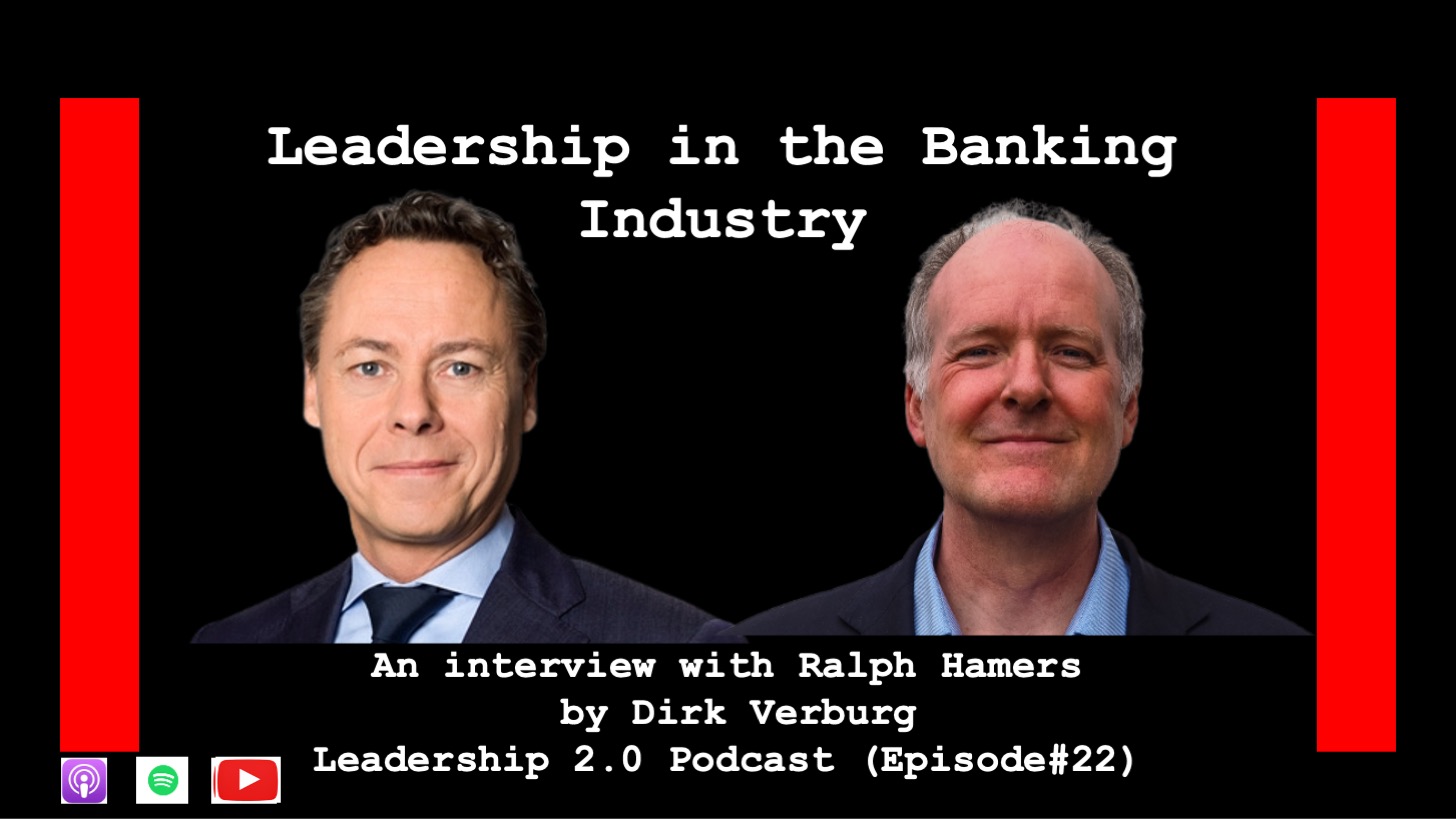
The image of the banking industry has been severely tarnished by the financial crisis (2007-2008), which led to increasing regulatory and compliance demands. At the same time, the industry is experiencing emerging competition from FinTechs, evolving business models, and disruptive technologies.
In light of these challenges, I recently spoke with Ralph Hamers, to explore his views on what effective leadership in the banking sector entails.
In our conversation, we touched on the following topics:
1️⃣ Why Ralph decided to join the banking industry
2️⃣ When and why did innovation become an important theme for him?
3️⃣ How ‘traditional’ banks should deal with Fintech companies
4️⃣ The culture change required in traditional banks
5️⃣ Addressing the image of the banking industry
6️⃣ The impact of technological developments on compliance costs
7️⃣ How to create successful top teams in the banking world
8️⃣ How to develop and foster a collective ethical mindset
9️⃣ Final thoughts
► You can watch or listen to this podcast episode on:
➡️ YouTube
➡️ Apple Podcasts
➡️ Spotify
► No time to listen to podcast now? Here is a short summary of our conversation ⤵
Dirk Verburg: You studied business econometrics and operations research. What motivated you to work in banking despite other industry options?
Ralph Hamers: I graduated in econometrics with a focus on financial industry models. About 35 years ago, there were significant developments in areas like capital asset pricing models, option models, and forecasting for market movements and efficient portfolios. This intellectual interest in applying econometric developments to financial markets was my primary motivation for entering the banking industry.
Dirk Verburg: Innovation has always been a major theme for you in banking. When and why did it become so important?
Ralph Hamers: My interest in innovation dates back to my studies, where I learned to code models and explored AI and philosophy. I’ve always been fascinated by how technology could mimic human capabilities, whether through electronic execution, process automation, or digital user experience. Throughout my career, I’ve sought assignments where technology could act as a differentiator, fundamentally changing how business is conducted, rather than just supporting existing processes. This forward-looking perspective on leveraging technology for transformation has always driven my focus on innovation.
Dirk Verburg: Do fintech companies pose a significant threat to traditional banks, or are there areas where traditional banks will always prevail?
Ralph Hamers: It’s “all of the above.” Technology has always pushed banking forward. Investment banking, particularly trading, was initially disrupted by supercomputers and electronic execution in the 80s, a trend that continues today with traders being coders. The next wave was process automation for efficiency. Then came digitalization, where fintechs, unburdened by legacy systems and cultures, gained direct consumer access through superior user experience. Now, AI is the next frontier, potentially revolutionizing areas like wealth management. Fintechs are both learning opportunities and formidable independent disruptors. Banks must adapt, acquire, or collaborate to compete.
Dirk Verburg: You’ve advocated for cultural change and agility in banking. How can leaders in this often-conservative industry change deeply ingrained cultures?
Ralph Hamers: Cultural change is essential; “culture eats strategy for breakfast.” Banks must adapt to technology-driven client expectations. This requires changing from a waterfall approach to continuous improvement, with small, frequent changes. Agile working is key: cross-functional teams (marketing, product, compliance, tech) work in short sprints, typically two weeks. They continuously check progress and client uptake, stopping if the business case falters. This empowers decision-making closer to execution, demanding greater collaboration and accountability. Instilling such empowerment and collaboration is a significant cultural shift for most banks.
Dirk Verburg: How did you achieve engagement for these cultural concepts in a traditional banking environment?
Ralph Hamers: It’s challenging to create a “burning platform” in banking because balance sheets generate consistent income, making immediate threats less apparent. Instead, you need a “burning ambition” – a compelling, constructive story for change, highlighting external trends. To achieve this ambition, discussions must encompass changes in structure, governance, culture (behaviors like openness and embracing opportunities), and capabilities. People are motivated to accept massive change if they truly buy into a compelling, positive vision of what they will collectively generate.
Dirk Verburg: The banking industry’s reputation suffered post-2008. Is this hurting interest, and should the industry address it collectively?
Ralph Hamers: Yes, it should be addressed collectively. Individual banks struggle to step out of the category. While massive progress has been made since the 2008 crisis, it resulted from broader economic policies, not solely banks. Banks mistakenly believed they played a primary role, whereas they are secondary, supportive actors in economic development. Realizing this supporting role and acting prudently and considerately is crucial. Improving reputation requires collective effort, with leaders setting examples for others to follow.
Dirk Verburg: Do you expect technology to eventually drive down the relative cost of compliance in the banking industry?
Ralph Hamers: While technology could eventually reduce compliance costs, we’re currently in a phase where it enables us to be even more effective in compliance. Banks have a vital societal role in ensuring secure payment systems, detecting bad actors, and designing transparent products. As technology, especially AI and enhanced processing capacity with current chips, advances, the expectations for banks to be compliant are rising. This means requirements will continue to grow for a while, pushing banks to do an even better job, before a potential stabilization and tipping point in cost reduction.
Dirk Verburg: How can a CEO instill team spirit in a diverse and highly complex banking environment with different business units?
Ralph Hamers: Banking’s core function, maturity transformation (e.g., short-term deposits funding long-term mortgages), inherently creates complexity, making products difficult to simplify and requiring high regulation. For top teams to work effectively, three things are key: First, collectively develop a Clear Vision – a “compelling story” based on shared understanding of challenges and opportunities, fostering team buy-in. Second, align Key Performance Indicators (KPIs) across the team, ensuring transparency and shared objectives. Third, foster an altruistic culture where team members support each other, recognizing mutual skill development. This holistic approach builds strong team spirit.
Dirk Verburg: How can a CEO implement and ingrain a sense of ethics throughout a large organization, essentially scaling it?
Ralph Hamers: Ethics, confidentiality, and integrity have always been crucial in banking; the crisis underscored this. At ING, we quickly implemented the “Orange Code” – three values and three behaviors – translated specifically for nearly every job role. The next step was appraisal against these values, weighing them equally with KPIs. This means performance isn’t just about results, but how those results are achieved. Leaders must “walk the talk,” living and acting by these codes, setting the example. This consistent behavior from the top down, coupled with aligned KPIs for both performance and conduct across all teams, allows ethics to scale throughout the organization.
Dirk Verburg: Any final thoughts on leadership in any industry?
Ralph Hamers: As a leader in any industry, remember that change is the only constant. Whether due to geopolitics, economics, regulation, or new technology, every industry is touched by change. The question is whether you want to be a leader or a follower in this change. If you aim to lead, you must look outside your industry for inspiration. Don’t just observe peers; analyze how companies like Google or Spotify innovate, or how industries dealing with intangibles (like music) were disrupted. Banking, dealing with money and being highly digitalizable, is particularly susceptible to disruption. Learn from these external shifts to lead effectively.
► About Ralph Hamers
Ralph Hamers advises both established and emerging players in the finance and digital industries. As former CEO of ING and UBS, he successfully led these global banks through significant transformations.
Discover more from Dirk Verburg
Subscribe to get the latest posts sent to your email.


This interview with Ralph Hamers offers valuable insights into the evolving challenges and leadership strategies in the banking industry
Great insights from Ralph Hamers on leadership and innovation in banking.