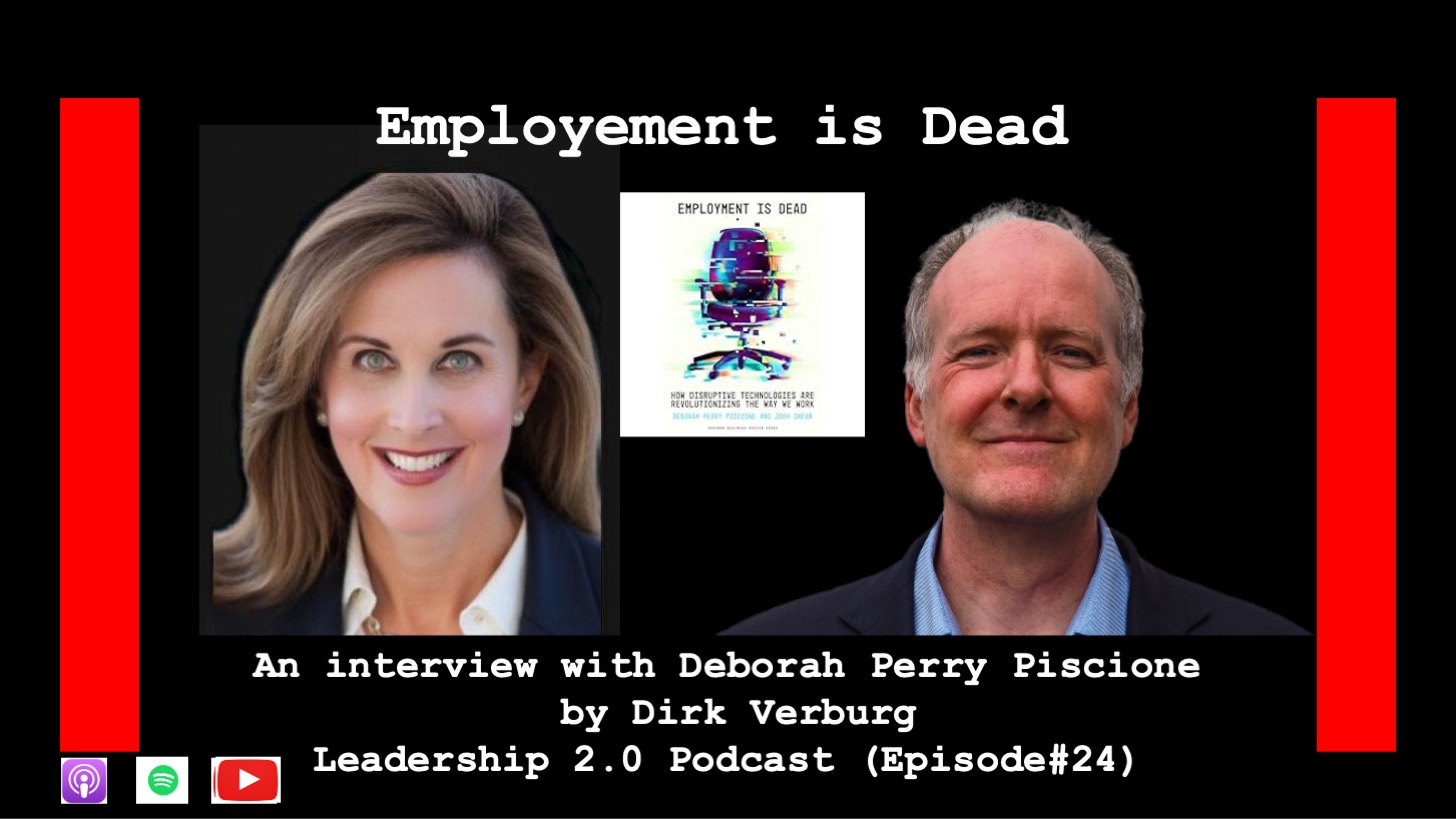
Earlier this week, one of the most important business books on the Future of Work was published by Harvard Business Review Press: ‘Employment Is Dead: How Disruptive Technologies Are Revolutionizing the Way We Work’ by Deborah Perry Piscione and Josh Drean.
The central theme of this book is that traditional employment models are becoming outdated due to the evolving needs and expectations of the modern workforce, in combination with, and enabled by, disruptive technologies.
This will lead to the end of the traditional employment model, as well as the traditional form of companies, as we know them today.
Monday, just hours before the book was released, I had the chance to interview Deborah Perry Piscione for my Leadership 2.0 Podcast.
► In our conversation, we touched on the following topics:
0️⃣1️⃣ What is the new workforce, what do they want, and why?
0️⃣2️⃣ The importance of Blockchain for the future of work
0️⃣3️⃣ Companies that are early movers in this space
0️⃣4️⃣ The Gig Economy: Utopia or Dystopia
0️⃣5️⃣ How individuals should prepare themselves for the Future of work
0️⃣6️⃣ Implications for our education system
0️⃣7️⃣ How should established companies prepare themselves
0️⃣8️⃣ The role HR should play in this transition
0️⃣9️⃣ The role of national governments
1️⃣0️⃣ The popularity of the book
1️⃣1️⃣ Final Thoughts
► You can watch or listen to this podcast episode on
➡️ YouTube
➡️ Apple Podcasts
➡️ Spotify
► No time to listen to podcast now? Here is a short summary of our conversation ⤵
Dirk Verburg: Can you describe the modern workforce, their needs, and why they have these expectations regarding employment models?
Deborah Perry Piscione: The modern workforce, particularly Gen Z, has evolved with technologies like AI and blockchain, fostering a desire for decentralized work. Platforms like Uber and Upwork showed people they could earn a sustainable income on their own terms. This has led to portfolio careers, where individuals combine various interests and passions for income, often dedicating only a small portion of their time to their formal education. COVID-19 proved the viability of remote and alternative work styles, reinforcing this desire for flexibility and autonomy.1
Dirk Verburg: How will blockchain, specifically, facilitate the move to new employment models, emphasizing results over physical presence?
Deborah Perry Piscione: Blockchain technology is key because it enables a shift to measuring results rather than physical presence. Gen Z is already adopting Web3 platforms like Roblox, where individuals can earn significant income through their creations in decentralized environments. Decentralized Autonomous Organizations (DAOs) facilitate decision-making, often reducing the need for traditional managers.2 Smart contracts validate work relationships. This framework necessitates a mindset shift from “employment” to “employability,” forcing individuals to embrace an entrepreneurial approach, which contrasts with traditional schooling models.
Dirk Verburg: Can you share examples of companies already embracing this combination of technologies and new ways of working?
Deborah Perry Piscione: Nvidia is a prime example, pushing digital twinning (metaverse) for industrial and enterprise applications. This allows for real-time virtual-to-reality operations, fostering innovation, manufacturing, and supply chain efficiency. Lowe’s, the home improvement store, uses this for rapid supply chain adjustments during emergencies. These technologies enable efficient problem-solving and rapid prototyping, saving immense time and money, as seen with Ericsson. Many interesting case studies highlight this convergence.
Dirk Verburg: What are your thoughts on the development of the gig economy—will it be a Utopia or a Dystopia?
Deborah Perry Piscione: I believe the gig economy will lead to a more balanced, life-stage flexible future, resembling a “Utopia.” AI augmentation will free us from routine tasks, allowing more time for personal interests and community engagement, akin to the European lifestyle with more leisure. While there are concerns about vulnerability for those not “schooled as entrepreneurs” or reliant on traditional benefits, the shift allows people to pursue passions and live as digital nomads. This isn’t about work-life balance but work-life integration, making work a source of self-realization and fulfillment.
Dirk Verburg: What are the biggest challenges individuals will face in this new era of work, and how should they prepare themselves?
Deborah Perry Piscione: The biggest challenge for individuals is adoption due to fear of the unknown. Just as people initially resisted smartphones, there’s a learning curve with new technologies like AI.3 Individuals should challenge themselves to spend an hour a week experimenting with AI platforms like Claude, ChatGPT, or Gemini. These tools can automate tasks that once took days or weeks, freeing up time for more meaningful work. It’s an extraordinary transformation, but requires overcoming initial apprehension and embracing continuous learning.
Dirk Verburg: How should formal institutions like schools and universities adapt their curricula to prepare individuals for this new work era?
Deborah Perry Piscione: Curricula must massively shift to prioritize skills over college degrees. While higher education offers social and emotional development, these skills can be acquired elsewhere. The greatest transformation will occur in K-12 and higher education, similar to how schools adopted calculators. The technology’s increasing intelligence will force us to think more critically and authentically about our unique contributions and how we apply them daily. This authenticity is a key “last post” for humanity amidst the engulfing tech wave.
Dirk Verburg: How should traditional Fortune 500 organizations, like oil and gas companies or healthcare organizations, reinvent themselves?
Deborah Perry Piscione: Even traditional industries, like healthcare (where AI is rapidly integrating), will see cost-cutting through reduced headcount. However, they must re-emphasize the human element. Companies are increasingly using commercials showing human connections to customers, like PG&E addressing fire safety. We need to move beyond Taylorism’s view of people as “cogs on a wheel” and rediscover the human value in the workplace. While some “return to office” mandates seem contradictory, the long-term trend demands a focus on human contribution and empathy to create a better world.
Dirk Verburg: What should be on top of HR organizations’ and leaders’ agendas to help their executive committees make this transition?
Manuela Staub: HR leaders are crucial. Beyond integrating new tech into the tech stack, their primary focus must be the people side of the transformation road map. This involves transparent communication, involving employees in the process, addressing their fears, and providing necessary support.4 HR should encourage experimentation with new technologies and actively listen to feedback on wins and challenges. HR must become very data-driven while still valuing anecdotal input, to effectively guide employees through this new reality, especially as younger generations are already fluent in it.
Dirk Verburg: Do you see a role for national governments in this wave of change, considering some are critical of the gig economy?
Deborah Perry Piscione: Governments face two challenges: the AI arms race and the unprecedented unknown. There’s a fear of who leads in AI development and the implications for business models and national security. Simultaneously, the lack of historical precedent means protecting citizens and global stability is uncharted territory. The rapid development of AI, including authentic AI and symbiotic robotics, raises concerns about job displacement and even military control.5 Governments must sprint to innovate while concurrently developing protective measures, as falling behind is not an option in this global competition.
Dirk Verburg: Why do you think so many people are currently interested in your book and eagerly awaiting its release?
Deborah Perry Piscione: The book’s traction is unexpected but reflects current global shifts. Beyond technological advancements like generative AI and digital assets (e.g., Roblox’s $900 million quarterly sales from digital assets), there’s a significant geopolitical reordering and a widespread questioning of government roles. This creates both fear and immense opportunity. People are ready to learn about the metaverse, crypto, and how young people are building new economies. Our book, Employment Is Dead, resonates because it speaks to communities that are ready to shed old controls and redefine their contributions, rejecting traditional monitoring and mandatory office returns.
Dirk Verburg: Are there any final aspects you’d like to highlight that we haven’t discussed?
Deborah Perry Piscione: Beyond technology, employers must adopt an entirely new mindset. This isn’t about traditional employer-employee relationships but about partnership, collaboration, and transparency. We detail ten operating principles for this new space. When people are treated better and allowed to work on their own terms – not confined to 9-to-5 – they offer more loyalty, even if they have side hustles.6 The goal is to make work more human, leveraging this incredible opportunity to rewrite the rules of employment as we’ve known them and create a new, more flexible model.
► About Deborah Perry Piscione
As a serial entrepreneur, Deborah (co) founded five companies, including the Work3 Institute, an advisory firm that helps enterprises evolve into an AI, web3 + work3 future of business, and where she is serving as CEO. Deborah Is also a thought leader in innovation, AI + web3, advisor, New York Times bestselling author, LinkedIn author, serial entrepreneur, and global keynote speaker.
Earlier books (co) authored by Deborah Perry Piscione are ‘Secrets of Silicon Valley: What Everyone Else Can Learn From the Innovation Capital of the World’, ‘The Risk Factor: Why Every Organization Needs Big Bets, Bold Characters, and the Occasional Spectacular Failure ‘, and ‘The People Equation: Why Innovation Is People, Not Products’.
She also developed Improvisational Innovation™, a bottom-up methodology that engages all the talents of the entire organization, helps the organization shift to a growth mode, and addresses the question on how to identify, source, data-mine and execute upon new ideas from any employee.
Discover more from Dirk Verburg
Subscribe to get the latest posts sent to your email.
 Dirk Verburg