🚫 Many organizations mistakenly relegate Learning & Development (L&D) to a “nice-to-have” status. It’s seen as something every HR organization needs to have (if only for the optics), but often the prevailing attitude is that, while great L&D is a pleasant surprise, if it falls short, there’s no serious harm done to the organization.
❗This is often reflected in bland L&D offerings, which, more often than not, are so generic, that they fail to address the strategic issues organizations need to address
⁉️ However, what would happen if organizations truly would treat Learning & Development as a strategic instrument?
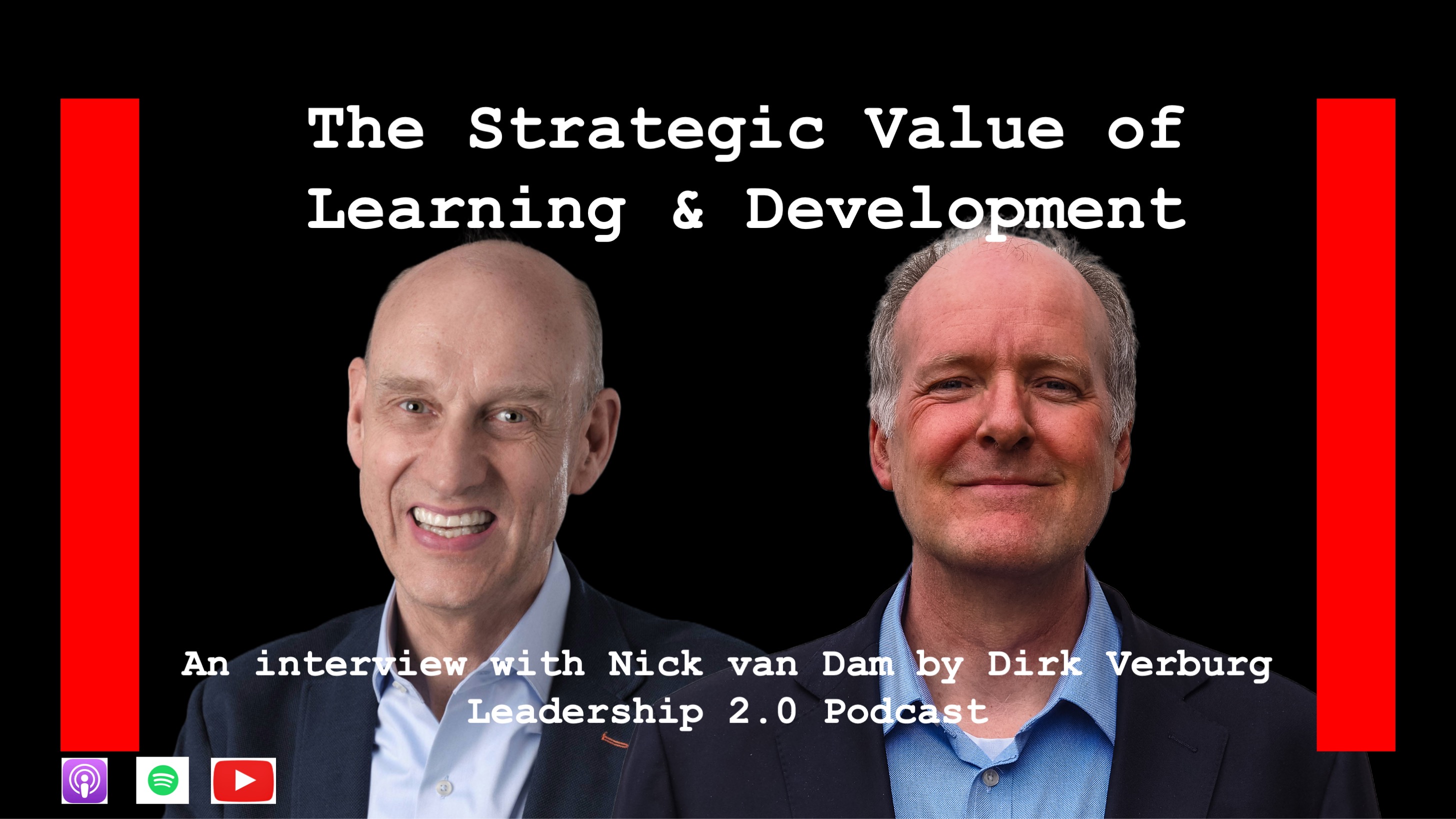
🎙️ In the 29th episode of the Leadership 2.0 podcast, I interview Nick van Dam about ‘The Strategic Value of Learning & Development’. Nick van Dam is an internationally recognized thought leader, advisor, executive coach, researcher, facilitator, and best-selling (co-) author of more than 29 books on Leadership, Organizational Behavior, and Corporate Learning & Talent Management.
► During our conversation, we discussed the following topics:
0️⃣1️⃣ Where Nick’s interest in Learning & Development (L&D) stems from
0️⃣2️⃣ How Nick put L&D on the map of McKinsey and Deloitte
0️⃣3️⃣ How to link L&D to business strategy
0️⃣4️⃣ How to determine the ROI of L&D
0️⃣5️⃣ Should L&D efforts be limited to Soft Skills?
0️⃣6️⃣ A strength-based approach to L&D
0️⃣7️⃣ The implications of Generational Differences for L&D
0️⃣8️⃣ Has the role of L&D changed over the years?
0️⃣9️⃣ What world class L&D organizations look like
1️⃣0️⃣ Nick’s latest book: ‘The Best Version of Me’
► You can watch or listen to this podcast episode on:
➡️ YouTube
➡️ Apple Podcasts
➡️ Spotify
➡️ No time to watch or listen to podcast now? Here is a short summary of our conversation ⤵
Dirk Verburg: Nick, welcome to the podcast. You’ve been a pioneer in learning and development for decades and are now considered a true guru. What originally drew you to this field, and what keeps inspiring you to contribute today?
Nick van Dam: Thanks, Dirk. I started at Siemens in the Netherlands in software development and soon became involved in customer training. I realized the impact training has on people and enjoyed interacting with diverse individuals. What keeps me inspired is the profound impact L&D has on individuals, families, teams, organizations, and society. The field itself is also fascinating, fueled by insights from developmental psychology, neurosciences, and human capital. I’m a lifelong learner, always seeking new knowledge.
Dirk Verburg: I admired how you put L&D on the map at consulting firms like Deloitte and McKinsey. How did you demonstrate the value L&D could add to these companies?
Nick van Dam: At both Deloitte and McKinsey, I focused on linking all people development efforts to the overall business strategy. This involved understanding the firm’s strategy, identifying required capabilities, and addressing skill gaps. I created curricula that provided expertise, skills, and mindsets, emphasizing behavioral change. I also implemented learning technology infrastructures to provide accessible learning and fostered a culture of continuous learning by empowering leaders as role models and coaches. Ultimately, it was about demonstrating business impact.
Dirk Verburg: You mentioned tying the learning strategy to business strategy. Could you provide an example of how two companies might apply different learning strategies based on their strategic goals?
Nick van Dam: Certainly. A technology company focused on rapid innovation would have a learning agenda centered on agility, cross-functional collaboration, and methods like design thinking. A financial services firm prioritizing compliance and operational excellence would focus its learning on risk management, regulation, and lean operations. For a pharmaceutical company embarking on an AI strategy, the learning agenda would be all about developing people in using AI and its applications to support their business. It’s always about aligning with specific business objectives.
Dirk Verburg: How can L&D organizations demonstrate the return on investment of their strategy?
Nick van Dam: Firstly, align all learning interventions with business strategy. Secondly, look at leading indicators such as employee engagement, capability development, and learning program adoption rates. Specific business KPIs like client retention or improved sales also show impact. While we don’t believe in a pure financial ROI due to too many variables, we can show behavioral change and alignment with business priorities. Testimonials from participants and leaders on what they learned and how it changed their behavior are also powerful qualitative examples of impact.
Dirk Verburg: In recent years, L&D seems to have shifted heavily towards soft skills. Do you agree with this observation, and what’s the right balance between soft and hard skills?
Nick van Dam: I agree that there’s a strong focus on what we now call power skills (formerly soft skills). These are not easy to develop but are crucial, especially in the age of AI. While AI will handle many tasks, human skills like building high-performing teams, leading innovation, and managing change will make us unique. This doesn’t negate the importance of hard skills—doctors need medical knowledge, lawyers need legal expertise. These hard skills are supplemented by essential human skills. My upcoming book, Leading with Human Skills: Thriving in the Age of AI, will delve into this further.
Dirk Verburg: You advocate a strength-based approach to L&D, but also encourage people to step out of their comfort zones. Do you see a tension or complementarity between these two ideas?
Nick van Dam: I believe they reinforce each other. Focusing on strengths leverages motivation and confidence, drawing from positive psychology. Learning new things often requires stepping out of our comfort zone into a learning zone. This learning zone can still build upon existing strengths or explore untested skills where individuals may discover new strengths. It’s not necessarily about addressing weaknesses, but rather about expanding capabilities in areas that might be unfamiliar but still align with innate talents or potential.
Dirk Verburg: Do you believe there are generational differences in how people learn, and if so, how can organizations tailor their L&D strategies to meet these differences?
Nick van Dam: Yes, there are some differences. Gen Z, being digital natives, prefer learning at their fingertips through microlearning and valuing digital platforms. However, they also highly value in-person programs for networking, culture building, and focused reflection time away from virtual work. For instance, Deloitte University Europe attracts Gen Z professionals who appreciate the in-person experience for connection and access to leaders. It’s about blending digital learning with meaningful in-person “anchor moments” for culture building and deeper engagement.
Dirk Verburg: How has the role of L&D organizations evolved over the past 20-25 years, especially in large companies?
Nick van Dam: Absolutely, it has evolved significantly. From being a mere training provider, L&D has transformed into a strategic business partner. Learning delivery has shifted from predominantly classroom-based to a complete learning ecosystem incorporating blended and digital approaches, alongside high-impact immersive facilities. The focus has moved from just content delivery to comprehensive capability building and cultural transformation. Finally, there’s been a shift from a top-down, push strategy to a more pull-based, personalized, and AI-enabled learning approach where employees drive their own development.
Dirk Verburg: What should a world-class L&D department look like in a large company today, in terms of organization, focus, and technology?
Nick van Dam: A world-class L&D department is deeply embedded in the business strategy, operating as an integral part of the business, not just a function.2 It combines human-centered learning design with AI-enabled personalization for on-demand learning. Key elements include utilizing learning analytics, skill taxonomies to identify and close skill gaps, and often working with internal academies. The L&D function itself is elevating, with professionals developing stronger leadership skills, deeper disciplinary expertise, and incorporating roles like data scientists, behavioral scientists, and experience designers.
Dirk Verburg: Your latest book, The Best Version of Me, seems to shift from organizational L&D to individual development. Can you explain what the book is about and how it fits into your broader work?
Nick van Dam: The Best Version of Me addresses the future of work, where careers will span 45-50 years, requiring lifelong learning. Using the caterpillar metaphor, it explores how humans, born with immense potential, can become their best selves by focusing on their mind, body, purpose, and environment (social, work, nature, climate). The book integrates insights from psychology, neuroscience, and human development. By the way, all royalties are donated to a children’s foundation, making it a truly impactful work.
Dirk Verburg: Are there any other areas, trends, or topics in learning that we haven’t discussed that you’d like to highlight?
Nick van Dam: Beyond being a business imperative for success and a personal imperative for employability, learning is deeply connected to purpose. It allows us to become our best selves. My advice to everyone is to embrace curiosity—always ask “why”—and to care for others. As leaders, our true legacy isn’t about systems or financial records, but how we’ve impacted and helped others grow. Leadership is about empowering people to become their best selves, which is incredibly rewarding.
► About Nick van Dam
Dr. van Dam has over 30+ years of business experience as a former Partner, Global Chief Learning Officer, HR Executive, and Client Advisor at Siemens, Deloitte and McKinsey. As an advisor or faculty, he has served over 100 clients around the world. He is (visiting) Professor at The University of Pennsylvania , Harvard Business School- Corporate Learning, IE Business School, and Nyenrode Business University. Nick is Director of the IE Business School, Center for Corporate Learning and Talent Management. He is the Director of the IE Business School, Global HR Leadership Program and Global L&D Leadership Program. He is a core faculty member of CEDEP. (INSEAD Campus, France) and a co-founder of Pathos Leadership Institute. Nick is an External Senior Advisor and Faculty member at McKinsey & Company.
► Books (selection)
- Van Dam, N.H.M., et al. (April 2024) The Best Version of Me: Boosting Your Well-Being, Lulu Publishing. Van Dam, N.H.M., Marcus, J. (2023).
- Handbook Organization & Management (5th edition), Noordhoff Publishers.
- Brassey, J., van Dam, N.H.M., Van Witteloostuijn, A. (2022) Authentic Confidence. Vakmedianet.
- Feser, C., Nielsen, N., Rennie, M., editors (2018) Leadership at Scale. HBG (Nick has co-authored 4 chapters)
- Rogers, E., & van Dam, N.H.M. (2014). YOU! The Positive Force in Change: Leveraging Insightsfrom Neurosciences and Positive Psychology. Raleigh (NC): Lulu Publishing.
► Website: http://www.nickvandam.com
Discover more from Dirk Verburg
Subscribe to get the latest posts sent to your email.
 Dirk Verburg