❗ ‘We live in the most Generationally Diverse Demographic’ (Rebecca Robins).
🚫 Unfortunately, generational differences are often seen as a source of problems – sometimes misunderstood, and exaggerated by social media.
⁉️ However, what would happen if we saw Generational Differences as Opportunities instead of Issues?
📖 This is precisely the topic of the book ‘Five Generations at Work: How We Win Together, For Good’ by Rebecca Robins CMgr CCMI and Patrick Dunne.
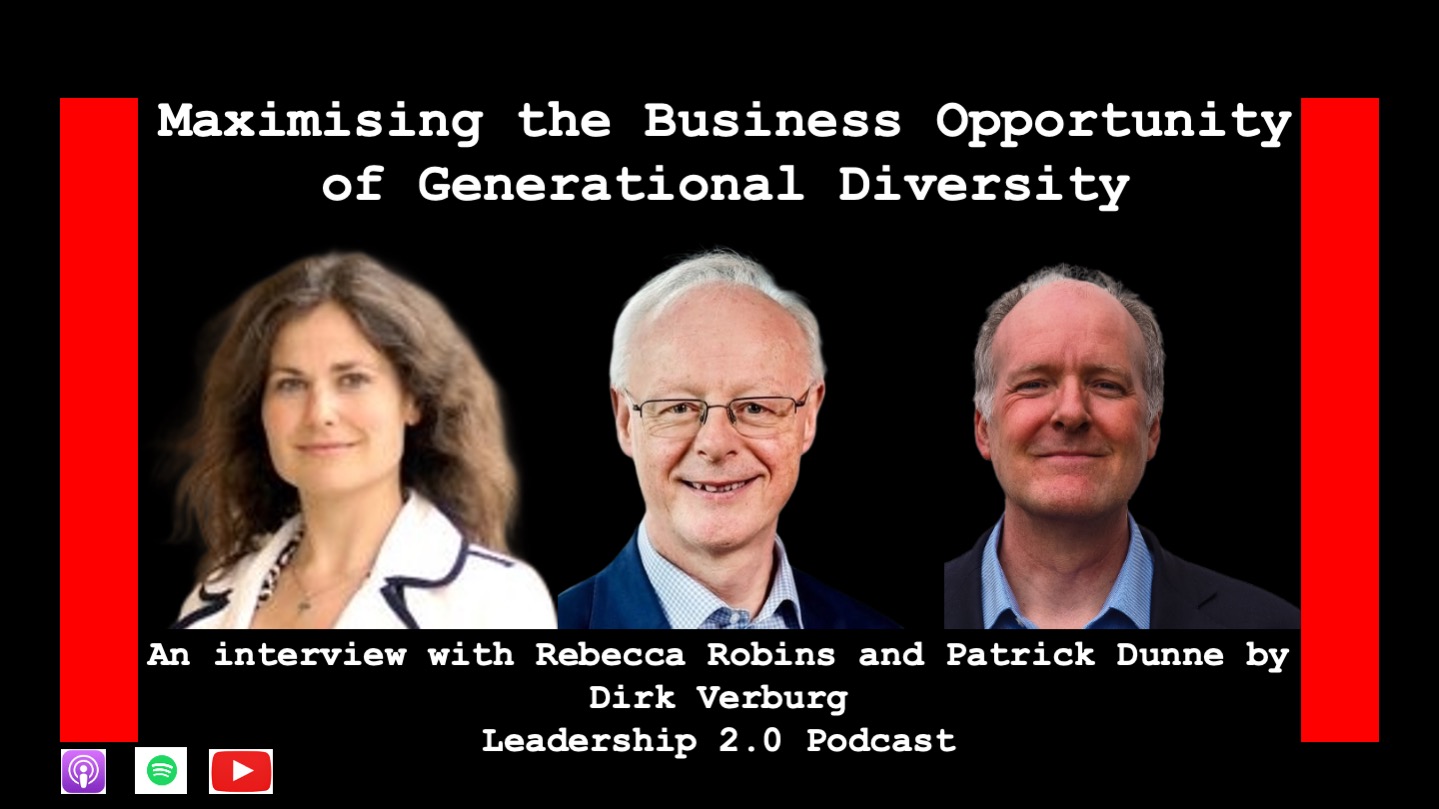
🎙️ In the 30th episode of the Leadership 2.0 podcast, I interview Rebecca Robins CMgr CCMI and Patrick Dunne about ‘Maximising the business opportunity of generational diversity’
During our conversation, we discussed the following topics:
0️⃣1️⃣ Are generational differences real?
0️⃣2️⃣ Friction Points and Stereotypes
0️⃣3️⃣ Respect between Generations (and ‘The Dirk Problem’)
0️⃣4️⃣ Turning Generational Labels into Generational Lenses
0️⃣5️⃣ Using Generational Lenses to gain a Competitive Advantage
0️⃣6️⃣ Are Family Companies ahead of Publicly Traded Companies?
0️⃣7️⃣ Generational Differences and Brand Relevance
0️⃣8️⃣ Ageism, Social Tension, and an ‘Africa Strategy’
0️⃣9️⃣ Do younger Generations want to Learn from older ones?
1️⃣0️⃣ Next Generation Boards versus Focus Groups
1️⃣1️⃣ Final Thoughts
► You can watch or listen to this podcast episode on:
➡️ YouTube
➡️ Apple Podcasts
➡️ Spotify
➡️ No time to watch or listen to podcast now? Here is a short summary of our conversation ⤵
Dirk Verburg: Are generational differences a real phenomenon, or are they simply a result of marketing and media hype?
Rebecca Robins: Generational differences are very real, and their existence can be traced back to Aristotle. Generations are the wheels through which history turns. However, what has changed recently is the media and marketing’s tendency to overhype and stereotype these differences. They often pit generations against each other, creating a divisive narrative.
Patrick Dunne: The key is to remember that the context in which a generation grows up, including geopolitics, climate, and technology, plays a crucial role in shaping their perspective. We’re currently in a unique inflection point with five generations in the workforce for the first time, which presents both challenges and a huge opportunity for organizations.
Dirk Verburg: Can you give some examples of the friction points and stereotypes that different generations have about each other?
Patrick Dunne: Most friction points stem from a lack of understanding and communication. People often don’t take the time to listen to what others think, not just what they say. Stereotypes often lead to feelings of being the “worst treated” generation, which can be seen across different age groups. For example, younger generations might criticize older generations for their impact on the environment, while older generations might point to their role in building the welfare state. This highlights a mutual lack of respect. However, these differences aren’t a negative thing; they can be the spark for tremendous creativity and innovation.
Dirk Verburg: In the book you use the metaphor of “turning generational labels into lenses.” Could you elaborate on what this means?
Rebecca Robins: It means moving beyond oversimplified labels and stereotypes and instead viewing each generation through a specific lens to understand their unique context and perspective. This approach helps leaders to better understand the evolving demographics of their workforce and close the “think-say” gap—the difference between what people think and what they actually say. This shift from labels to lenses fosters understanding and communication, which are the two biggest factors we found in our research. It also turns conflict into an opportunity for creativity and innovation. This approach is more effective for building a resilient organization than relying on rigid, siloed categories.
Dirk Verburg: How can companies strategically leverage a multigenerational workforce for a competitive advantage?
Patrick Dunne: One of the most effective ways is through NextGen boards, which are rapidly growing and involve younger generations in real decision-making. We found over 200 examples of these boards, like the one at the EY foundation. Another powerful strategy is to create innovative, cross-generational platforms. A great example is LVMH’s “DARE” (Disrupt, Act, Risk to be an Entrepreneur) platform. It started with a single employee’s idea and now involves 30,000 people from across the company’s 75+ brands, fostering collaboration and innovation.
Rebecca Robins: These initiatives prove that there is no single solution; many transferable strategies can turn generational diversity from a problem into a long-term advantage.
Dirk Verburg: Can publicly traded companies realistically adopt the long-term practices of family-owned businesses, and if so, how?
Patrick Dunne: While publicly traded companies often face pressure for short-term results, they can still adopt some of the long-term practices of family-owned businesses. Many successful family businesses, like Bosch and Mars, maintain family ownership to uphold their core values but hire professional management to run daily operations.
This hybrid model allows them to benefit from a long-term perspective while still operating efficiently. For instance, the Mars family has a founding principle of “mutuality” dating back to 1947, which has helped the company stay resilient for nearly a century. Public companies can leverage this by focusing on a clear, long-term purpose and a holistic stakeholder approach that extends beyond just shareholder value. The key is to build a governance model that protects and promotes these long-term values.
Dirk Verburg: Can you unpack the quote, “Brand relevance is about how we connect across generations?”
Rebecca Robins: The quote from Charlie Rubin of Pentland Capital means that a brand’s long-term success isn’t just about appealing to a single generation but about maintaining relevance across all age groups. Brands that have stood the test of time, like many Swiss watchmakers, have a strategy that thinks in decades, not just in years. They constantly reinvent themselves while staying true to their core identity.
For example, Hermes is known for a culture of excellence and says “no” far more often than “yes” to collaborations to protect its long-term brand value. This intentional approach ensures that the brand remains valuable for future generations. It’s about building a brand that can connect with multiple generations simultaneously, like parents and their children. This strategy helps businesses protect their long-term value and ensure their relevance for decades to come.
Dirk Verburg: Should age and the potential for ageism be a core part of diversity, equity, and inclusion (DEI) initiatives, especially given the current demographic shifts?
Patrick Dunne: Yes, age should be a crucial dimension of DEI. We’re seeing a significant discrepancy where life expectancy is increasing, yet many companies are hesitant to hire or retain employees over 50. This creates social tension, particularly in countries like the US, where people need to work longer to support themselves but face ageism in the job market.
Demographic data shows inverted population pyramids in Europe, the Americas, and Asia, with birth rates falling in places like Korea to a current rate of just 0.74. This highlights a need for a more multigenerational workforce. Some companies are already adapting. BMW, for example, has brought back retired engineers to mentor younger staff on problem-solving. This approach not only addresses a skills gap but also leverages the valuable experience of older generations.
Dirk Verburg: Are there more examples of younger generations reaching out to older generations to gain their insights?
Rebecca Robins: While the concept of “reverse mentoring” often gets attention, the most effective initiatives are based on mutuality and a two-way street of learning. The best organizations foster a “learning from and with each other” culture. Instead of a one-way transfer of knowledge, these programs are platforms of mutual benefit.
An excellent example is next-generation boards, which go beyond being simple focus groups. They are a strategic tool that gives a voice to younger employees, but the real power comes from the mutual exchange of ideas and perspectives with senior leaders. The St. Gallen Symposium, for instance, tracks board age and found the average age to be 63, which means two generations are often unrepresented at the highest levels of a company. These boards, therefore, serve as a business imperative to ensure that leadership reflects the diverse customer base the company serves.
Dirk Verburg: Do you have any final thoughts or crucial aspects of intergenerational dynamics that we haven’t yet discussed?
Rebecca Robins: We must reinforce that the multigenerational workforce is a maximizing opportunity, not just a problem to solve. We’re living in the most generationally diverse demographic in history, and this trend will continue as people live and work longer. We’ve identified three categories of organizations: those taking no action, those in problem-solving mode, and those who see this as a huge opportunity. Our hope is to see more organizations move into that third category by actively leveraging their intergenerational workforce.
Patrick Dunne: I would like to finish on one word: think. We all need to think more about this opportunity and listen more to what people are truly thinking.
► About Rebecca Robins CMgr CCMI
Rebecca Robins is a global advisor and expert in brands, leadership and cultures of excellence,. She is the author of two industry-leading books on brands and culture, and also writes for numerous leading publications. Rebecca is ever at the intersection of education and industry as lecturer and programme advisor, and is a Board Trustee at The EY Foundation.
► About Patrick Dunne
Patrick Dunne is an experienced Chair. He gained this experience with Air Products and FTSE100 3i Group plc where he was Communications Director, a member of its Operating Committee and Chairman of its Operational Risk forum.
Patrick is a member of the Higgs Review and Visiting Professor at Cranfield University.
He also has extensive experience of developing social enterprises, most notably with Leap Confronting Conflict, the EY Foundation and Warwick in Africa.
Discover more from Dirk Verburg
Subscribe to get the latest posts sent to your email.
 Dirk Verburg