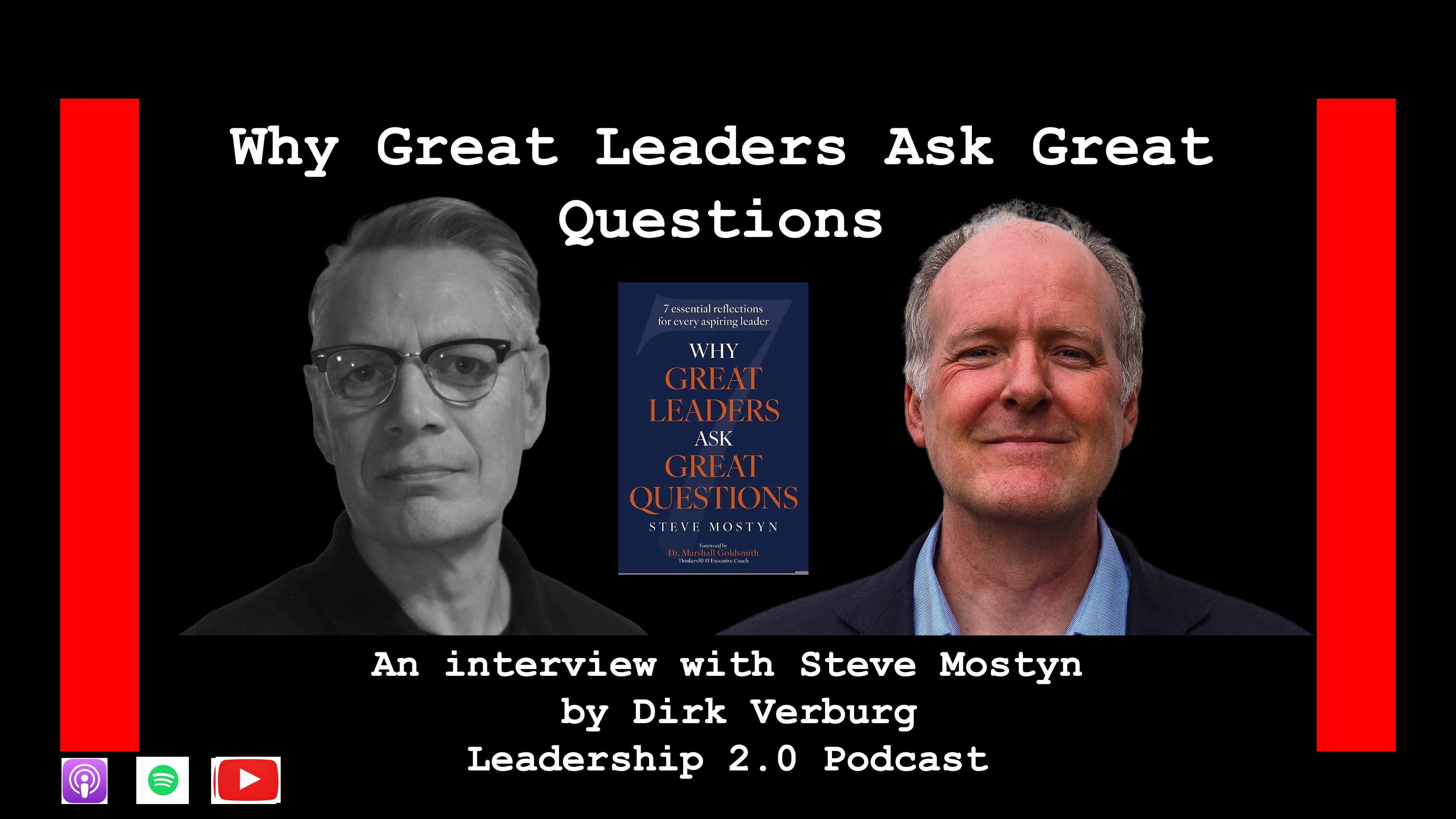
‘Why Great Leaders Ask Great Questions’ – Steve Mostyn

Are you working ‘in’ or ‘on’ the firm?

This is just one of the many provocative and thought stimulating questions Steve Mostyn asks in his book ‘Why Great Leaders Ask Great Questions’.

For a long time we looked to leaders to get answers. According to Steve this is because we confuse authority with leadership.

True leadership in business is grounded in knowing ourselves and building a reflective practice to enhance the understanding of ourselves, our organization and our enviroment, with the aim to develop ourselves, our teams, and our business.

In the 40th episode of the Leadership 2.0 podcast, I interview Steve Mostyn, focusing on the question how leaders can develop such a reflective practice.

Steve is a globally recognised leader in senior executive leadership development and an internationally acclaimed thought-leader in leadership training, and the author of the book ‘Why great Leaders ask Great Questions’.

During our conversation we discussed the following topics:

  • Why Great Leaders ask Great Questions
  • How Leaders Reflect
  • Skilled Defensiveness
  • How Leaders can learn to Reflect
  • The impact of reflection on execution
  • Experiences and Empowerment
  • Business Reviews as Joint Problem solving sessions – instead of blame games
  • How Reflective Leaders grow Reflective Leaders
  • Reflection in Executive Programs of the Said Business School

► You can watch or listen to a podcast with our conversation on:

➡️ Apple Podcasts

➡️ Spotify

➡️ YouTube

➡️ No time to watch or listen to the podcast now? Here is a short summary of the key points of our conversation:

Dirk Verburg: Why did you title your book Why Great Leaders Ask Great Questions rather than Why Great Leaders Give Great Answers, which is our typical expectation of leaders?

Steve Mostyn: Actually, my working title was The Best Leaders Ask the Best Questions, but my publisher and editor suggested Why Great Leaders Ask Great Questions.

Your provocative point about answers is interesting because we often conflate leadership with authority, which are two quite different things. Authority is about meeting the process needs for protection, direction, and order, where answers play an important part. However, leaders are asking a different question: what adaptations are necessary in my organization or team to thrive?

While that can start as an individual quest, it ultimately must become a community activity. Leadership is a process, an action, and a verb—not a noun. In the complexity of the modern world, leaders actually fuel greater productivity by asking questions.

Answers belong to the domain of authority, not leadership. In organizations, C-suite members are authority figures who may or may not exercise leadership. We all know authority figures who do not exercise leadership, as well as individuals without official titles who do. That distinction is why I focused on the power of questions.

Dirk Verburg: You say the best leaders must know two things: how they reflect, and how to build a reflective practice. How can leaders discover if and how they reflect?

Steve Mostyn: I think it is foundational. When working with executive groups, I am often deeply disappointed by the quality of questions from the C-suite. Most of their questions are driven by ego needs to reinforce their authority. Conversely, the most effective leaders know themselves quite well.

My starting point is to ask people in the first person: “How do I reflect?” I ask them to journal their responses without any prior explanation. To ask good questions in the moment, you must become better at reflecting in the midst of action.

You have to slow down to speed up. Understanding how you reflect helps you stand back from the psychological anxiety of needing to reinforce your authority status. A better question always comes from the art of reflection.

Dirk Verburg: What answers do you typically get when you ask leaders how they reflect? Do you sometimes get no answers at all?

Steve Mostyn: I sometimes hear, “I don’t reflect,” which makes me question how they manage, because everyone reflects. However, the most typical response is actually an answer to a different question: where do I reflect? Leaders will say they reflect while cycling, in the shower, or hill walking. Those are great answers, but they address location rather than method.

When we push further into the how, some explain that they use a journal, ask themselves specific questions, or perform a mental postmortem after an event. I also notice a deeply held assumption that reflection is only about improving weaknesses. Very few people seem to reflect on celebrating success.

Additionally, clever people often get exceptionally good at “skilled defensiveness.” They can use solitary journaling for self-justification. To examine your assumptions truly, the next stage requires reflecting with critical friends, confidants, or mentors. Ultimately, reflection can involve journaling or meditation; it is about whatever works for you. Some reflection is always better than none.

Dirk Verburg: The phrase “skilled defensiveness” sounds intriguing. Can you expand a little bit on that notion, Steve?

Steve Mostyn: The workplace is full of theater, and the more senior you are, the richer that theater becomes. People are constantly managing self-justification and self-defense routines.

There is a dark side to constant, isolated journaling: you might just use it to justify your own autocratic tendencies. Debriefing your reflections with someone who is close enough to the situation, but not too close, helps mitigate that skilled defensiveness. We see this dynamic in organizations all the time.

Dirk Verburg: If a leader realizes they should reflect more, what would you recommend to them?

Steve Mostyn: I believe in mini-experiments. My colleague at Saïd Business School, Mark Clark, suggests a “one-minute reflection” utilizing three simple questions. You can do it in 20 seconds:

  • When did I lead today?
  • When could I have led, but didn’t?
  • What did I learn most today?

Write these down as quick bullet points and then close your journal. This technique directly challenges the number-one excuse I hear, which is “I don’t have time.” Once people try this one-minute technique, they naturally start writing a bit more in the margins. Before they know it, it grows into five minutes.

Journaling physically gets thoughts out of your head onto the paper so you can look at them differently. This builds emotional mastery. It allows you to hold back raw anger or frustration and reframe the moment, giving you an edge as a leader.

Dirk Verburg: What do you recommend to leaders in high-paced industries, like Financial Services, to introduce reflection without slowing down execution?

Steve Mostyn: While financial services are high-paced, the idea that they are constant, non-stop decision-making machines is a bit of a myth. There is actually a ton of time in financial institutions that is deeply reflective. The long hours often involve a different rhythm of work, such as one-to-one discussions and informal corridor meetings.

There is always time if you choose to create it. Leaders in these environments are constantly involved in sense-making, particularly regarding markets. As the poet David Whyte says, the CEO is the chief storyteller. In the best institutions, leaders are sense-makers who tell the story of the market to their peers.

Even the busiest places have reflective routines; you just have to use the right language to access them. There is a cultural expectation to look busy, almost running between meetings. When greeted with “Busy?”, the mandatory answer is “Very busy!” We have to find our moments to access that available time productively.

Dirk Verburg: How do we recommend leaders to move away from the “blame game” we call operational business reviews and get into a joint problem-solving mindset?

Steve Mostyn: It starts with the leader. The easy, authoritarian route in an operational review is to play the blame game by asking one-sided questions about why figures are down.

A generative leader takes a different approach: “I see some concerning trends. Could the team convene a workshop to understand the root cause? I am happy to come along.” The people closest to the problem are usually both the problem and the solution. By giving the work back to the team, they leave empowered and engaged to conduct root-cause analysis.

Change in the market often happens at the periphery, not the center. Weak signals are more prevalent and crucial today than they were five years ago due to the complexity of technology and AI. Giving the work back allows the team to spot those quirky, peripheral signals and experiment.

Do not just outsource the problem by telling them to blindly fix it. That is old-school management, not leadership.

Dirk Verburg: Is there a lesson for corporate talent management and succession planning in your philosophy that reflective leaders grow more reflective leaders?

Steve Mostyn: Succession management is a process, not a standalone event. To have an easier life as an executive, you must constantly grow more leaders. While formal leadership programs are excellent, real development happens in micro-moments and by giving the work back.

For example, if you culturally always chair a specific meeting, rotate the chair. Let a team member manage the details. This allows you to step onto the balcony and observe the process. You might be pleasantly surprised by how fabulously they run it.

Leadership development is a behavior forged in the moment. You cannot develop leaders without giving people the headroom, elbow room, and scope to make decisions.

Dirk Verburg: How do reflection and experimentation shape the way you design and deliver executive education at the Saïd Business School?

Steve Mostyn: It is fundamental. Saïd Business School is part of Oxford, where the tutorial system relies on challenging assumptions. On our eight-week Oxford Executive Leadership Program, reflection is deeply embedded into the design.

We encourage journaling, host online tutorials, and conduct live sessions to manage the momentum. I used to be cynical about online learning for leadership development, but I have changed 360 degrees. It absolutely works, and it builds an incredibly strong, mutually helpful alumni community.

Participants must write a concise 500-word submission on a specific question each week. They initially complain that 500 words is too short and difficult, but the constraint is intentional. It forces them to be incredibly concise and clear about their assumptions. By the end, they are glad for the constraint because it works.

Dirk Verburg: Steve, thank you so much for this interview. I really enjoyed it.

Steve Mostyn: Yes, I am always happy to discuss this. Thank you for your support, interest, and your own curiosity, Dirk, which is a strong feature of your style.

About Steve Mostyn

Steve Mostyn is the author of Why Great Leaders Ask Great Questions: 7 essential reflections for every aspiring leader (John Murray Business). Mostyn is one of the world’s leading designers and directors of senior executive leadership programs and an internationally recognised thought leader in leadership training. He is Associate Fellow at Saïd Business School, University of Oxford; creates and leads the Oxford University Executive Leadership Program; and is Honorary Professor, Adam Smith Business School, University of Glasgow. Mostyn has led many corporate programs for senior leaders including the UN, Standard Chartered Bank, Royal Mail, The Financial Services Authority, and Mercedes F1 Team.

The Book ‘Why Great Leaders Ask Great Questions’

Oxford Executive Leadership Program Said Business School

The 70% Failure Rate: Why are most Business Transformations STILL getting ‘Lost’? – Interview Rupert Brown

McKinsey’s infamous stat haunts every executive: 70% of all change management efforts fail. Despite decades of expertise, this number seems frozen in time. Why?

In the 35th episode of the Leadership 2.0 podcast, I sat down with a true transformation veteran, Rupert Brown, author of the eye-opening book, ‘Lost in Transformation’.

Rupert is an experienced Chief People Officer and change management specialist with deep expertise in M&A, digital transformation, and turnarounds, having advised giants like Procter & Gamble and Maersk.

This wasn’t just a discussion of tactics; it was a candid, emotionally intelligent discussion on how Transformations can be handled better.

Tune in to learn about:

  • Why Transformation projects continue to fail
  • The difference between Change and Transformation
  • The Bad Reputation of the word ‘Transformation’
  • Why we still struggle with Change Management  
  • In-Groups and Out-Groups in Change Management Processes  
  • Chief Acceleration Officers
  • Trust is Energy
  • Crises as Catalysts for Change
  • The impact of our Permacrisis on Change Management 
  • Behavioral Skills to cope with the BANI world’
  • Change Management and AI

If you’re leading a transformation—or struggling to survive one—you can’t afford to miss this. Rupert delivers the hard truths and the practical guidance needed to shift from ‘being Lost’ to becoming ‘the Leader of change’.

► You can watch or listen to a podcast with our conversation on:

Continue reading

‘The Change Philosopher’ – An interview with Daniël Wolfs

🎙️ Even though we have a vast array of change management theories and methodologies at our disposal (John Kotter, Kurt Lewin, Elisabeth Kübler-Ross, William Bridges, ADKAR, etc.), it still proves to be very hard for us as leaders and consultants to implement real, sustainable change (transformation).

🚫 The harsh reality is that most change projects fail (the famous 70% of McKinsey), or end with a superficial victory declaration, after which the organization often falls back to ‘the way we DID things here’.

⁉️ ‘Why is that?’ That very question drove Daniël Wolfs, experienced change consultant and co-founder of The Change Studio (Netherlands), to write his thought-provoking book ‘De Veranderfilosoof’ (The Change Philosopher) on how we can approach transformation in a deeper, more human, and more sustainable way.’

► In our conversation about this book, we discussed the following topics:

Continue reading
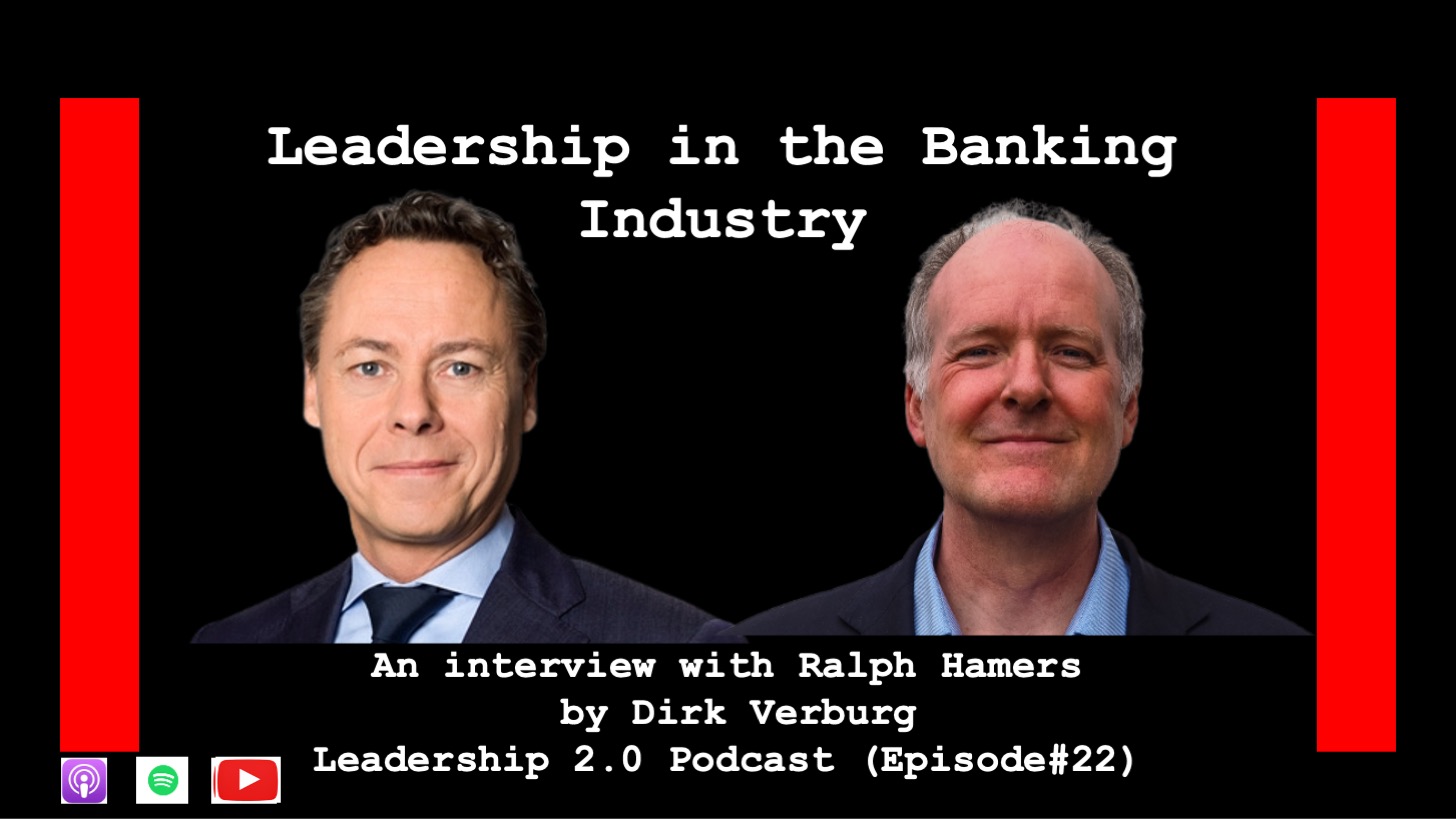
Leadership in the Banking Industry – Interview Ralph Hamers

The image of the banking industry has been severely tarnished by the financial crisis (2007-2008), which led to increasing regulatory and compliance demands. At the same time, the industry is experiencing emerging competition from FinTechs, evolving business models, and disruptive technologies.

In light of these challenges, I recently spoke with Ralph Hamers, to explore his views on what effective leadership in the banking sector entails.

In our conversation, we touched on the following topics:

Continue reading
Realizing Deep & Sustainable Behavorial Change – An interview with Arend Ardon

Why leaders should

  • reflect on their own role and behaviors to prevent self-fulfilling prophecies,
  • release control if they want to make things happen, and
  • consider creating ‘a sense of belonging’ instead of ‘burning platforms’

if they want to implement deep and sustainable behavioral change in their organizations…

These were just some of the topics I discussed with the management consultant and change management guru (although he would reject that classification!) Arend Ardon.

Arend wrote a number of bestsellers in the area of change management and leadership, and is the co-founder and co-owner of the Change Studio, a consultancy firm specializing in change management and leadership.

During our conversation, Arend and I discussed the following topics:

Continue reading

Is your change management initiative doomed to fail before you even started?

Last week I attended an interesting Webinar from Gartner about change fatigue.

According to data collected by Gartner, change fatigue is quickly becoming the number 1 priority for most HR organizations in 2023.

The reason is that the number of change initiatives in organizations is increasing exponentially; simultaneously, the enthusiasm of the workforce to embrace, or at least support these changes, is plummeting.

As a result, many organizations are currently looking for resources to address this, for instance in the form of change management methodologies (e.g. ADKAR), or by asking for support from specialized consulting boutiques.

The why of change

However, as valuable as these resources might be, it is important not to jump to the ‘how’, without paying attention to the ‘why’, the ‘what’ and ‘the team’.

In my personal experience, most people do not resist change if they understand the ‘why’, the ‘what’, and if they recognize ‘the team’.

In this post, I will deal with the why.

Continue reading