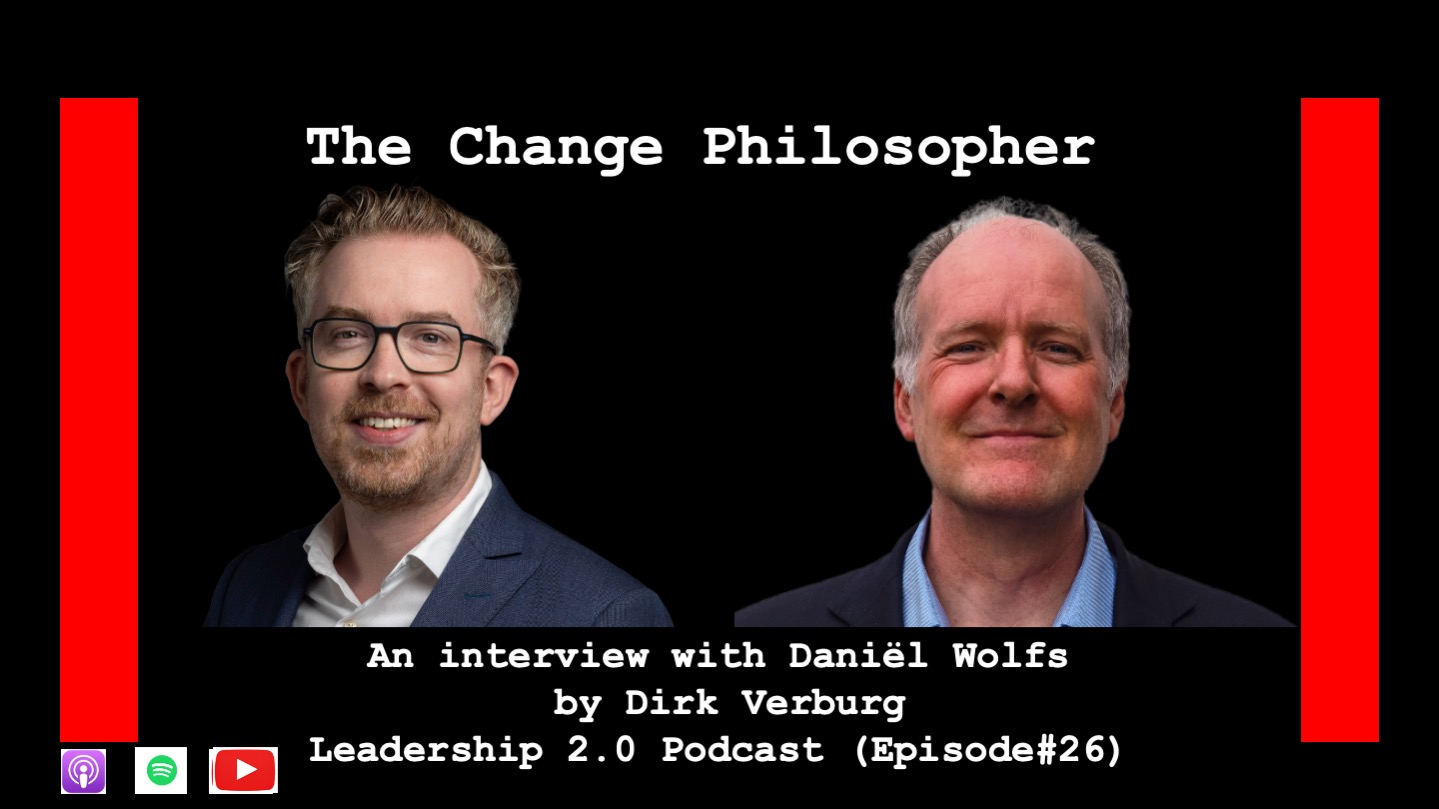
🎙️ Even though we have a vast array of change management theories and methodologies at our disposal (John Kotter, Kurt Lewin, Elisabeth Kübler-Ross, William Bridges, ADKAR, etc.), it still proves to be very hard for us as leaders and consultants to implement real, sustainable change (transformation).
🚫 The harsh reality is that most change projects fail (the famous 70% of McKinsey), or end with a superficial victory declaration, after which the organization often falls back to ‘the way we DID things here’.
⁉️ ‘Why is that?’ That very question drove Daniël Wolfs, experienced change consultant and co-founder of The Change Studio (Netherlands), to write his thought-provoking book ‘De Veranderfilosoof’ (The Change Philosopher) on how we can approach transformation in a deeper, more human, and more sustainable way.’
► In our conversation about this book, we discussed the following topics:
0️⃣1️⃣ The Why of this book
0️⃣2️⃣ ‘Fake News’ in Organizations
0️⃣3️⃣ ‘Storytelling’ versus ‘Storyselling’
0️⃣4️⃣ Preventing entropy in change processes
0️⃣5️⃣ The ‘Shifting Baseline’ Syndrome
0️⃣6️⃣ The Soul of Organizations
0️⃣7️⃣ Plessner: Individual identities <> Collective processes
0️⃣8️⃣ Focusing on the change instead of the outcome
0️⃣9️⃣ Why Daniel is fascinated by change
► You can watch or listen to this podcast episode on
➡️ YouTube
➡️ Apple Podcasts
➡️ Spotify
► No time to watch or listen to the entire podcast now? I summarized some key points of my conversation with Daniël below:
Why did you write this book?
“This book was born from questions about change management, not a search for answers. Inspired by the idea that wisdom lies in questioning, I explored fundamental, often unaddressed questions about the nature of change, resistance, time’s role, and connection. My aim wasn’t a how-to guide, but to explore deeper dynamics and shift the conversation. Practical insights were secondary. Ultimately, the book invites readers to rethink their approach to change management in their own context.”
Why is ‘fake news’ so dangerous in organizations?
In many organizations, genuine dialogue seems to be fading. We’re becoming adept at shaping narratives that, while perhaps rooted in some truth, can morph into a form of organizational ‘fake news.’ This happens for instance, when staff say that ‘management talks about engagement, but that their decisions are already made’, or management labels resistance from their staff simply as ‘clinging to the past’.
These situations often arise from unchallenged assumptions that solidify into accepted truths. To address this, I find the concept of ‘deconstruction,’ drawing from organizational narrative theory and the work of thinkers like Dorita, particularly insightful. Unlike simply breaking things down, deconstruction is an active, reflective process of examining how these organizational stories are constructed. It involves holding multiple perspectives, questioning how a narrative shifts when viewed from different angles, and considering alternative viewpoints. By actively engaging in this kind of deconstruction, we can potentially shift perspectives and challenge the underlying ‘fake news’ that can hinder genuine understanding and progress within organizations.”
In your book you describe the danger of ‘storyselling’ instead of ‘storytelling’. Why is storyselling so dangerous?
From my experience as a change management consultant, storytelling is incredibly powerful. As humans, we make sense of the world through stories; they’re how we connect and understand change. As my colleague once wrote, ‘Stories are the currency of change,’ and I wholeheartedly agree. They help us grasp the ‘why’ and build connection.
However, the danger lies when we over-polish a story, turning it into a tool for mere persuasion. We then become more focused on getting people to ‘buy our story’ rather than engaging in authentic storytelling. I don’t believe this kind of ‘story selling’ truly helps change. Real change happens when people are touched, when they’re inspired by an authentic narrative. Story selling, on the other hand, is simply selling a narrative, and that misses the essence of what storytelling for change is all about.”
You draw an analogy between the energy required in change processes and the concept of entropy in thermodynamics. Can you explain this?
“The concept of entropy is key – without injecting energy, chaos takes over, whether it’s personal health or organizational change. If we don’t fuel the change we desire, it likely won’t unfold as envisioned. This energy isn’t about hype, but consistent, meaningful effort in areas that drive change. This includes bringing the future into the present by making it tangible, embedding it in daily life, and engaging in self-reflection by asking tough questions about our own changed behaviors. It also means creating dedicated time and space for change, making it part of the norm, and implementing change in small, experimental steps while celebrating successes. Everyone has a role in sustaining this energy to counter entropy and steer change in the desired direction.”
In part three of the book, you discuss taking enough time for change, introducing a thought experiment of an organizational decay time-lapse and the shifting baseline syndrome. Can you share this experiment and its lessons?
“The idea of shifting baselines, stemming from time-lapse experiments, highlights how change can be deceptive. For example, employees initially offering feedback might eventually become quiet, feeling it’s safer, while those taking initiative might be told nothing’s changing. In isolation, these stories make sense, but collectively, they reveal a gradual decline in energy, connection, and ambition, hindering change. This mirrors the ecological concept of shifting baselines, where we slowly lower our standards for ‘normal.’ Organizations can similarly find themselves wishing for the past, unaware that the seeds of the current undesirable state were sown gradually. A thought experiment of creating an organizational time-lapse video could reveal these turning points, though privacy regulations make it impractical. The core idea is to recognize the danger of these subtle, cumulative shifts.”
You argue there’s a difference between an organization’s soul and its culture. What does that soul look like, and how can we observe it?
“I can’t definitively answer what a soul is, but I believe we possess one, something beyond just bones and organs that animates us. Similarly, organizations have a ‘soul’ that transcends their physical structure. It’s not the culture – which is ‘how we do things’ – but the deeper ‘why,’ the core purpose. For instance, during the intense pressure of COVID, a healthcare organization I observed radiated a profound sense of purpose in caring for people – that’s the soul. Honoring this organizational soul, this deeper reason for being, allows the culture, the visible behaviors, to flourish. The soul is the invisible compass guiding the organization. While I can’t tangibly define or observe it, I believe it’s a fundamental aspect.”
You use the term ‘Plessner Paradox’. What do you mean with this?
“Inspired by Helmuth Plessner’s concept of ‘the borders of community I believe that while a community or organization demands from individuals, complete merging is never fully realized. Even with shared goals, individuals retain their unique perspectives and free will. Unlike biological family bonds, organizational bonds are purpose-driven. We align with a shared ambition and collaborate, but never fully become one entity.
This Plessner Paradox, is crucial for change. Many change programs unrealistically expect total embrace and zero resistance. True change isn’t about complete identification, but meaningful contribution. When working with leaders, I focus on whether people see the value of the goal, believe they can contribute, and if the potential gains outweigh the effort. If these conditions are met, you foster real emotional buy-in and authentic engagement from diverse individuals willing to move forward together.”
The final notion in the book seems to be that ‘the change’ is actually the journey, and not so much the destination?
“At Change Studio, we view change as a journey or innovation journey, marked by both highs and lows. Often overlooked is that the real transformation occurs not at the ‘destination,’ but within the conversations, decisions, doubts, and breakthroughs along the way. My book addresses the myth of predictability in change, the idea that it can be perfectly mapped and controlled. Many models aim for this control, suitable for structured environments. However, most organizations I work with are dynamic, living systems where individual unpredictability reigns. Therefore, implementing change is less about rigid design and more about focusing on the real-time conversations, tensions, and doubts. It’s about embracing the messy reality of living through change, rather than just planning it.”
Are there any final thoughts on your side about change and change management that you would like to share?
Keep asking questions. I think that’s the main thing. I think we can bring the field of change management, but also organizations and maybe our own lives, further in the direction we want to achieve if we are posing more questions to each other and ourselves instead of just staring at the right answers, because that’s what this book also taught me: the value of questions. I would be a lousy philosopher if I would not be enthusiastic about questions. It’s the core of the book. So that’s my final thought: keep asking questions.
► About Daniël Wolfs
Daniël Wolfs is co-founder and co-owner of The Change Studio, where he works with clients and colleagues on modern approaches to organizational change and leadership. The guiding principles: Lead. Inspire. Create.
He is the author of the book ‘De Veranderfilosoof ‘- op zoek naar de kern van verandering (‘The Change Philosopher – Searching for the core of change’), in which he explores both the visible and invisible dynamics of organizational change.
Drawing on philosophy, systems thinking, and real-world cases, he challenges conventional change management with fresh perspectives and provocative questions.
Daniël has spent his career helping leaders and organizations navigate complex transformations—by making change tangible in the day-to-day, and by creating space for the kind of conversations that actually move people.
Whether guiding leadership teams, designing change journeys, or deconstructing old patterns, his work is rooted in connection, reflection, and practical momentum.
Through writing, speaking, and advising, he continues to explore how we can make change not just possible—but meaningful…
Discover more from Dirk Verburg
Subscribe to get the latest posts sent to your email.
 Dirk Verburg