
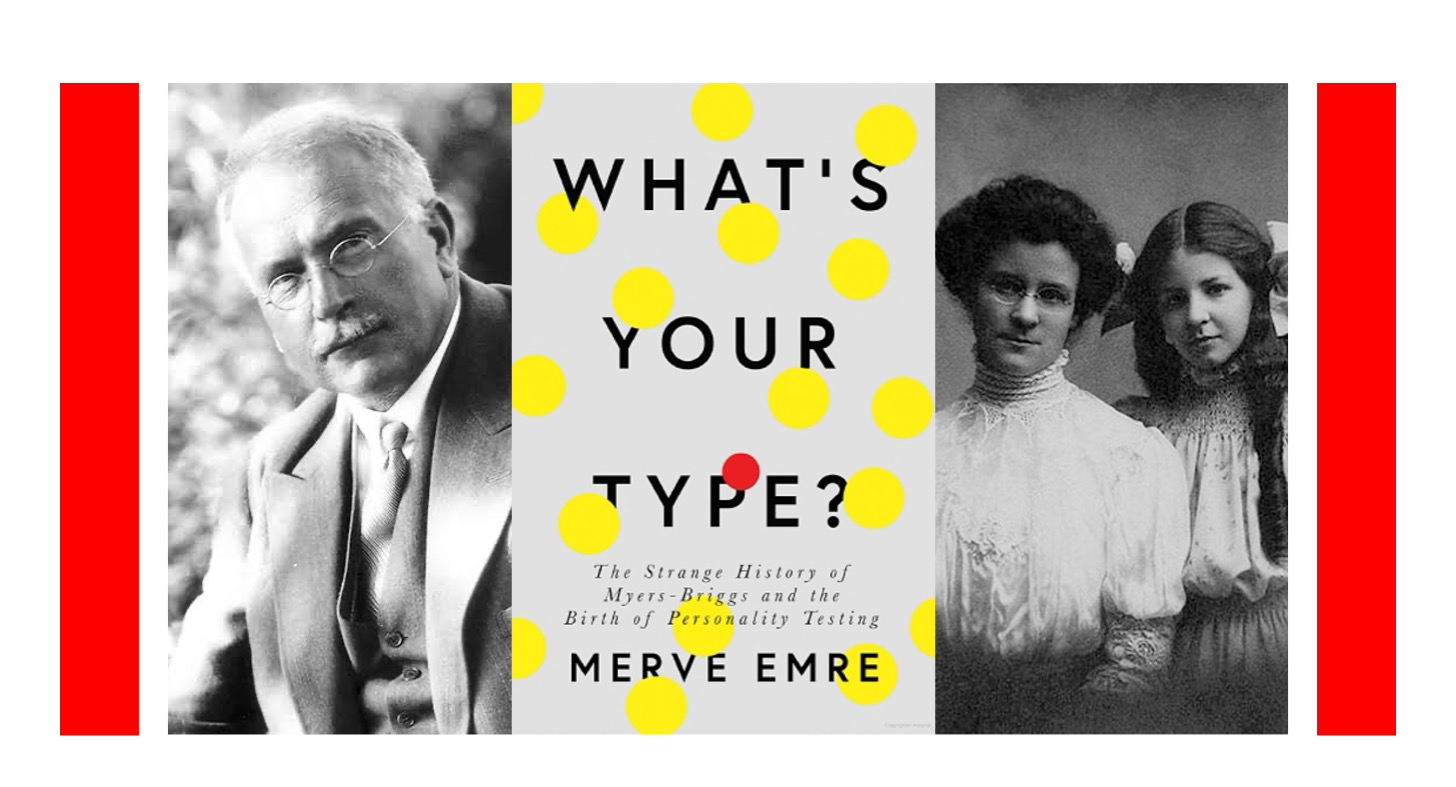
Because I extensively use the MBTI when coaching executives, and because of my general interest in the work of the Swiss Psychiatrist Carl Gustav Jung (1875-1961), I was looking forward to read ‘What’s Your Type? – The Strange History of Myers-Briggs and the Birth of Personality Testing’ by Merve Emre.
For those not familiar with the Myers-Briggs Type Indicator (MBTI), the MBTI has been developed by Katherine Briggs (1875-1968) and her daughter Isabel Myers (1897-1980) on the basis of Jung’s Personality (‘Type’) Theory. It enables the categorization of individual personalities in 4 dimensions, resulting in the (well-known) 16 different ‘types’ (e.g., ‘ISTJ’ or ‘ENFP’).
| Function | Preference | Preference |
|---|---|---|
| Energy | I – Introversion (ideas) | E – Extroversion (people) |
| Perception | S – Sensing (data) | N – Intuition (intuition) |
| Judgment | T – Thinking | F – Feeling |
| Attitude towards outside world | J – Judging | P – Perceiving |
Until a decade ago, the MBTI was one of the most popular personality assessment instruments, and, although it is far less popular today than it used to be, it is still extensively (ab)used.
For this reason, I was very curious to read the book. Unfortunately, I found it a mixed bag.
What I do not like about this book
There are four things I do not like about the book:
Lack of Focus
The book lacks a clear focus. Instead, it blends the history of the MBTI, an evaluation of the instrument, a biography of Katharine Briggs and one of Isabel Briggs Myers, as well as the author’s personal experiences with and opinions about the instrument, in one book. This, in combination with the lack of a clear structure, creates a kaleidoscopic reading experience.
Cluttered
Emre includes a lot of interesting, but superfluous, material she gathered whilst doing research for this book. Examples include detailed descriptions of a WWII spy training program (including a completely fictional scene) and anecdotes about the author Truman Capote. It’s akin to writing a biography of tennis player Boris Becker and devoting large sections to the history of Puma, the sportswear company whose gear Boris Becker used.
Bias
In the beginning of her book, Emre points out that she does not have a lot of confidence in the instrument. Apparently, this was also the impression of CAPT and therefore this institution did not grant her access to materials that would have been very valuable for this book, most notably the correspondence between Katharine Briggs and Carl Jung in the CAPT (1) archives. Emre also does not seem to hold a favorable opinion of Katharine Briggs, largely due to Briggs’s esoteric ideas on raising children, lack of formal (academic) education, Christian background, and blind admiration for Carl Jung. These negative views are “carpet-bombed” throughout the entire book. It might have been better for the author (and the reader) to address her views on Katherine Briggs in a single chapter to “get it out of her system” and get on with it.
Key questions are not answered
The most important shortcoming of the book, however, is that at least three key questions are not answered:
- Relevance of MBTI – Is the personality theory of Carl Jung still relevant in 2025 (the book was published in 1921, i.e., 97 years before the publication of Merve Emre’s book)? Several well-known critics (ranging from Adam Grant to Jordan Peterson) expressed great doubts about the validity of the instrument, and have argued that, for instance, the ‘Big 5’ (which has several elements in common with the MBTI by the way), is a much better alternative to identify personality types. It would have been great if Emre had spent a dedicated chapter on this.
- Link to Jung’s work – To what degree is the MBTI based on the Personality Theory of Jung? I.e., do the questions and scoring mechanism adequately identify the underlying attitude types and functions as described by Jung? Additionally, the question could be addressed if the attitude to the outside world, as measured by the MBTI (Judging or Perceiving), is actually a part of Jung’s Personality theory.
- Opinion Jung – Did Jung have an opinion about the instrument, and if so, what was it? There has been correspondence between Carl Jung, Katharine Briggs, and Isabel Myers, and it would have been interesting to see if this could shed any light on the question. Unfortunately, the author shares only snippets of this correspondence and does not clarify to which parts of the correspondence she had and did not have access to. There is also no information about this topic in the well-known (and very extensive) biography of Jung, written by Deirdre Bair. However, Bair mentions in the book that Jung complained that the book in which he shared his typology was often used as a ‘childish parlour game’, and, to his dismay, was even used by medical professionals to slot patients into his system and give them corresponding advice (p. 288) (2).
What makes the book nevertheless an interesting read?
I am not in the habit of writing negative reviews. If I felt I wasted my time reading a book I did not like, why bother myself and others with it? So why did I write this review? Because I think there are a couple of elements that make the book an interesting read for people interested in the MBTI instrument:
- The development of the instrument – The book contains a lot of interesting information about the development of the instrument, e.g., the evolution through the different ‘forms’ (J, K, Q, etc.), populations that were used to test the instrument, and the psychometric testing process at ETS. Also, interesting pieces of trivia are shared, for instance, when and why the name of the instrument was changed from Briggs Meyers Type Indicator (BMTI) to MyersBriggs Type Indicator (MBTI) (3).
- The role of Mary Hawley McCauley – The author does a great job in highlighting the key role Mary Hawley McCauley of the University of Florida played in avoiding the premature death of the instrument.
- The commercial success of the instrument – The author vividly describes the initial success of the instrument just after the end of World War II, its subsequent stagnation and lack of commercial success until 1975, and its remarkable resurgence when the publication rights were transferred from ETS to CPP (Consulting Psychologists Press- the predecessor of The Myers-Briggs Company.).
Conclusion
Despite its shortcomings, for people interested in the history of the MBTI, the book remains an interesting read (I would give it three stars on Amazon). However, like me, they might also find it an unsatisfactory one, because the key questions I referred to earlier are not answered.
(1) The Center for Applications of Psychological Type (CAPT) – a nonprofit research organization co-founded by Isabel Myers
(2) Although Bair’s biography is a whopping 881 pages long (including endnotes and references), neither the names of Katharine Briggs, and Isabel Myers, nor the term MBTI, feature anywhere in this book.
(3) This was done for marketing purposes because “BM” could be construed as the “Bowel Movement”. Another interesting piece of trivia is that it was Henry Chauncey, founder and first president of the Educational Testing Service (ETS), who changed the letter for Intuition from “I” to “N”, to avoid confusion with Introversion.
Discover more from Dirk Verburg
Subscribe to get the latest posts sent to your email.
 Dirk Verburg