‘Eating radishes’
That is how, according to Matt Dixon, many ‘doer-sellers’ experience selling their services.
People do not become management consultants, executive coaches, accountants, lawyers, or engineers to sell. However, for those working in professional service firms or independently, selling is an integral part of their role.
At the same time, professional sales processes are changing. More and more professional services are sourced through RFPs, and buying committees are replacing traditional client relationships. This means that doer-sellers need to change their approach to sales in order to stay relevant.
Based on an extensive quantitative study of nearly three thousand partners across industries such as law, accounting, consulting, investment banking, executive search, and public relations, five distinct seller types within professional service industries were identified; however only one of them, the Activator, consistently drives growth.
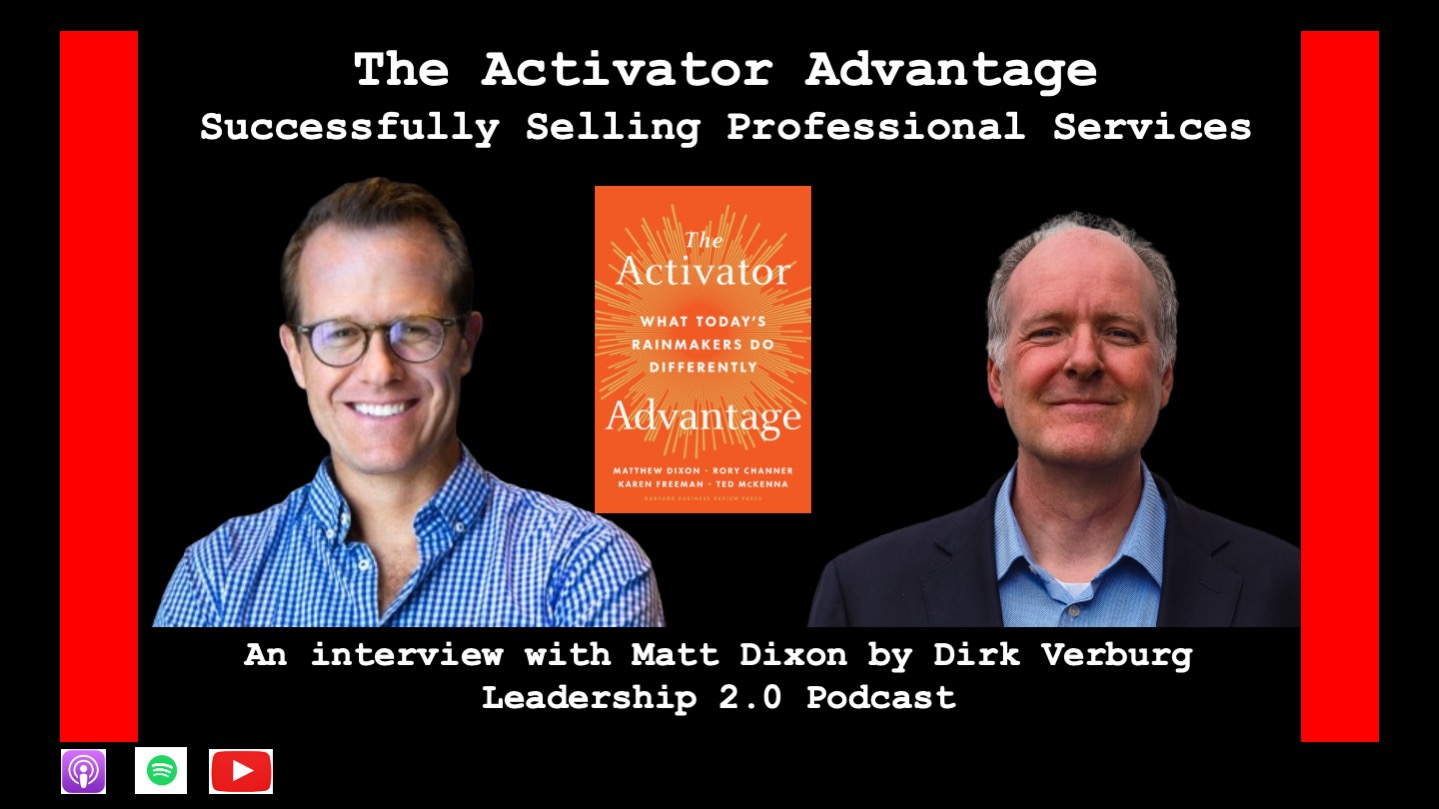
In the 33rd episode of the Leadership 2.0 podcast, I interviewed Matt Dixon from DCM Insights about ‘The Activator Advantage – What Today’s Rainmakers Do Differently‘.
► You can watch or listen to a podcast with our conversation on:
➡️ Spotify
➡️ YouTube
➡️ No time to watch or listen to the podcast now? Here is a short summary of our conversation ⤵
Dirk Verburg: Which of these three words is your favorite and why: sales, acquisition, business development?
Matt Dixon: I’ve used sales the most, but I don’t like acquisition because it only tells part of the story, leaving out retention and expansion. In professional services, though, many people dislike the term “sales.” Therefore, I’d say business development is probably the non-confrontational word, as everyone, including lawyers and consultants, can relate to it without being offended.
Dirk Verburg: I, as a doer seller, am not particularly fond of the selling element. Am I unique, or is this aversion a common habit among doer sellers, and what are the reasons for it?
Matt Dixon: You’re not unique at all. Professionals who sell advice for a living—including consultants, lawyers, and accountants—generally have an aversion to sales or business development. They didn’t go to school to become salespeople. We found that 80% of professionals will avoid business development unless they absolutely have to, such as when they lose a big client or the business is slow. Most do it reluctantly, when they “get around to it.”
Dirk Verburg: The Challenger Sale was groundbreaking. Which specific event or observation inspired you to write The Activator Advantage?
Matt Dixon: The inspiration came from an experience presenting the Challenger Sale research to partners at a large consulting firm. About 45 minutes into the keynote, the managing partner stopped me, stating, “We are not salespeople.” This made me realize the research was about B2B salespeople, not doer sellers, who generally don’t see themselves as salespeople and dislike selling. This gap in relevance led me to launch a large global study in 2022 across 3,000 partner-level professionals, which became The Activator Advantage.
Dirk Verburg: Could you perhaps explain the characteristics of the five partner types and why only the Activator drives consistent growth.
Matt Dixon: These five profiles emerged from the data, based on what partners do when selling, not personality.
- Expert: Reluctant, believes their expertise should speak for itself; they aggressively wait for the phone to ring, often resulting in RFP-driven purchasing.
- Confidant: Old-school trusted advisor who builds a small portfolio of deep personal and professional client relationships and is often unwilling to share clients internally.
- Debater: Opinionated know-it-all who develops business by telling clients they are wrong, a tough posture when you are the product.
- Realist: Glass half-empty professional focused on managing client expectations by emphasizing high costs, long timelines, and limited impact.
- Activator: Super connector who proactively brings new ideas to clients, establishes multiple points of connection, and shifts client loyalty to the firm (“the we”). They have the highest probability of being high performers because of this approach.
Dirk Verburg: Could you say some words about the three C’s of the Activator?
Matt Dixon: The three C’s are Committing to business development, Connecting broadly and deeply, and Creating value proactively.
- Committing: Means establishing a rhythmic cadence and routine for business development, unlike the 80% who do it only when they “get around to it.” This ensures a healthy pipeline of opportunities.
- Connecting: Involves actively building a broad network, which is seen as their most important strategic asset. It also means connecting deeply internally by bringing in colleagues as a “general contractor for expertise” to make the client relationship “stickier.”
- Creating: Centers on proactively bringing new ideas to clients before they realize a need or risk. This establishes goodwill, shapes the client’s understanding of the opportunity, and addresses the client complaint that partners disappear between paid work.
Dirk Verburg: Clients are less loyal than before, rendering traditional business development approaches less effective. What are the root causes of this shift in client behavior and purchasing processes?
Matt Dixon: Client loyalty has dropped, with only 50% of decision-makers now saying they’d return to a firm that did good work, down from 75% five years ago.
The main drivers include:
- Increased Procurement Involvement: Professional services spend is now subject to more scrutiny and rigorous purchasing processes.
- Rise of Alternative Providers: Boutique and niche firms are now competing for larger, more expensive projects previously reserved for big, prestigious firms.
- Impact of AI (e.g., ChatGPT): Clients love AI for two reasons: they expect it to put downward pressure on rates, and it makes it much easier to shop around and compete the entire universe of providers for a specific need. Clients feel they do themselves a disservice by assuming the incumbent firm is always the best choice.
Dirk Verburg: Your book divides client stakeholders into three categories: Blockers, Talkers, and Mobilizers. How can doer sellers recognize and deal with each of them?
Matt Dixon: Doer sellers must navigate an average buying committee that has grown to over 10 or even 20 stakeholders, as the senior executive may sign the check but isn’t the sole decision-maker.
- Mobilizer: The most important stakeholder; they have the influence and gravitas to get the buying committee to move forward. They are motivated by what’s best for the company (e.g., customers, shareholders). Activators seek out and align with Mobilizers.
- Talker: Good for gathering information but will lean back in the debate.
- Blocker: Typically the status quo defender. A consultant must identify and neutralize this person, who likely doesn’t want the deal to move forward.
Dirk Verburg: Could you perhaps describe the three elements of the Activator mindset (self-determination, other focus, and resiliency) and explain their importance.
Matt Dixon: These mindsets, unlike personality traits, can be developed.
- Resiliency: The best business developers have a thick skin because they are told no more often than yes. They don’t take rejection personally and protect the relationship to go after the next opportunity.
- Other Focus: Activators prioritize helping the client and show pride in their colleagues. They love introducing colleagues to clients, knowing the client will value the interaction and that it deepens the relationship. Their posture is “How can I be helpful?” with almost no expectation of immediate payment.
- Self-Determination: The mindset that business development success is up to the individual. Activators believe that if they consistently execute their playbook (connect broadly, create value proactively), they will be successful, and they blame themselves, not the market or competitors, if things go wrong.
Dirk Verburg: What habits or mindset do Activators embed in their daily workflow, and which might be the most challenging for people to develop?
Matt Dixon: The most challenging habit is often simply carving out and protecting time to do business development. Because most partners dislike selling, their preferred client delivery work expands to fit the time, pushing out sales activities.
The mistake is trying to go from zero to an hour of business development, which is a recipe for discouragement. Instead, the habit must start small, such as 15 minutes. Critically, to avoid the “deer in the headlights” moment, partners must separate system one (reflexive) and system two (contemplative) thinking. Activators do all of their planning (System Two) on Sunday night or Monday morning, so when the calendar reminder pops up, it’s only System One execution.
Dirk Verburg: How can a firm instill a collective Activator mindset and increase collaboration beyond the individual partner level?
Matt Dixon: A major challenge is getting partners to collaborate, but the biggest barrier isn’t compensation—it’s the fear of talking about things outside their area of expertise. Partners worry that if a client asks about an issue outside their specialization, they will damage their credibility.
Activators are comfortable with this; they don’t give advice on the matter but position themselves as a general contractor for expertise. They’ll offer to take the client’s non-specialist issue back to their colleagues and set up a call with the right expert. This requires comfort in venturing beyond their “skis,” but it delivers value, deepens the client relationship, and drives firm-wide collaboration. Compensation is a necessary hygiene factor—it must be aligned to avoid disincentivizing collaboration, but it won’t drive the desired behavior alone.
Dirk Verburg: For doer sellers like me who know selling is good but don’t enjoy it, can we ever start to like it, and do you have any advice?
Matt Dixon: Yes. Activators don’t really like selling either, but their approach makes it feel less like sales. For most partners, the dynamic is: I will build a relationship and deliver value after you pay me. Activators flip this: I’m going to build a relationship and deliver value first.
This proactive approach makes the eventual ask for paid work a natural evolution of the relationship. As one lawyer put it using a marriage metaphor, you’re less fearful of asking a question when you’ve done all the work that precedes it. This is how activators make it feel more like eating cookies.
Dirk Verburg: Are there any things about The Activator Advantage that we have not discussed that you would like to mention or highlight?
Matt Dixon: I hope listeners are interested in learning more. The book goes into greater detail on:
- The data and performance analysis.
- The significant changes in client buying behavior.
- The three C’s, the six habits, the three mindsets, and the five key pivot points.
- A dedicated chapter for firm leaders on “how do I build an activator firm.”
For more research and resources since the book’s release, people can visit Matt’s website: dcminsights.com.
Discover more from Dirk Verburg
Subscribe to get the latest posts sent to your email.
 Dirk Verburg