
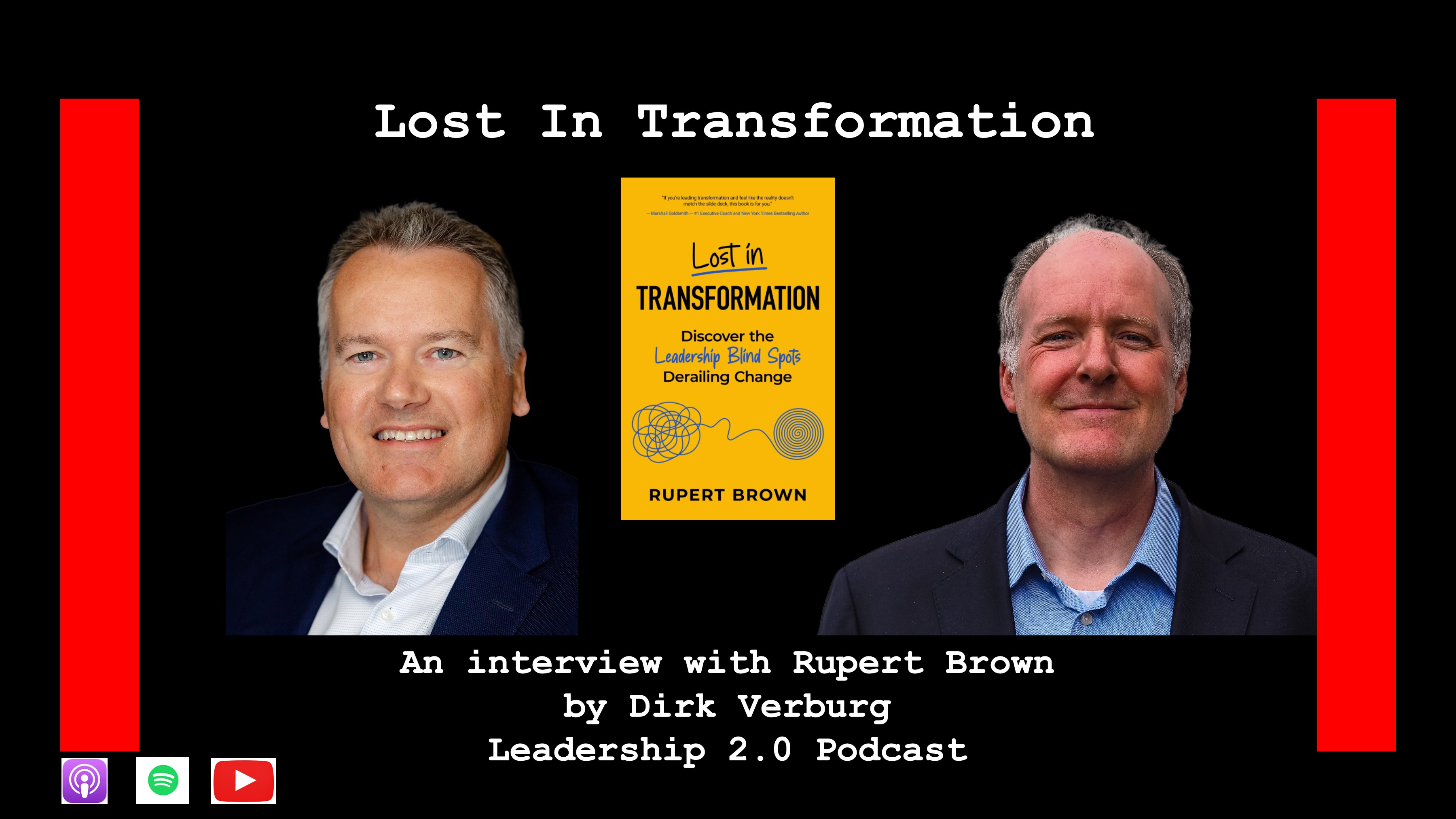
McKinsey’s infamous stat haunts every executive: 70% of all change management efforts fail. Despite decades of expertise, this number seems frozen in time. Why?
In the 35th episode of the Leadership 2.0 podcast, I sat down with a true transformation veteran, Rupert Brown, author of the eye-opening book, ‘Lost in Transformation’.
Rupert is an experienced Chief People Officer and change management specialist with deep expertise in M&A, digital transformation, and turnarounds, having advised giants like Procter & Gamble and Maersk.
This wasn’t just a discussion of tactics; it was a candid, emotionally intelligent discussion on how Transformations can be handled better.
Tune in to learn about:
- Why Transformation projects continue to fail
- The difference between Change and Transformation
- The Bad Reputation of the word ‘Transformation’
- Why we still struggle with Change Management
- In-Groups and Out-Groups in Change Management Processes
- Chief Acceleration Officers
- Trust is Energy
- Crises as Catalysts for Change
- The impact of our Permacrisis on Change Management
- Behavioral Skills to cope with the BANI world’
- Change Management and AI
If you’re leading a transformation—or struggling to survive one—you can’t afford to miss this. Rupert delivers the hard truths and the practical guidance needed to shift from ‘being Lost’ to becoming ‘the Leader of change’.
► You can watch or listen to a podcast with our conversation on:
➡️ Spotify
➡️ YouTube
➡️ No time to watch or listen to podcast now? Here is a short summary of our conversation ⤵
Dirk Verburg: What is the number one reason 70% of change projects fail, and what is the single most important thing companies must get right to prevent this?
Rupert Brown: That 70% failure rate is contested, but it feels right from a practitioner’s perspective. A common mistake is planning change in isolation, behind closed doors, with the concept of doing change to others, often due to confidentiality or conflict aversion. Change is frequently done reactively, with haste, anger, and frustration, then imposed on the organization. While it’s hard to name one thing, the most important element is the reflection and awareness of what change is, what works, and how change actually happens here. Every organization is different, and the dynamic evolves, so this pause and reflection is often missed. Companies must contextualize change to their history and culture for an optimal chance of success, rather than using a generic blueprint.
Dirk Verburg: What is the essential difference you see between “change” and “transformation” in the context of your book Lost in Transformation?
Rupert Brown: I define change as being broader than just the project rolled out by the project management office. I wanted to encompass the whole human side, including multiple, simultaneous impacts on an individual, some of which they are unaware of, like personal life transitions. Change is happening anyway. Transformation is often what we call it when we try to do change deliberately and intentionally. My joking definition is that transformation is like change, but bigger and better. The word “transformation” has a bad reputation because it’s often associated with job losses, causing the positive aspects like reinventing culture to largely disappear.
Dirk Verburg: Given that change management models have been around for decades, why do we still struggle so much in the area of change management?
Rupert Brown: The problem is often not the model itself, but the attention the models’ insights receive. Good intentions and plans are often buried in slideware or lower in the organization, failing to infuse the leadership approach. Leaders don’t typically think about change management models. When asked, they often reference something read long ago, like a few steps from Kotter’s model (the burning platform is always remembered). It’s important to meet clients where they are, which is often at this low level of awareness. Change management has become a discipline of its own, in danger of being suppressed. The real challenge is what actually gets the attention of the leadership and decision-makers.
Dirk Verburg: How should a change team be composed and behave to prevent the “in-group/out-group” dynamic and be accepted by the organization?
Rupert Brown: An early experience I had during an acquisition involved “clean teams” with representatives from both companies, meaning everyone had skin in the game and was respected as a subject matter expert with cultural insight. However, that approach is often unrealistic due to resource constraints. A hybrid model—internal consultants, external consultants, and client system members—is common. The ideal change leader should be an internal person who understands the business, can foresee industry future, connect dots across functions, and has the influence and trust to make things happen. When too many bright, external profiles are hired, they easily create the in-group/out-group dynamic. Their primary skin in the game is the short-term success of their program, not the long-term success of the company; they work on the business rather than in it. This places them outside the system, which is challenging boundary work. Internal change roles are brilliant accelerator experiences for talent in the core business, and cross-fertilizing these groups is key.
Dirk Verburg: What is your take on the creation of a separate Chief Acceleration Officer, and what boundary conditions would be needed for that role to succeed?
Rupert Brown: These non-line C-level roles evolve out of necessity, often when the CEO’s attention is pulled in too many directions. They are appointed to play a “joining of the dots” role or to draw some of the internal heat of change away from the CEO. While born out of necessity, the role usually causes issues from the get-go. The main boundary condition is defining the rules of the game when the “disruptor” is in the room. You need someone who brings in inconvenient external truths. However, knowledge leaders like the Head of Strategy often lack the organizational clout to shift the large chunks of the business, which have the budget and momentum. You need someone of equal stature and mass to help shift the business’s direction.
Dirk Verburg: Rachel Botsman says trust is like energy; it changes form and flows to different actors. Where does trust flow if change management is not handled effectively?
Rupert Brown: Trust doesn’t disappear; it goes sideways, downwards, and outwards. Within the organization, it quickly flows sideways to peers and small teams, who become tight-knit, often adopting a “shop steward” mentality of being “in it together” against the owner/leader. The leadership gap often erodes under harsh conditions. Trust also goes outwards, leading people to strengthen relationships with external contacts, like headhunters, during times of organizational stress. These externals often validate the internal experience of a toxic workplace, which is “music to your ears” and further strengthens those outside relationships at the expense of believing the leaders. When the reality inside a company (e.g., disappointing results) is totally different from the positive spin given to external analysts, trust erodes and escapes.
Dirk Verburg: Crisis can be an opportunity to structurally change companies for the better, as with the cyberattack on Maersk. Do you have any process suggestions for organizations to use a crisis to identify and implement changes?
Rupert Brown: A crisis is a great opportunity for good, people-centric leadership to shine. During the Maersk cyberattack, the leader took a “team of teams” approach, ensuring people felt very involved, included, cared for, and had purpose. One person’s reflection was: “I really miss coming to work and doing the impossible”. The company’s technology was able to take great leaps in its evolution during that short, sharp period. The suggested “process” is that great leadership is the right process in a crisis. It involves intentional, intense leadership, which, while not sustainable all the time, offers clues to what makes people thrive at work. If you can involve and take people with you, they learn and grow enormously during the experience.
Dirk Verburg: Living in a “perma-crisis” (brittle, anxious, nonlinear, incomprehensible – BANI) world, should we step away from classical waterfall-style change projects and look to concepts like agility?
Rupert Brown: In the cyberattack example, the success was due to a combination: a leader holding the cards (centralized control) and a methodology (team of teams) for organizing people. Agility often fails because the idea of ceding control and allowing experimentation does not sit easily with leaders during change, especially when they need to explain what’s going on to their superiors. I get nervous about the “control tower” approach of centralizing all change knowledge. There is value in a decentralized approach where everyone is skilled and has context, but connectedness is crucial. Waterfall can work for orchestrated big things, like building an airport, where you need a strong plan and budget. The “team of teams” concept is strong, but if “agile” is simply interpreted as “I can just get on and do it” without updating others, it doesn’t work.
Dirk Verburg: The BANI world suggests addressing non-linearity with “context and flexibility.” Could you illustrate this with an example from your experience?
Rupert Brown: I’m currently helping an organization rethink goal setting by shortening the planning horizon. In my early days, we did three to five-year brand strategy plans, but that feels academic now. While planning skill is still necessary for focus, resource allocation, and accountability, we are compressing the time frame to feel more in control and be more flexible. This is a response to nonlinearity that invokes a creative and entrepreneurial sense: doing Y now instead of X because it makes more sense. It allows the organization to take advantage of market opportunities to outperform the industry. This links to incomprehensibility; people get sidetracked when they can’t see the change coming and leaders don’t describe the bigger picture. A big job of leadership is making sense of what’s going on and what to do next.
Dirk Verburg: How do you think Artificial Intelligence will enhance our change management capabilities and increase the chances of success for change programs?
Rupert Brown: I’ve observed that some people place a lot of trust in technology and ask questions to their LLM that they might ideally ask a therapist, trusted friend, or coach. People who weren’t using coaching before are now getting coaching benefits from technology. If AI allows you to interrogate a body of knowledge with the problems you face, that is probably a good thing for change management. However, we must remember that everything AI generates requires discretion and human interpretation; it should not be taken at face value. The critical skill for the future will be moral reasoning. Like any tool—such as a knife—technology can be used for good or for bad. AI can enhance capabilities, but we head in the wrong direction if we conclude it means we no longer need the humans who influence leaders.
► Book ‘Lost In Transformation‘
► Website Rupert Brown
Discover more from Dirk Verburg
Subscribe to get the latest posts sent to your email.
 Dirk Verburg