
Unfortunately, today, a single television news bulletin, or a glance at the front page of a newspaper, is enough to reveal the dark side of leadership.
However, many people do not need to switch on the TV or read the paper to witness this; instead, they experience the dark side of leadership every day within their own organizations. They happen to work for ‘Psychopath Lights’—or, as Manfred Kets de Vries calls them, ‘Seductive Operational Bullies’ (SOBs).
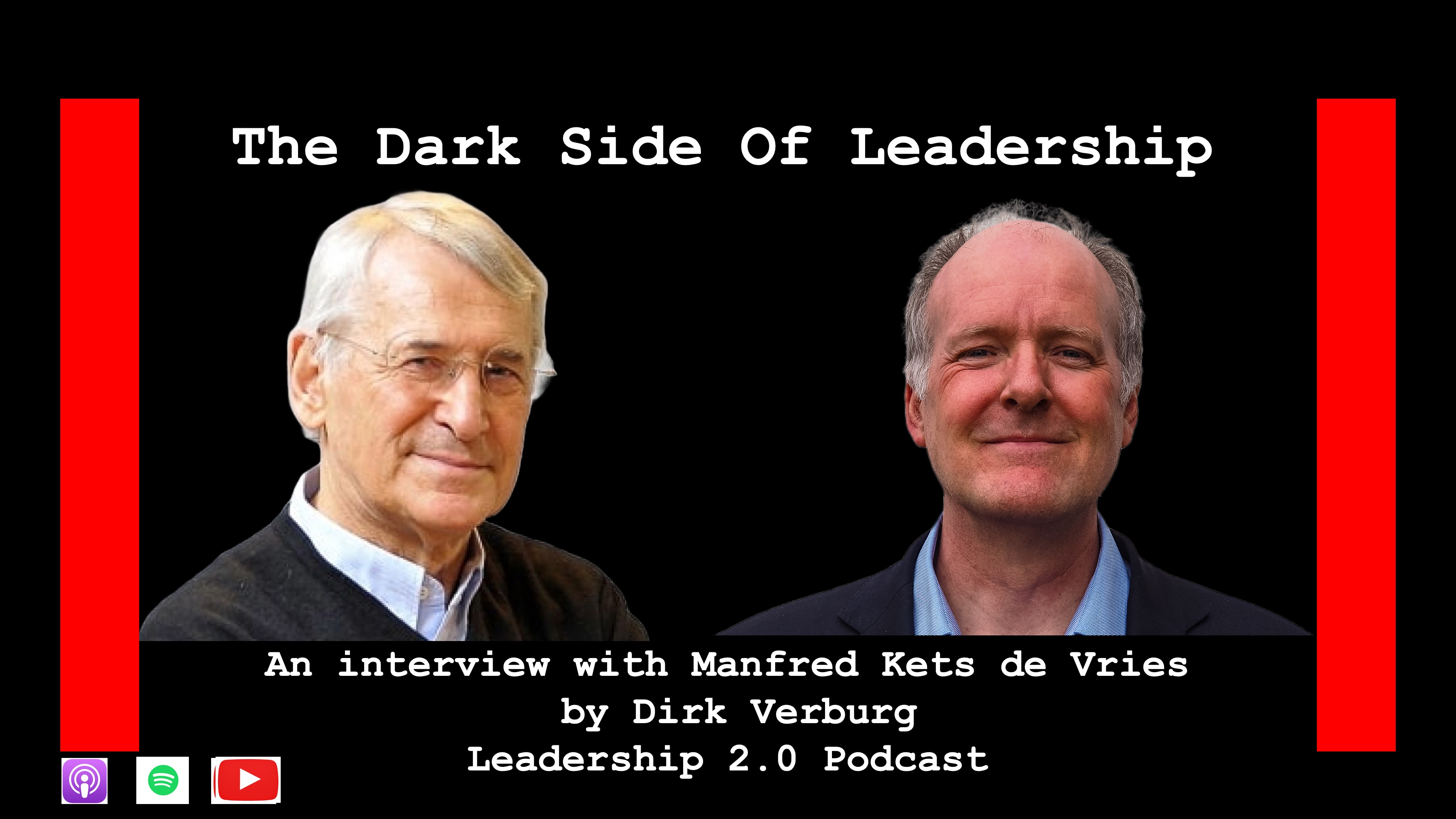
In the 36th episode of the Leadership 2.0 podcast, I sit down with Manfred to explore his extensive research on this phenomenon. During our conversation, we discussed the following topics:
- Why do people want to lead others?
- Why do people want to be led?
- The Dark Dyad and Psychopaths Lights (SOBs)
- Why are SOBs attracted to the Financial Sector?
- Can SOBs Be coached?
- The Impact of Life Changing Circumstances On SOBs
- Strategies for SOB victims
- Why Leaders Should Understand Their Shadow Side
► You can watch or listen to a podcast with our conversation on:
➡️ Spotify
➡️ YouTube
➡️ No time to watch or listen to podcast now? Here is a short summary of the key points of our conversation ⤵
Dirk Verburg: What is the primary reason people have an intrinsic drive to lead others, even when it isn’t just about having influence?
Manfred Kets de Vries: There isn’t a simple answer, as many leaders are actually reluctant and find themselves in the “limelight” by accident or financial necessity, such as paying for their children’s school fees. I often see people who were “number two” suddenly become “number one” and realize they don’t actually enjoy the scrutiny or the criticism that comes with the territory. Some entrepreneurs lead primarily because they are “difficult people” who find it impossible to work within structures they do not control; they need to be in charge just to function. Most people I interview don’t explicitly state a desire to “lead” as a goal; they are driven by the need for an interesting life, independence, or what is often called “FU money.”
Dirk Verburg: Why do humans have a universal, often strong desire to be led by others?
Manfred Kets de Vries: This is a result of “regression.” In times of high anxiety—whether due to war, disease, or climate change—people tend to regress to a childhood state. They seek a messianic figure, a “father or mother” who promises to take care of everything so the individual no longer has to think or take responsibility for themselves. While this provides a temporary sense of security, it is a dangerous dependency reaction. It creates an “echo chamber” where the leader is surrounded by “yes-men” who are afraid to speak the truth, preventing any critical feedback and ultimately leading to organizational or societal failure.
Dirk Verburg: How does the “dark dyad” manifest in leadership, and why do you prefer this term over the “dark triad”?
Manfred Kets de Vries: I prefer the term “dark dyad” because I believe Machiavellianism is often just a derivative or a symptom of the two core traits: narcissism and psychopathy. While 1% of the general population has psychopathic tendencies, that figure jumps to 3.9% in executive positions. These “malignant narcissists” lack guilt and possess a high degree of vindictiveness. They are often “seductive operational bullies” who are masters at “managing upward” to impress their superiors with results while being incredibly toxic and destructive to those working beneath them. They use their charm to climb the ladder, but leave a trail of “human wreckage” behind them.
Dirk Verburg: Why is there such a high concentration of the “dark dyad” within the financial sector?
Manfred Kets de Vries: The financial sector acts as a magnet for individuals with “dark dyad” traits because it offers the most direct route to extreme wealth and power. In these environments, the focus is often on “getting rich quickly” and securing that “FU money” which provides a sense of total independence. The industry’s structure frequently rewards ruthlessness and high-risk behavior, allowing these “seductive operational bullies” to thrive. Because they lack a “functioning internal brake” or a sense of guilt, they can manipulate systems and people for personal gain without the emotional toll that would stop others. This creates a self-reinforcing cycle where toxic behavior is not only tolerated but often seen as a competitive advantage.
Dirk Verburg: Have you ever successfully coached or treated leaders exhibiting these “dark dyad” or “SOB” traits?
Manfred Kets de Vries: Generally, no. Real psychopaths are masters of seduction; they can make a coach feel like progress is being made while they are actually just playing a game and observing how to better manipulate the situation. If I identify someone as a true psychopath, I won’t even start the process—as I often say, the best thing is to “lock them up and throw away the key.” Most of my “bread and butter” work involves micromanagers or those with “neurotic” styles who have the capacity for guilt and can improve. However, for those with deep-seated psychopathic traits, the chance of meaningful change through coaching is nearly zero because they lack the fundamental empathy required for growth.
Dirk Verburg: Can life-changing traumatic events, such as a health crisis or personal loss, cause these toxic leaders to change?
Manfred Kets de Vries: Yes, these “trigger points” are often the only way a breakthrough happens. When the traditional drivers of “beauty, money, and power” are no longer enough—or when faced with a “mild coronary,” a family breakdown, or the loss of a loved one—a leader may finally become a “reflective practitioner.” In these moments of vulnerability, they might move away from the “external” world of endless growth and toward “internal” meaning. This involves developing a sense of belonging, practicing gratitude, and realizing that a life spent only on power and 24-hour work cycles is ultimately a meaningless life. It is about shifting from “having” to “being” and finding purpose beyond the ego.
Dirk Verburg: What practical strategies do you recommend for employees managed by a toxic “SOB” boss?
Manfred Kets de Vries: First, try to understand the boss’s world and the pressures they face; sometimes what looks like malice is just extreme stress. However, if they are a true “SOB,” you must protect yourself. Try to move laterally within the organization to a different department to escape their direct influence. If that isn’t possible, you must quit. You only have one life, and staying under a toxic leader will destroy your energy, your health, and your self-esteem. Organizations should use 360-degree feedback to catch these individuals early, as they are often very good at hiding their toxic behavior from their own bosses while terrorizing their subordinates.
Dirk Verburg: Why is self-awareness and understanding one’s “shadow side” so critical for the leaders of the future?
Manfred Kets de Vries: Self-understanding allows a leader to become an “integrated person.” By knowing your strengths and your “shadow”—the parts of yourself you’d rather not acknowledge—you can delegate effectively to people who complement your weaknesses. Many executives “couldn’t give a damn” about reflection and focus only on short-term results, but this is unsustainable. Without self-awareness, you risk becoming a slave to your own ego or destructive work habits—like some executives I’ve seen who feel they must have their mobile phones with them even in the shower. Leadership without reflection eventually leads to burnout and a total lack of true purpose.
► About Manfred Kets de Vries
Manfred F. R. Kets de Vries is the Distinguished Clinical Professor of Leadership Development and Organisational Change and the Raoul de Vitry d’Avaucourt Chaired Professor of Leadership Development, Emeritus, at INSEAD.
He brings a different view to the much-studied subjects of leadership and the dynamics of individual and organisational change. Bringing to bear his knowledge and experience of economics (EconDrs, University of Amsterdam), management (ITP, MBA, and DBA, Harvard Business School), and psychoanalysis (Canadian Psychoanalytic Society and the International Psychoanalytic Association), he scrutinises the interface between international management, psychoanalysis, psychotherapy, and dynamic psychiatry.
He has held professorships at McGill University, the Ecole des Hautes Etudes Commerciales, Montreal, and the Harvard Business School, and has lectured at management institutions around the world. Financial Times, Le Capital, Wirtschaftswoche, and The Economist rated Manfred Kets de Vries as one of the world’s top fifty leading management thinkers, as well as one of the most influential contributors to human resource management.
His specific areas of interest are leadership, career dynamics, executive stress, entrepreneurship, family business, succession planning, cross-cultural management, team building, coaching, and the dynamics of corporate transformation and change.
In 2008, he received the Lifetime Achievement Award from the International Leadership Association (the Leadership Legacy Project), being viewed as one of the world’s six founding professionals in the development of leadership as a field and discipline.
Finally, Manfred is also the chairman of the Kets de Vries Institute (KDVI), a boutique leadership development consulting firm.
He is the author, co-author or editor of forty-nine books and has published over 400 papers as articles or chapters in books.
► Kets De Vries Institute (KDVI)
Discover more from Dirk Verburg
Subscribe to get the latest posts sent to your email.
 Dirk Verburg