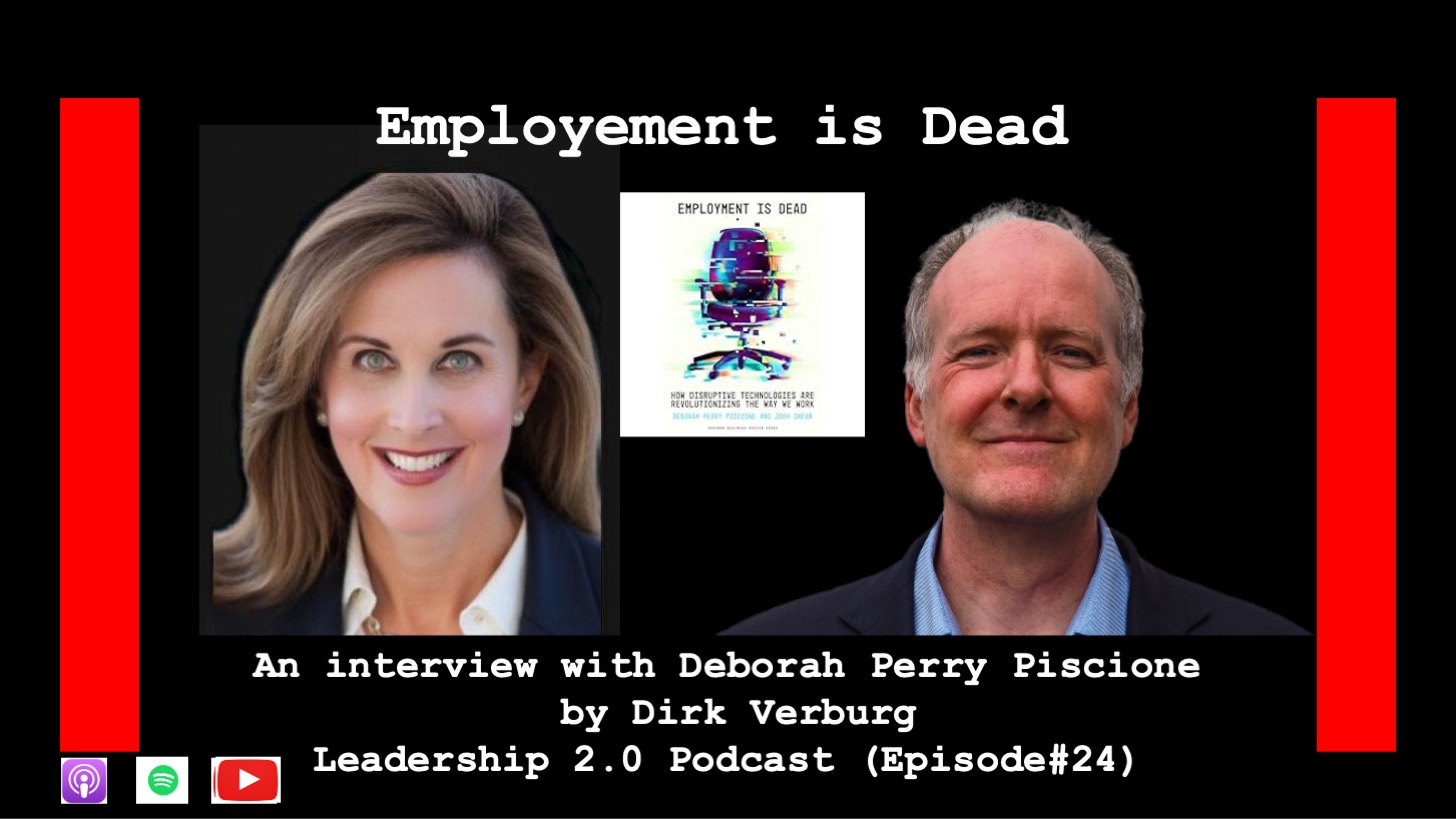
‘Employment is Dead’ – An interview with Deborah Perry Piscione

Earlier this week, one of the most important business books on the Future of Work was published by Harvard Business Review Press: ‘Employment Is Dead: How Disruptive Technologies Are Revolutionizing the Way We Work’ by Deborah Perry Piscione and Josh Drean.

The central theme of this book is that traditional employment models are becoming outdated due to the evolving needs and expectations of the modern workforce, in combination with, and enabled by, disruptive technologies.

This will lead to the end of the traditional employment model, as well as the traditional form of companies, as we know them today.

Monday, just hours before the book was released, I had the chance to interview Deborah Perry Piscione for my Leadership 2.0 Podcast.

► In our conversation, we touched on the following topics:

Continue reading

‘Scenario Thinking and Leadership’ – An interview with Jeremy Bentham

Scenario thinking enables organizations to establish possible visions of the future in the form of scenarios.

These scenarios enable decision-makers to think through the different ways in which the environment of their organizations could evolve, based on different sets of assumptions. It enables leaders to ‘think through ‘a wide range of what if questions’: ‘What if the dollar…’, ‘What if China…’, ‘What if scientific developments make it possible in the near future to…’, etc. This enables them to mentally prepare themselves for possible ‘Black Swans’, and review the ability of their organization to cope with, or, iedeally, benefit from these.

One of the companies that is best known for its scenario-thinking activity is Shell. For decades, Shell’s scenarios have supported the decision-making of Shell leaders, academics, governments, and businesses.

Jeremy Bentham led this activity in Shell between 2006 and his retirement in 2022 as Shell Scenarios & strategy Leader and VP Global Business Environment.
In this episode of the Leadership 2.0 podcast, I am interviewing Jeremy Bentham about scenario thinking and leadership.

During our conversation, Jeremy and I discussed the following topics:

Continue reading

Three imperatives for Talent Management in a VUCA world

Talent management originates from the late 1960s. Since then the business environment has changed dramatically. However, talent management practices in many organizations have not been adapted to cope effectively with these changes. This makes these organizations vulnerable to disruptions in their environment. Talent managers should therefore do three things to ensure their businesses have the necessary adaptive and innovative capabilities to cope with disruptions.

Almost 50 years ago, in 1968, Paul S. Ostrowski published an article with the title “Prerequisites for Effective Succession Planning”. This article is often seen as the starting point for Talent Management. The business environment at that time looked completely different from today:

Continue reading