Book Review: ‘What’s Your Type?’ – The history of the MBTI

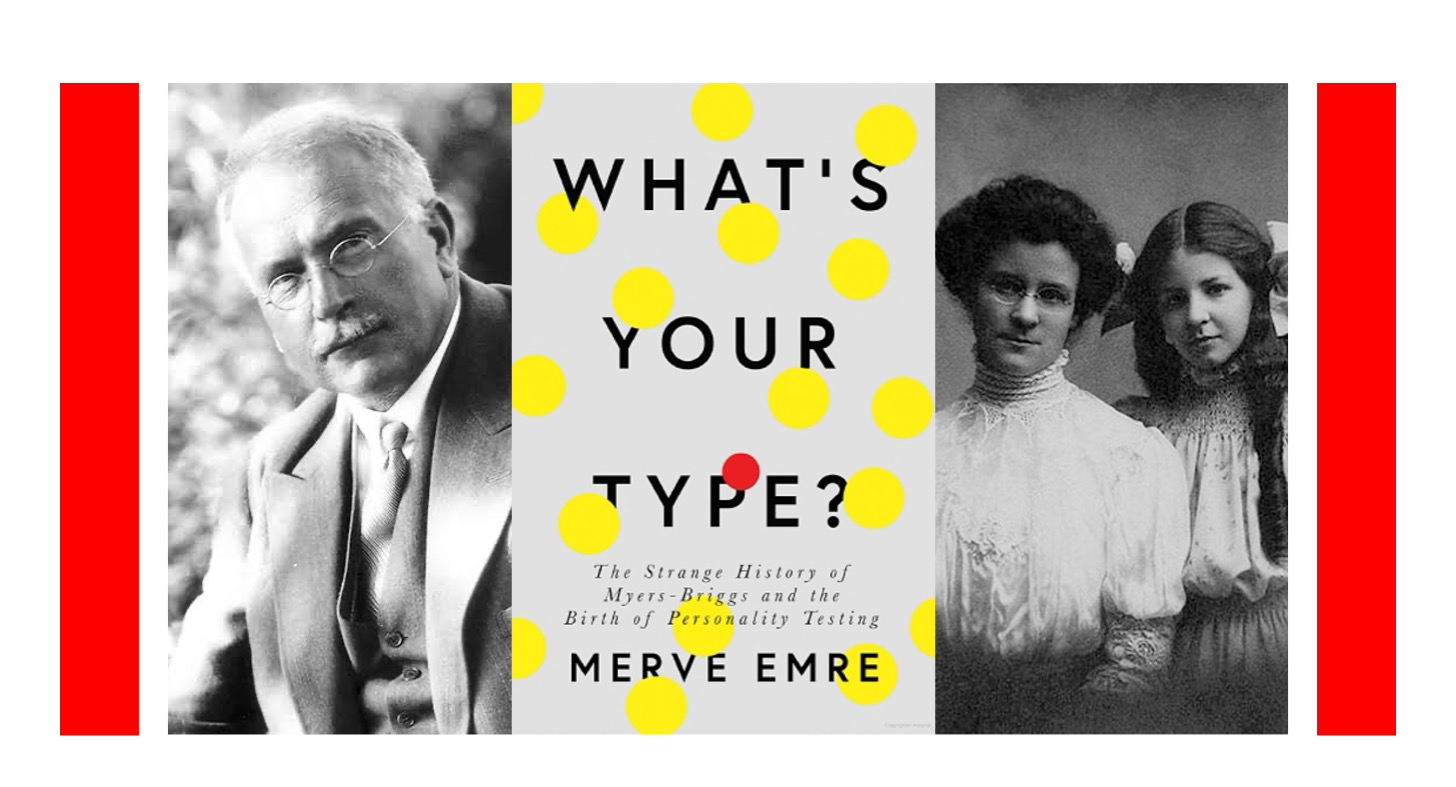
Because I extensively use the MBTI when coaching executives, and because of my general interest in the work of the Swiss Psychiatrist Carl Gustav Jung (1875-1961), I was looking forward to read ‘What’s Your Type? – The Strange History of Myers-Briggs and the Birth of Personality Testing’ by Merve Emre.

For those not familiar with the Myers-Briggs Type Indicator (MBTI), the MBTI has been developed by Katherine Briggs (1875-1968) and her daughter Isabel Myers (1897-1980) on the basis of Jung’s Personality (‘Type’) Theory. It enables the categorization of individual personalities in 4 dimensions, resulting in the (well-known) 16 different ‘types’ (e.g., ‘ISTJ’ or ‘ENFP’).

Function PreferencePreference
Energy I – Introversion (ideas) E – Extroversion (people)
Perception S – Sensing (data) N – Intuition (intuition)
Judgment T – Thinking F – Feeling
Attitude towards outside world J – Judging P – Perceiving

Until a decade ago, the MBTI was one of the most popular personality assessment instruments, and, although it is far less popular today than it used to be, it is still extensively (ab)used.

For this reason, I was very curious to read the book. Unfortunately, I found it a mixed bag.

What I do not like about this book

Continue reading

Why I still use the MBTI for executive coaching in 2024

One of the most important influencers on LinkedIn is Adam Grant. His seminal article about the MBTI (Myers-Briggs Type Indicator) in 2013 initiated the downhill trajectory of the reputation of this instrument.

I think that is a pity, because I consider the MBTI as a valuable personality inventory for personal development. In this post I explain why I think that is the case, and when and how I use it in my executive coaching practice.

Continue reading

Jungian analytical psychology in the Workplace – An Interview with Murray Stein

I am a big fan of the work of Carl Jung, and in my opinion the business world could really benefit from his insights. Therefore, I was pleased to have the opportunity to have a conversation with Murray Stein about applying Jungian Analytical Psychology in the workplace.

Murray Stein is a graduate of Yale University (B.A. and M.Div.), the University of Chicago (Ph.D.), and the C.G. Jung Institut-Zurich (Diploma). He is a founding member of the Inter-Regional Society of Jungian Analysts and of the Chicago Society of Jungian Analysts. He has been the president of the International Association for Analytical Psychology (2001-4), and President of The International School of Analytical Psychology (ISAP)in Zurich (2008-2012).

He published tens of books about Carl Jung and analytical psychology, including for instance ‘Jung’s Treatment of Christianity’ and ‘Jung’s Map of the Soul’.

The focus of our conversation was a book Murray edited with John Hollwitz called ‘The Psyche at work – Workplace Applications of Jungian Analytical Psychology’.

We discussed a number of topics, including:

Continue reading