
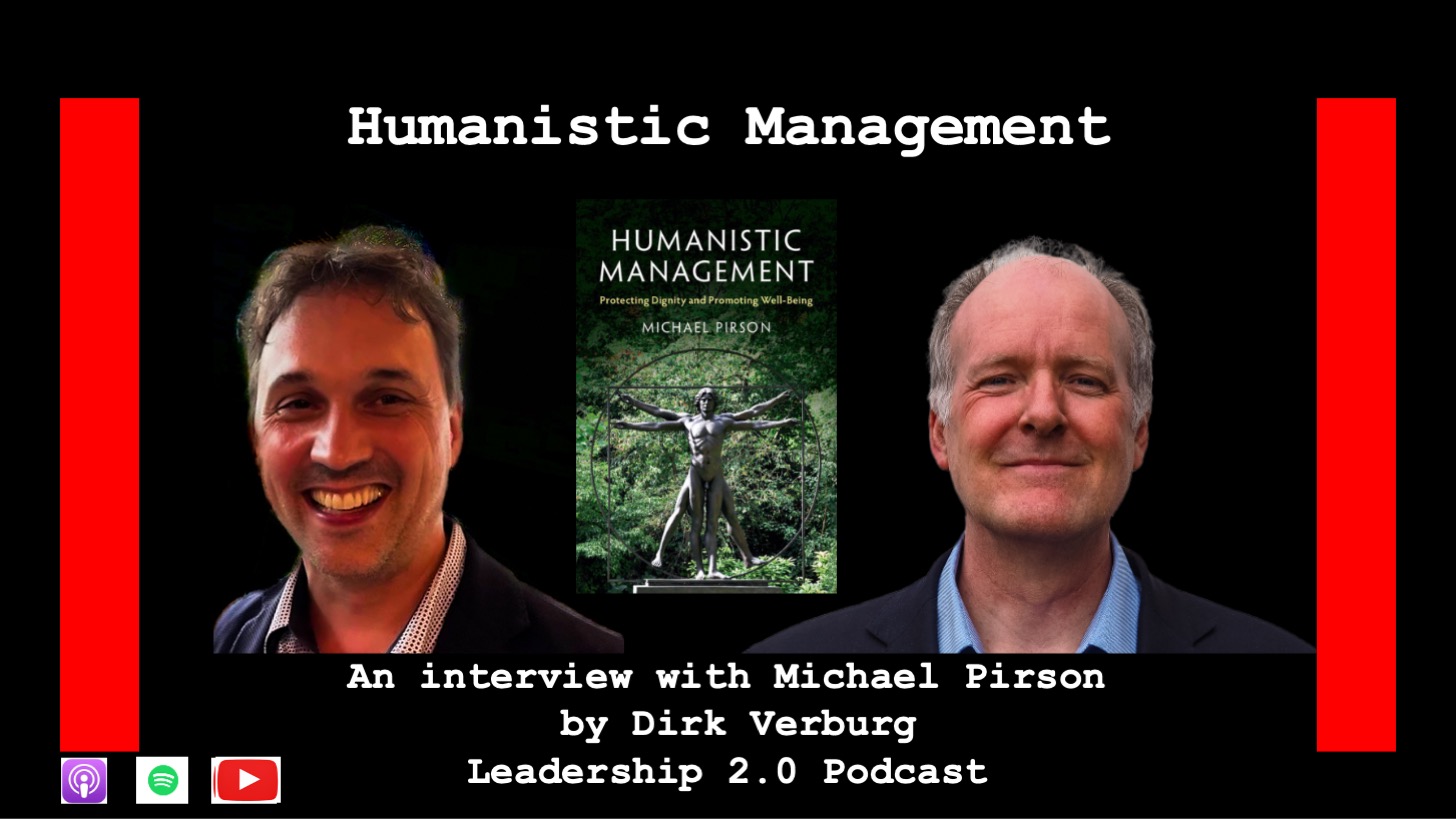
‘Everyone who wins nowadays is challenging the Shareholder Value Maximization doctrine’
This is just one of the powerful and thought-provoking statements Professor Michael Pirson (Fordham University – Gabelli School of Business) made when I interviewed him about ‘Humanistic Management’.
In the last decades, the shortcomings of the neo-liberal economic order in our society have become clearer than ever (e.g. the credit crunch, climate change, and wars). An increasing number of people want to move away from a system that commoditizes human beings, and the natural environment in which they live.
They seek, amongst others, dignity, a sense of purpose, and attention to well-being, instead of material prosperity only.
Humanistic Management is a relatively young academic movement that seeks to create a more balanced relationship between those things that can be exchanged on markets and those that are not but make life worthwhile.
Michael Pirson is an active member of this movement, and in this episode of the Leadership 2.0 podcast, I discuss with him
1️⃣ What Humanistic Management is
2️⃣ How Michael discovered Humanistic Management
3️⃣ What we as mankind can learn from the Covid 19 Pandemic
4️⃣ Measuring Wealth versus Wellbeing
5️⃣ Will Shareholder Value (Economistic Management) not always prevail?
6️⃣ Is Humanistic Management industry agnostic?
7️⃣ Resources on Humanistic Management
8️⃣ Final Thoughts
👇 You can watch or listen to this podcast episode on
➡️ YouTube
➡️ Apple Podcasts
➡️ Spotify
➡️ No time to watch or listen to podcast now? Here is a short summary of our conversation ⤵
Dirk Verburg: Michael, thank you for joining the podcast. You are a prominent thinker in humanistic management. Can you describe what humanistic management is for our listeners?
Michael Pirson: Humanistic management is a catchphrase for practices that protect dignity and promote well-being.1 It’s not just for businesses, but how we manage our lives and relationships. The main pillars are understanding and protecting inherent value, which we call dignity, and then promoting well-being, or what Aristotle called Eudaimonia.2 The opposite is economistic management, which has informed our world for the last 200 years, focusing on wealth, status, and power, but has led to a global crisis.
Dirk Verburg: How did you discover and become involved in humanistic management? What particular event triggered you to think our current economic system is hitting its limits?
Michael Pirson: There were multiple events. One early memory was as a child in Germany, seeing the border between East and West Germany, which made me question why people would be shot for crossing a line within the same country. This sparked questions about society and economic systems. Later, working for a consulting firm, I felt a deep struggle with the idea that I could be doing more than just helping clients reduce costs. I was confronted with what Rutger Bregman calls “moral ambition,” feeling there must be a higher purpose I could serve than flying around for clients. My dissertation focused on trust, which often contradicts economic logic, and I realized that many important things like love and happiness actually grow when you share them.
Dirk Verburg: Do you think the COVID-19 pandemic served as a catalyst for humanistic management, and if so, why?
Michael Pirson: The pandemic was an amplifier for many things, both good and bad. It was a wakeup call for many people, who understood their foundational social nature when they were forced into isolation. We saw how health is impacted by isolation. The pandemic also highlighted that current work-life arrangements often do not support human flourishing, which is why we’ve seen phenomena like the “Great Resignation” and “quiet quitting.” It also humanized everybody, as technology allowed us to see each other in our homes, with all our personal struggles. The virus was a great equalizer, though traditional inequalities still persisted.
Dirk Verburg: In one of your articles, you say we’re at a paradigm change, shifting from a focus on wealth to one on well-being. How can well-being be measured?
Michael Pirson: That’s a critical question, and we’re not saying we have all the answers yet, but many smart people are focused on it. I would say one of the key single indicators is a simple question: “How alive do you feel?” Most people in corporations would pause at that question and realize they don’t feel fully alive or able to bring their full humanity to work. That’s where well-being is located. It’s a state of being alive and flourishing, even in difficult circumstances. While money is an easy yardstick to count, it is not a perfect measure. You can be wealthy on paper but own nothing. Over the last 20 years, the conversation has shifted. Organizations like the OECD and the UN have developed well-being indices and sustainable development goals, recognizing that GDP is insufficient.
Dirk Verburg: Some critics say humanistic management is unsustainable because at the end of the day, shareholder value will always prevail. Do you think this is the case?
Michael Pirson: I doubt it, because shareholder value is a relatively new invention, a successful academic project supported by moneyed interests. The dominant narrative is being challenged by people all over the globe, who are retreating and going back to tribalistic perspectives. Even the most powerful companies, like the Business Roundtable in the US, felt compelled to shift their focus toward stakeholder capitalism. The evidence so far is that what is good for humans is also more sustainable. If shareholder value maximization hurts people, it’s not sustainable. Humanistic management works very well in many places, but it is difficult to do in the context of our current short-term-oriented financial system. The number of public corporations is actually decreasing, with many delisting to pursue long-term thinking.
Dirk Verburg: You’ve worked in the financial services industry. Humanistic management seems quite far from the DNA of that industry. Do you think certain industries are more receptive to it than others, or is it industry agnostic?
Michael Pirson: I think it’s industry agnostic, but as you describe, the DNA of the finance industry is economistic. Unfortunately, finance has an outsized influence on the world. You do see some shifts, with powerful investors like Larry Fink and Ray Dalio interested in long-term viability, as short-term thinking is very risky. However, it’s difficult to shift the entire industry because it’s swimming in that water without being conscious of it. A real solution to the issues we have requires finance to serve the real economy, not the other way around.
Dirk Verburg: If our listeners want to learn more about humanistic management, what resources would you recommend, in addition to your books?
Michael Pirson: I’d recommend checking out the Humanistic Management International website. We have a YouTube channel with talks, clips, and documentaries that offer a different perspective on what’s possible. There are also many classic business books with humanistic principles, such as “Good to Great,” which shows that to have an excellent organization, you need to focus on the human beings within it. Peter Drucker, Henry Mintzberg, and Tom Peters are also great thinkers who have written about humanistic principles, even if they don’t always use the exact term.
Dirk Verburg: We’ve covered a number of aspects of humanistic management. Are there any important points you’d like to mention that we haven’t discussed yet?
Michael Pirson: I think it’s important to understand that humanistic management is both a reality and a potentiality. It’s a journey, not a perfect state. There is no perfection, and it’s never easy. The simplicity of economistic management, focusing on cost-cutting and transactions, may seem easier, but in my experience, it’s actually much harder because it’s difficult to reconcile who you want to be as a person with the behavior you’re exhibiting. The journey requires grace. We should invite people who have an authentic intention to be on this journey, even if they start from a difficult place, and not criticize every imperfection.
Dirk Verburg: Michael, thank you very much. I learned a lot from you and about humanistic management.
Michael Pirson: Thank you so much for the opportunity. It was a pleasure to be here.
► About Michael Pirson
Michael Pirson, Ph.D., is the chair of the Leading People and Organizations Area within the Gabelli School of Business. He is the James A. F. Stoner Endowed Chair in Global Sustainability and is a full professor with a focus on global sustainability and social entrepreneurship. Michael is a research associate at Harvard University’s Human Flourishing Program (HFP). He co-founded the Humanistic Management Network and is founder and president of the International Humanistic Management Association. He is the editor in chief of the Humanistic Management Journal.
Additionally he is a full member of the Club of Rome, leads the Humanistic Management working group at the UNPRME, and advises a number of social enterprises. He has won numerous awards for his work including from the Academy of Management and the Association of Jesuit Universities.
► Website
► Publications
► Other resources
Discover more from Dirk Verburg
Subscribe to get the latest posts sent to your email.
 Dirk Verburg