‘A transformational read that every leader of today needs’.
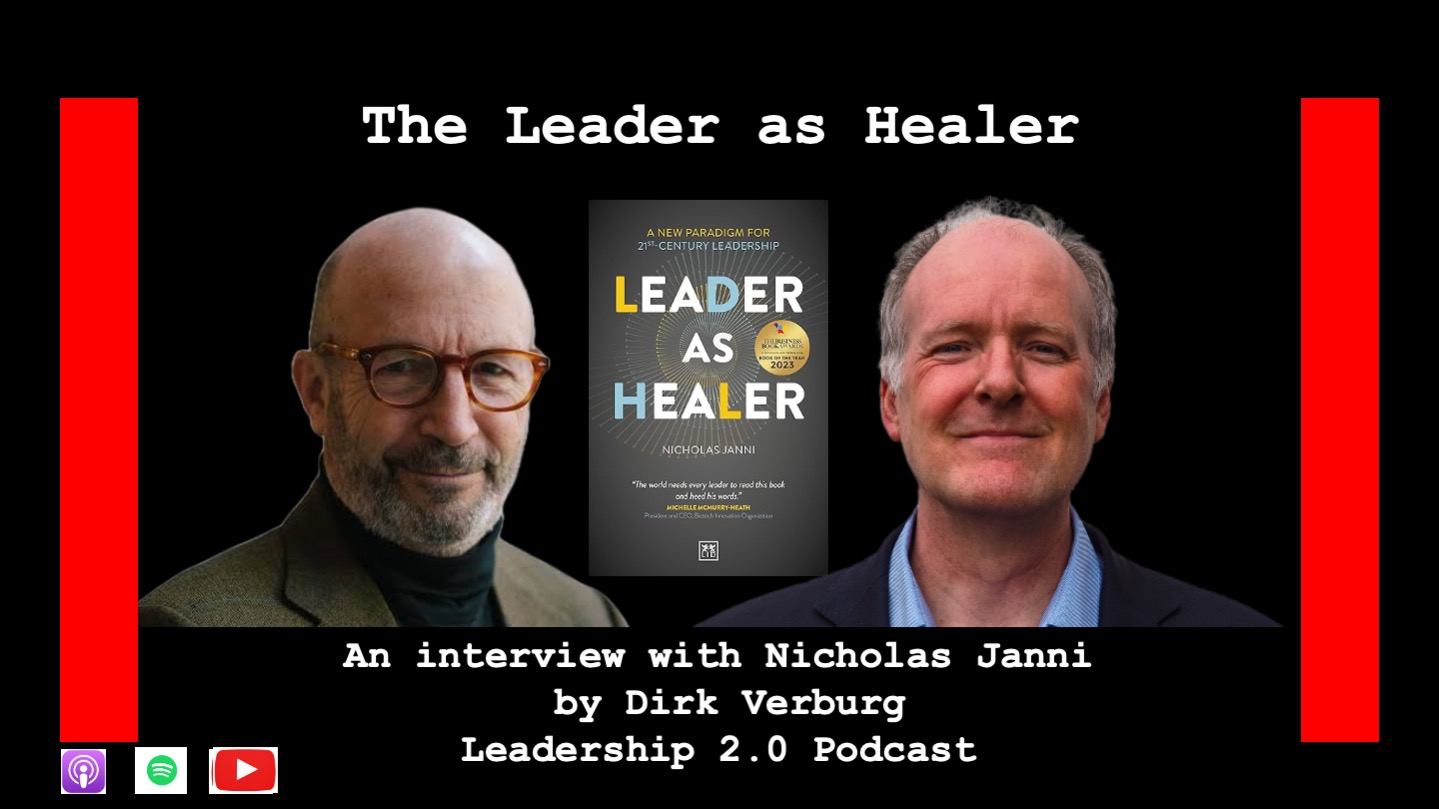
These were the words Head Judge, Jacq Burns used when she announced that ‘Leader As Healer’, written by Nicholas Janni was selected as the overall winner for the 2023 Business Book Awards.
In his book, Nicolas Janni argues that we need a new leadership model to address the challenges our society faces.
Our current leadership model is one where we see great leaders as warriors ‘on the battlefield of relentless competition’, who drive action, pursue instrumental (shareholder value related) goals, and maintain transactional relationships.
Instead, Nicholas Janni pleads for leaders who are empathetic, intuitive, present, skilled in mindfulness and deep listening, and who can inspire colleagues to engage and collaborate.
In this episode of the Leadership 2.0 podcast, I discuss with Nicholas:
1️⃣ What does ‘The Leader as Healer’ mean?
2️⃣ What is the positive difference leaders as healers can make?
3️⃣ Why did ‘The Leader as Healer’ become business book of the year 2023?
4️⃣ Why our society and many organizations are ‘broken’
5️⃣ Why leaders as healers occasionally need to use a scalpel
6️⃣ Why emotions are important and need to be taken seriously
7️⃣ How can leaders become healers?
8️⃣ Practical exercises for leaders
9️⃣ Final thoughts
👇 You can watch or listen to this podcast episode on
➡️ YouTube https://youtu.be/LzMEyGYSX_k
➡️ Apple Podcasts https://podcasts.apple.com/ch/podcast/18-nicholas-janni-the-leader-as-healer-business-book/id1511327057?i=1000671667850
➡️ Spotify https://open.spotify.com/episode/7FDUMdIVGNH0kC2j9VeIpd?si=6a0e49f5dfd54d6c
➡️ No time to watch or listen to podcast now? Here is a short summary of our conversation ⤵
Dirk Verburg: In your book, “Leader as Healer,” you present a different type of leader than the rational, results-driven “executor.”1 What is a leader as a healer, and how are they different?
Nicholas Janni: The critical difference is one of bandwidth. The “leader as executor” operates with a narrow perceptual and experiential bandwidth, dominated by linear thinking.2 This leads to a high degree of disconnection from the body, emotions, intuition, and even the soul. The “leader as healer,” on the other hand, activates whole-self intelligence.3 As the world becomes more complex and unstable, this broader bandwidth is our highest possibility and is absolutely necessary. The old linear intelligence is simply not enough to navigate the challenges we face.
Dirk Verburg: What are some of the ways leaders as healers make a positive difference for their organizations and the people working for them?
Nicholas Janni: A leader as a healer brings much higher levels of energy, engagement, and creativity to a team. As we know, there’s a global crisis of disengagement, and cultures are not functioning well. This approach leads to much stronger implementation and action. A team under a leader as a healer is more energized and connected, with people experiencing more meaning and satisfaction in their work. I would argue there is no business case for not embracing this, as high-quality critical thinking and performance require all our energy to be flowing, which the narrow executor model inhibits.
Dirk Verburg: Your book was selected as the Business Book of the Year 2023. What does this tell us about the times we are living in?
Nicholas Janni: I was astonished by the award, but I believe it is a sign of the times. The head judge said she chose my book because she believed it was the one everyone needed to read now. I took it as a huge affirmation that the ways we have normalized doing business are broken, and that something new is urgently needed. It highlights a widespread acknowledgment that traditional approaches are failing to address the deep-seated issues of stress, poor relational skills, and dehumanized environments that are prevalent in today’s workplaces.
Dirk Verburg: You also mention that a leader as a healer must sometimes use a scalpel. What is the relationship between the scalpel and the healer, and when would it be used?
Nicholas Janni: The relationship is very simple. A leader as a healer is not here to take care of everyone at all costs. If a team member is consistently underperforming or creating conflict, and you have given them every opportunity to address the issues, but no change is happening, they have to go. That is the scalpel. It is a decisive act to remove a “moral and spiritual tumor” from the organization. The healer’s goal, like a good surgeon, is to preserve all healthy tissue to the greatest extent possible, and sometimes that requires a difficult but necessary separation.
Dirk Verburg: In your book, you plead for letting emotions back into our decision-making process. Where does this reappreciation of emotion stem from?
Nicholas Janni: I believe the idea that emotions are useless is a profound misunderstanding of human beings and is guaranteed to create a dehumanized, soulless workplace. There’s no such thing as a purely rational decision; we are all carrying degrees of emotion at all times. The re-appreciation of emotion stems from understanding that emotions are life energy. The reason we think they are negative is because we’re afraid of them, often due to unresolved childhood experiences. But when we allow ourselves to feel our emotions, like fear, our energy opens up, and we become more alive. We need to normalize emotional expression in the workplace to unlock our full potential and creativity.
Dirk Verburg: For leaders who want to embark on the journey of becoming more a leader as a healer, what are some of the obstacles they might face?
Nicholas Janni: The first obstacle is waking up to the “prison” they’ve normalized living in. There’s no blame, but they need to realize their current state of disconnection is not serving them. Then, they will need to find a mentor. They must commit to a journey that will be both exciting and very uncomfortable, as it will require them to face parts of themselves they have long suppressed. This is a life-changing journey that will affect both their personal and professional life. The most significant obstacle is the initial fear and resistance to truly opening up and doing the deep inner work required.
Dirk Verburg: In your book, you describe a whole series of practical exercises leaders can do. Can you give a couple of examples to illustrate this?
Nicholas Janni: One of the most effective practices is what I call the difference between being on a “forward circle” and a “backward circle.” In a forward circle, our energy is ungrounded and forward-focused. In a backward circle, we drop back and become grounded, feeling our presence. Before a meeting or a call, a leader checks in: “Am I really here?” The backward circle allows for genuine presence and a game-changing quality of listening. Another masterful practice is having both inner and outer attention at the same time, being fully available to the outside while also being aware of your inner state. Finally, deep body work is essential, as we are often so disconnected from our bodies.
Dirk Verburg: We’ve discussed a wide range of topics. Is there anything important we haven’t covered that you would like to mention?
Nicholas Janni: Yes, a very important aspect is why meditation is so critical. In many mystical traditions, there is the image of a book with black letters on a white page. Our “doing” mode focuses only on the black letters, missing the vastness of the “white page” which holds new ideas and connections. Meditation opens up this white page. My final message is this: given the state of the world, it’s never been more urgent to wake up out of the coma of absence and disconnection. We need to move into the fullness of who we are to bring about the actions, innovations, and changes that are needed now. We are at a critical point, and more and more people must wake up.
About Nicholas Janni
Nicholas Janni has devoted his life to the study of human potential. Over the last 20 years he has gained an international reputation for his transformational coaching and leadership development seminars.
He works with organisations, NGO’s and senior leaders worldwide and currently teaches at the IMD Business School in Switzerland and the Saïd Business School, University of Oxford.
He bridges the worlds of creative, personal, spiritual and professional development in a uniquely powerful, relevant and accessible way.
He started his career as a theatre director. He taught acting at Royal Academy of Dramatic Art and directed his own theatre company. He has spent over 30 years researching the theory and the practice of ‘the zone’ of peak performance in art, life and work. He trained intensively for five years with Thomas Hübl, PhD, to work with personal, intergenerational and collective trauma.
➡️ Book https://www.nicholasjanni.com/book-leader-as-healer/
➡️ Matrix Development https://www.thematrixdevelopment.com/
➡️ Website https://www.nicholasjanni.com/
Discover more from Dirk Verburg
Subscribe to get the latest posts sent to your email.

