Only a decade ago, executive coaching was associated with either very senior business leaders coached by well-known authors and thought leaders, or with leaders who were struggling in their roles and were given a coach as a last resort.
Today, executive coaching has become mainstream — and it has changed significantly.
First, despite the name, it is no longer the prerogative of C-level executives or their direct reports. Many companies now offer coaching to leaders at all levels of the organisation.
Second, it is no longer seen as a remedy for underperformance. Instead, executive coaches are increasingly viewed the way we view coaches in sport: helping already high-performing individuals to become even better. As an executive coach myself for instance, I support business leaders at all levels with a wide range of challenges: transitioning into new roles, defining strategies for their teams and organisations, enhancing the collaboration with their own leaders and teams, and navigating change.
As a result, executive coaching has evolved from a niche activity into a serious industry. And, like any growing industry, this raises questions about developing and maintaining professional standards, pricing, quality and technology.
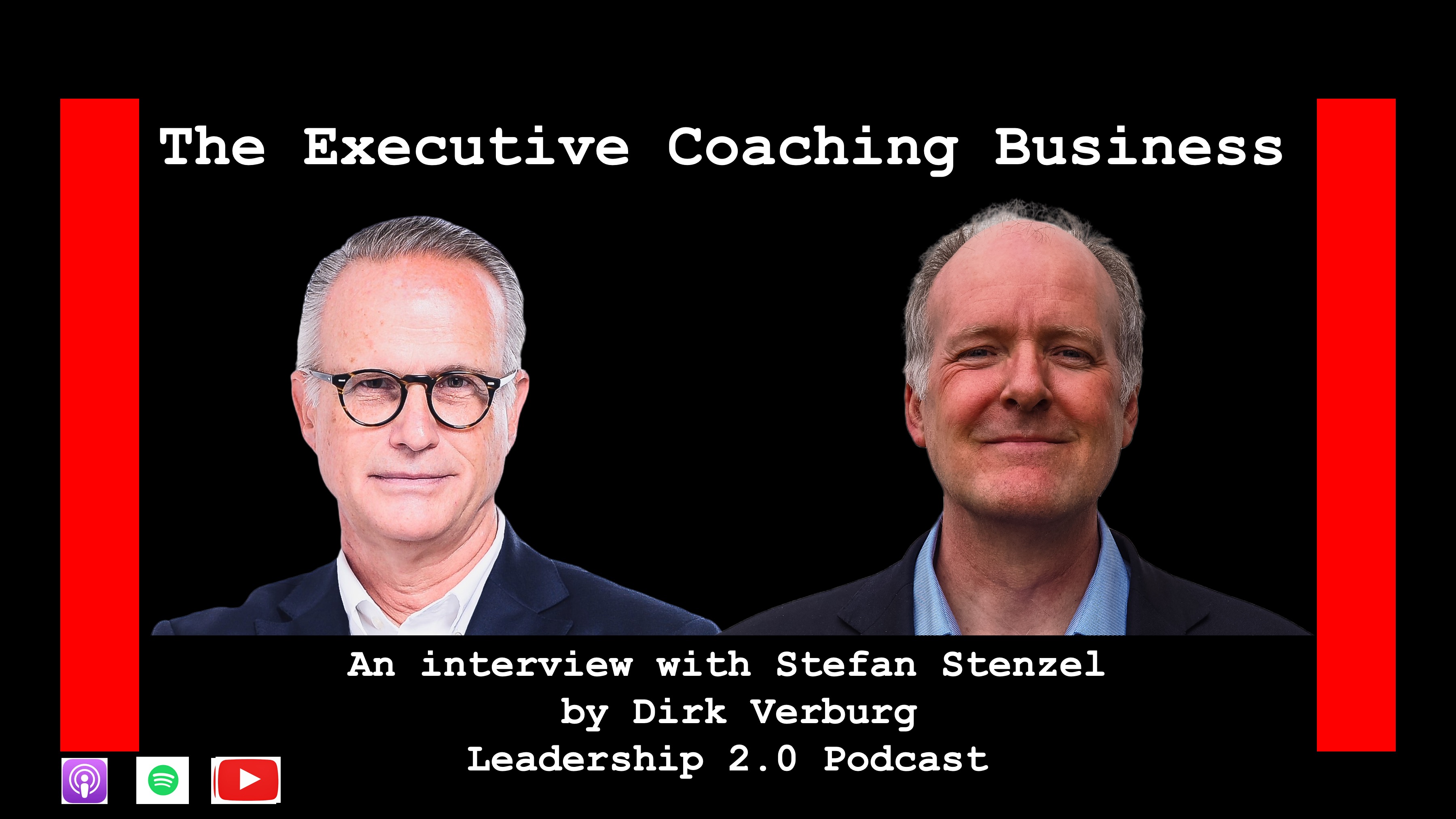
Stefan Stenzel has been active in the coaching business since the early 2000s and published ‘Die Zukunft des Coaching-Business’ (‘The Future of the Coaching Business’) in 2022.
I recently sat down with him for two conversations to explore the state of the executive coaching business today.
In our first conversation, we focused on ‘The Executive Coaching Business’ and covered the following topics:
- The value of executive coaching
- Measuring the ROI of executive coaching
- The characteristics of a good executive coach
- Assessing the quality of an executive coach
- Does the downward pressure on fees impact the quality of executive coaches?
- The red and blue oceans for executive coaches
- The place for independent coaches in the world of Digital Coaching Platforms (DCPs)
- Face-to-face versus digital coaching
- External coaches versus internal coaches
► You can watch or listen to a podcast with our conversation on:
➡️ Spotify
➡️ YouTube
➡️ No time to watch or listen to podcast now? Here is a short summary of the key points of our conversation ⤵
Dirk Verburg: What is the value of executive coaching for large international organizations, and for what purposes are coaches typically engaged at companies like SAP?
Stefan Stenzel: The primary answer is innovation. Engaging external coaches provides a new perspective, time for reflection, and a “helicopter view” to address dysfunctional behavior. Coaching is highly effective when embedded into larger programs, helping leaders digest and individualize what they have learned so the knowledge sticks. It facilitates “vertical development”—thinking about how and why you think—which goes beyond normal skills training.
As leaders reach the executive level, they must shift from technical expertise to “winning the hearts, heads, and hands” of their people. At this stage, you cannot simply instruct mature people; you must influence them informally. Coaching also addresses “executive presence”—the ability to project confidence on big stages—and provides a safe space to navigate the stress and power plays inherent in high-level corporate environments.
Dirk Verburg: How can organizations measure the return on investment for coaching?
Stefan Stenzel: This is the “million-dollar question.” First, it is important to have solid descriptive measures—knowing how many coaching engagements are happening, where, and with whom. This foundation is essential, yet many companies lack it.
The “master class” involves measuring impact via correlations. However, executive coaching is often driven by the leader’s own conviction, and executives are rarely willing to fill out long questionnaires. Currently, we measure this via employee surveys focused on leadership KPIs, comparing data before and after the coaching period.
Ultimately, you must ask what will be done with the numbers. Measuring must make sense for the company. I compare coaching to car maintenance: you can skip it to save money immediately, but the eventual “repairs” or leadership failures are far more expensive. We must also challenge “status coaching,” where high fees are paid for big names without clear evidence of superior impact.
Dirk Verburg: In your professional opinion, what are the characteristics of a good executive coach, and is business acumen or content knowledge important?
Stefan Stenzel: It often starts with the “brand”—the ability to create an “eye-level” discussion where the coach is accepted by the executive. Having a similar career background can create immediate credibility and rapport.
However, a coach needs to “unlearn” the habit of giving immediate advice. I look for solid education and accreditation, such as from the ICF or DBVC. Many people have business experience but lack the formal training required to be a professional coach.
A good coach needs the self-confidence to challenge executives and deep business knowledge to offer new perspectives. If a coach does not offer innovation, they are not earning their fee. While credentials provide a foundation, the “chemistry” and rapport between the coach and the client are the final selection criteria.
Dirk Verburg: The title “Executive Coach” is not protected, and the number of coaches is mushrooming. How can organizations or individuals accurately assess coach quality?
Stefan Stenzel: Accreditations are vital because they prove the individual has undergone the hard work of formal education. These provide foundational criteria for selection.
However, even with credentials, an informed decision is necessary. In a large company, my job is to pre-select coaches to ensure quality standards are met before the coaching begins. It is like car manufacturing: you must embed quality at the beginning of the process.
Dirk Verburg: Digital coaching platforms are creating downward pressure on rates. Is coaching at risk of becoming a “hollowed-out” profession, and is it still sustainable?
Stefan Stenzel: Platforms are a natural consequence of digitalization. For the customer, they provide transparency and ease of comparison that was missing 20 years ago.
For coaches, it is harder to stand out. If you are just one of thousands on a platform, it is a “red ocean” of competition. To escape this, coaches must differentiate themselves through their brand and expertise—moving from “bestseller coaching” to “craft coaching.”
Top-tier coaches rarely need platforms because their brands are established. For others, they must treat their practice as a business. If you are a business coach, you should be able to run your own practice successfully. While platforms handle distribution and data, the core relationship between the coach and the client remains unchanged.
Dirk Verburg: Is there still a place for face-to-face coaching, or has technology made physical presence unnecessary?
Stefan Stenzel: Yes, but the customer will decide. The “art of coaching” involves blending virtual and in-person offers professionally. Face-to-face is compelling when topics become highly complex, emotional, or involve “embodiment coaching.”
There is also value in “outdoor coaching,” where fresh air and a change of environment can open a person up to new perspectives. However, because executives face heavy time pressure, coaches must be able to prove the additional value of meeting in person. Professionalism means knowing when to deviate from a digital script based on the client’s needs.
Dirk Verburg: I am skeptical about internal coaching pools regarding distance and confidentiality. Where do they work, and what are their constraints?
Stefan Stenzel: I have been an internal coach for 25 years and have rarely encountered trust issues. The real challenge is that you are part of the system. This is both an advantage and a disadvantage.
The benefit is understanding internal processes and linking coaching directly to them. The disadvantage is that you are affected by the same reorganizations as your clients. Maintaining “working distance” requires high professionalism to avoid simply being compassionate without adding a new perspective.
We have 650 internal coaches, and the company is convinced of their value. To be successful, they must be professionally educated to ensure they have a real impact while navigating the internal system.
► About Stefan Stenzel
Stefan Stenzel (Dipl.-Psych.) studied Organizational Psychology at Heidelberg and Mannheim with a minor in business administration. He has almost 30 years of experience in PD and OD. Since 2001 he is working at SAP SE in the role of a HR Senior Expert for Learning in the team of Global Leadership Development with varying areas of responsibilities. Based on his initial coaching training in 1998, he is working as an internal coach at SAP since 2002. With short interruptions he is globally responsible for the external coach pool across all management levels and is currently implementing a coachbot to complement the service portfolio. He is Co-founder of DBVC e.V. in 2004. In 2023 he co-founded in this context with, Dr. Uwe Böning. the so-called Think Tank “Future of Coaching” . He is author of various publications on the topic of (the future of) coaching.
Stefan Stenzel Linkedin
Book: Die Zukunft des Coaching-Business
► Disclaimer
The statements and expressed opinions of Stefan Stenzel are his own and do not represent the views, positions, or policies of SAP SE.
Any comments he made are purely personal and should not be interpreted as being endorsed with SAP SE.
For any official information or statements, please refer directly to SAP SE.
Discover more from Dirk Verburg
Subscribe to get the latest posts sent to your email.

