Leadership lessons from a CEO – An interview with Jeroen van der Veer (Shell)

Twenty years ago, in 2004, Shell was hit by the reserves scandal. In the midst of this crisis, the board asked Jeroen van der Veer to become CEO and navigate the company out of this crisis. Recently Jeroen wrote a book titled ‘Van A near B – Lessen in leiderschap’ (‘From A to B – Lessons in Leadership’), in which he reflects on these, and other experiences during his long career (which also included for instance being the chairman of the supervisory board of ING during the financial crisis).

In this episode of the Leadership 2.0 podcast, I discuss with Jeroen:

Continue reading
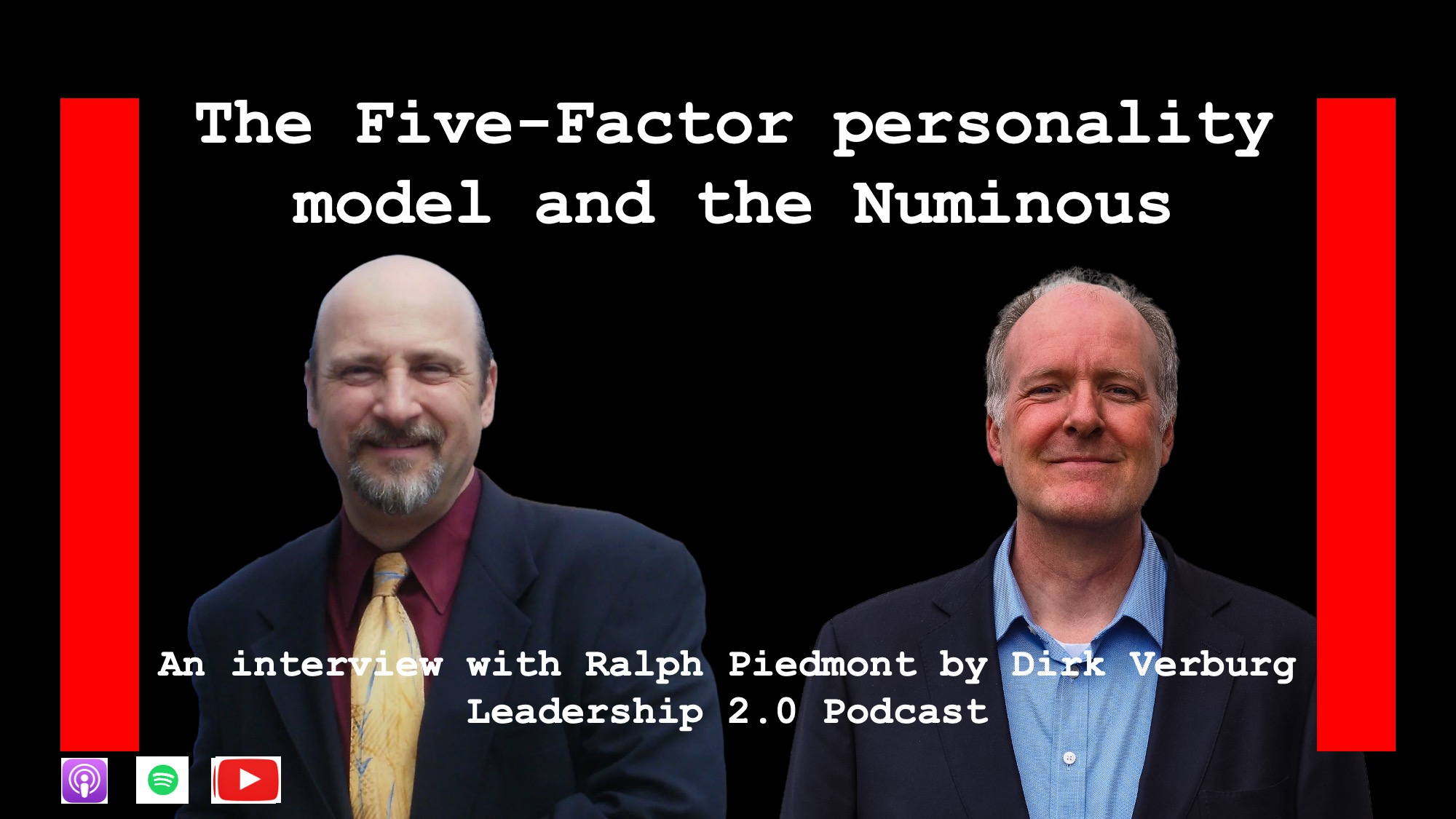
The Five-Factor Personality Model and the Numinous – An interview with Ralph Piedmont

Current thinking in Psychology is that there are five dimensions we can use to describe the most important personality dimensions. Dr. Ralph Piedmont discovered the 6th one: ‘the Numinous’.

The five-factor model of personality (FFM) is a set of five broad trait dimensions or domains, often referred to as the “Big Five”: Extraversion, Agreeableness, Conscientiousness, Neuroticism (sometimes named by its polar opposite, Emotional Stability), and Openness to Experience (sometimes named Intellect). The Big Five/FFM was developed to represent as much of the variability in individuals’ personalities as possible, using only a small set of trait dimensions. Many personality psychologists agree that its five domains capture the most important, basic individual differences in personality traits and that many alternative trait models can be conceptualized in terms of the Big Five/FFM structure (www.oxfordbibliographies.com).

Dr. Ralph Piedmont discovered the 6th factor: the Numinous.

During our conversation, Ralph and I discussed the following topics:

Continue reading

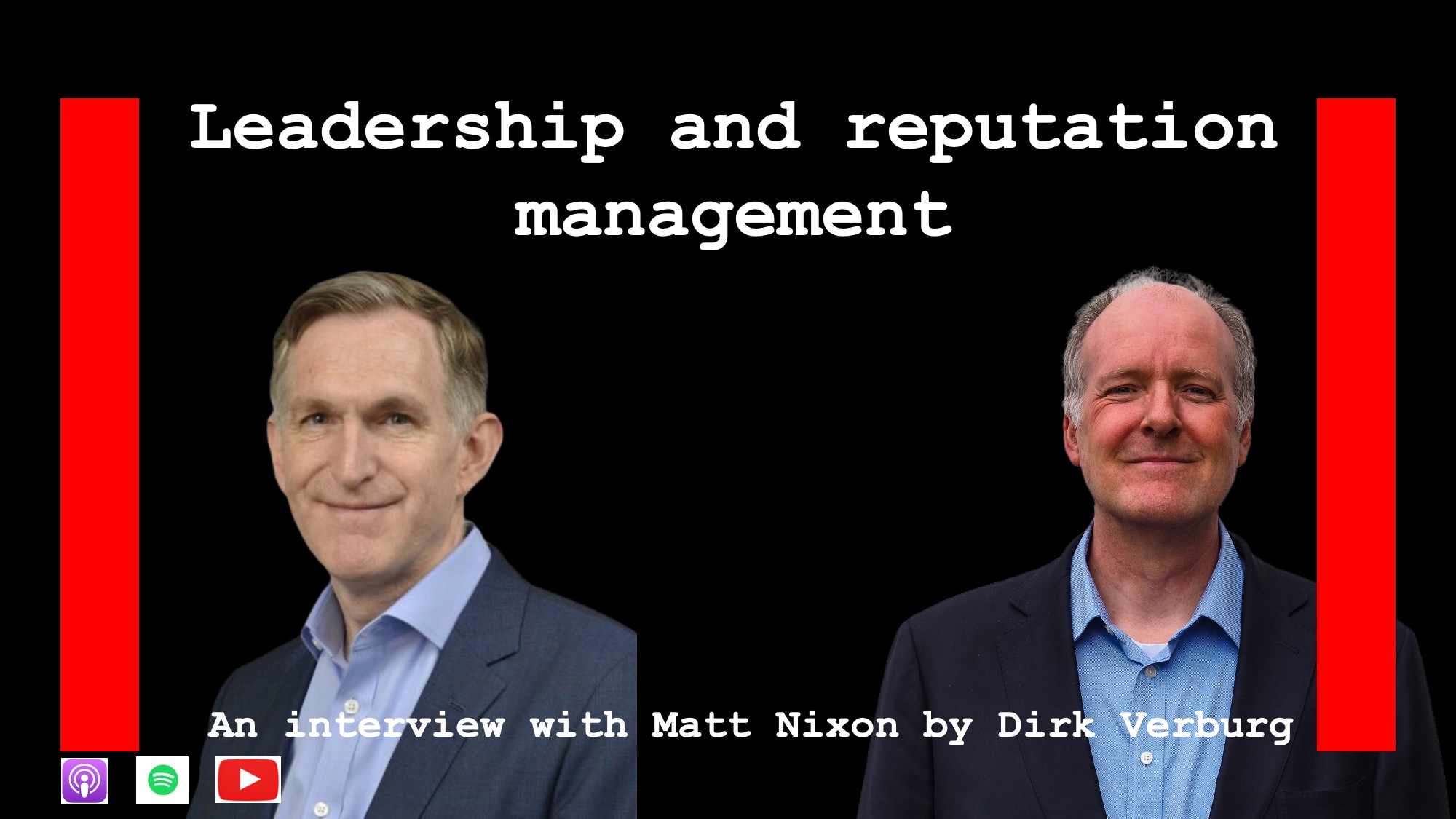
‘Leadership and reputation management’ An interview with Matt Nixon

‘The real problem of humanity is the following: we have Paleolithic emotions, medieval institutions, and god-like technology’.

With this quote from Edward O. Wilson 1929 Matt Nixon answered my question if our requirements about leadership have changed in the last decades. 

Matt Nixon has more than 30 years of experience as a management consultant and HR executive, working with CEOs and senior leaders around the world. An Oxford classics graduate, he was a partner in Towers Perrin in Chicago and London, and subsequently held the positions of Global Head of Organization Effectiveness for Royal Dutch Shell, and Managing Director, Group Head of Talent for Barclays, before returning to the consulting industry.

Nowadays Matt works as a partner in a specialized consulting boutique where he coaches and advises CEOs and other senior leaders during career transitions and other periods of change and transition.

Matt has written and taught extensively on hubris in executives.

During our conversation, Matt and I discussed the following topics:

Continue reading

How to engrain ethics in your corporate culture? One decision at the time!

Ethics deal with what makes something morally right or wrong.

Almost any sizeable company nowadays has a code of ethics. The main catalysts for these were the corporate scandals in the early 2000s (Enron, Worldcom, Tyco, and others). Also, in the last couple of years having a sense of purpose has become pretty much en vogue.

As a result, every year millions of employees now dutifully complete e-learning modules and sign declarations (‘To the best of my knowledge…’).

If you think about this on a philosophical level, it is actually quite sad. Apparently, companies need to invest millions of dollars each year because a shared understanding of what is morally right or wrong to do on behalf of the company, is not a given.

Obviously, from a pragmatic point of view, companies have no choice but to invest in this type of training. First of all, it helps individuals to avoid taking decisions that can create reputational and compliance-related problems for the company. The second reason is the need to demonstrate institutional compliance to governments, regulatory bodies and other stakeholders.

Limitations of codes of ethics

Continue reading

Why leadership has become more difficult and why this matters

I spent a significant part of my working life developing leaders in organizations. What strikes me is that during COVID-19 the demand for this type of work has not decreased; if anything, the demand for leadership development has increased. That is remarkable. During the financial crisis in 2007-2008, for instance, most companies tried to save money, and one of the first things they considered was decreasing the out-of-pocket costs associated with these, and other kind of developmental activities.

Recently I was asked why companies continue to invest in the quality of their leadership at all levels of the organizations, despite the economic uncertainty they are facing.

In my opinion, the reason is that companies have come to realize the growing importance of the quality of leadership at all levels of the organization. I believe that this is a good thing, especially because leadership roles have become more demanding in the last couple of decades, not only for senior leaders, but also for first, and second-level leaders in organizations. 

Continue reading

Corporate Social Responsibility starts with looking after your own employees

A couple of days ago my bible app opened with this verse of the day: ‘To do righteousness and justice is more acceptable to the LORD than sacrifice’ (Proverbs 21:3). 

This text reminded me of the way some companies deal with Corporate Social Responsibility (CSR). Rather than doing the right thing, they do the wrong thing and compensate for this by deploying CSR initiatives. There is even a special term describing this phenomenon: ‘Greenwashing’. In this context, it is no wonder that two professors from IMD (a leading Swiss Business School) published an article in 2018 with the provocative title: ‘Why nobody takes corporate social responsibility seriously’.

Continue reading

Building an authentic personal brand starts with ‘why?

Two weeks ago, I was asked to participate in an event about personal branding. The organizer asked me to focus specifically on the link between creating a personal brand and remaining authentic.

Because I have been irritated by the majority of the publications on this topic in the last 5+ years, I was excited to speak about it. Why? Because these articles often suggest people need a partial, or even full, make-over, in order to fit the mold of the specific environment they seek employment in. If that does not feel natural to them, the second piece of advice most publications give them is: ‘Fake it until you make it’.

Continue reading

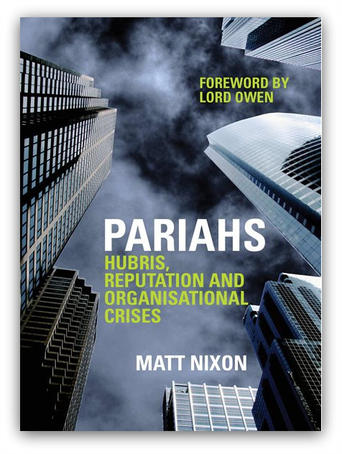
Book Review: Pariahs, Hubris, Reputation and Organizational crises

Tw Cover PariahsA ‘must read’ for the C-suite.

By Dirk Verburg

Ever since the industrial revolution, large corporations have played an important role in our society. Due to the globalization in the past decades, their influence is continuously increasing.

At the same time it seems that the number of scandals caused by these large organizations is growing as well. Established names, such as Barclays, Siemens, Wells Fargo, Ahold, VW, BP, Shell, Worldcomm, Tyco, Enron, Olympus, Arthur Anderson, E&Y, the BBC and many others, have all experienced scandals, and some no longer exist as a result.

What complicates this situation even is that governments and other institutions (e.g. regulators and ‘independent’ accounting firms) do not seem to be able to control, or at least monitor, the way companies in the private sector are operating. Continue reading