We are always informed by our intuition when it comes to making decisions. More often than not our intuition is ‘right’, but there are also situations when we should definitely not rely on our intuition.
Being able to determine when to use our intuition and when not, often means the difference between our success and failure.
In my second interview with Professor Eugene Sadler-Smith for the Leadership 2.0 Podcast, we discussed the role of intuition in decision-making processes.
During our conversation, we touched on the following topics:
‘We live in a world of organizations – and we do not understand them’
This is one of the statements Henry Mintzberg, one of the leading thinkers in the field of Management, made when I interviewed him for my Leadership 2.0 Podcast about his latest book ‘Understanding Organizations…Finally’.
During our conversation, we discussed the following topics:
0️⃣1️⃣ The importance for organizations to get their structure ‘right’ 0️⃣2️⃣ The evolvement of Henry’s thinking about organizations 0️⃣3️⃣ ‘Every (organization) form contains the seeds of its own destruction’ 0️⃣4️⃣ ‘Emergent structures’ versus large-scale reorganizations 0️⃣5️⃣ The fit between the leader and the structure of the organization 0️⃣6️⃣ The structures of Apple and Tesla and the personalities of their founders 0️⃣7️⃣ The complementary role of conflict and culture in organizations 0️⃣8️⃣ The relationship between the structure and the culture of an organization 0️⃣9️⃣ The gap between formulators and implementers of corporate strategies 1️⃣0️⃣ The interest in structuring organizations in academia and business
You can watch or listen to this podcast episode on:
We are always informed by our intuition when it comes to making decisions. More often than not our intuition is ‘right’, but there are also situations when we should definitely not rely on our intuition.
Being able to determine when to use our intuition and when not, often means the difference between our success and failure.
In my second interview with Professor Eugene Sadler-Smith for the Leadership 2.0 Podcast, we discussed the role of intuition in decision-making processes.
During our conversation, we touched on the following topics:
0️⃣1️⃣ What intuition is and what it is not 0️⃣2️⃣ The two types of intuition 0️⃣3️⃣ Adopting an Ambidextrous Mindset 0️⃣4️⃣ How to take important decisions in business 0️⃣5️⃣ Carl Jung and Intuition 0️⃣6️⃣ Why the intuitive mind is a slow learner 0️⃣7️⃣ Values and ethics in decision-making processes 0️⃣8️⃣ Final Thoughts – AI and intuition
You can watch or listen to this podcast episode on:
Scenario thinking enables organizations to establish possible visions of the future in the form of scenarios.
These scenarios enable decision-makers to think through the different ways in which the environment of their organizations could evolve, based on different sets of assumptions. It enables leaders to ‘think through ‘a wide range of what if questions’: ‘What if the dollar…’, ‘What if China…’, ‘What if scientific developments make it possible in the near future to…’, etc. This enables them to mentally prepare themselves for possible ‘Black Swans’, and review the ability of their organization to cope with, or, iedeally, benefit from these.
One of the companies that is best known for its scenario-thinking activity is Shell. For decades, Shell’s scenarios have supported the decision-making of Shell leaders, academics, governments, and businesses.
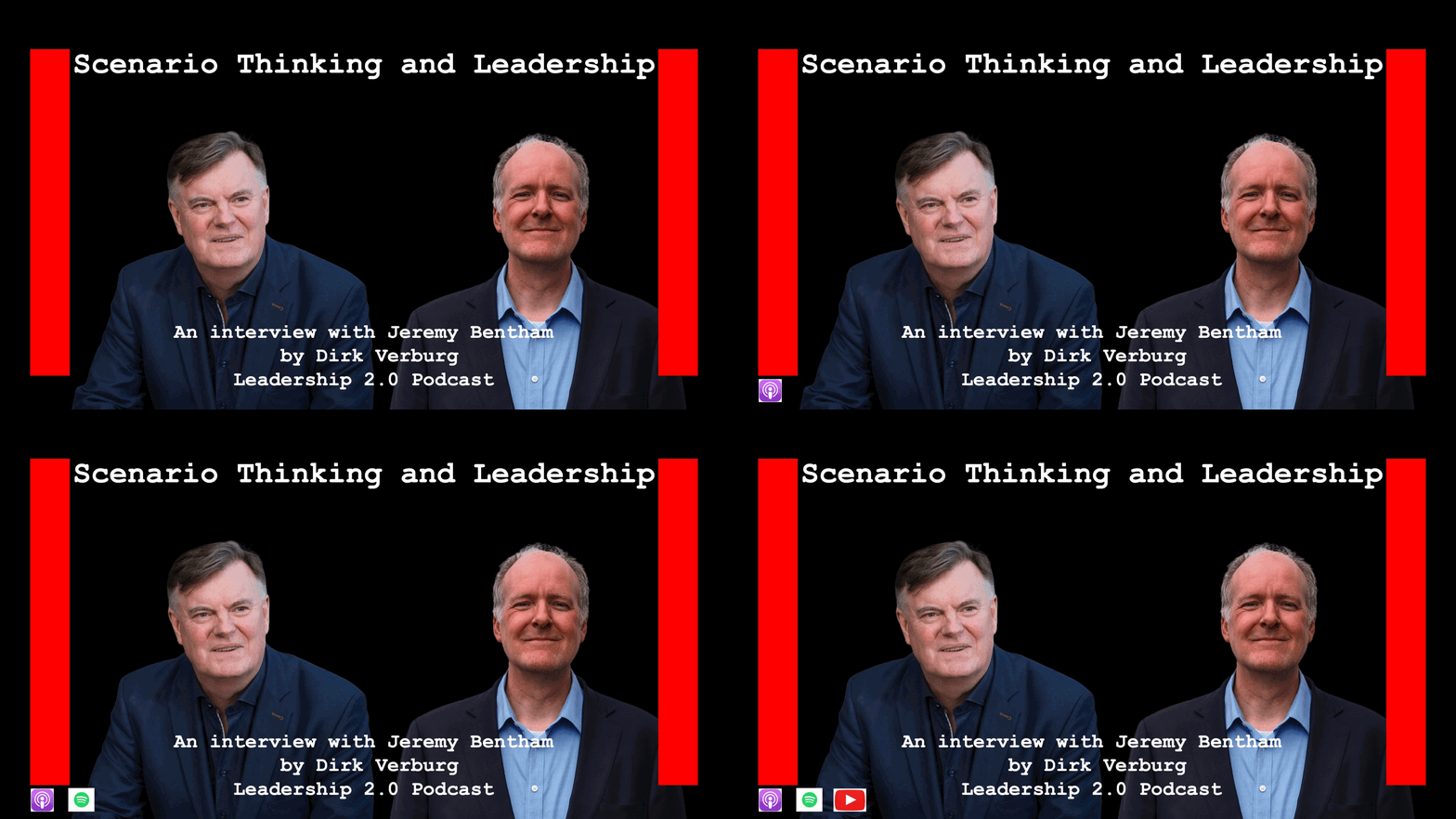
Jeremy Bentham led this activity in Shell between 2006 and his retirement in 2022 as Shell Scenarios & strategy Leader and VP Global Business Environment. In this episode of the Leadership 2.0 podcast, I am interviewing Jeremy Bentham about scenario thinking and leadership.
During our conversation, Jeremy and I discussed the following topics:
A couple of days ago my bible app opened with this verse of the day: ‘To do righteousness and justice is more acceptable to the LORD than sacrifice’ (Proverbs 21:3).
This text reminded me of the way some companies deal with Corporate Social Responsibility (CSR). Rather than doing the right thing, they do the wrong thing and compensate for this by deploying CSR initiatives. There is even a special term describing this phenomenon: ‘Greenwashing’. In this context, it is no wonder that two professors from IMD (a leading Swiss Business School) published an article in 2018 with the provocative title: ‘Why nobody takes corporate social responsibility seriously’.



 Dirk Verburg