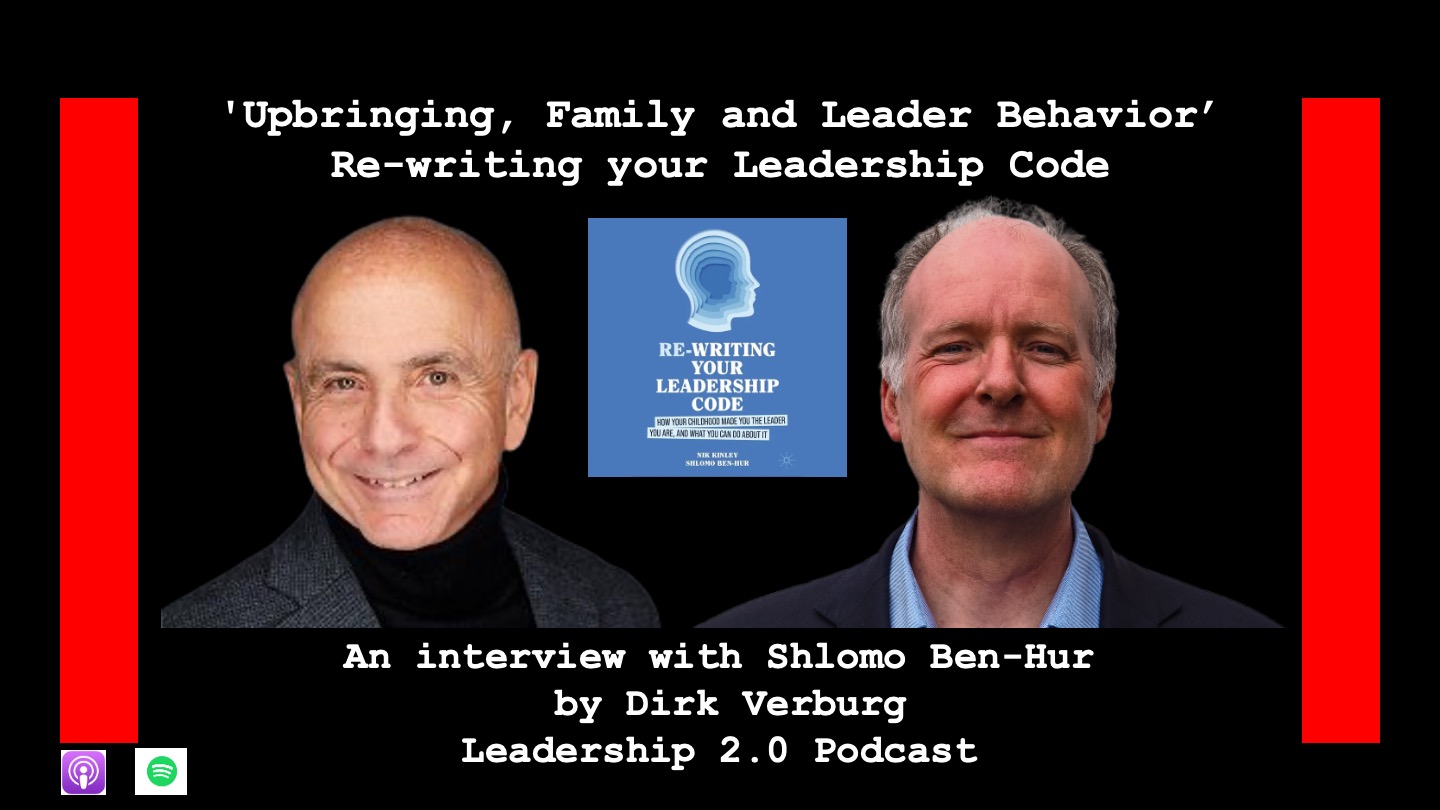
How Your Family & Upbringing Shape Your Leadership Style (Rewriting Your Leadership Code) – Shlomo Ben-Hur

Nature versus Nurture?

The oldest debate in the world is the question if we have free will (my take on this: It is probably useful for yourself and others to pretend you have one), the second oldest about nature (DNA) versus nurture (Upbringing).

In my perception, it is not a question of Nature versus Nurture but of nature and nurture. I am a strong believer in the ‘Big Five’ and a strong believer (as well as an ‘Expert by experience’) in the role that upbringing and family structure play in our development as leaders.

However, given the fact that we cannot change our DNA, that makes our need to analyze the impact our upbringing and family structure played in our development more important than ever.

The best book I ever read about this topic was ‘Rewriting your Leadership Code’ by Shlomo Ben-Hur and Nik Kinley.

This book posits that our core instincts originate in childhood, creating neural pathways that act like the code of our internal operating system (OS). This OS determines how we process events, make choices, interact with others, and influence our teams. While professional composure usually masks these deep-seated traits, high-pressure situations strip away that filter and reveal our true reactions. Ultimately, leading through crisis exposes both the strengths and flaws of our fundamental character.

I recently had the pleasure of having a conversation with Shlomo about this book. In our conversation, we discussed:

  • The Leadership Code
  • The importance of Self-Awareness for Leaders
  • How Leaders can increase their Self-Awareness
  • Three critical capabilities for Leaders
  • The Big Themes: Free Will and Nature versus Nurture
  • Childhood Traumas and Executive Coaching
  • Rewriting our code?

► You can watch or listen to a podcast with our conversation on:

► No time to watch or listen to the podcast now? Here is a short summary of the key points of our conversation:

Continue reading →
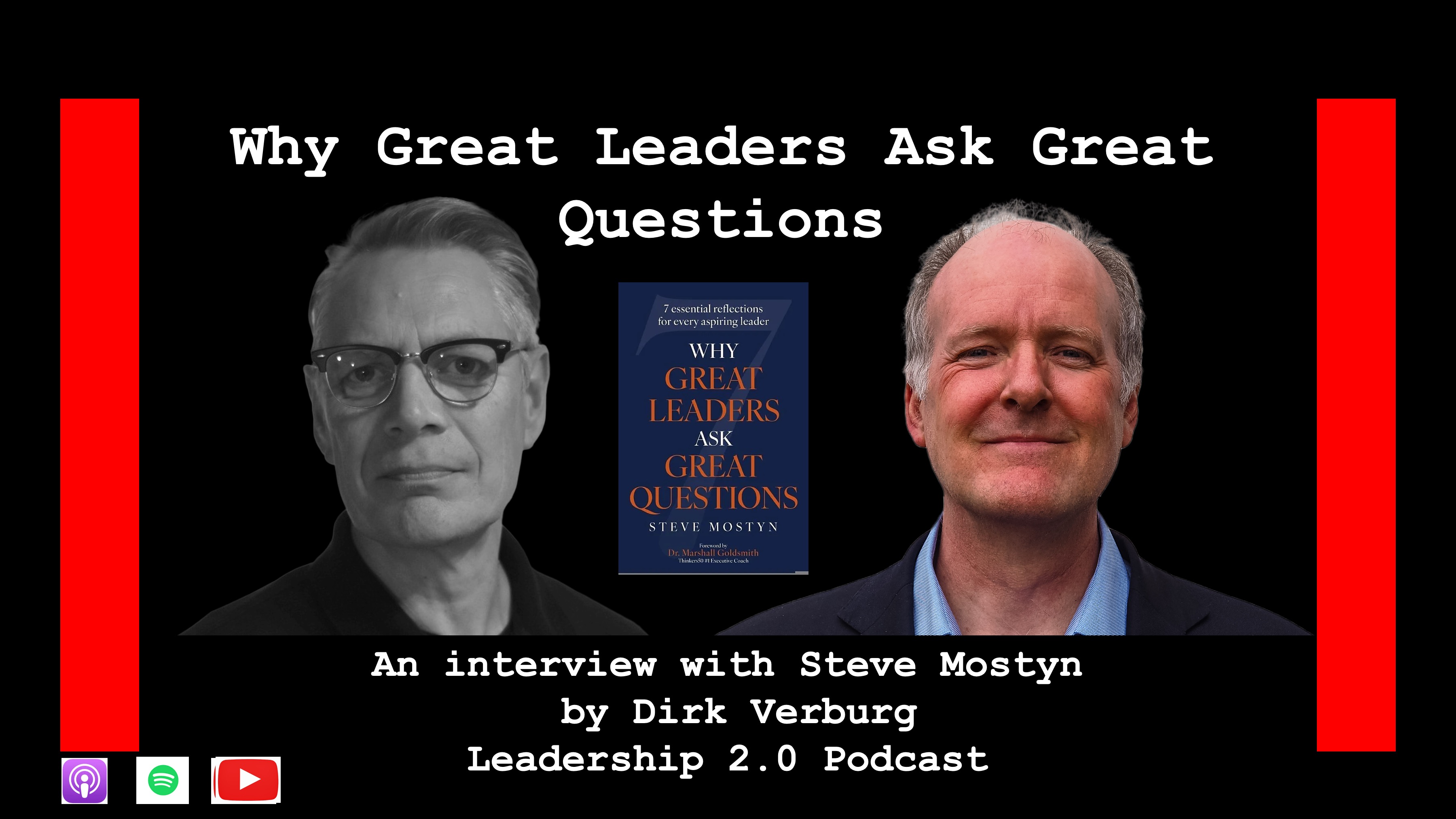
‘Why Great Leaders Ask Great Questions’ – Steve Mostyn

Are you working ‘in’ or ‘on’ the firm?

This is just one of the many provocative and thought stimulating questions Steve Mostyn asks in his book ‘Why Great Leaders Ask Great Questions’.

For a long time we looked to leaders to get answers. According to Steve this is because we confuse authority with leadership.

True leadership in business is grounded in knowing ourselves and building a reflective practice to enhance the understanding of ourselves, our organization and our enviroment, with the aim to develop ourselves, our teams, and our business.

In the 40th episode of the Leadership 2.0 podcast, I interview Steve Mostyn, focusing on the question how leaders can develop such a reflective practice.

Steve is a globally recognised leader in senior executive leadership development and an internationally acclaimed thought-leader in leadership training, and the author of the book ‘Why great Leaders ask Great Questions’.

During our conversation we discussed the following topics:

Continue reading →

Are you too engaged? From”I Have To” to “I Choose To”: A High-Achiever’s Two-Step Guide to prevent Burnout

Many high performers are inclined to take on too much responsibility. These people are often a dream for the companies they work for: in addition to being dedicated and hardworking, they are always willing to go the extra mile. However, as a result, a number of them experience serious work-life balance issues, and some even suffer from mental and/or physical health problems.

These issues do not stem from the content of their work; they all like their work. Instead, these issues stem from the fact that they assume responsibility for elements in their work that they cannot control.

A Blast from the Past: Stephen Covey

Continue reading →

‘Trust You Gut – Decision Making and Intuition’ – An interview with Eugene Sadler-Smith

We are always informed by our intuition when it comes to making decisions. More often than not our intuition is ‘right’, but there are also situations when we should definitely not rely on our intuition.

Being able to determine when to use our intuition and when not, often means the difference between our success and failure.

In my second interview with Professor Eugene Sadler-Smith for the Leadership 2.0 Podcast, we discussed the role of intuition in decision-making processes.

During our conversation, we touched on the following topics:

Continue reading →

Heroic Leadership – An interview with Chris Lowney

Many people in the workplace wrestle with combining their ethical and spiritual convictions on the one hand, with what they feel is required of them to progress their careers, or simply to stay in their roles, on the other.

For people who want to address this tension, ‘Heroic Leadership – Best Practices from a 450-Year-Old Company That Changed the World’ by Chris Lowney. ‘ will be a great read!

Chris Lowney, is a one-time Jesuit seminarian, who currently chairs the board of CommonSpirit Health, America’s largest not-for-profit healthcare system with 140 hospitals and more than 150,000 employees. Previously, he served as a Managing Director of J.P. Morgan & Co. in Tokyo, Singapore, London and New York.

In the 28th episode of the Leadership 2.0 podcast, I interview Chris Lowney about Heroic Leadership. During our conversation, we discussed the following topics:

Continue reading →

Select the right members and agenda items for your Leadership Team

Most leaders leave the composition and agendas of their leadership teams to chance. This is a waste of time, energy, and focus.

Almost all senior leaders choose the members of their leadership teams almost by default: all their direct reports, as well as a selection of participants from staffing and back-office roles ‘in the matrix’ (Finance, HR, IT, Regulatory, Affairs, Communications, Quality Assurance, etc.).

The advantages of composing leadership teams in this way are that:

✅ Representatives of all functions are aware of every topic that is discussed (information and awareness)

✅ Participants from staffing and back-office functions feel they (and their functions) are taken seriously as true ‘business partners’

✅ The leader avoids difficult discussions about the composition of their leadership team

Although this sounds great, this typically results in:

❌ Large teams

❌ Long meetings

❌ Meeting agendas that lack a clear focus

Let me explain.

Continue reading →

‘Understanding organizations…Finally’ – An interview with Interview with Henry Mintzberg

‘We live in a world of organizations – and we do not understand them’

This is one of the statements Henry Mintzberg, one of the leading thinkers in the field of Management, made when I interviewed him for my Leadership 2.0 Podcast about his latest book ‘Understanding Organizations…Finally’.

During our conversation, we discussed the following topics:

0️⃣1️⃣ The importance for organizations to get their structure ‘right’
0️⃣2️⃣ The evolvement of Henry’s thinking about organizations
0️⃣3️⃣ ‘Every (organization) form contains the seeds of its own destruction’
0️⃣4️⃣ ‘Emergent structures’ versus large-scale reorganizations
0️⃣5️⃣ The fit between the leader and the structure of the organization
0️⃣6️⃣ The structures of Apple and Tesla and the personalities of their founders
0️⃣7️⃣ The complementary role of conflict and culture in organizations
0️⃣8️⃣ The relationship between the structure and the culture of an organization
0️⃣9️⃣ The gap between formulators and implementers of corporate strategies
1️⃣0️⃣ The interest in structuring organizations in academia and business

You can watch or listen to this podcast episode on:

▶ YouTube https://youtu.be/sDWnSgQNmKs

▶ Apple Podcasts https://podcasts.apple.com/ch/podcast/henry-mintzberg-understanding-organizations-finally/id1511327057?i=1000656746374

▶ Spotify https://open.spotify.com/episode/0npqef0iZdAvrOeTiRLyfV?si=VIJT0CjrRF6Zhm6379JIHg

Continue reading →

‘The advantages and limitations of intuition in decision-making’ – An interview with Eugene Sadler-Smith

We are always informed by our intuition when it comes to making decisions. More often than not our intuition is ‘right’, but there are also situations when we should definitely not rely on our intuition.

Being able to determine when to use our intuition and when not, often means the difference between our success and failure.

In my second interview with Professor Eugene Sadler-Smith for the Leadership 2.0 Podcast, we discussed the role of intuition in decision-making processes.

During our conversation, we touched on the following topics:

0️⃣1️⃣ What intuition is and what it is not
0️⃣2️⃣ The two types of intuition
0️⃣3️⃣ Adopting an Ambidextrous Mindset
0️⃣4️⃣ How to take important decisions in business
0️⃣5️⃣ Carl Jung and Intuition
0️⃣6️⃣ Why the intuitive mind is a slow learner
0️⃣7️⃣ Values and ethics in decision-making processes
0️⃣8️⃣ Final Thoughts – AI and intuition

You can watch or listen to this podcast episode on:

▶ YouTube https://youtu.be/yaSpG5UtAis

▶ Apple Podcasts https://podcasts.apple.com/ch/podcast/the-advantages-and-limitations-of-intuition/id1511327057?i=1000654506560

▶ Spotify https://open.spotify.com/episode/6mCsVQCSuQ7XzYtQjvdem1?si=UiEy1VZlR0q1GB6XLyJPlA

Continue reading →