
We all have different behavioral preferences: some of us get energy from being part of a group, others from quiet reflection on their own. When it comes to how we gather data in decision-making processes, some people prefer looking at the facts presented by the current situation, while others rely more on the future possibilities the current situation offers.
The way we make decisions is also different. There are people who prefer to make decisions based on an analytical decision-making process, with their values as ‘guard rails’, while others are guided primarily by their values.
The founder of Analytical Psychology, Carl Jung, described these behavioral preferences (‘predispositions) ‘in his book ‘Psychological Types’ as Extraversion versus Introversion, Sensing versus Intuition, and Thinking versus Feeling. This was later popularized by Isabel Briggs Myers and her mother Katharine Cook Briggs in their Myers-Briggs Type Indicator (MBTI).
Jung himself, however, was very critical about boxing people into categories. He reportedly complained that his work had been turned into ‘nothing but a childish parlour game’ and was particularly concerned, for instance, about the reductive application of type theory in the medical profession, where practitioners would slot patients into his system and give them the corresponding advice.
It is important, therefore, to recognize our predispositions as strengths, but not to see them as excuses to neglect the development of our other potential capabilities.
For example, I always preferred to take decisions based on my Intuition. That worked perfectly fine when I was a single contributor, but became increasingly ineffective as I moved into more senior roles. I quickly had to learn to collect and use data (Sensing) in order to convince my leaders, peers, and staff of my ideas and proposals. And guess what – I quickly started to like it, and in due course even built a reputation for being ‘data savvy’.
Overcoming this “one-sidedness” — by bringing our psychological dispositions into conscious awareness and balance — is one the essential elements of ‘Individuation’, a key concept in Jung’s work.
Although Jung published ‘Psychological Types’ more than a century ago, the core notions of psychological types and individuation are still very much in use today. Think, for instance, about ‘strengths-based management’ — which primarily focuses on exploiting the strengths of individuals, rather than focusing on their development needs — or the fact that executive coaches like me encourage people to develop themselves ‘outside their comfort zone’.
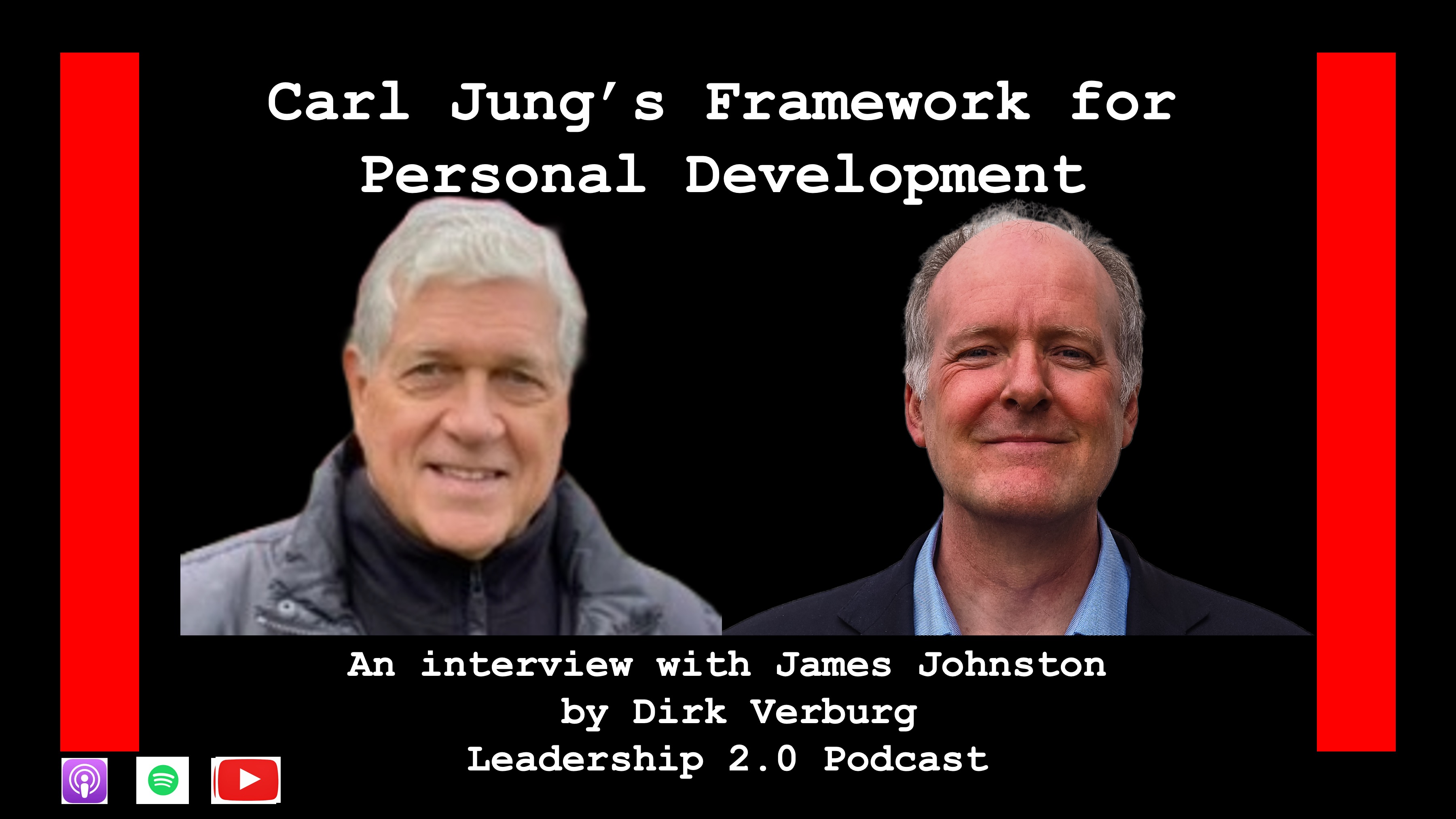
In the 39th episode of the Leadership 2.0 podcast, I interviewed author James Johnston, a prominent figure in the field of Jungian typology, about key notions of Personal Development in the work of Carl Jung.
During our conversation we discussed the following topics:
- What is Individuation?
- What happens if Individuation is blocked?
- Can Individuation be accelerated?
- Do organizations have a psychological identity?
- How to prevent an organizational monoculture?
- The importance of understanding one’s Psychological Type
- Can One’s Psychological Type change over time?
- The development of the Gifts Compass Inventory (GCI)
- Practical applications of the GCI
► You can watch or listen to a podcast with our conversation on:
➡️ Spotify
➡️ YouTube
➡️ No time to watch or listen to podcast now? Here is a short summary of the key points of our conversation ⤵
Dirk Verburg: James, thank you so much for doing the podcast. I think Jung’s work really deserves a wider audience.
James Johnston: Well, it’s indeed my pleasure. I think Jung’s work really deserves quite a wide audience, so hopefully we can bring some insights to make them more accessible.
Dirk Verburg: How would you unpack the definition of individuation for first-time listeners, and why do you consider it so central to human development?
James Johnston: Individuation is the centerpiece of analytical psychology. It’s the lifelong process of becoming oneself, or as Jung beautifully said, “The privilege of a lifetime is to become who we truly are.” It is the essential purpose of life and is highly congruent with Christian traditions, echoing the call to move toward perfection.
It starts with developing the unique personality we were born to become, which is our great contribution to the world. Individuation shifts us from an ego-centered existence to a soul-centered life, aligning us with what Jung called “the infinite” or the transcendent reality present within the human psyche. Jung noted that only by connecting with the infinite can we avoid wasting life on futilities or false possessions, which lead to envy and limited aims.
Ultimately, it is a process of becoming whole, unified, and guided by a presence greater than ourselves.
Dirk Verburg: What are the psychological and practical costs when individuation doesn’t happen, both for individuals and for the organizations they are a part of?
James Johnston: Culturally, there is a strong disposition to conform. When you enter a rigid, hierarchical organization, you often give up your own personality and put on a false persona or mask to abide by the culture and join the herd. This is the absolute antithesis of individuation.
When individuation is suppressed, the power of the unconscious to disrupt the system is extraordinary. It creates structural eruptions both within the individuals and across the organization. This manifests as intense conflict, ego-driven issues, envy, and jealousy.
Because individuation is a preeminent purpose of life—one whose importance is far greater than any organizational goal—stiff and controlling corporate structures ultimately deaden the vitality of their members. Organizations must find ways to enable people to pursue their unique developmental voyages while remaining part of the larger whole.
Dirk Verburg: Can the process of individuation be cultivated earlier and more intentionally through coaching, therapy, or tools like the Gift Compass, rather than waiting for midlife?
James Johnston: The ego would love to control and accelerate individuation, but the ego is not in control. In fact, to the degree that the ego seeks to take charge, it will actually obstruct the process. Individuation requires the ego to step aside and abide by a higher calling or transcendent direction.
While it is a lifelong, and perhaps eternal, process, the best we can do in this life is practice wu wei—doing by not doing—and stop letting our ego interests interfere. However, we can actively support the process through inner work, Jungian analysis, and dream tracking.
Life is swarming with clues for individuation that we normally ignore. These include sudden projections—like noticing why you intensely dislike or randomly admire someone—and recognizing spontaneous interests or core gifts we are born with. Attending to these clues helps us move away from narrow, egocentric journeys and leads us toward a richer, more whole, and more robust life.
Dirk Verburg: How do you see collective brand identities, like Apple or Mercedes-Benz, relating to or influencing the individual development of the people working within those organizations?
James Johnston: The degree to which an organization demands adherence to a rigid, dogmatic, or one-sided orientation is deeply deadening. As soon as we take only one side, we leave a crucial part of our personality behind, which stalls individuation.
Strong brands bring true life to their organization only when they embrace the full dimensions of their employees’ personalities. For example, Southwest Airlines historically fostered a “culture of love” for customers and employees alike. Love is explicitly one of the pathways to individuation, allowing anyone to join without losing themselves. Similarly, companies like Google tend to orient toward individual initiative and expression.
When an organization values individual uniqueness and initiative at every level, it naturally fosters an environment that encourages individuation.
Dirk Verburg: Do you have any practical ideas on how organizations can implement and stimulate the individuation of their members to counter this deadening one-sidedness?
James Johnston: Yes, it all starts with the leader. This approach to life must be explicitly adopted by the leadership so that it creates an ongoing invitation and openness throughout the culture.
People constantly look to their leaders to understand the true nature of the corporate culture and how they can best serve it. At Southwest Airlines, the leader was a massive advocate for promoting love, and everyone got on board because of that clear modeling.
This is fundamentally about actively encouraging diversity of thought and ideas, and allowing people to bring their whole selves to work. Monocultures are highly vulnerable, rigid, unable to adapt, and ultimately destined to pass out of this world. Conversely, a diverse, individuated culture breeds immense structural strength, resilience, and long-term vitality.
Dirk Verburg: What do you see as the main advantages of individuals understanding their psychological type, given how heavily the concept has been debated?
James Johnston: The advantages are massive, but we must separate Jung’s original work from the static system of 16 personality categories, which Jung was not about. Jung’s model is fluid, dynamic, and organic. It features eight psychological types that represent orientations to conscious life experience, based on four functional orientations modified by extraversion or introversion.
We are born with natural dispositions toward certain orientations; these are our gifts or baseline strengths. Early in life, we should leverage these strengths. However, as we individuate, the goal is to comfortably engage all eight orientations. These eight types can combine in over 40,000 ways, creating incredibly nuanced composite strengths.
Understanding your profile builds immense self-awareness regarding what you contribute to a team, while simultaneously fostering deep empathy and mutual understanding for how others are uniquely oriented. Mutual understanding is the bedrock for flourishing teamwork and empathy.
Dirk Verburg: Do you believe that an individual can radically change their psychological type over time, or is it a more evolutionary process of broadening your repertoire?
James Johnston: Type is completely integral to depth psychology and individuation. Your unique, core personality is sacrosanct and does not change, but your conscious orientation to the eight types absolutely evolves if you are actively individuating.
The first couple of orientations that are clear to us at age 20 will likely still be our home or resting place at age 70. However, individuation is a process of knitting together oppositions. When we overdevelop one type early in life, its compliment is left in the shadow. Individuation brings up those shadow types, integrating them into the fabric of the whole personality.
When you unite these compliments, you arrive at what Jung called the tertium non datur—the third not given—out of which true personality emerges. Rather than relying on a narrow preference, you unlock all eight orientations to express your individuality. Life becomes significantly richer, more robust, and more engaged.
Dirk Verburg: Why did you undertake the endeavor to develop the Gift Compass, and what were some of the core principles you used in designing it?
James Johnston: It grew out of intellectual curiosity, a fascination with Jung, and frustration with the standard 16 personality type models. As an architect trained to design elegant solutions to complex problems, I couldn’t accurately find myself in those static boxes.
Reading Jung’s original writings, I realized he explicitly viewed his model as a compass for exploring both the conscious and unconscious realms. I wanted to rescue the depth of his original, organic vision and map out how type directly drives individuation.
I started drawing the compass layout on napkins, figuring out how to layer extraversion and introversion over the four functions. It evolved from a pen-and-paper test into an online instrument. The Gift Compass assesses all eight orientations and maps out how they dynamically interact, making the full depth and breadth of Jungian psychology highly accessible for personal growth and depth work.
Dirk Verburg: How does the Gift Compass instrument differ from the MBTI?
James Johnston: The MBTI forces individuals into an incorrect paradigm. By misinterpreting four key paragraphs in Jung’s Psychological Types, its creators concluded that there are rigid, predetermined rules for how types combine. Consequently, they only look at the first two types and identify just 16 rigid combinations, completely leaving behind 40 other natural variations.
The GCI has no predetermined boxes. We simply ask people to identify what is uniquely true for them across all eight types. We look closely at the three to five orientations that have been most active in a person’s biography. This approach respects the highly nuanced, realistic composition of an individual’s conscious and unconscious orientation to life.
Dirk Verburg: What do you see as the most important and useful practical applications of the Gift Compass for individuals, teams, and organizations?
James Johnston: It is indispensable for self-awareness. Because we have lived with our natural gifts since childhood, they are like water to a fish—we use them constantly without even noticing them. The GCI brings these out by asking individuals to reflect on highly enjoyable past experiences to pinpoint what they naturally bring to life and teams.
It also builds immense empathy for others by showing how uniquely they are oriented. In the US, we use a tool called “Discover Your Passion” to help undecided college students identify a general career direction based on their gifts, preventing costly trial-and-error changes.
Recently, we trained an AI bot on a decade of our profile data and Jung’s writings to analyze the “melody” of all eight types. It maps out custom career pathways for any of the 40,000 combinations. In HR, it optimizes teams by matching roles to what people actually enjoy, reducing burnout. It is even highly useful in marriage counseling to foster mutual understanding between opposite partners.
Dirk Verburg: James, thank you so much for this interview. I am sure this will be incredibly valuable for our listeners.
James Johnston: Thank you, Dirk. It’s been a real pleasure.
► About James Johnston
James (Graham) Johnston is an artist, architect, author, and entrepreneur. He is passionate about innovation to make the world a better place.
Out of that passion, he created the Gifts Compass Inventory (GCI), an online self-assessment founded in C.G. Jung’s theory of psychological types. His book, ‘Jung’s Indispensable Compass: Navigating the Dynamics of Psychological Types’, lays out the intellectual foundation for understanding Jung’s type model as a compass.
He founded the training company Gifts Compass Inc. to train professionals in the use of the GCI and other instruments. The aim of the work is to engage the types, as Jung did, for the development of a more unique personality.

