Most of us are acutely aware of the gap between how organizations aspire to operate and the everyday reality of working within them.
This discrepancy often has a negative impact on the motivation and well-being of employees, ranging from a decrease in employee engagement, to mental health issues,
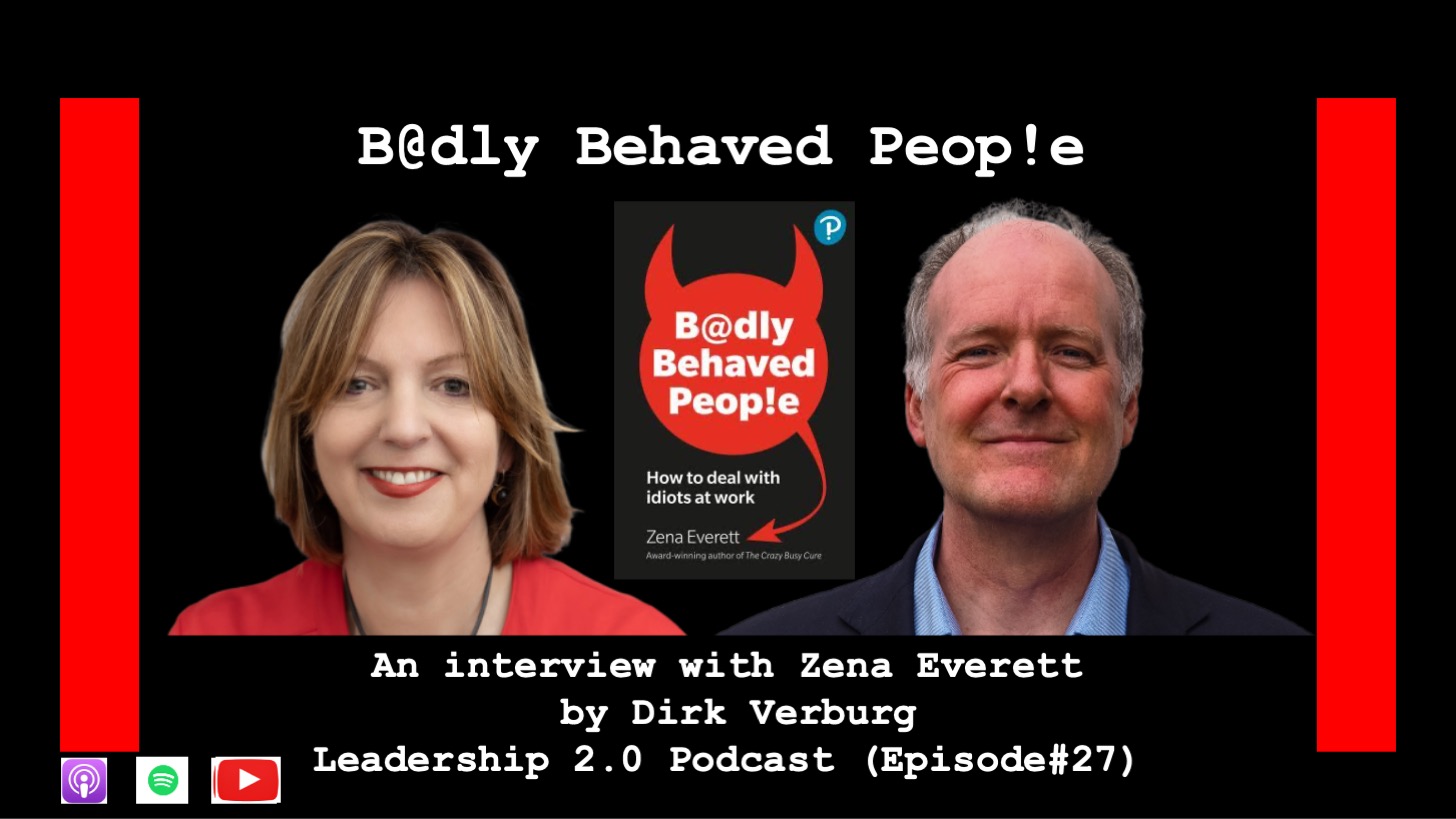
In her book ‘Badly Behaved People’, my fellow executive coach Zena Everett describes a number of real-world cases about how this discrepancy can manifest itself, and, perhaps more importantly, how we can address them
What I particularly like about about this book is how Zena makes complex psychological concepts (for instance, Transactional Analysis) accessible without oversimplifying them, and demonstrates how they can be applied in the workplace.
In our conversation about her book, Zena and I discussed the following topics:
0️⃣1️⃣ Why Zena wrote Badly Behaved People
0️⃣2️⃣ ‘Healthy Competitive Friction’ versus ‘Mindless Harmony’
0️⃣3️⃣ Culture: ‘A lived experience’ or ‘A poster with statements behind the Reception’?
0️⃣4️⃣ Dealing with Childhood Experiences in Executive Coaching
0️⃣5️⃣ If we cannot trust ‘our Perception’, what is the alternative?
0️⃣6️⃣ Emotional Intelligence and Anger Management
0️⃣7️⃣ What if your line manager has a Narcissistic Personality Disorder (NPD)?
0️⃣8️⃣ ‘Scrappy Careers’ versus ‘Listening to our Inner Voice’
0️⃣9️⃣ Final Thoughts
► You can watch or listen to this podcast episode on
➡️ YouTube
➡️ Apple Podcasts
➡️ Spotify
► No time to listen to podcast now? Here is a short summary of our conversation ⤵
Dirk Verburg: What inspired you to write Badly Behaved People, and how do you address the concept of “idiots at work” as quoted?
Zena Everett: The book was inspired by my coaching experiences, where I consistently observed that “people problems” were at the root of most issues, not systems or technology. People simply weren’t communicating. The “idiots at work” title was my publisher’s idea for SEO, and it’s a massive disclaimer that I would never call anyone an idiot! My aim was to highlight that most people aren’t inherently “badly behaved” but are under pressure, and the solution lies in rebuilding communication channels. We need to talk to each other, especially in a hybrid work environment where casual conversations are often lost.
Dirk Verburg: Your book states, “We don’t want mindless harmony; we want just healthy competitive friction and a shared commitment to making a difference.” What triggered this statement, and when does healthy friction become unhealthy?
Zena Everett: This statement is rooted in the concept of psychological safety, where people feel safe to speak up and challenge the status quo, as championed by Amy Edmondson’s work and Google’s Project Aristotle. We want leaders to encourage independent thinking. Sometimes, psychological safety is misinterpreted as seeking complete harmony, which isn’t the intention. Healthy friction becomes unhealthy when there’s a lack of trust, often due to insufficient communication. In hybrid work, where chitchat is less common, challenging ideas can be taken personally if relationships aren’t strong.
Dirk Verburg: You discuss that organizations rely on “big experiences” for culture, but “what matters to the rest of us is our lived experience.” Is there still a place for institutionalized culture change initiatives?
Zena Everett: Absolutely, there’s still a crucial place for them! The values and purpose are the DNA of an organization and are more important than ever for efficiency, building trust, and establishing good behavior. The problem arises when these initiatives are just performative — expensive consultants create values that nobody remembers or lives by. They become cynical exercises. Culture initiatives are effective when translated into everyday business decisions, so people can use values to guide their actions. Leaders must consistently live these values; otherwise, trust is easily lost.
Dirk Verburg: How important is it for executive coaches to look at clients’ childhood experiences, considering coaching is future-oriented and coaches aren’t psychotherapists?
Zena Everett: As a coach, I don’t aim to change childhoods, as that’s not my role, nor is it necessary. However, understanding the origin of an inhibiting belief (like someone not speaking up in meetings due to childhood messaging) can help clients understand why they react a certain way now. My focus is on present-day challenges and helping clients navigate them. Furthermore, managers should have a sense of their people’s backstories to offer sympathetic support, as external life stressors (like mental health concerns with an adolescent child) can impact work behavior. We need more genuine conversations, not just “my door is always open” platitudes.
Dirk Verburg: You quote Nietzsche: “There are no facts, only interpretations,” and discuss that “feelings are not facts.” If people can’t trust their perception or what they see as facts, what can they trust?
Zena Everett: It’s a balance between instinct and data. Our gut feelings can be excellent initial indicators, but they need to be backed up by evidence. For example, a manager might have a gut feeling that an employee isn’t engaged. The data might show them looking down or arriving late. However, our instinct also tells us there might be more going on. We often tell ourselves stories that aren’t true (e.g., “I don’t deserve this promotion”). Coaching helps to slow down these thoughts and focus on facts. Both feelings and facts are useful; feelings provide a first alert, but they should be fact-checked through communication with others.
Dirk Verburg: In your book, you discuss anger management, referencing Dominic Raab. Is anger management something people can develop, and if so, how?
Zena Everett: Yes, anger management can absolutely be developed. Often, when people receive direct, constructive feedback about how their outbursts affect others, their behavior changes. Emotional self-regulation is fundamental. Basic techniques like deep breathing in the moment can be highly effective. It’s also important to acknowledge external factors. Many people are exhausted from endless screen time, leaving them with less energy to self-regulate. Prioritizing self-care—like fresh air and exercise—can significantly improve one’s ability to manage anger.
Dirk Verburg: You state that “corporate life rewards visibility, not unsung heroes.” What practical advice do you have for unsung heroes with career aspirations?
Zena Everett: For unsung heroes, it’s important to get better at showing data and evidence of your achievements. Instead of just saying your team is “great,” present concrete outcomes, like “we achieved X last year, which resulted in Y benefit for our customers.” This isn’t about hyperbolic self-promotion, but about presenting undeniable facts. Find opportunities to share this data; it’s business, not personal. Sometimes, it’s also about “hanging in there” – the tortoise often wins the race.
Dirk Verburg: You describe people with narcissistic personality disorder and advise “getting out.” How can people recognize if their leader has this disorder, and why doesn’t standing up to them work?
Zena Everett: Individuals with narcissistic personality disorder (a small percentage of the population, often in leadership due to charisma) make you feel nothing you do is good enough. They are inconsistent and can destroy lives with their emotional damage. You’ll feel like you’re treading on eggshells. Standing up to them doesn’t work because they bear grudges and will actively try to sabotage you publicly. They target strong individuals to destroy. Instead of confronting them, the advice is to strategically distance yourself: seek a different project, department, or reporting line. The goal is to get off their radar, as they’ll find someone else to pick on.
Dirk Verburg: You advocate for “scrappy careers” over following an “inner voice” or “calling.” Can you explain your thinking behind this?
Zena Everett: The concept of scrappy careers encourages focusing on what you’re doing now: identifying where you add value, building networks, and developing skills. It’s about maximizing your current situation and looking for the “next island” of opportunity rather than a rigid, grand plan. This approach reduces stress and inertia that can come from striving for a magnificent, distant goal. It allows people to enjoy their current roles and remain open to unexpected opportunities. Networking is crucial, as it creates opportunities. It’s about taking achievable steps and making the most of what’s within easy reach, rather than comparing oneself to others or pursuing an elusive “north star.”
Dirk Verburg: If you could stress one single most important topic from your book that wasn’t covered, what would it be?
Zena Everett: I’d like to stress two things. First, ask people questions and don’t make assumptions. Just because someone was okay last month doesn’t mean they are now. Practice “inquiry-driven leadership”: “What’s going on?”, “How can we make this better?”, “What’s working well?” Get into the habit of asking. Second, boundaries are essential for safety—both behavioral boundaries (what’s acceptable) and personal ones. This includes setting clear expectations for communication, even down to the minutia like email response times. Leaders must set these guardrails, as “real life is lived in the everyday.” What worked six months ago might not work now, so continuous conversation about how we work together is key.
► About Zena Everett
“Zena Everett has a global leadership coaching and speaking practice, with a reputation for evidence-based content and practical takeaways, delivered in a very entertaining way.
Originally a recruitment entrepreneur, Zena sold her business and studied an MSc in Career Management and Coaching and other post graduate qualifications in psychological coaching and leadership (MIT). She has coached on the Executive MBA Programme at Oxford University’s Saïd Business School and is a member of the Associate Faculty at Henley Business School. Her focus is on replacing bad behaviour and crazy busyness with productive, thriving and profitable team relationships.
Zena believes that real success comes from flipping our focus away from ourselves, and onto the problems that we, uniquely, can solve for others. It’s not about us and our egos: it’s what we can do for others that matters”.
► Resources
Email Zena Everett: zena@zenaeverett.com
Book ‘Badly Behaved People’: https://lnkd.in/d97TYphf
Other books by Zena Everett: https://lnkd.in/dyVj2QXy
Website Zeba Everett: https://lnkd.in/dsW3YeUh
Discover more from Dirk Verburg
Subscribe to get the latest posts sent to your email.
 Dirk Verburg