Almost 90% of senior HR leaders agree that transitions into new roles are the most challenging periods in a leader’s professional life. However, organizational appetite to invest in these transitions remains minimal.
As business leaders, we seem to accept a 40% failure rate among newly appointed executives as an unavoidable risk.
The consequences of these failures are significant for both the individual and their organization.
For the individual, a failed transition damages their professional reputation and potentially their livelihood. For their organization, it results in direct financial costs (recruitment), opportunity costs, diminished employee engagement, and a degraded Employer Value Proposition (EVP).
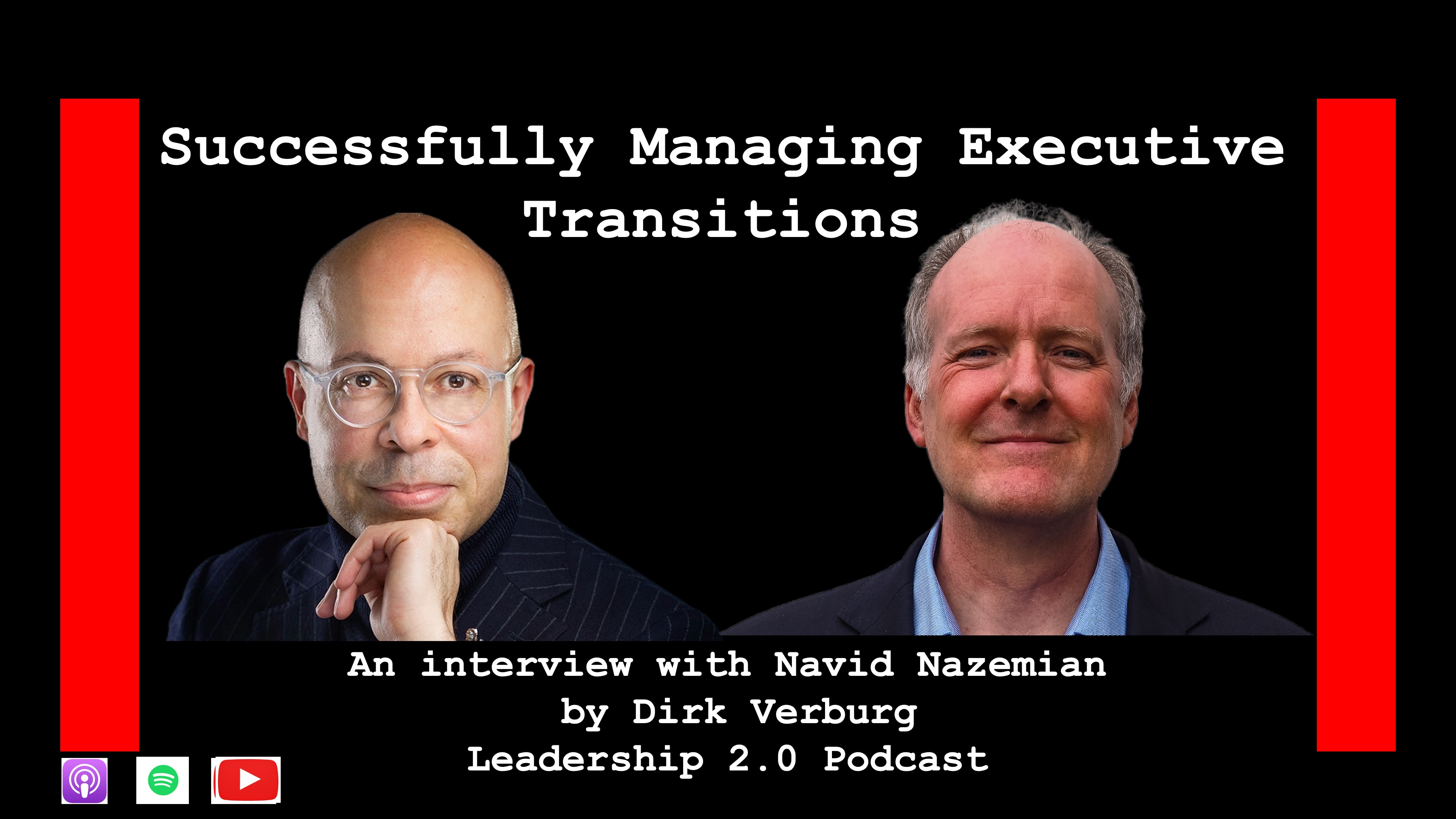
In the 37th episode of the Leadership 2.0 podcast, I speak with Navid Nazemian—my brother-in-arms in the Executive Transition Coaching space—about how organizations can mitigate the risks of executive appointments by engaging an executive coach.
During our conversation, we discussed:
- Why executive transitions must be actively managed
- The number one reason executive transitions fail
- The ROI of coaching during leadership shifts
- Why many organizations still hesitate to use transition coaching
- The ideal timeframe and structure for coaching engagements
- Identifying the right “early wins”
- Balancing “learning vs. delivering”
- Selecting the right transition team
- Developing long-term transition skills
- Managing executive exits with dignity
- Final thoughts and key takeaways
► You can watch or listen to a podcast with our conversation on:
➡️ Spotify
➡️ YouTube
➡️ No time to watch or listen to podcast now? Here is a short summary of the key points of our conversation ⤵
Dirk Verburg Why is the proper orchestration of executive transitions so important for an organization?
Navid Nazemian The statistics are shocking: four out of ten executives fail, even at the world’s most admired companies. This isn’t just an issue for small or poor-performing firms. The second reason is the high cost of failure. While a junior employee’s failure is manageable, a group CXO’s failure creates enormous ripple effects. The cost to the company far exceeds the individual’s salary; it can bring an entire company to a standstill.
Dirk Verburg What is the number one mistake most executives make when moving into a new role, and how can a coach or transition expert help them?
Navid Nazemian As Dr. Marshall Goldsmith says, “What got you here won’t get you there.” The number one mistake is assuming that because you have transitioned successfully in the past, you are future-proofed for all subsequent transitions. Past success provides no guarantee of future success in a new context.
Dirk Verburg Why are executive coaches better suited for this work than internal stakeholders like line managers, board members, or HR leaders who already know the organization?
Navid Nazemian When you reach the C-suite, the dynamics change. You are often cut off from informal communication and must rely on official dashboards.
Research highlights two distinct advantages of specialized transition coaching. First, it can shorten the time to productivity by 50% or more. Normally, an external hire takes six to nine months to show value. Second, coaching reduces the “derailment risk,” potentially cutting that 40% failure rate by half.
Dirk Verburg Why do many executives and organizations still fail to utilize specialized transition coaching despite the compelling business case?
Navid Nazemian It is a relatively new discipline that has only professionalized in the last 20 years. Even most coach education focuses on general leadership development. I compare it to a GP versus a specialist; this field is the “neuroscience” of leadership. There is also a lack of awareness; many organizations use general practitioners, not realizing there is a professional discipline tailored to these specific complexities.
Dirk Verburg Which timeframe do you recommend for the transition coaching of a senior executive?
Navid Nazemian It takes newly appointed executives several months to get their bearings. Therefore I recommend 12-plus months because it allows time to deliver measurable value. Furthermore, corporate cycles—budgets, strategies, and performance reviews—are typically anchored to a 12-month period. It makes sense for coaching to sync with that rhythm.
Dirk Verburg What does your typical transition coaching approach look like?
Navid Nazemian I start by getting input from the sponsor to define success. For diagnostics, I use the Hogan assessment to understand the leader’s traits. Three to six months in, I conduct a qualitative 360 assessment by interviewing the line manager, peers, and direct reports. These are confidential interviews; I only share feedback if at least two people point out the same issue, providing the leader with clear data to move the needle.
Dirk Verburg Can you share highlights of the value you add, perhaps using your “Double Diamond” or “Five Cs” frameworks?
Navid Nazemian The Five Cs framework helps leaders reflect on context, culture, commitments, circles, and confidence. Most failures aren’t technical; they are due to people, culture, and politics. I also use a “Double Diamond” model involving divergence and convergence. I advise leaders to resist making grand decisions in the first 100 days unless the company is hitting an iceberg. Without enough data points, you are likely to make the wrong call early on.
Dirk Verburg How should executives balance ‘learning and delivering’, especially regarding replacing underperforming members of their inherited leadership team?
Navid Nazemian The number one regret CEOs have a year into the role is not moving fast enough to replace certain leadership team members. While you shouldn’t “kill” the team immediately, you should trust your “executive hunch” after three or four months. If you know someone doesn’t have the required capability, waiting another nine months just leaves money on the table, especially since it takes significant time to hire at that level.
Dirk Verburg Is there a point where transition coaching is officially over, or do you continue coaching the executive on different subjects?
Navid Nazemian I rarely engage for less than 12 months. I use the final session for “reflective practice,” asking the executive what they learned and what mistakes they made. This is often unnatural for executives focused on the next target, but it allows them to embody those learnings for future transitions. Sometimes, this evolves into a separate leadership team journey if they want me to work with their entire team.
Dirk Verburg Why did you include a chapter on exiting an executive role in your book, and why should executives in your opinion not shy away from difficult people decisions during that stage?
Navid Nazemian A transition is an end-to-end process; it doesn’t just start with the new person’s first day. Ideally, the outgoing leader passes the baton. I advocate for “the last 90 days,” where the outgoing executive reflects on what they would change if they had three more years. This might include making difficult decisions they were tempted to push off. These insights are mission-critical for the incoming leader.
Dirk Verburg Are there any other important aspects of executive transitions that we haven’t discussed yet?
Navid Nazemian Yes, two things. First, research shows you should prioritize your line manager and direct reports over peers during onboarding, as peers are too busy with their own deliveries. Second, studies show female executives often receive less transition support. To eliminate this gender bias, HR leaders should standardize support based on the level of promotion—such as Vice President and above—rather than waiting for individuals to request it.
► About Navid Nazemian
When it comes to executive transitions, Navid Nazemian speaks with an authority that is grounded in research and complemented by authentic, demonstrated experience. His coach education took him on a three-year journey across three continents—Europe, Africa, and America. Working with over 250 C-level coaching clients worldwide, he distills key insights, guidance, and coaching to maximize leadership impact. Using strategies designed to avoid and overcome obstacles quickly, he has helped numerous C-suite coaching clients successfully eliminate unproductive actions and solve their toughest, most complex transition challenges.
Navid has been recognized as HR’s Most Influential Practitioner by HR Magazine, received the Outstanding Leadership Award from Education 2.0, and has been ranked as the world’s #1 Executive Coach by CEO Today for three consecutive years. He is the author of ‘Mastering Executive Transitions: The Definitive Guide’.
Discover more from Dirk Verburg
Subscribe to get the latest posts sent to your email.
 Dirk Verburg