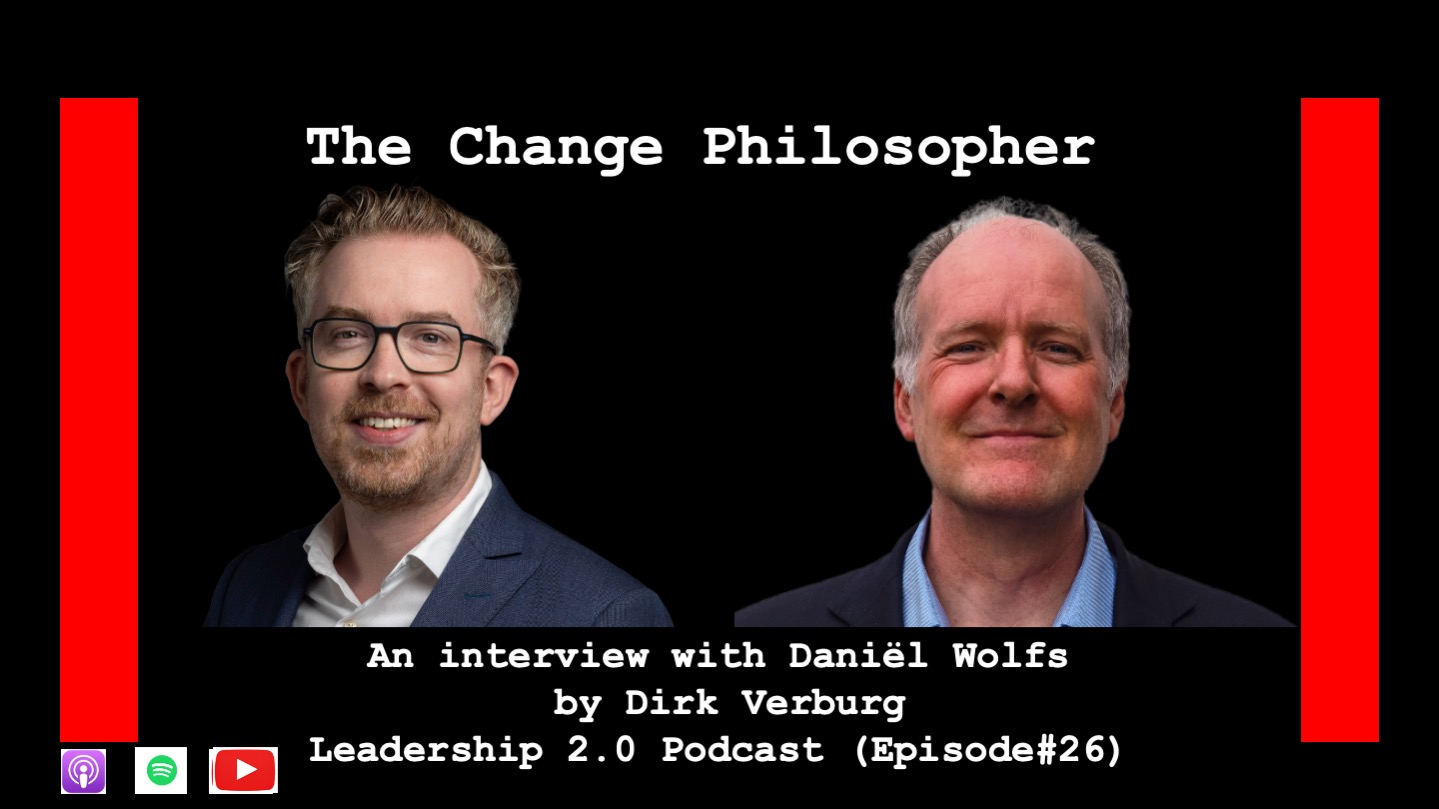
‘The Change Philosopher’ – An interview with Daniël Wolfs

🎙️ Even though we have a vast array of change management theories and methodologies at our disposal (John Kotter, Kurt Lewin, Elisabeth Kübler-Ross, William Bridges, ADKAR, etc.), it still proves to be very hard for us as leaders and consultants to implement real, sustainable change (transformation).

🚫 The harsh reality is that most change projects fail (the famous 70% of McKinsey), or end with a superficial victory declaration, after which the organization often falls back to ‘the way we DID things here’.

⁉️ ‘Why is that?’ That very question drove Daniël Wolfs, experienced change consultant and co-founder of The Change Studio (Netherlands), to write his thought-provoking book ‘De Veranderfilosoof’ (The Change Philosopher) on how we can approach transformation in a deeper, more human, and more sustainable way.’

► In our conversation about this book, we discussed the following topics:

Continue reading

Why ‘The rest is politics’ is my favorite Podcast

According to Moises Naim, polarization, together with populism and post-truths, is one of the three p’s undermining democratic societies.

Observing the public debate, which is becoming more and more polarized, it seems we are losing our ability to talk with people who have other opinions. Instead, we talk about them.

We try to classify people who have a different opinion than us, with a label. Once this label has been issued, we feel we do not have to enter in debates with them anymore. On the contrary, we try to prevent debates, since this would provide our opponents with an opportunity to share their opinions.

The difficulty however is that the effectiveness of human societies depends on our ability to cooperate and reconcile our differences. 

Continue reading

The power of clarity in a very noisy world

Three things to avoid if you want to make sure people understand you

‘This is a very noisy world, so we have to be very clear what we want them to know about us’

Steve Jobs

In 1920 Vladimir Lenin already recognized the power of controlling the printing press. A century later, in today’s social media world, the real battle ground is our everyday language.

Language is the ultimate tool to inspire people to take action. Unfortunately, we frequently squander its impact by making three mistakes:

Continue reading