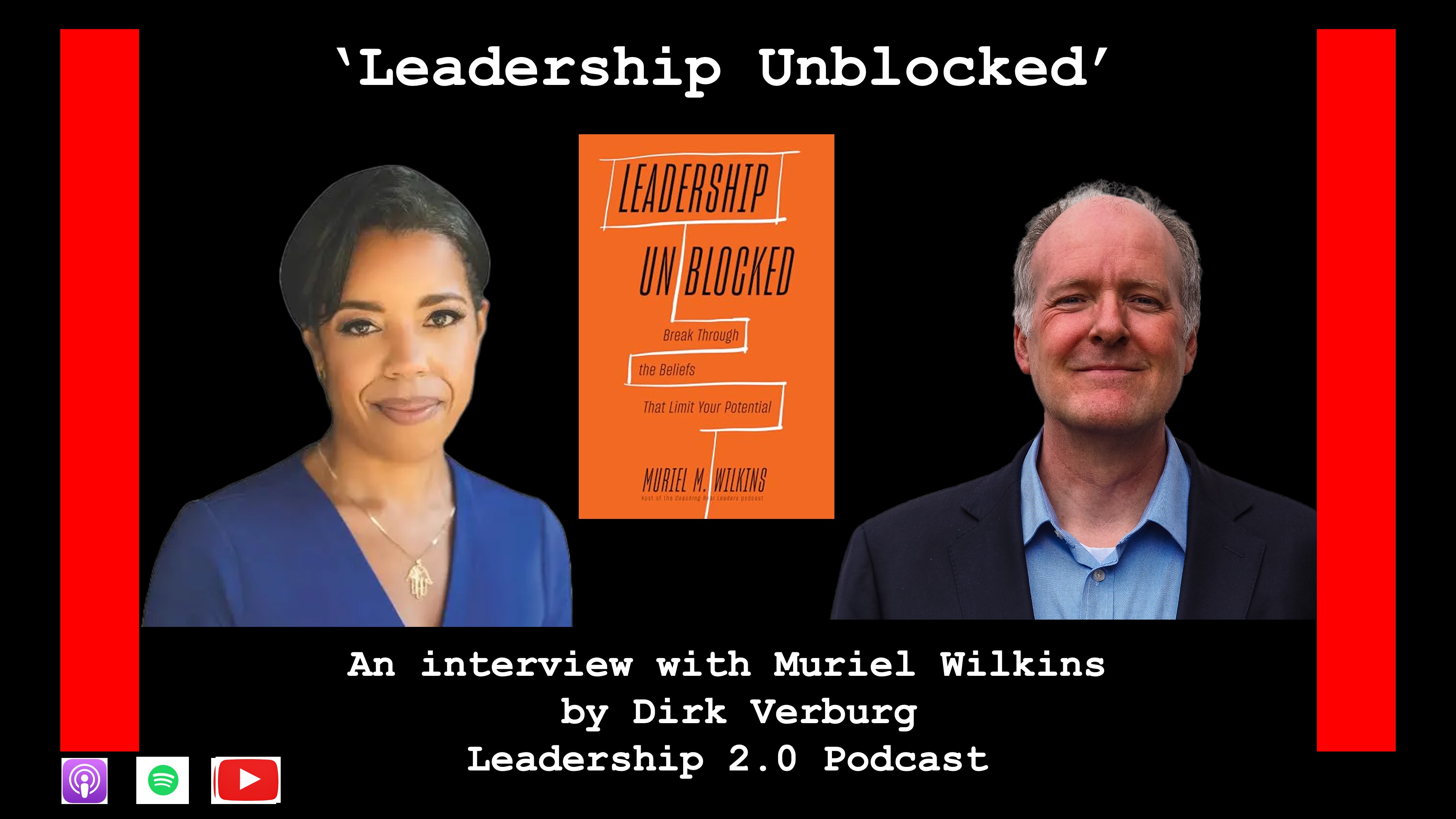
‘Leadership Unblocked: Break Through the Beliefs that Limit Your Potential’ – Muriel Wilkins

“Most leaders want to lead at scale and with ease.”

This insight triggered Muriel Wilkins—a fellow executive coach and one of the best in our industry I know—to analyze what holds leaders back from achieving this ambition.

What she found was that many leaders are held back from reaching their full potential by one or more “Hidden Blockers”.

These hidden blockers are:

  • I need to be involved
  • I need it done now
  • I know I’m right
  • I can’t make a mistake
  • If I can do it, so can you
  • I can’t say no
  • I don’t belong here

These blockers almost always stem from beliefs we adopted somewhere in our private or professional lives. Most often, we are not aware of them, and that might be a problem because what served us well in the past won’t necessarily serve us now or in the future.

Muriel Wilkins wrote a thought-provoking and highly recommended book about this topic called ‘Leadership Unblocked: Break Through the Beliefs that Limit Your Potential’. This book not only describes what these blockers are and how we develop them, but, more importantly, how we can address them through a three-step approach: “uncover,” “unpack,” and “unblock.”

I recently had the pleasure of having a conversation with Muriel about her book. In our conversation, we discussed:

  • Hidden blockers and their impact
  • How to handle (multiple) blockers
  • How coaches can learn from their clients
  • The relationship between Hidden Blockers, Success, and Identity
  • Addressing Hidden Blockers in Coaching Relationships
  • Muriel Wilkins’s Coaching Process
  • Why Muriel Wilkins became an Executive Coach
  • Paravis Partners

You can watch or listen to a podcast with our conversation on:

► No time to watch or listen to the podcast now? Here is a short summary of the key points of our conversation:

Dirk Verburg: Muriel, thank you so much for joining the podcast. I love your book, Leadership Unblocked. Could you describe what hidden blockers are, how they develop, and why they can negatively impact a leader’s career?

Muriel Wilkins: Thank you so much for having me. I have been looking forward to our conversation.

Hidden blockers are the beliefs leaders hold that get in their way. They are a very specific sort of belief. When I say they get in leaders’ way, I mean they hinder what most leaders want to achieve: the ability to lead at scale, to handle complexity, and to lead with a little more ease.

When I work with clients as an executive coach, this is what they come to me for. They want to learn how to lead more sustainably and with a little more peace. A tremendous amount of energy is spent on the actions needed to get results. I used to be very action-based, but I realized that when you focus solely on actions without ensuring your mindset is aligned, the results are not long-lasting.

Beliefs are the assumptions we make about ourselves, others, and the context. A hidden blocker is a belief that hinders rather than serves your desired outcomes. They are “hidden” because they served you at some point so much that they became habitual, leaving you unaware of them.

Dirk Verburg: In your book, you list seven hidden blockers. Do your clients often encounter more than one blocker at once? If so, how do you determine which one to prioritize?

Muriel Wilkins: Yes, absolutely. Leaders can hold multiple blockers because human beings are not one-dimensional; we have multiple, sometimes conflicting thoughts. These seven blockers are not exhaustive, but they help people learn how to identify their own.

To prioritize, look at your desired outcomes. When there is a gap between what you are experiencing and the outcome you desire, it is a clue that a belief is getting in the way. If there are multiple, just pick one to test out first, exactly as you would test a business strategy assumption.

At a macro level, this points to metacognition—the ability for leaders to become more deliberate about how they think. Many senior leaders are masterful at doing this with their businesses, but they are not able to do it with themselves. Learning to apply these skills to yourself creates a compounding positive result, elevating your capacity to lead the business. Ultimately, it is about expanding your capacity to think about your thoughts and expanding the range of thoughts you can hold at any given time.

Dirk Verburg: Does a higher level of performance or seniority mean a leader has larger hidden blockers and a greater need to address them?

Muriel Wilkins: I do not know if the hidden blocker is bigger, but the more successful you are, the more attached you become to the belief. You stop seeing it as a belief and start viewing it as part of your identity, saying things like, “That’s just the way I am”.

Over-identifying with a belief creates a higher risk: the more results you achieve, the less willing you are to expand your identity. My job as a coach is to help clients expand their identity rather than reduce it. Beliefs are malleable assumptions, stories, and clouds—they are not who you are.

We default to holding onto them out of fear that letting go will compromise fundamental needs. Underneath this attachment, we usually fear three main things: that we will not feel safe (or in control), that we will not feel connected, or that we will not feel worthy or valued. Understanding that these are fundamental needs allows you to get them met in other ways without remaining rigidly attached to a single belief.

Dirk Verburg: How do you handle situations where you clearly see a client’s blocker, but the client denies that it exists?

Muriel Wilkins: My starting point is a little different because I do not assume I can see inside someone else’s head. My role is to remain curious and act as a mirror by asking questions or reflecting what I hear.

I start from their desired outcome and ask what assumptions they are making about the situation, person, or role. If they do not recognize a particular assumption, I leave it alone. That simply tells me it is not where the coaching needs to happen at that moment. Either they are not ready, or it is not where we need to operate.

It is like landing a plane. If air traffic control tells you to hold, you hold. The point is to land safely, not to push it. As a coach, I must meet the client where they are, not where I think they need to be. Eventually, I try to help clients learn to coach themselves around those beliefs when they are ready.

Dirk Verburg: Once you and a client identify a blocker and they express a willingness to address it, what specific process or techniques do you follow?

Muriel Wilkins: I ground all coaching in specific, practical situations. The process follows three steps:

  1. Uncover and name the belief: Ask what you are assuming about yourself, the other person, or the context.
  2. Unpack it: Become familiar with the belief by asking if it is helping or hindering you in that moment.
  3. Unblock it: Reframe the belief to drive a different behavior that increases the probability of showing up the way you want.

The goal is to build the skill to do this process in the moment. It requires constant practice and viewing every situation as a learning opportunity rather than a failure. You do not get a gold medal for this; it is a daily practice that requires grace. Even when a conversation goes poorly, it is a reminder that there is always work to do and something to learn for next time.

Dirk Verburg: You were a very successful corporate executive before making a deliberate turn to become an executive coach. What triggered that 180-degree turn?

Muriel Wilkins: Twenty-five years ago, I was hitting walls as a leader and went looking for a coach. I was frustrated that I could not find a coach who had strong business acumen alongside coaching skills.

When I mentioned this frustration to a mentor, he pointed out that businesses start when someone finds an unsolved need. He encouraged me to start my own coaching firm, offering to hire me if it did not work out. That was 22 years ago.

My goal has been to bring together the best of both worlds: strategy consulting experience and business acumen combined with leadership, adult development, and human development principles. While this combination may not be right for everyone, I feel privileged to have worked with many incredible clients over the past two decades.

Dirk Verburg: What is the origin of your firm’s name, Paravis Partners, and what is the company’s core purpose?

Muriel Wilkins: Our original name created some issues, so we had to rename the firm. “Paravisio” combines “partnering” (para) and “vision” (visio), reflecting how we partner with others to achieve their vision.

Our mission has always been to help leaders expand their capacity so they can achieve their desired outcomes with more ease. I fundamentally believe that if leaders learn to lead with more ease, it creates ease for everyone around them.

A key measure of success for us is that if we have made things harder for a client at any point, we haven’t done our job. Our goal is to expand capacity and choice, because with choice comes freedom, and with freedom comes peace and ease.

Dirk Verburg: Thank you so much, Muriel, for this interview. I really enjoyed it and learned a lot from you.

Muriel Wilkins: Thank you. I appreciate you, value the work you are doing, and feel honored to be on your show.

About Muriel Wilkins

Muriel M. Wilkins is the CEO and Founder of Paravis Partners and a sought-after executive coach and C-suite advisor with more than two decades of experience helping leaders elevate their performance and navigate their toughest challenges.

She has served as the trusted partner to hundreds of senior executives who rely on her as a confidante, valued for her strategic acumen, ability to cut through complexity, and talent for catalyzing lasting results. Her approach is anchored in deep insight, practical rigor, and a belief that meaningful change begins from within—helping leaders expand their capacity and deliver sustained results.

Muriel’s new book, Leadership Unblocked: Break Through the Beliefs That Limit Your Potential, was published by Harvard Business Review Press in October 2025 and is a USA Today Bestseller, an Amazon Bestseller and a Next Big Idea selection.

She is also the co-author of Own the Room: Discover your Signature Voice to Master your Leadership Presence and hosts the award-winning podcast, Coaching Real Leaders. Muriel was recognized as a finalist for the Thinkers50 Coaching Award, placing her among the world’s leading contributors to the coaching field.

Her insights have been featured in major media outlets such as Forbes, Business Insider, Chief Executive Magazine, and The Wall Street Journal, and she is the author of the Harvard Business Review magazine cover article, “The Hidden Beliefs That Hold Leaders Back.”

Raised in North Africa, Europe, the Caribbean, and the United States, Muriel brings a global perspective to her work with leaders navigating increasingly complex environments. She holds an MBA from Harvard Business School and an undergraduate degree from Georgetown University. Muriel’s mission is simple: to help leaders evolve so they—and those around them—can lead and live with greater ease.

Book ‘Leadership Unblocked’

Paravis Partners