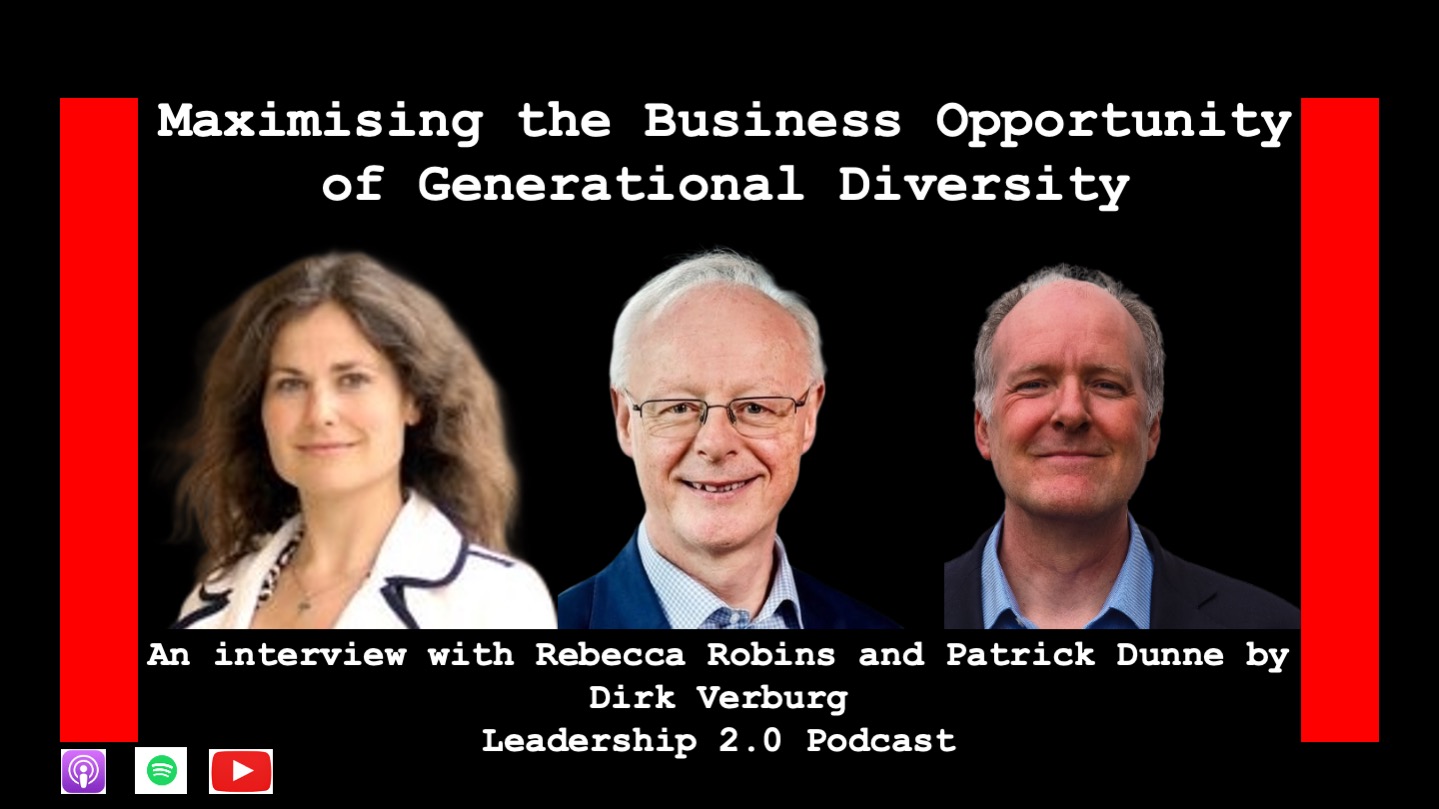
🎙️ In the 30th episode of the Leadership 2.0 podcast, I interview Rebecca Robins CMgr CCMI and Patrick Dunne about ‘Maximising the business opportunity of generational diversity’
During our conversation, we discussed the following topics:
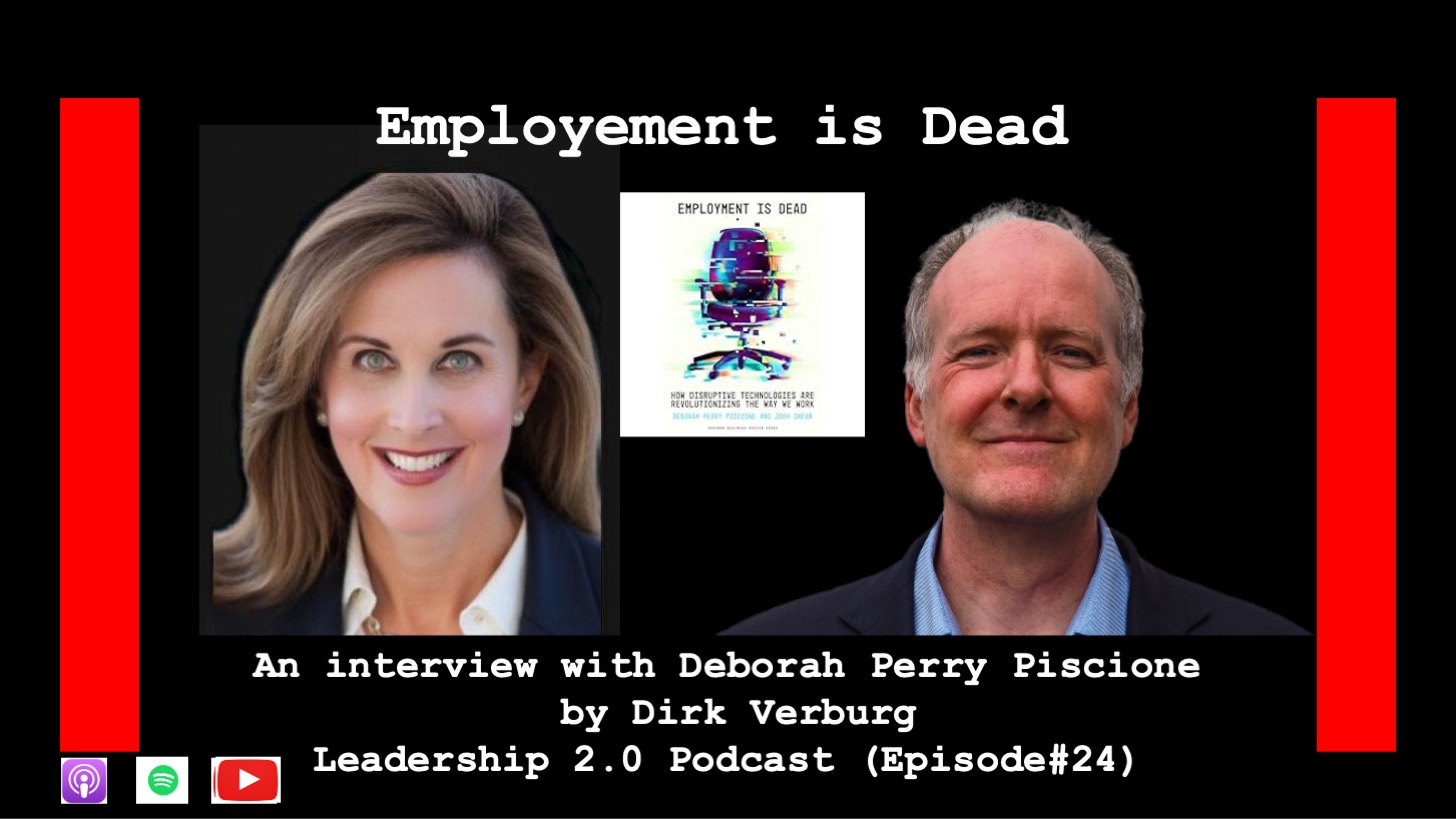
Earlier this week, one of the most important business books on the Future of Work was published by Harvard Business Review Press: ‘Employment Is Dead: How Disruptive Technologies Are Revolutionizing the Way We Work’ by Deborah Perry Piscione and Josh Drean.
The central theme of this book is that traditional employment models are becoming outdated due to the evolving needs and expectations of the modern workforce, in combination with, and enabled by, disruptive technologies.
This will lead to the end of the traditional employment model, as well as the traditional form of companies, as we know them today.
Monday, just hours before the book was released, I had the chance to interview Deborah Perry Piscione for my Leadership 2.0 Podcast.
► In our conversation, we touched on the following topics:
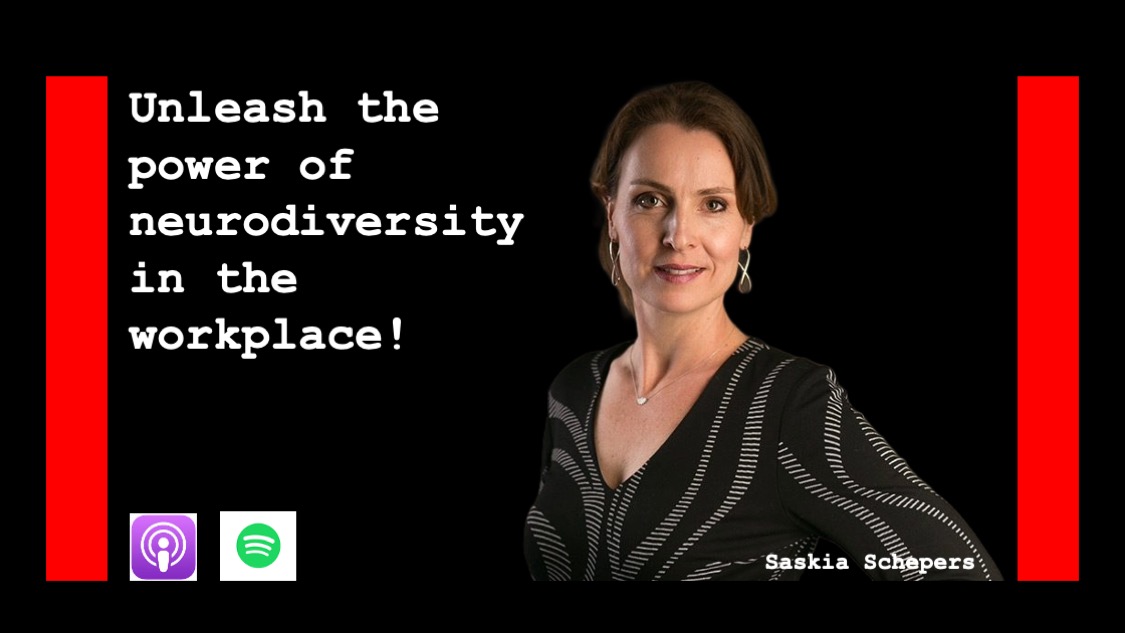
Recently I had a conversation with Saskia Schepers about her book on Neurodiversity in the workplace with the title ‘Als alle breinen werken – Waarom ruimte voor neurodiversiteit op het werk goed is voor iedereen’ (‘When all brains are switched on – Why space for neurodiversity in the workplace benefits everyone’).
Around 80% of mankind is neurotypical, and 20% is neurodivergent. We tend to ‘equip’ people in the latter category with labels like ADD, DHD, bipolar, autistic, etc.
Most leaders find it hard to integrate neurodivergent people in their teams.
The reason is that most of us have preconceived ideas about the way people in the workplace should behave. For instance, we expect people to like attending and participating in meetings, do their work in teams, be productive in open-plan offices, and socialize with their colleagues after work.
People who do not fit this mold are seen as bad ‘team players’, and are often criticized for this behavior, e.g. during annual performance review meetings.
The book almost immediately reached the number 1 position in the Dutch bestseller list of management books, was quickly sold out, and is now in its third printed edition.
An English translation is in the making and will be published in 2024.
During our conversation, we discussed the following topics:
Our society is more complex than ever. For the first time since WWII two nations find themselves at war on the European continent. At the same time our economy is slowing down, inflation is on the rise, whilst technological developments in the AI space are more unpredictable than ever, and we are still trying to find out if these will be our friend or foe…
In times like these ethics, and a sense of purpose are more important than ever. Therefore I was glad to have the opportunity to have a conversation on these topics with John Hollwitz.
John Hollwitz is a University Professor of psychology and rhetoric. Before coming to Fordham, he was the A.F. Jacobson Professor of Communications at Creighton University and dean of arts and sciences at Loyola College in Maryland. He also has been the vice president of academic affairs at Fordham.
Our interview was focused on the why and how of corporate ethics. During our conversation, we discussed, amongst others, the following topics:
Our expectations of leaders and ideas about leadership have changed dramatically in the last couple of years.
Recently I was introduced to Sophia Town, Ph.D. , an assistant professor of organizational behavior at the Gabelli School of Business of Fordham University, who is at the forefront of academic research in this area.
In the classroom, Professor Town’s curriculum is guided by the question: “How can we develop compassionate leaders in service of a flourishing world?”
SophiaTown leads Fordham’s Human Flourishing Project (FHFP), a mixed-methods, interdisciplinary research lab that explores behavioral, psychological, communicative, and spiritual development in business education. Related to this project, Dr. Town serves as a Research Affiliate and Advisory Board Member for the Human Flourishing Program at Harvard University.
During our conversation, we discussed, amongst others, the following topics:
For those who have never experienced it firsthand, or witnessed it from nearby, scientific research has shown that work can be a considerable source of stress.
This stress can manifest itself in the form of emotions (e.g. anxiety and depression), cognitive performance (e.g. in decision-making), negative behaviors (e.g. unhealthy eating habits, alcohol and drug abuse, aggression), and physical symptoms (e.g. high blood pressure, neck-, head- and shoulder pain).
Not only does stress have a negative impact on individual employees, absenteeism and low engagement for instance can seriously impact the performance of their organizations as well.
Resilience training
The popularity of resilience training in the workplace has dramatically increased in the last couple of years (particularly as a result of the COVID-19 pandemic), and there is evidence that, if done in the right format, this training can help individuals in certain target groups to deal with stress.
Positioning
The problem is that resilience training is almost always only a part of the solution, and that is almost meaningless if offered in isolation to mitigate work-related stress.
Last week I attended an interesting Webinar from Gartner about change fatigue.
According to data collected by Gartner, change fatigue is quickly becoming the number 1 priority for most HR organizations in 2023.
The reason is that the number of change initiatives in organizations is increasing exponentially; simultaneously, the enthusiasm of the workforce to embrace, or at least support these changes, is plummeting.
As a result, many organizations are currently looking for resources to address this, for instance in the form of change management methodologies (e.g. ADKAR), or by asking for support from specialized consulting boutiques.
The why of change
However, as valuable as these resources might be, it is important not to jump to the ‘how’, without paying attention to the ‘why’, the ‘what’ and ‘the team’.
In my personal experience, most people do not resist change if they understand the ‘why’, the ‘what’, and if they recognize ‘the team’.
One of the big temptations we as leaders face is our urge to add value to the work of our staff. Typically, we add this value in the form of change or additional requests.
There are three reasons why adding value is tempting for us:
Accountability – We are accountable for the work of our staff. If something goes wrong, we as leaders suffer the consequences (‘It happened on your watch’)
Know-how – We know it better than our staff. Seriously. That is most often the reason why we were appointed
We like it – As leaders it is often tempting to take a break from the daily grind of budgets and office politics, to dive back into the content we love(d) so much (‘Let me show you how it is done’)
As with every temptation in life, we need to fight this one as well. There are fivereasons for this:
Everyone who ever worked in a large organization, can probably relate to at least one of the following examples of conflicts that regularly occur in organizations:
A sales leader wants to close a deal with a low margin to meet her targets and to safeguard the relationship with the customer. The product manager does not want to sign off on the deal, because she wants to protect the margin of the product in the longer term
A business leader wants to hire a star performer working for another company, and is prepared to pay her more than the maximum of the corporate salary band for these types of roles. The HR Business Partner tries to prevent this because he does not want to create a precedent that can create upward pressure on the salary costs of the company
The head of a shared service department wants to hire an independent contractor for a project for USD 1.200 a day. The Purchasing department forces him to work with a consultant from a well-established firm on the preferred supplier list, for a fee rate that is 3 times as high as the one of the independent contractor
These, and other types of conflicts, seem to be an inevitable part of life in large organizations. The question is: why we have those types of conflicts, and if and how we can prevent them?
What do the notorious former marketing director of American Apparel, Ryan Holiday, and renowned Dutch reformed theologian Bram van de Beek have in common? They both have written a book about the danger of egocentricity.
Social media…are not to blame
Social media offers endless possibilities to promote ourselves and serve as outlets for our vanity. It enables us to humble brag about our professional achievements on LinkedIn, share evidence of our successful ‘friends & family’ life on Facebook, and demonstrate our cutting-edge lifestyle on Instagram.
However, looking at our current society and world history, it seems we as human beings always have been prone to self-centeredness and self-promotion. Social media therefore merely enables us to express something that is already deeply rooted in us.
Ethics deal with what makes something morally right or wrong.
Almost any sizeable company nowadays has a code of ethics. The main catalysts for these were the corporate scandals in the early 2000s (Enron, Worldcom, Tyco, and others). Also, in the last couple of years having a sense of purpose has become pretty much en vogue.
As a result, every year millions of employees now dutifully complete e-learning modules and sign declarations (‘To the best of my knowledge…’).
If you think about this on a philosophical level, it is actually quite sad. Apparently, companies need to invest millions of dollars each year because a shared understanding of what is morally right or wrong to do on behalf of the company, is not a given.
Obviously, from a pragmatic point of view, companies have no choice but to invest in this type of training. First of all, it helps individuals to avoid taking decisions that can create reputational and compliance-related problems for the company. The second reason is the need to demonstrate institutional compliance to governments, regulatory bodies and other stakeholders.
The world will fundamentally change in the next decade
Whether you are listening to McKinsey, the IMF or the Economist, all modern-day prophets of doom agree that COVID-19 is having a devastating impact on our society and the economy. This impact will be felt long after this pandemic has passed.
Although I am not an incarnation of Alvin Toffler, the famous futurist and author of ‘Megatrends’, merely by observing the news and talking to clients and colleagues, I see a couple of clear trends and tipping points, which lead me to believe that the ‘new normal’ will look different than the ‘old normal’.





 Dirk Verburg