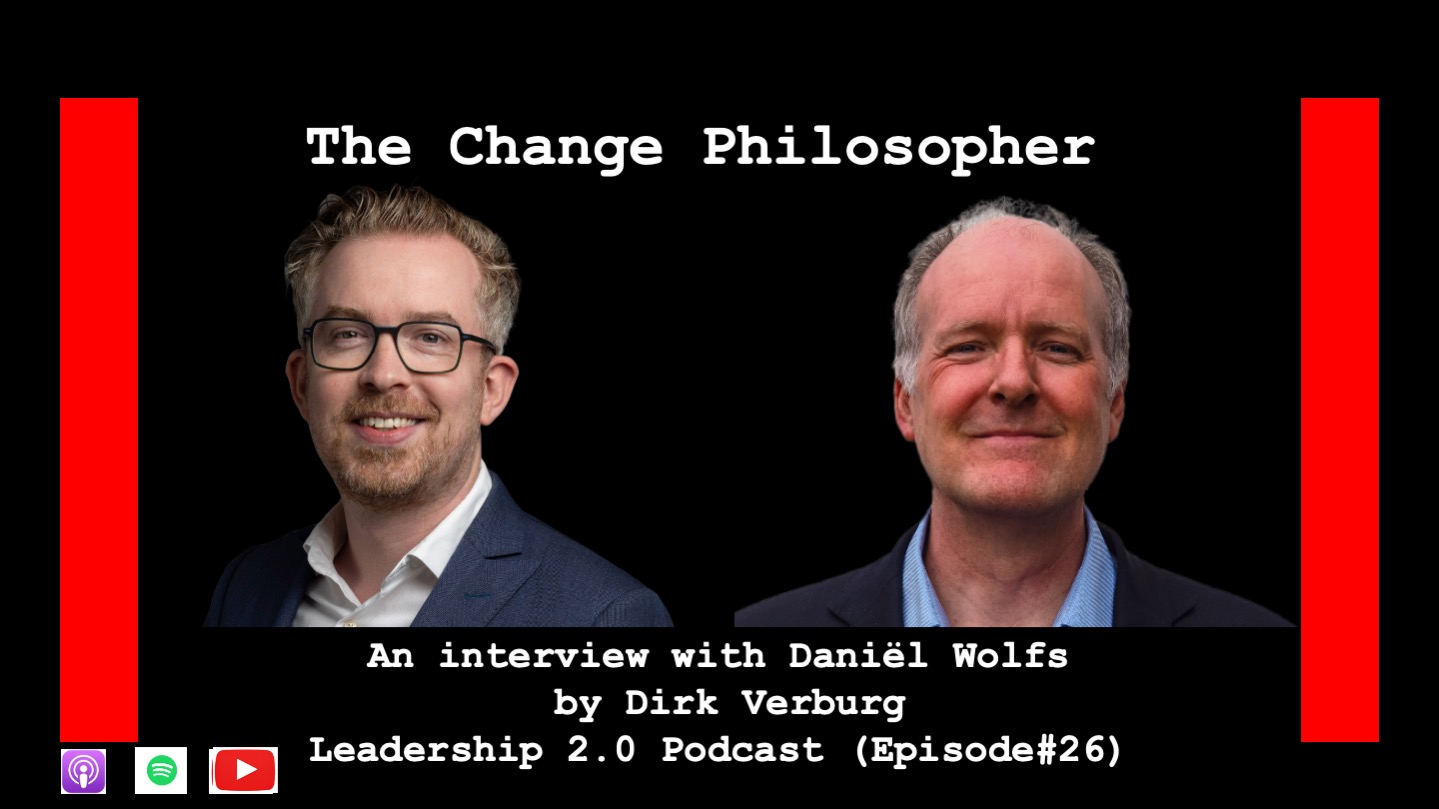
‘The Change Philosopher’ – An interview with Daniël Wolfs

🎙️ Even though we have a vast array of change management theories and methodologies at our disposal (John Kotter, Kurt Lewin, Elisabeth Kübler-Ross, William Bridges, ADKAR, etc.), it still proves to be very hard for us as leaders and consultants to implement real, sustainable change (transformation).

🚫 The harsh reality is that most change projects fail (the famous 70% of McKinsey), or end with a superficial victory declaration, after which the organization often falls back to ‘the way we DID things here’.

⁉️ ‘Why is that?’ That very question drove Daniël Wolfs, experienced change consultant and co-founder of The Change Studio (Netherlands), to write his thought-provoking book ‘De Veranderfilosoof’ (The Change Philosopher) on how we can approach transformation in a deeper, more human, and more sustainable way.’

► In our conversation about this book, we discussed the following topics:

Continue reading

Is your change management initiative doomed to fail before you even started?

Last week I attended an interesting Webinar from Gartner about change fatigue.

According to data collected by Gartner, change fatigue is quickly becoming the number 1 priority for most HR organizations in 2023.

The reason is that the number of change initiatives in organizations is increasing exponentially; simultaneously, the enthusiasm of the workforce to embrace, or at least support these changes, is plummeting.

As a result, many organizations are currently looking for resources to address this, for instance in the form of change management methodologies (e.g. ADKAR), or by asking for support from specialized consulting boutiques.

The why of change

However, as valuable as these resources might be, it is important not to jump to the ‘how’, without paying attention to the ‘why’, the ‘what’ and ‘the team’.

In my personal experience, most people do not resist change if they understand the ‘why’, the ‘what’, and if they recognize ‘the team’.

In this post, I will deal with the why.

Continue reading

Three design principles for Leadership Development

In the last three decades, the business world has become more complex than ever before. This complexity is mainly driven by two factors:

  • Globalization – Never before in the history of mankind have materials, capital and people moved faster and more freely across our planet
  • Technology – The amount of data we have at our disposal for decision-making is dramatically increasing each year, and AI is providing us with the tools to do this faster and more effective than ever.

As a result, our world has become more interconnected and interdependent than ever. A case in point are the supply chain issues businesses experienced in the initial stage of the COVID-19 pandemic.

This interconnectedness and interdependence has huge implications for the way organizations need to operate, both externally as well as internally.

Continue reading