The 70% Failure Rate: Why are most Business Transformations STILL getting ‘Lost’? – Interview Rupert Brown

McKinsey’s infamous stat haunts every executive: 70% of all change management efforts fail. Despite decades of expertise, this number seems frozen in time. Why?

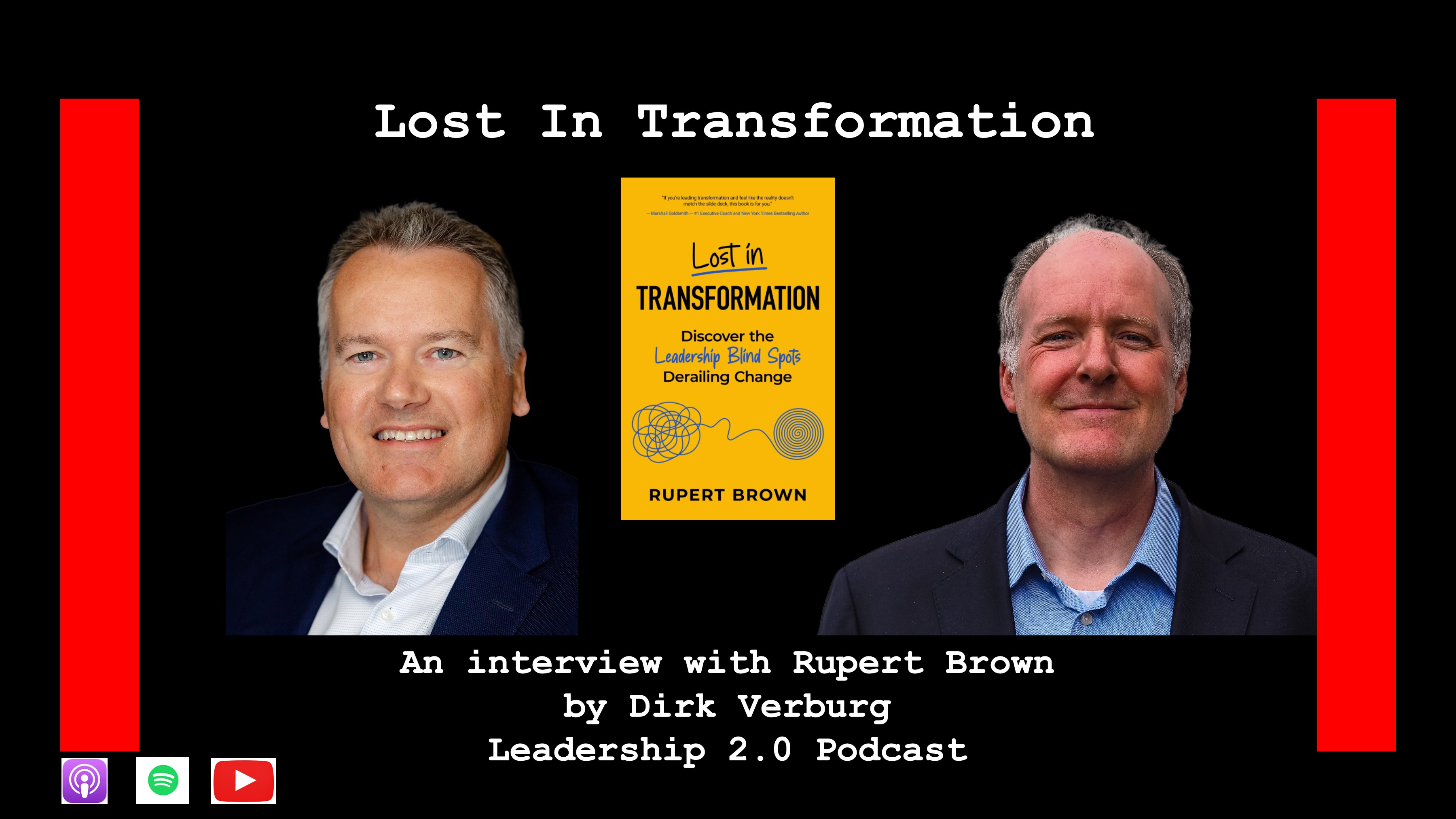
In the 35th episode of the Leadership 2.0 podcast, I sat down with a true transformation veteran, Rupert Brown, author of the eye-opening book, ‘Lost in Transformation’.

Rupert is an experienced Chief People Officer and change management specialist with deep expertise in M&A, digital transformation, and turnarounds, having advised giants like Procter & Gamble and Maersk.

This wasn’t just a discussion of tactics; it was a candid, emotionally intelligent discussion on how Transformations can be handled better.

Tune in to learn about:

  • Why Transformation projects continue to fail
  • The difference between Change and Transformation
  • The Bad Reputation of the word ‘Transformation’
  • Why we still struggle with Change Management  
  • In-Groups and Out-Groups in Change Management Processes  
  • Chief Acceleration Officers
  • Trust is Energy
  • Crises as Catalysts for Change
  • The impact of our Permacrisis on Change Management 
  • Behavioral Skills to cope with the BANI world’
  • Change Management and AI

If you’re leading a transformation—or struggling to survive one—you can’t afford to miss this. Rupert delivers the hard truths and the practical guidance needed to shift from ‘being Lost’ to becoming ‘the Leader of change’.

► You can watch or listen to a podcast with our conversation on:

Continue reading
‘ESG: Farce of Force for Good?’ – An Interview with Sander Tideman (‘Triple Value Leadership’)

‘You need to provide recyclable note paper to demonstrate the commitment of our company to sustainability’, I was told when I co-organized a meeting where the vast majority of participants arrived by airplane, most of them on intercontinental flights…

I have always been quite cynical about ESG (Environmental, Social, and Governance) and CSR (Corporate Social Responsibility) initiatives from public companies.

Some of my favorite examples include:

  • A “Big Oil” company using the “greenness” of suppliers as a selection criterion in the purchasing process
  • A Financial Services company that directly contributed to the Euro crisis but gave its employees an afternoon off to paint schools in derelict areas to “give back to society”
  • ESG leaders flying en masse to conferences in New York to discuss how to make the world a more sustainable place
  • Companies that started “recalibrating” their DEI efforts in the aftermath of the last US presidential election.

The behavior of most pubic companies in the ESG and CSR space always strikes me as ‘Do as I say, not what I do’. Not because the leaders of these companies are inherently ‘evil’ or ‘immoral’, but simply because, when push comes to shove (most often under pressure from their supervisory boards, or activist shareholders), they do not seem to have an alternative but to let Shareholder Value prevail in their decision-making process.


‘People, Planet, and Profit. But the greatest of these is Profit…’


🎙️ ‘A big conversation with big questions’, that is how Sander Tideman characterized the conversation I had with him about ESG and CSR.

Sander is a researcher, author, entrepreneur and executive coach in sustainable leadership. He works with leaders to build flourishing organizations equipped to address the unprecedented challenges of today. He has worked for and consulted with leading organizations on three continents, and is publicly known for his work with top leaders in, for instance, Unilever.

In the 31th episode of the Leadership 2.0 podcast, I interview Sander about the question if and how pubic companies and our society should adopt ESG and CSR concepts.

During our conversation, we discussed the following topics:

Continue reading

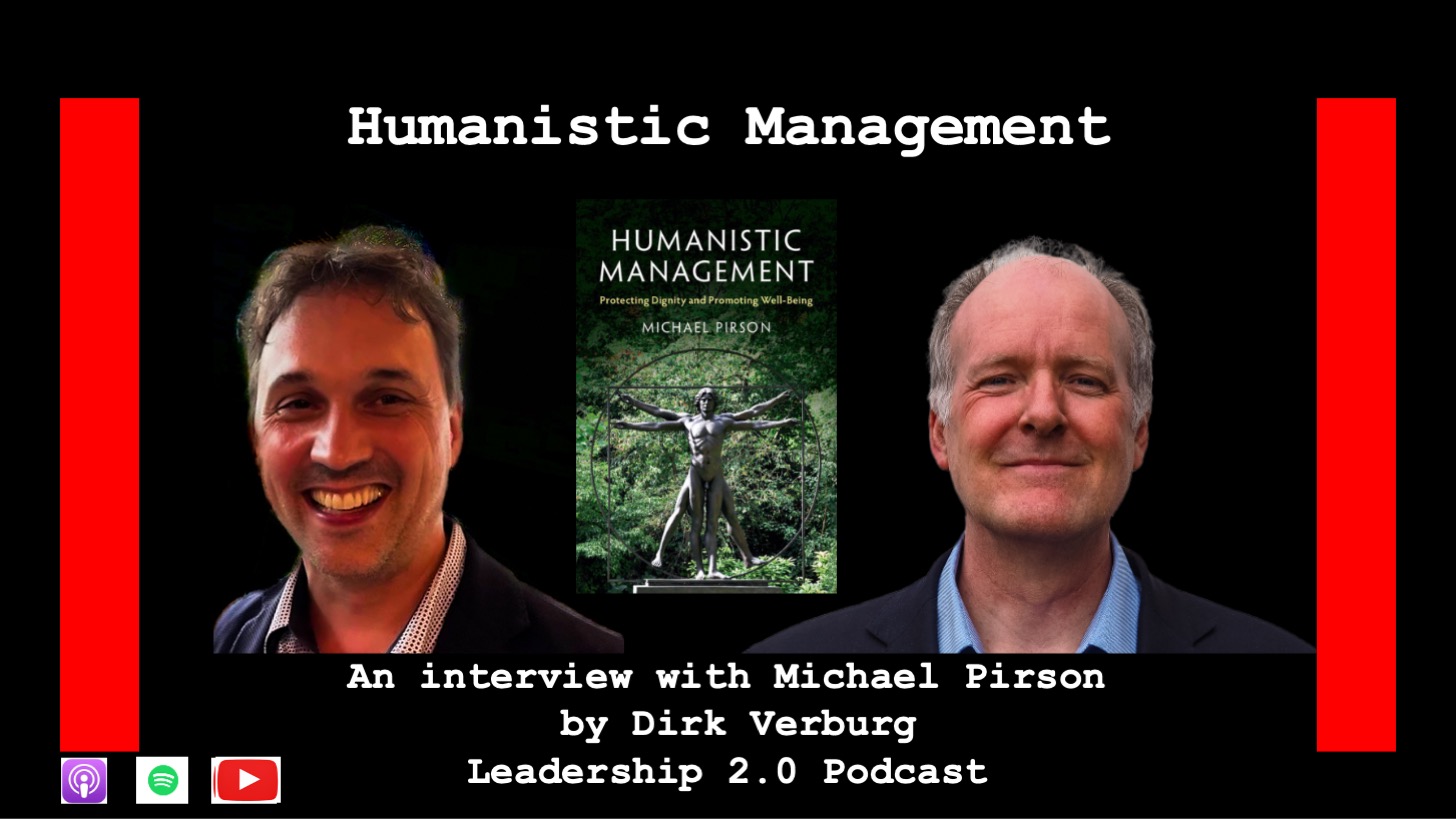
‘What is Humanistic Management?’ – An Interview with Professor Michael Pirson

‘Everyone who wins nowadays is challenging the Shareholder Value Maximization doctrine’

This is just one of the powerful and thought-provoking statements Professor Michael Pirson (Fordham University – Gabelli School of Business) made when I interviewed him about ‘Humanistic Management’.

In the last decades, the shortcomings of the neo-liberal economic order in our society have become clearer than ever (e.g. the credit crunch, climate change, and wars). An increasing number of people want to move away from a system that commoditizes human beings, and the natural environment in which they live.

They seek, amongst others, dignity, a sense of purpose, and attention to well-being, instead of material prosperity only.

Humanistic Management is a relatively young academic movement that seeks to create a more balanced relationship between those things that can be exchanged on markets and those that are not but make life worthwhile.

Michael Pirson is an active member of this movement, and in this episode of the Leadership 2.0 podcast, I discuss with him

1️⃣ What Humanistic Management is
2️⃣ How Michael discovered Humanistic Management
3️⃣ What we as mankind can learn from the Covid 19 Pandemic
4️⃣ Measuring Wealth versus Wellbeing
5️⃣ Will Shareholder Value (Economistic Management) not always prevail?
6️⃣ Is Humanistic Management industry agnostic?
7️⃣ Resources on Humanistic Management
8️⃣ Final Thoughts

👇 You can watch or listen to this podcast episode on


➡️ YouTube
➡️ Apple Podcasts
➡️ Spotify

Continue reading

‘Scenario Thinking and Leadership’ – An interview with Jeremy Bentham

Scenario thinking enables organizations to establish possible visions of the future in the form of scenarios.

These scenarios enable decision-makers to think through the different ways in which the environment of their organizations could evolve, based on different sets of assumptions. It enables leaders to ‘think through ‘a wide range of what if questions’: ‘What if the dollar…’, ‘What if China…’, ‘What if scientific developments make it possible in the near future to…’, etc. This enables them to mentally prepare themselves for possible ‘Black Swans’, and review the ability of their organization to cope with, or, iedeally, benefit from these.

One of the companies that is best known for its scenario-thinking activity is Shell. For decades, Shell’s scenarios have supported the decision-making of Shell leaders, academics, governments, and businesses.

Jeremy Bentham led this activity in Shell between 2006 and his retirement in 2022 as Shell Scenarios & strategy Leader and VP Global Business Environment.
In this episode of the Leadership 2.0 podcast, I am interviewing Jeremy Bentham about scenario thinking and leadership.

During our conversation, Jeremy and I discussed the following topics:

Continue reading

The why and how of corporate ethics – An interview with John Hollwitz

Our society is more complex than ever. For the first time since WWII two nations find themselves at war on the European continent. At the same time our economy is slowing down, inflation is on the rise, whilst technological developments in the AI space are more unpredictable than ever, and we are still trying to find out if these will be our friend or foe… 

In times like these ethics, and a sense of purpose are more important than ever. Therefore I was glad to have the opportunity to have a conversation on these topics with John Hollwitz.

John Hollwitz is a University Professor of psychology and rhetoric. Before coming to Fordham, he was the A.F. Jacobson Professor of Communications at Creighton University and dean of arts and sciences at Loyola College in Maryland. He also has been the vice president of academic affairs at Fordham.

Our interview was focused on the why and how of corporate ethics. During our conversation, we discussed, amongst others, the following topics:

Continue reading

Developing compassionate leaders – An interview with Sophia Town

Our expectations of leaders and ideas about leadership have changed dramatically in the last couple of years.

Recently I was introduced to Sophia Town, Ph.D. , an assistant professor of organizational behavior at the Gabelli School of Business of Fordham University, who is at the forefront of academic research in this area.

In the classroom, Professor Town’s curriculum is guided by the question: “How can we develop compassionate leaders in service of a flourishing world?”

SophiaTown leads Fordham’s Human Flourishing Project (FHFP), a mixed-methods, interdisciplinary research lab that explores behavioral, psychological, communicative, and spiritual development in business education. Related to this project, Dr. Town serves as a Research Affiliate and Advisory Board Member for the Human Flourishing Program at Harvard University.

During our conversation, we discussed, amongst others, the following topics:

Continue reading

Jungian analytical psychology in the Workplace – An Interview with Murray Stein

I am a big fan of the work of Carl Jung, and in my opinion the business world could really benefit from his insights. Therefore, I was pleased to have the opportunity to have a conversation with Murray Stein about applying Jungian Analytical Psychology in the workplace.

Murray Stein is a graduate of Yale University (B.A. and M.Div.), the University of Chicago (Ph.D.), and the C.G. Jung Institut-Zurich (Diploma). He is a founding member of the Inter-Regional Society of Jungian Analysts and of the Chicago Society of Jungian Analysts. He has been the president of the International Association for Analytical Psychology (2001-4), and President of The International School of Analytical Psychology (ISAP)in Zurich (2008-2012).

He published tens of books about Carl Jung and analytical psychology, including for instance ‘Jung’s Treatment of Christianity’ and ‘Jung’s Map of the Soul’.

The focus of our conversation was a book Murray edited with John Hollwitz called ‘The Psyche at work – Workplace Applications of Jungian Analytical Psychology’.

We discussed a number of topics, including:

Continue reading

What the workplace in 2021 will look like and what this means for you

2021 will be a very interesting year! If all prognoses are correct, sometime in the next six months we should have developed a grip on COVID19. 

For 2021, I foresee three trends in the workplace. Although none of these trends is initiated by COVID19, the pandemic will definitely act as a catalyst.

Continue reading

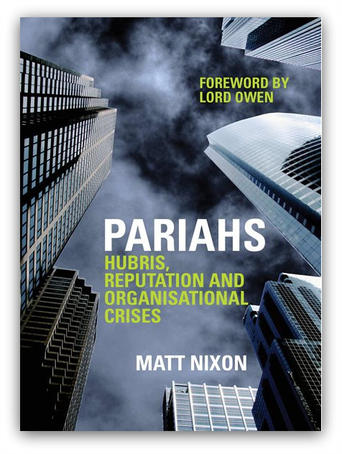
Book Review: Pariahs, Hubris, Reputation and Organizational crises

Tw Cover PariahsA ‘must read’ for the C-suite.

By Dirk Verburg

Ever since the industrial revolution, large corporations have played an important role in our society. Due to the globalization in the past decades, their influence is continuously increasing.

At the same time it seems that the number of scandals caused by these large organizations is growing as well. Established names, such as Barclays, Siemens, Wells Fargo, Ahold, VW, BP, Shell, Worldcomm, Tyco, Enron, Olympus, Arthur Anderson, E&Y, the BBC and many others, have all experienced scandals, and some no longer exist as a result.

What complicates this situation even is that governments and other institutions (e.g. regulators and ‘independent’ accounting firms) do not seem to be able to control, or at least monitor, the way companies in the private sector are operating. Continue reading