How NOT to select participants for a Leadership Development program

I recently heard an HR leader proudly explain her rigorous selection process for a basic leadership program aimed at newly appointed people leaders. She first pre-selected potential participants based on their performance ratings, then personally interviewed all the top performers. Those who passed were sent by her for a final interview with a senior business leader, and only the successful candidates were allowed to attend the training.

While I appreciated her personal involvement and the engagement of the business leader in the selection process, I do not think this is the right approach.

Continue reading

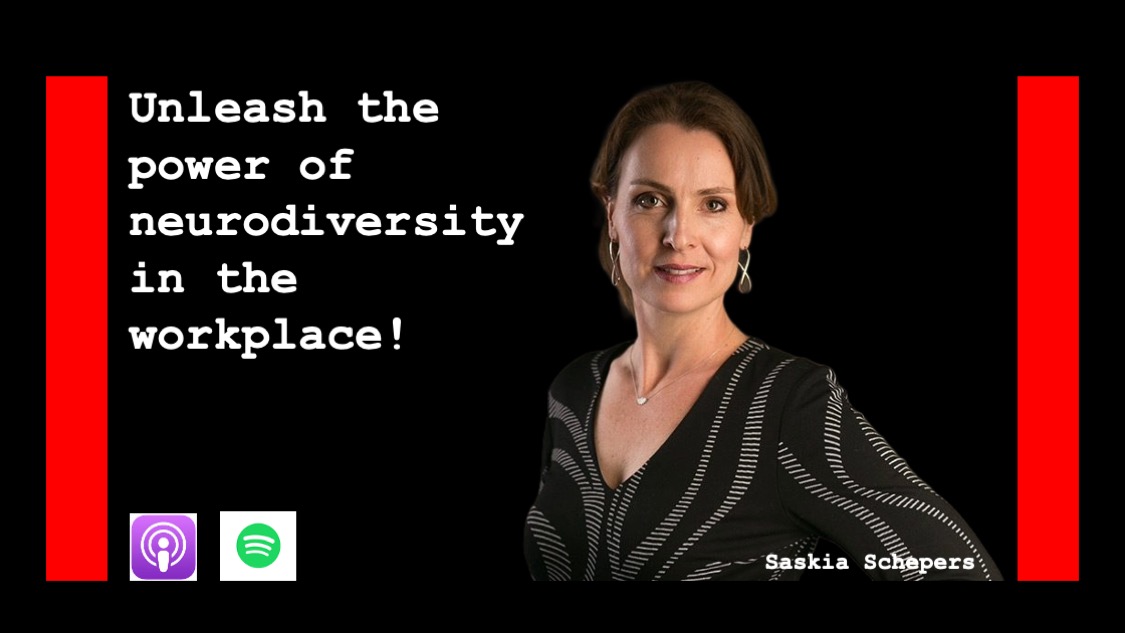
Unleash the power of neurodiversity in the workplace! – An interview with Saskia Schepers

Recently I had a conversation with Saskia Schepers about her book on Neurodiversity in the workplace with the title ‘Als alle breinen werken – Waarom ruimte voor neurodiversiteit op het werk goed is voor iedereen’ (‘When all brains are switched on – Why space for neurodiversity in the workplace benefits everyone’).

Around 80% of mankind is neurotypical, and 20% is neurodivergent. We tend to ‘equip’ people in the latter category with labels like ADD, DHD, bipolar, autistic, etc.

Most leaders find it hard to integrate neurodivergent people in their teams.

The reason is that most of us have preconceived ideas about the way people in the workplace should behave. For instance, we expect people to like attending and participating in meetings, do their work in teams, be productive in open-plan offices, and socialize with their colleagues after work.

People who do not fit this mold are seen as bad ‘team players’, and are often criticized for this behavior, e.g. during annual performance review meetings.

In her book, Saskia Schepers describes what neurodiversity is, what the strong points of different types of neurodivergent people are, and how, as an organization, you can integrate neurodivergent people and capitalize on their strengths.

The book almost immediately reached the number 1 position in the Dutch bestseller list of management books, was quickly sold out, and is now in its third printed edition.

An English translation is in the making and will be published in 2024.

During our conversation, we discussed the following topics:

Continue reading

Your wellbeing: why a personal mission is more important than a position

What do the notorious former marketing director of American Apparel, Ryan Holiday, and renowned Dutch reformed theologian Bram van de Beek have in common? They both have written a book about the danger of egocentricity. 

Social media…are not to blame

Social media offers endless possibilities to promote ourselves and serve as outlets for our vanity. It enables us to humble brag about our professional achievements on LinkedIn, share evidence of our successful ‘friends & family’ life on Facebook, and demonstrate our cutting-edge lifestyle on Instagram. 

However, looking at our current society and world history, it seems we as human beings always have been prone to self-centeredness and self-promotion. Social media therefore merely enables us to express something that is already deeply rooted in us.

Continue reading

Three design principles for Leadership Development

In the last three decades, the business world has become more complex than ever before. This complexity is mainly driven by two factors:

  • Globalization – Never before in the history of mankind have materials, capital and people moved faster and more freely across our planet
  • Technology – The amount of data we have at our disposal for decision-making is dramatically increasing each year, and AI is providing us with the tools to do this faster and more effective than ever.

As a result, our world has become more interconnected and interdependent than ever. A case in point are the supply chain issues businesses experienced in the initial stage of the COVID-19 pandemic.

This interconnectedness and interdependence has huge implications for the way organizations need to operate, both externally as well as internally.

Continue reading

Why leadership has become more difficult and why this matters

I spent a significant part of my working life developing leaders in organizations. What strikes me is that during COVID-19 the demand for this type of work has not decreased; if anything, the demand for leadership development has increased. That is remarkable. During the financial crisis in 2007-2008, for instance, most companies tried to save money, and one of the first things they considered was decreasing the out-of-pocket costs associated with these, and other kind of developmental activities.

Recently I was asked why companies continue to invest in the quality of their leadership at all levels of the organizations, despite the economic uncertainty they are facing.

In my opinion, the reason is that companies have come to realize the growing importance of the quality of leadership at all levels of the organization. I believe that this is a good thing, especially because leadership roles have become more demanding in the last couple of decades, not only for senior leaders, but also for first, and second-level leaders in organizations. 

Continue reading

The Negative Feedback Paradox

Let me start with a confession:I never liked receiving negative feedback, and have spent the largest part of my professional life ignoring it.

I found ignoring negative (or perhaps I should euphemistically say ‘corrective’) feedback to be quite easy. Depending on the situation, I either did not take the person who gave me feedback seriously (‘that is rich – from him?’), comforted myself that the feedback concerned only a minor issue in the grand scheme of my behavior (and that other aspects of my behavior would compensate this), or convinced myself that the person giving me feedback did not understand the context in which I acted the way I did or said the things I said.

It was not until I hit a serious roadblock in my career, that I started to see the fact that systematically ignoring feedback was not necessarily a great idea. 

Continue reading

Adopting a growth mindset requires critical self-reflection from leaders

HC Gage Skidmore

Critical self-reflection is difficult to acquire, but extremely important for leaders

By Dirk Verburg

For several reasons I love reading autobiographies of leaders in business and politics. The first reason is plain curiosity: the possibility to take a look behind the stage of well-known events. The second reason is because these autobiographies provide a unique opportunity to understand decision making processes from the perspective of the decision makers. Why did they take certain decisions in specific situations? Were they aware of certain developments? From whom did they obtain advice? What was the role of important stakeholders? etc. Continue reading

Three imperatives for Talent Management in a VUCA world

Talent management originates from the late 1960s. Since then the business environment has changed dramatically. However, talent management practices in many organizations have not been adapted to cope effectively with these changes. This makes these organizations vulnerable to disruptions in their environment. Talent managers should therefore do three things to ensure their businesses have the necessary adaptive and innovative capabilities to cope with disruptions.

Almost 50 years ago, in 1968, Paul S. Ostrowski published an article with the title “Prerequisites for Effective Succession Planning”. This article is often seen as the starting point for Talent Management. The business environment at that time looked completely different from today:

Continue reading

Why I feel sorry for Donald Trump

By Dirk Verburg

How you can prevent pursuing the wrong role and what you can do if you find yourself in one.

Trump Skidmore
Photo by George Skidmore

No – this is not the title of yet another ‘Trump-bashing’ article, but a genuine empathetic feeling I have for Donald Trump. I already suspected for a long time what Donald Trump recently admitted, namely that he finds the job of being president of the US harder than he expected. The reason I feel sorry for Donald Trump is that I think he might have made a mistake a lot of us are prone to. It is the mistake of applying for a prestigious job, without a proper vision as to what the actual content might be and without honestly reflecting whether this content plays to our strengths and will keep us engaged in the future.

Why people pursue roles that do not fit them Continue reading