
Book Review: ‘What’s Your Type?’ – The history of the MBTI

Because I extensively use the MBTI when coaching executives, and because of my general interest in the work of the Swiss Psychiatrist Carl Gustav Jung (1875-1961), I was looking forward to read ‘What’s Your Type? – The Strange History of Myers-Briggs and the Birth of Personality Testing’ by Merve Emre.

For those not familiar with the Myers-Briggs Type Indicator (MBTI), the MBTI has been developed by Katherine Briggs (1875-1968) and her daughter Isabel Myers (1897-1980) on the basis of Jung’s Personality (‘Type’) Theory. It enables the categorization of individual personalities in 4 dimensions, resulting in the (well-known) 16 different ‘types’ (e.g., ‘ISTJ’ or ‘ENFP’).

Function PreferencePreference
Energy I – Introversion (ideas) E – Extroversion (people)
Perception S – Sensing (data) N – Intuition (intuition)
Judgment T – Thinking F – Feeling
Attitude towards outside world J – Judging P – Perceiving

Until a decade ago, the MBTI was one of the most popular personality assessment instruments, and, although it is far less popular today than it used to be, it is still extensively (ab)used.

For this reason, I was very curious to read the book. Unfortunately, I found it a mixed bag.
What I do not like about this book

Continue reading

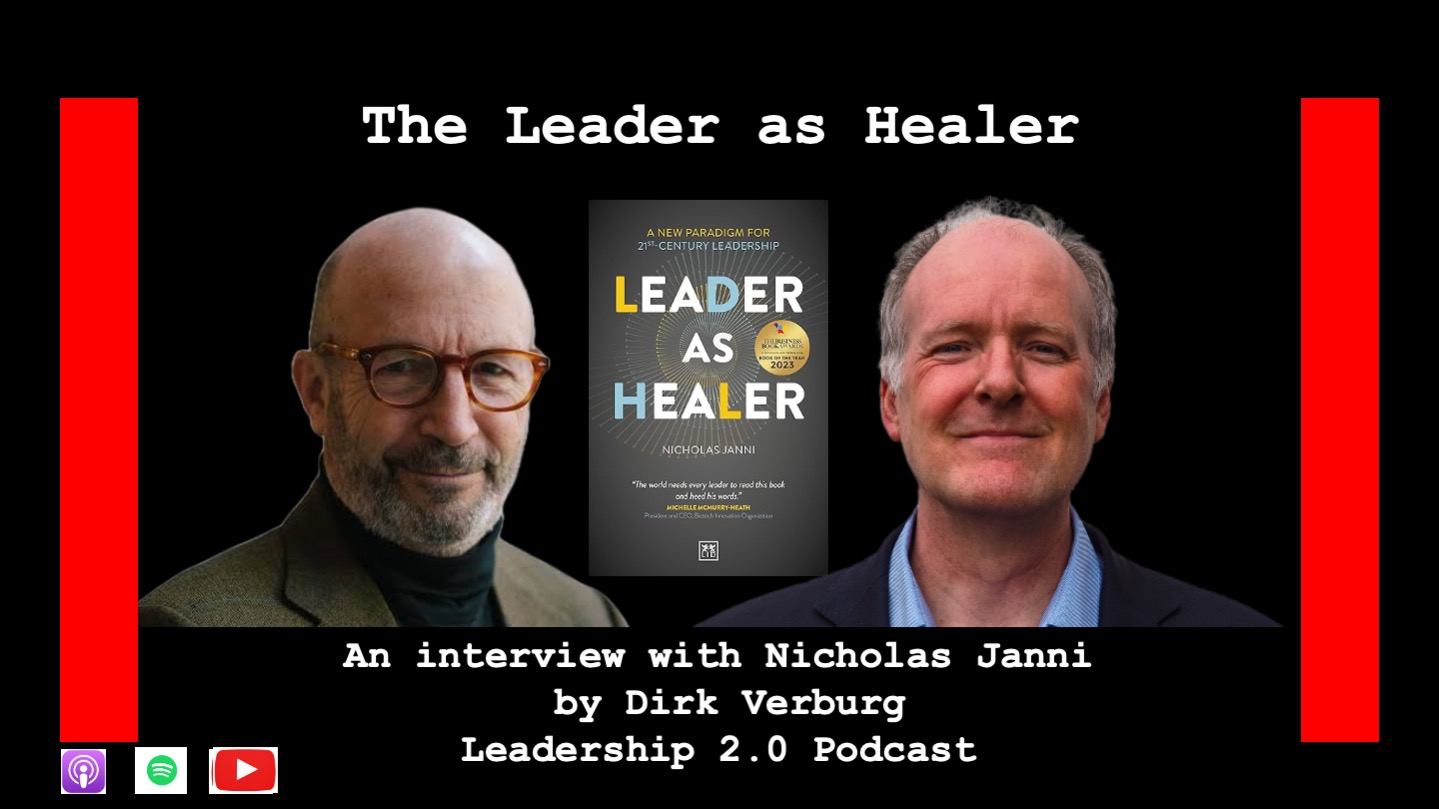
‘The Leader as Healer’ (Business Book of the year 2023) – An interview with Nicolas Janni

‘A transformational read that every leader of today needs’.

These were the words Head Judge, Jacq Burns used when she announced that ‘Leader As Healer’, written by Nicholas Janni was selected as the overall winner for the 2023 Business Book Awards.

In his book, Nicolas Janni argues that we need a new leadership model to address the challenges our society faces.

Our current leadership model is one where we see great leaders as warriors ‘on the battlefield of relentless competition’, who drive action, pursue instrumental (shareholder value related) goals, and maintain transactional relationships.

Instead, Nicholas Janni pleads for leaders who are empathetic, intuitive, present, skilled in mindfulness and deep listening, and who can inspire colleagues to engage and collaborate.

In this episode of the Leadership 2.0 podcast, I discuss with Nicholas:

Continue reading

Church Politics: The three organizational challenges congregational churches face

Applying Mintzberg’s concept of Community Ships

Recently I interviewed Henry Mintzberg about his latest book ‘Understanding Organizations…Finally!: Structuring in Sevens’. Central in Henry Mintzberg’s work about organizations is the question how they organize themselves to get work done.

Although his research and examples largely originate from organizations in the private and public sector, in his latest book he also describes a special kind of organization that does not fit into one of these categories: ‘The Community Ship’.

According to Mintzberg, Community Ships have the following characteristics:

  • Their culture forces the community to pull together
  • Members of the community are considered to be more than employees
  • The community is tightly knit and operates differently from other organizations in their environment (like a ship at sea).
  • The community closes ranks to protect itself from influences from the outside world, or use its position for evangelism (‘to launch missives at whatever they want to change on shore’.)

Congregational church communities as Community Ships

In this post I apply Mintzberg’s concept of ‘Community Ships’ to congregational church communities.

Continue reading

Boost your personal productivity with these tips from five experts

Steve Jobs said focusing “means saying no to the hundred other good ideas.”

Focusing is not something that comes naturally to me. Personally, I see opportunities everywhere around me, have a better eye for the upsides than for the downsides of these opportunities, and am blessed (cursed?) with a healthy degree of FOMO…

Therefore, I decided to make focusing my new-year resolution for 2023. 

For starters, I ordered five popular books of experts in the area of personal productivity in general, and more specifically on focusing.  

In this post, I will share my takeaways from their books. One word of warning: these are my personal takeaways – no mini-reviews! If you are looking for these, I highly recommend you to look them up on goodreads.com. 

Continue reading

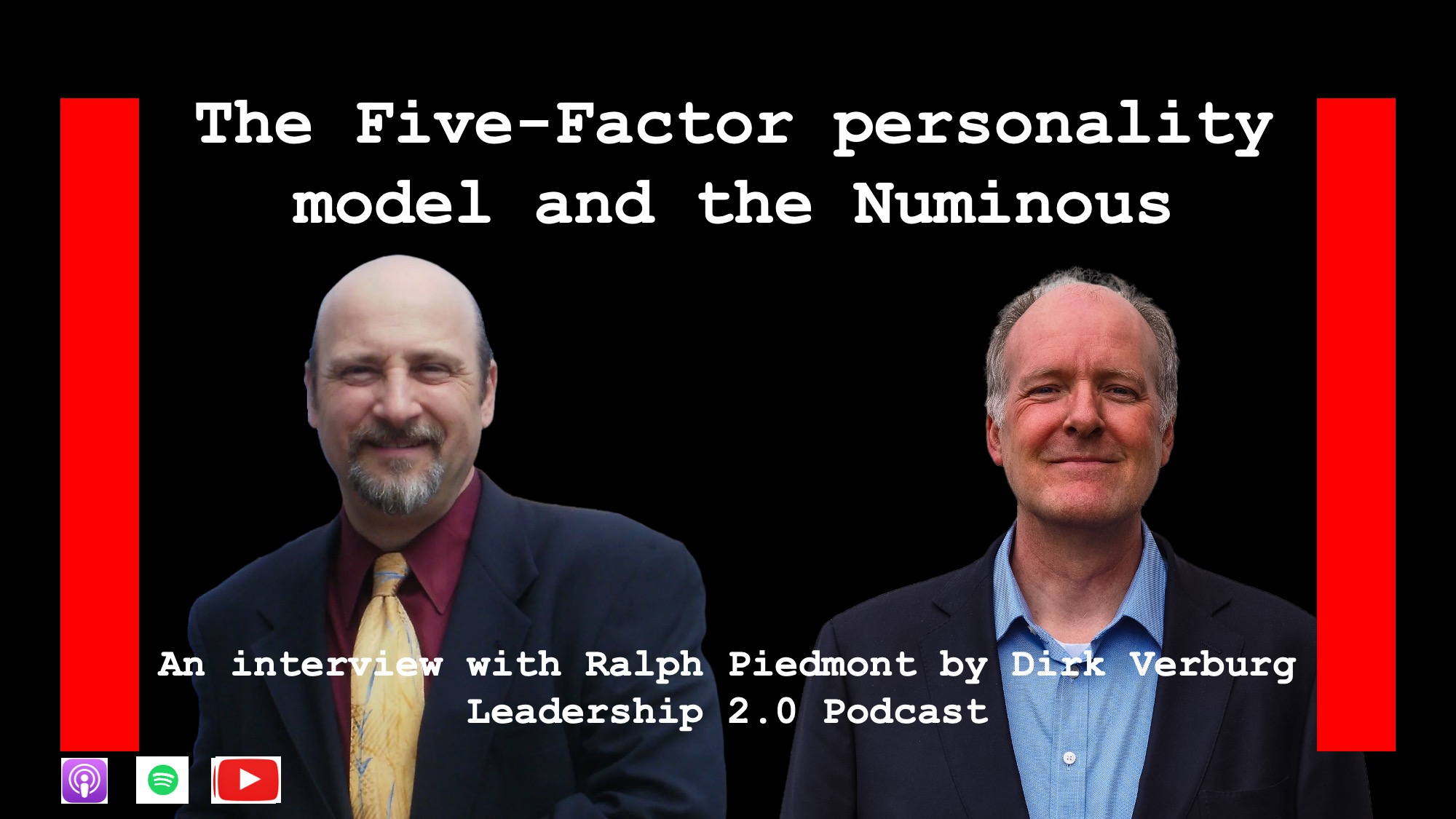
The Five-Factor Personality Model and the Numinous – An interview with Ralph Piedmont

Current thinking in Psychology is that there are five dimensions we can use to describe the most important personality dimensions. Dr. Ralph Piedmont discovered the 6th one: ‘the Numinous’.

The five-factor model of personality (FFM) is a set of five broad trait dimensions or domains, often referred to as the “Big Five”: Extraversion, Agreeableness, Conscientiousness, Neuroticism (sometimes named by its polar opposite, Emotional Stability), and Openness to Experience (sometimes named Intellect). The Big Five/FFM was developed to represent as much of the variability in individuals’ personalities as possible, using only a small set of trait dimensions. Many personality psychologists agree that its five domains capture the most important, basic individual differences in personality traits and that many alternative trait models can be conceptualized in terms of the Big Five/FFM structure (www.oxfordbibliographies.com).

Dr. Ralph Piedmont discovered the 6th factor: the Numinous.

During our conversation, Ralph and I discussed the following topics:

Continue reading

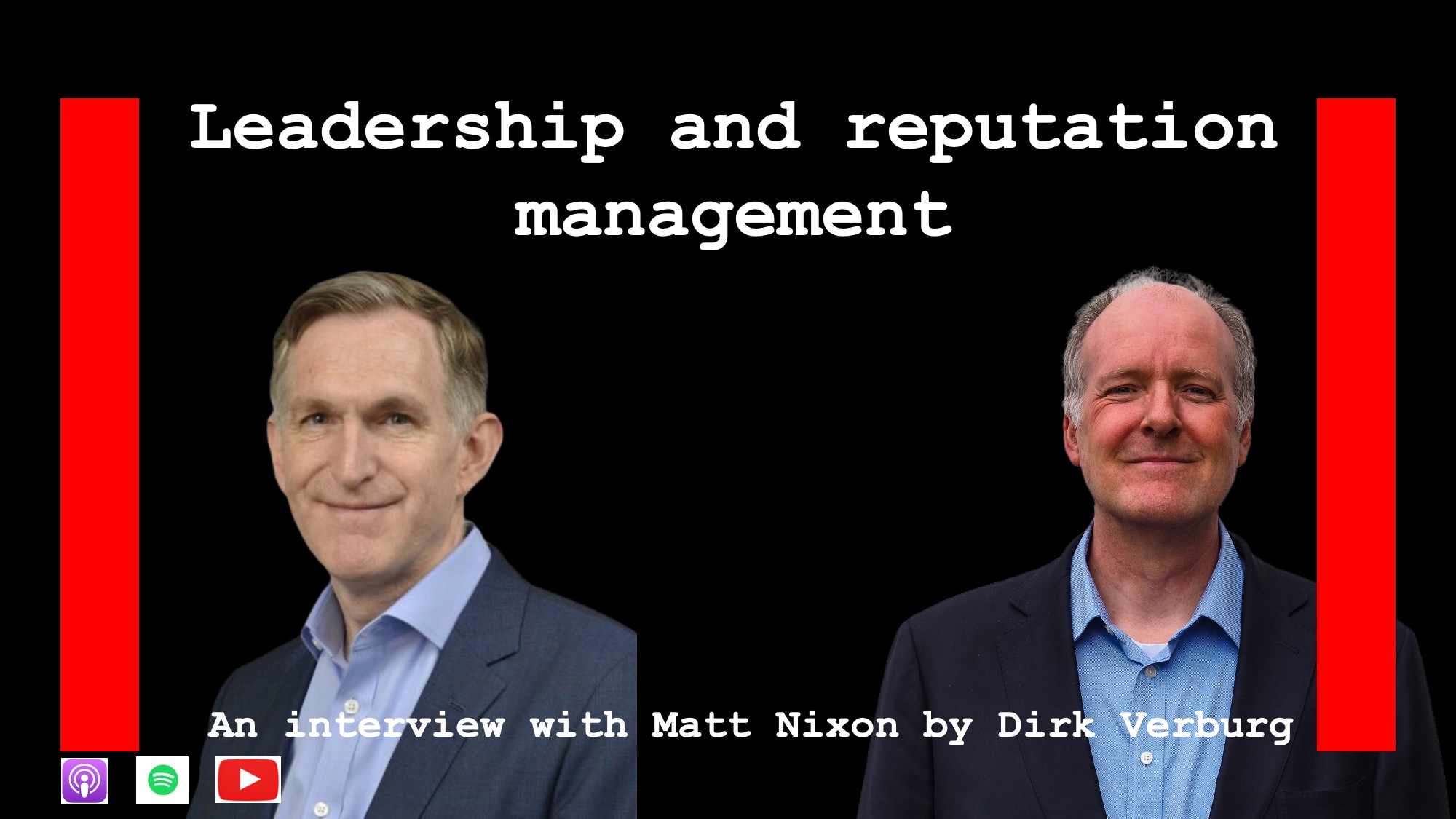
‘Leadership and reputation management’ An interview with Matt Nixon

‘The real problem of humanity is the following: we have Paleolithic emotions, medieval institutions, and god-like technology’.

With this quote from Edward O. Wilson 1929 Matt Nixon answered my question if our requirements about leadership have changed in the last decades. 

Matt Nixon has more than 30 years of experience as a management consultant and HR executive, working with CEOs and senior leaders around the world. An Oxford classics graduate, he was a partner in Towers Perrin in Chicago and London, and subsequently held the positions of Global Head of Organization Effectiveness for Royal Dutch Shell, and Managing Director, Group Head of Talent for Barclays, before returning to the consulting industry.

Nowadays Matt works as a partner in a specialized consulting boutique where he coaches and advises CEOs and other senior leaders during career transitions and other periods of change and transition.

Matt has written and taught extensively on hubris in executives.

During our conversation, Matt and I discussed the following topics:

Continue reading

For when I am weak, then I am strong – Authentic Self-Confidence

‘We read to know we’re not alone’ said actor Anthony Hopkins, playing the character of author C.S. Lewis, in the movie ‘Shadowlands’. 

People suffering from the imposter syndrome doubt their abilities and feel like a fraud at work.I personally suffered quite a bit from the ‘imposter’ syndrome in the past, and at times experience serious relapses. 

Fortunately, it turns out I am not the only one!

After reading ‘Authentic Self-Confidence’ by Jacqueline Brassey, Nick van Dam and Arjen van Witteloostduijn, I realize I am part of a large community that includes successful (and sometimes well-known) academics, surgeons, management consultants and senior executives.

Lack of Authentic Self-Confidence can lead to sub-optimal performance (e.g. because individuals feel constrained to bring the best version of themselves at work), which can have negative emotional impact on themselves, their families, teams and organizations. Therefore a high-quality publication on this topic is extremely welcome.

There are three reasons why I full-heartedly recommend this book.

Continue reading

Why do smart people make wrong decisions?

The most important part of leadership is making decisions. Decisions about products and markets to invest in, people to hire and to promote, IT-systems to select, to continue or terminate projects plagued by setbacks, mergers & acquisitions, etc. These decisions determine the success or failure of organizations, projects and individuals. 

Ever since my graduation in the field of Sociology, I have always been very interested in the topic of decision making in organizations. At university, I loved the lectures of Professor Lawler about concepts like bounded rationality. I also loved reading books on this topic, including ‘Essence of Decision’ (about decision making in the Kennedy administration during the Cuban missile crisis) and Barbara W. Tuchman’s classic ‘March of Folly’.

Do we really need another book on this topic?

Against this background, I was a bit concerned when my friend and former PA Consulting Group colleague Wim van Hennekeler, told me that he was writing a book about decision making. This was mainly due to my concern about whether he could possibly add value to the vast body of work that was already published on this topic.

Continue reading

Pump up the volume: why business books often are too voluminous!

Time-efficient alternatives for reading business books

During my years in college, one of the first rap songs that became extremely popular was ‘Paid in full’ from Eric B & Rakim in the Coldcut mix. Its signature ingredients contained the soundbite ‘Pump up the volume’. 

‘Pump up the volume’ also was the phrase that resounded in my head when I recently read ‘Rebel Talent – Why it Pays to Break the Rules at Work and in Life’, a bestseller written by Francesca Gino, a well-known Harvard Business School professor. The entire book is based on a single concept that could easily have been explained on one single page.

Instead, the author used more than 230 pages, which cost me the better part of a Sunday to read…

Why I like reading business books

I like reading business books for four reasons:

  1. To satisfy my intellectual curiosity
  2. To help me to make sense of what I personally observe about the way organizations ‘work’ (or not!)
  3. To enhance my skills 
  4. To keep me ‘current’

Why I am often disappointed after reading them

However, more often than not, I feel reading them is not the most efficient use of my time. The reason why is that (like the example mentioned at the beginning of this post), business books often try to expand ideas and concepts that could be explained in a couple of pages to the size of a book. This almost always means they need to cross the magical border of 200 pages.

I think this phenomenon is caused by the fact that business books mean ‘business’. Although it is not easy to gain insight into the market for business books, creatively extrapolating existing statistics indicate that each year more than tens of millions of business books are sold across the world. Therefore, the market for business books might be around one billion dollar. NB: This estimate excludes the sales of textbooks for higher education.

Continue reading

Mindf*ck: Politics, Psychology and Social Media

In 2018, the Cambridge Analytica scandal shocked the world. It became clear that Cambridge Analytica had used data from tens of million Facebook users, to influence the elections in the US, and the Brexit referendum

Continue reading

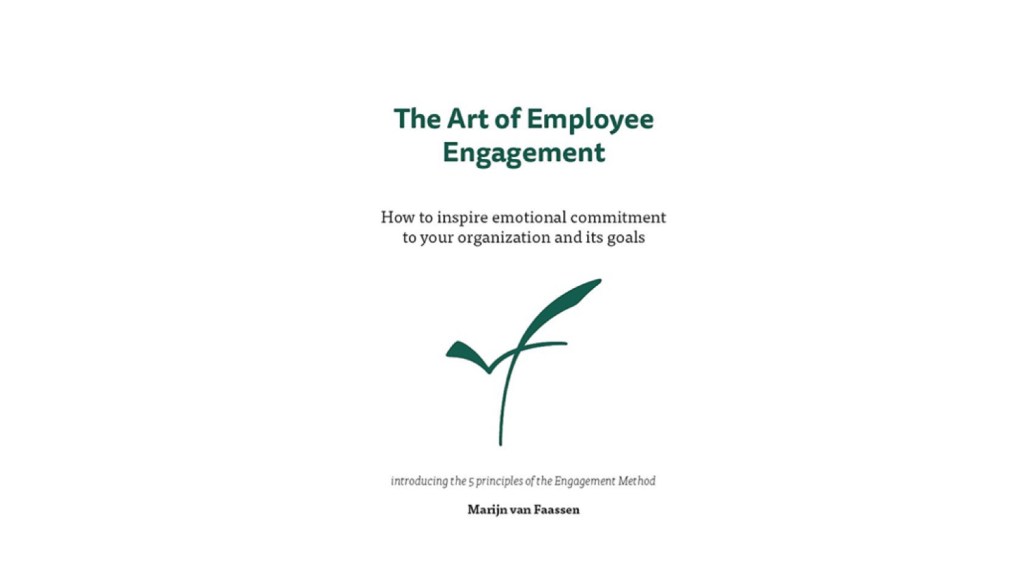
The Art of Employee Engagement (Book Review)

Employee engagement is a topic close to my heart. In the past two decades I have designed, managed and implemented the findings of engagement surveys multiple times, and also managed to write an article with my point of view on how to make them ‘work’.

Given my interest in this topic, I was very pleased to receive a copy of ‘The Art of Employee Engagement’ by Marijn Faassen. I read it in one go, because I found it a fascinating read, for a number of reasons:

Continue reading

Decision making for a new Decade

Every year millions of people around the world make New Year’s resolutions. Given that we are currently starting the 2020’s, we have the exciting opportunity to make resolutions for a whole new decade!

I decided to make mine around decision making. The reason for this was the fact that I had the opportunity to read ‘Unlocking Leadership Mindtraps – How to thrive in complexity’ by Jennifer Garvey Berger during the Christmas vacation.

One of the key notions in this book is that the world has become much more interconnected and therefore more complex. Unfortunately, our decision-making skills are ‘brilliantly designed – for an older, less connected, and more predictable version of the world’. In this context, Jennifer Garvey Berger mentions five mind traps we can find ourselves in, one of them being trapped in ‘Simple stories.

Continue reading

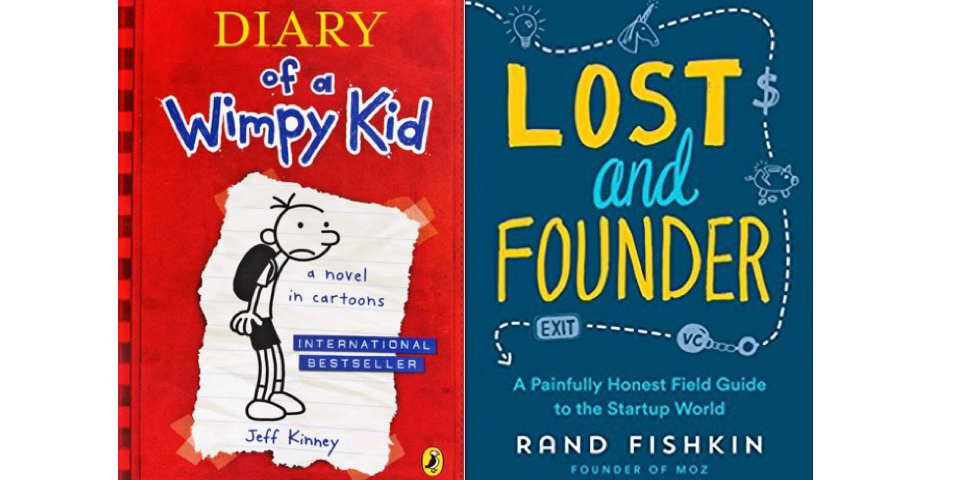
Unleash the Wimpy Kid!

illustration managing the wimpy way-1

Why I consider ‘Lost and Founder’ by Rand Fishkin to be a must read

At the beginning of my career, I managed a high profile ERP project. A couple of weeks before the go-live deadline, the customer introduced completely new requirements but did not want to shift the deadline. Needless to say, this significantly compromised the amount of time available for testing, something every available textbook warns one about. However, due to a combination of intimidating behavior of the customer, my own unwarranted optimism and lack of experience, I agreed to implement these new requirements and limit the amount of time available for testing. A decision which resulted in a rather ‘volatile’ go-live scenario which was highly visible for everyone in the company…

It is common wisdom that we learn more from our mistakes than from our successes. If anything, success has a tendency to make us complacent, whereas mistakes force us to take a step back, reflect on why our actions and behaviors did not work out as planned, and stimulate us to make changes in the way we approach opportunities and challenges.

Continue reading

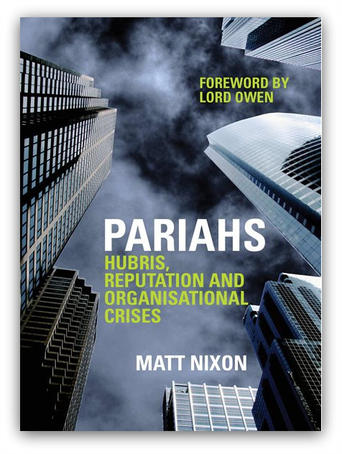
Book Review: Pariahs, Hubris, Reputation and Organizational crises

Tw Cover PariahsA ‘must read’ for the C-suite.

By Dirk Verburg

Ever since the industrial revolution, large corporations have played an important role in our society. Due to the globalization in the past decades, their influence is continuously increasing.

At the same time it seems that the number of scandals caused by these large organizations is growing as well. Established names, such as Barclays, Siemens, Wells Fargo, Ahold, VW, BP, Shell, Worldcomm, Tyco, Enron, Olympus, Arthur Anderson, E&Y, the BBC and many others, have all experienced scandals, and some no longer exist as a result.

What complicates this situation even is that governments and other institutions (e.g. regulators and ‘independent’ accounting firms) do not seem to be able to control, or at least monitor, the way companies in the private sector are operating. Continue reading