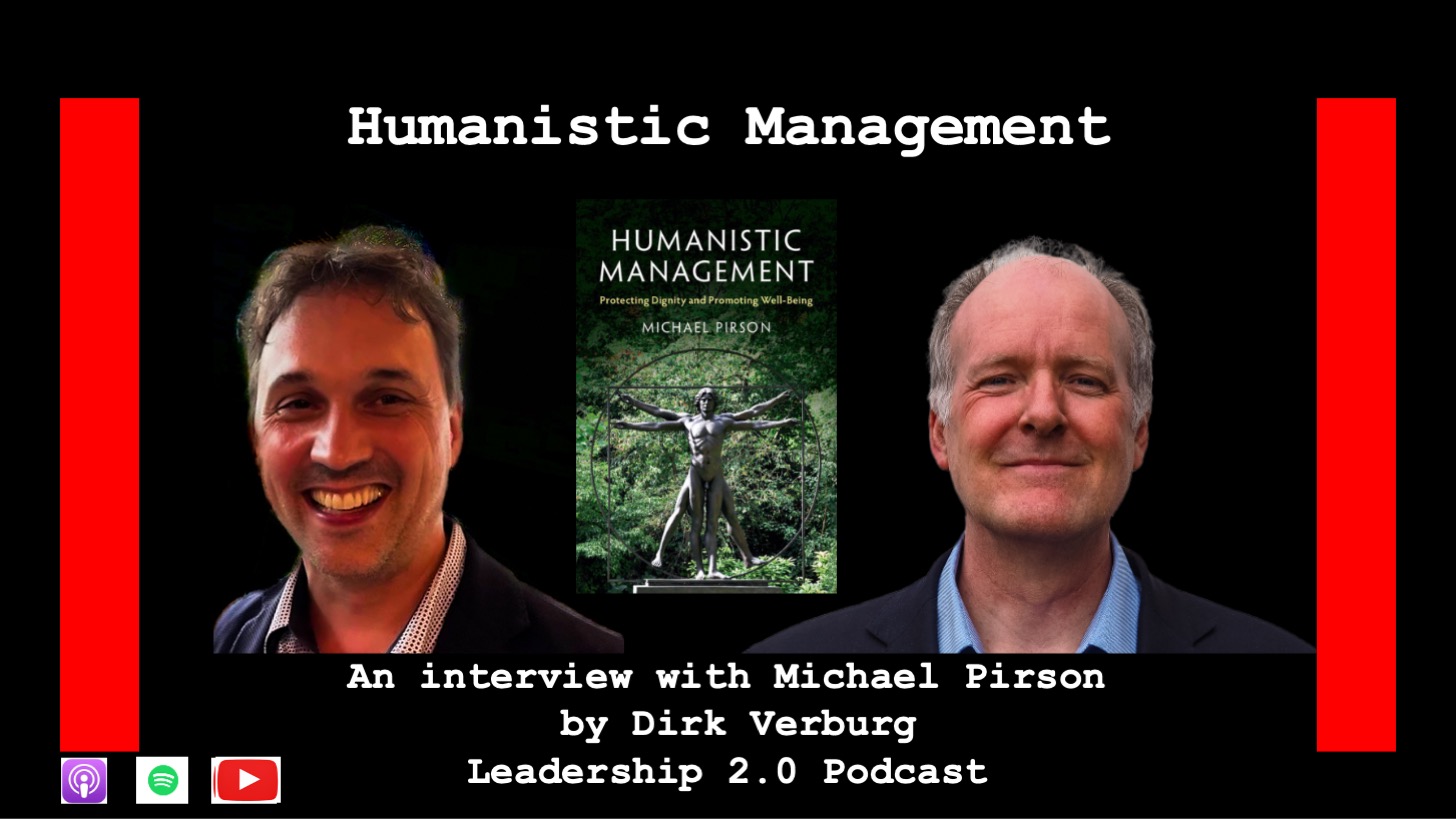
‘What is Humanistic Management?’ – An Interview with Professor Michael Pirson

‘Everyone who wins nowadays is challenging the Shareholder Value Maximization doctrine’

This is just one of the powerful and thought-provoking statements Professor Michael Pirson (Fordham University – Gabelli School of Business) made when I interviewed him about ‘Humanistic Management’.

In the last decades, the shortcomings of the neo-liberal economic order in our society have become clearer than ever (e.g. the credit crunch, climate change, and wars). An increasing number of people want to move away from a system that commoditizes human beings, and the natural environment in which they live.

They seek, amongst others, dignity, a sense of purpose, and attention to well-being, instead of material prosperity only.

Humanistic Management is a relatively young academic movement that seeks to create a more balanced relationship between those things that can be exchanged on markets and those that are not but make life worthwhile.

Michael Pirson is an active member of this movement, and in this episode of the Leadership 2.0 podcast, I discuss with him

1️⃣ What Humanistic Management is
2️⃣ How Michael discovered Humanistic Management
3️⃣ What we as mankind can learn from the Covid 19 Pandemic
4️⃣ Measuring Wealth versus Wellbeing
5️⃣ Will Shareholder Value (Economistic Management) not always prevail?
6️⃣ Is Humanistic Management industry agnostic?
7️⃣ Resources on Humanistic Management
8️⃣ Final Thoughts

👇 You can watch or listen to this podcast episode on


➡️ YouTube
➡️ Apple Podcasts
➡️ Spotify

Continue reading

How to ensure successful leadership transitions – An interview with Michael Watkins

The statistics are sobering: not only do 49% of external executive hires end in failure within 18 months, but internal moves prove to be challenging as well. For instance, 40% of internal job moves involving high potentials also end in failure.

Besides the fact that these failures often have a traumatic impact on the individuals involved, the costs for the organisations are huge. Not only in terms of image and hiring costs but, more importantly, in terms of opportunity costs.

To find out why leadership transitions prove to be so hard, and what companies and individuals can do about it, I interviewed Michael Watkins for my Leadership 2.0 podcast.

Continue reading

‘Scenario Thinking and Leadership’ – An interview with Jeremy Bentham

Scenario thinking enables organizations to establish possible visions of the future in the form of scenarios.

These scenarios enable decision-makers to think through the different ways in which the environment of their organizations could evolve, based on different sets of assumptions. It enables leaders to ‘think through ‘a wide range of what if questions’: ‘What if the dollar…’, ‘What if China…’, ‘What if scientific developments make it possible in the near future to…’, etc. This enables them to mentally prepare themselves for possible ‘Black Swans’, and review the ability of their organization to cope with, or, iedeally, benefit from these.

One of the companies that is best known for its scenario-thinking activity is Shell. For decades, Shell’s scenarios have supported the decision-making of Shell leaders, academics, governments, and businesses.

Jeremy Bentham led this activity in Shell between 2006 and his retirement in 2022 as Shell Scenarios & strategy Leader and VP Global Business Environment.
In this episode of the Leadership 2.0 podcast, I am interviewing Jeremy Bentham about scenario thinking and leadership.

During our conversation, Jeremy and I discussed the following topics:

Continue reading

Why ‘The rest is politics’ is my favorite Podcast

According to Moises Naim, polarization, together with populism and post-truths, is one of the three p’s undermining democratic societies.

Observing the public debate, which is becoming more and more polarized, it seems we are losing our ability to talk with people who have other opinions. Instead, we talk about them.

We try to classify people who have a different opinion than us, with a label. Once this label has been issued, we feel we do not have to enter in debates with them anymore. On the contrary, we try to prevent debates, since this would provide our opponents with an opportunity to share their opinions.

The difficulty however is that the effectiveness of human societies depends on our ability to cooperate and reconcile our differences. 

Continue reading

Censorship, social media, and self-confident societies

The Power of debate in the public domain

The invention of the printing press proved to be a pivotal point in the development of our society because it enabled the dissemination of ideas and information at an unprecedented pace. It is unlikely that, without the printing press, the Reformation in the 16th century would have had such a huge impact, so quickly.

In the 20th century, radio and television increased the speed of information even more. It is likely that the public opinion about the war in Vietnam (the first television war) changed significantly as a result of the coverage of this war on television.

Social media emerges

No wonder that many governments tried to control these media, either in the form of censorship, or by creating monopolies for news dissemination (e.g in the former Soviet Union).

At the end of the 1990s, social media platforms started to emerge, disrupting the traditional media landscape of newspaper, radio, and television organizations. 

Continue reading

Mindf*ck: Politics, Psychology and Social Media

In 2018, the Cambridge Analytica scandal shocked the world. It became clear that Cambridge Analytica had used data from tens of million Facebook users, to influence the elections in the US, and the Brexit referendum

Continue reading

Corporate Social Responsibility starts with looking after your own employees

A couple of days ago my bible app opened with this verse of the day: ‘To do righteousness and justice is more acceptable to the LORD than sacrifice’ (Proverbs 21:3). 

This text reminded me of the way some companies deal with Corporate Social Responsibility (CSR). Rather than doing the right thing, they do the wrong thing and compensate for this by deploying CSR initiatives. There is even a special term describing this phenomenon: ‘Greenwashing’. In this context, it is no wonder that two professors from IMD (a leading Swiss Business School) published an article in 2018 with the provocative title: ‘Why nobody takes corporate social responsibility seriously’.

Continue reading

Dietrich Bonhoeffer: Walking the talk

I always felt a deep respect for people who take personal risks in daring to confront oppression in a peaceful manner. Names like Mahatma Gandhi, Vaclav Havel and Andrei Sakharov spring to mind.

This Easter I especially think of German Lutheran theologian Dietrich Bonhoeffer (1906-1945), who was executed 75 years ago because of his active resistance against the German Nazi regime at that time.

Congruence between ideals and personal life

Continue reading

The European Union should review its strategy

The importance of the EU is increasing, but its continuity is threatened by the actions and behaviours of its own leaders

Picture EU article

By Dirk Verburg

European cooperation is now more important now than ever

To state the obvious: we are living in a VUCA world, a world that is Volatile, Uncertain, Complex and Ambiguous. The world order as we know it seems to be threatened by multiple problems, including (in arbitrary order): the nuclear ambitions of North Korea, the geo-political ambitions of China, wavering loyalty of the current US president regarding NATO, Climate Change, the Refugee crisis, the rise of populism in Western Democracies and Muslim extremism, to name but a few.

Given the nature and scale of these challenges, European countries have a far better chance to achieve a successful outcome if they deal with these challenges jointly, rather than individually.

EU politicians are ignoring warning signals about the lack of support of the EU by their voters Continue reading