
Have you ever considered taking a stimuli-rich holiday?

For a number of people, the summer holidays represent the mental equivalent of an oasis in a desert: a perfect opportunity to temporarily escape their daily grind and the stress of their work.

Although holidays are a fairly new invention in the history of mankind, and actually only a privilege for a, largely Western Europe-based, minority of the workforce, we ascribe almost magical powers to them. The most important ‘super’ power is the one that suggests that if we take one or more weeks off and label this ‘a holiday’, we are fully relaxed and ready to face our challenges in the workplace again.

Switching off?

However, many people find it hard to mentally switch off from their work during their holidays. Usually, they spend the first days of the holidays decompressing from their work, and they switch back on a couple of days before their work starts again.

I firmly belonged to this category as well.

Continue reading
The Company Culture of On – An interview with Alessandra Del Pino

There are some companies I deeply admire, and On, the Swiss sports and apparel brand is definitely one of them! Not only do they make amazing products and have an extremely powerful brand, they also have a unique company culture.

For this reason, I was thrilled to sit down with Alessandra Del Pino, Head of Engagement & Talent Growth at On, to discuss the company culture of On, or, as Alessandra describes it, their ‘secret sauce’.

During our conversation, we covered the following topics:

Continue reading

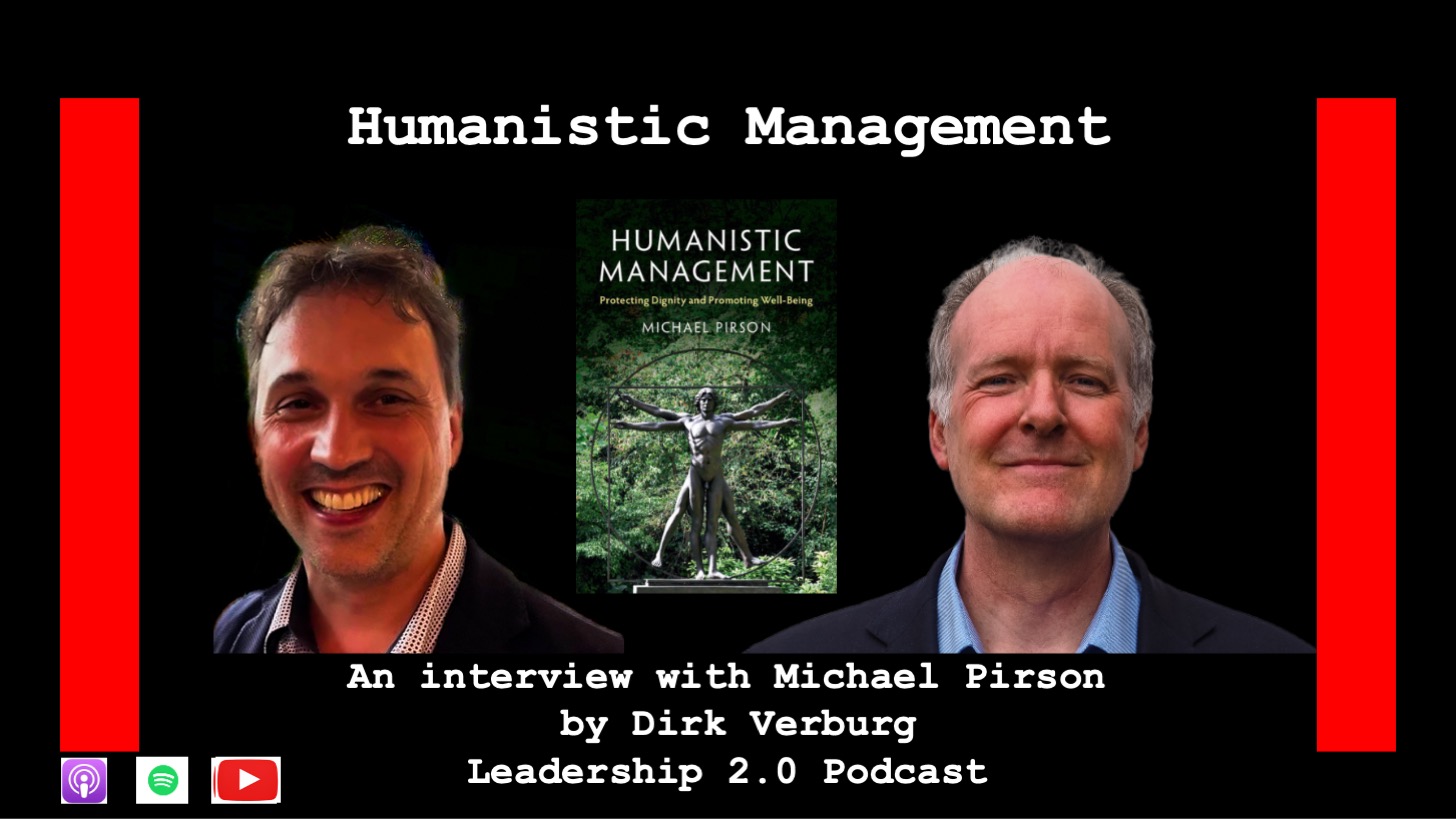
‘What is Humanistic Management?’ – An Interview with Professor Michael Pirson

‘Everyone who wins nowadays is challenging the Shareholder Value Maximization doctrine’

This is just one of the powerful and thought-provoking statements Professor Michael Pirson (Fordham University – Gabelli School of Business) made when I interviewed him about ‘Humanistic Management’.

In the last decades, the shortcomings of the neo-liberal economic order in our society have become clearer than ever (e.g. the credit crunch, climate change, and wars). An increasing number of people want to move away from a system that commoditizes human beings, and the natural environment in which they live.

They seek, amongst others, dignity, a sense of purpose, and attention to well-being, instead of material prosperity only.

Humanistic Management is a relatively young academic movement that seeks to create a more balanced relationship between those things that can be exchanged on markets and those that are not but make life worthwhile.

Michael Pirson is an active member of this movement, and in this episode of the Leadership 2.0 podcast, I discuss with him

1️⃣ What Humanistic Management is
2️⃣ How Michael discovered Humanistic Management
3️⃣ What we as mankind can learn from the Covid 19 Pandemic
4️⃣ Measuring Wealth versus Wellbeing
5️⃣ Will Shareholder Value (Economistic Management) not always prevail?
6️⃣ Is Humanistic Management industry agnostic?
7️⃣ Resources on Humanistic Management
8️⃣ Final Thoughts

👇 You can watch or listen to this podcast episode on


➡️ YouTube
➡️ Apple Podcasts
➡️ Spotify

Continue reading

‘From Crisis to Innovation: A Mental Health Entrepreneur’s journey’ – An interview with Vlad Gheorghiu

The World Health Organization estimates that 12 billion working days are lost every year due to depression and anxiety. This costs $1 trillion in lost productivity.

McKinsey research showed that ‘60 % of employees have experienced at least one mental-health challenge at some point in their lives’. According to the same study ‘Failing to address the effects of mental health and well-being challenges is a missed opportunity for employers’.

Employees dealing with mental health issues are 4x more likely to say they intend to leave, 3x more likely to report low job satisfaction, 3x more likely to experience toxic workplace behavior, and 2x more likely to report low engagement.

At the same time, classic Employee Assistance Programs do not seem to work…

Vlad Gheorghiu experienced mental health issues firsthand, whilst working for McKinsey. 

This experience inspired him to design solutions. First for McKinsey, and later by co-finding a start-up company called Kyan Health.

In my conversation with Vlad, we covered the following topics:

1️⃣ Vlad’s background

2️⃣ Vlad’s engagement with mental health

3️⃣ The gap in the workplace between the mental health support employees need and receive

4️⃣ The concept of Kyan Health

5️⃣ Measuring impact

6️⃣ Creating a start-up company: Three Dos

7️⃣ Creating a start-up company: Three Dont’s

8️⃣ Vlad’s role models as an entrepreneur

If you are interested, you can watch our conversation on YouTube.


You can also listen to it Apple Podcasts or Spotify

Continue reading