Heroic Leadership – An interview with Chris Lowney

Many people in the workplace wrestle with combining their ethical and spiritual convictions on the one hand, with what they feel is required of them to progress their careers, or simply to stay in their roles, on the other.

For people who want to address this tension, ‘Heroic Leadership – Best Practices from a 450-Year-Old Company That Changed the World’ by Chris Lowney. ‘ will be a great read!

Chris Lowney, is a one-time Jesuit seminarian, who currently chairs the board of CommonSpirit Health, America’s largest not-for-profit healthcare system with 140 hospitals and more than 150,000 employees. Previously, he served as a Managing Director of J.P. Morgan & Co. in Tokyo, Singapore, London and New York.

In the 28th episode of the Leadership 2.0 podcast, I interview Chris Lowney about Heroic Leadership. During our conversation, we discussed the following topics:

Continue reading
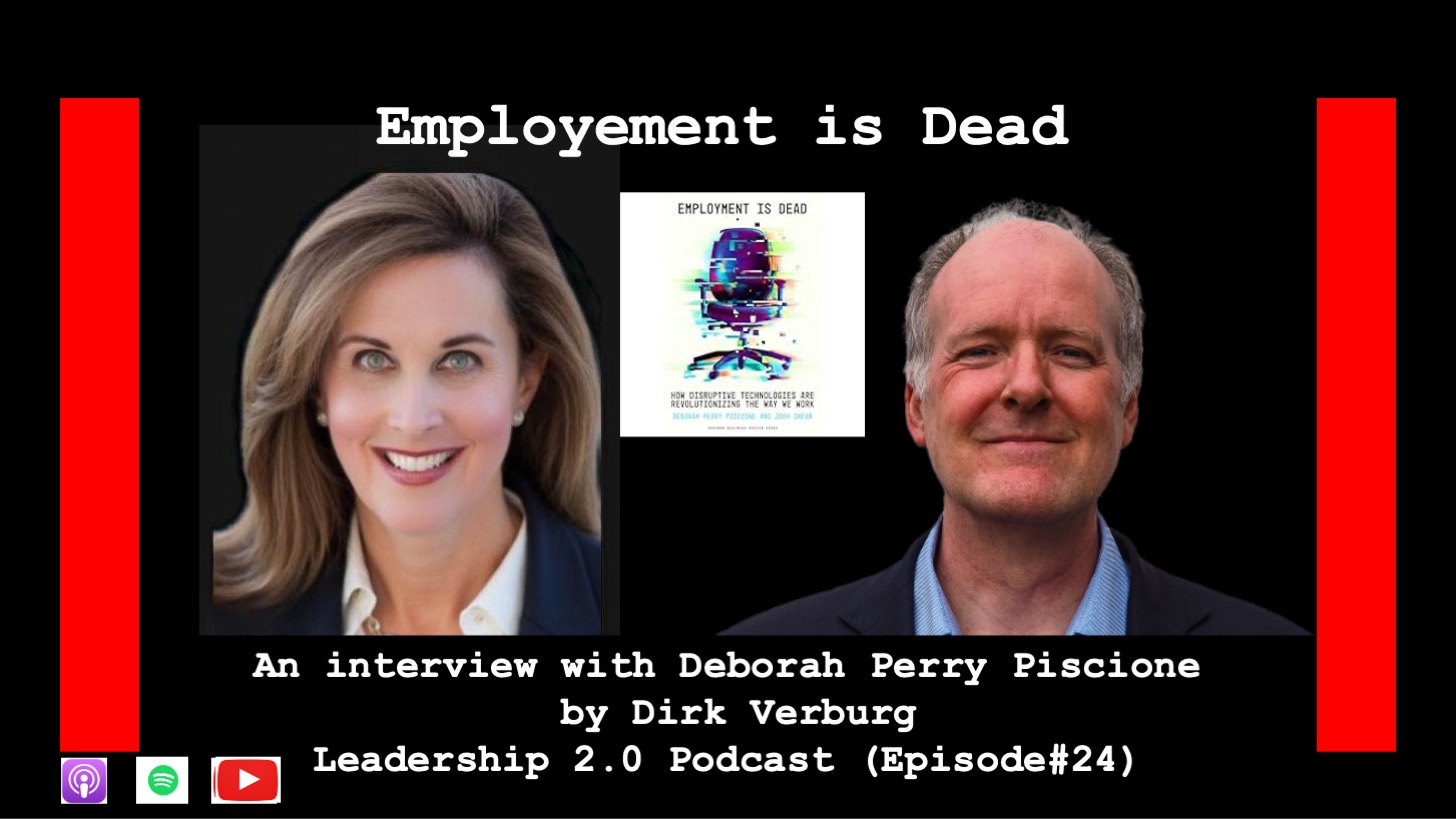
‘Employment is Dead’ – An interview with Deborah Perry Piscione

Earlier this week, one of the most important business books on the Future of Work was published by Harvard Business Review Press: ‘Employment Is Dead: How Disruptive Technologies Are Revolutionizing the Way We Work’ by Deborah Perry Piscione and Josh Drean.

The central theme of this book is that traditional employment models are becoming outdated due to the evolving needs and expectations of the modern workforce, in combination with, and enabled by, disruptive technologies.

This will lead to the end of the traditional employment model, as well as the traditional form of companies, as we know them today.

Monday, just hours before the book was released, I had the chance to interview Deborah Perry Piscione for my Leadership 2.0 Podcast.

► In our conversation, we touched on the following topics:

Continue reading
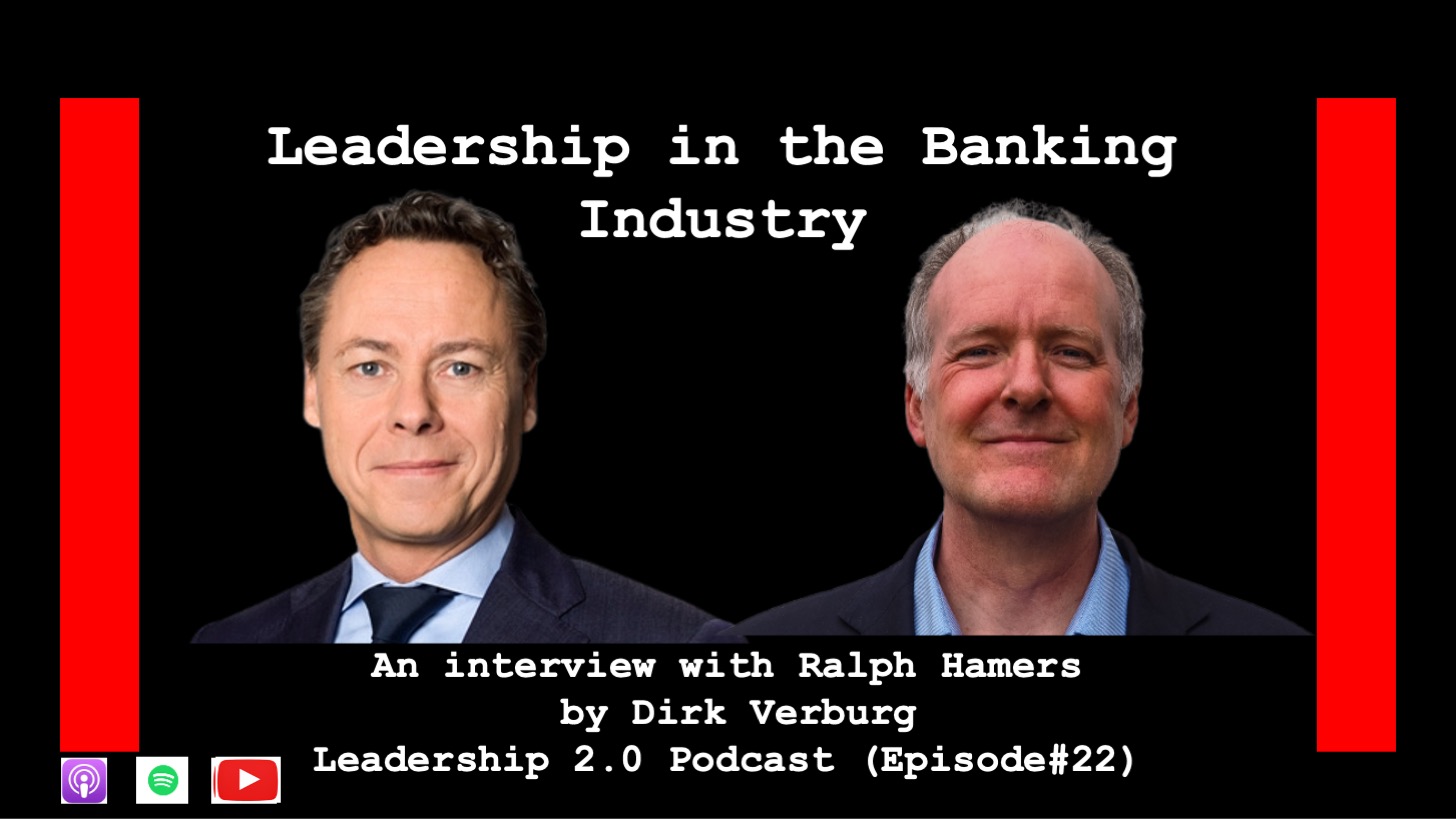
Leadership in the Banking Industry – Interview Ralph Hamers

The image of the banking industry has been severely tarnished by the financial crisis (2007-2008), which led to increasing regulatory and compliance demands. At the same time, the industry is experiencing emerging competition from FinTechs, evolving business models, and disruptive technologies.

In light of these challenges, I recently spoke with Ralph Hamers, to explore his views on what effective leadership in the banking sector entails.

In our conversation, we touched on the following topics:

Continue reading

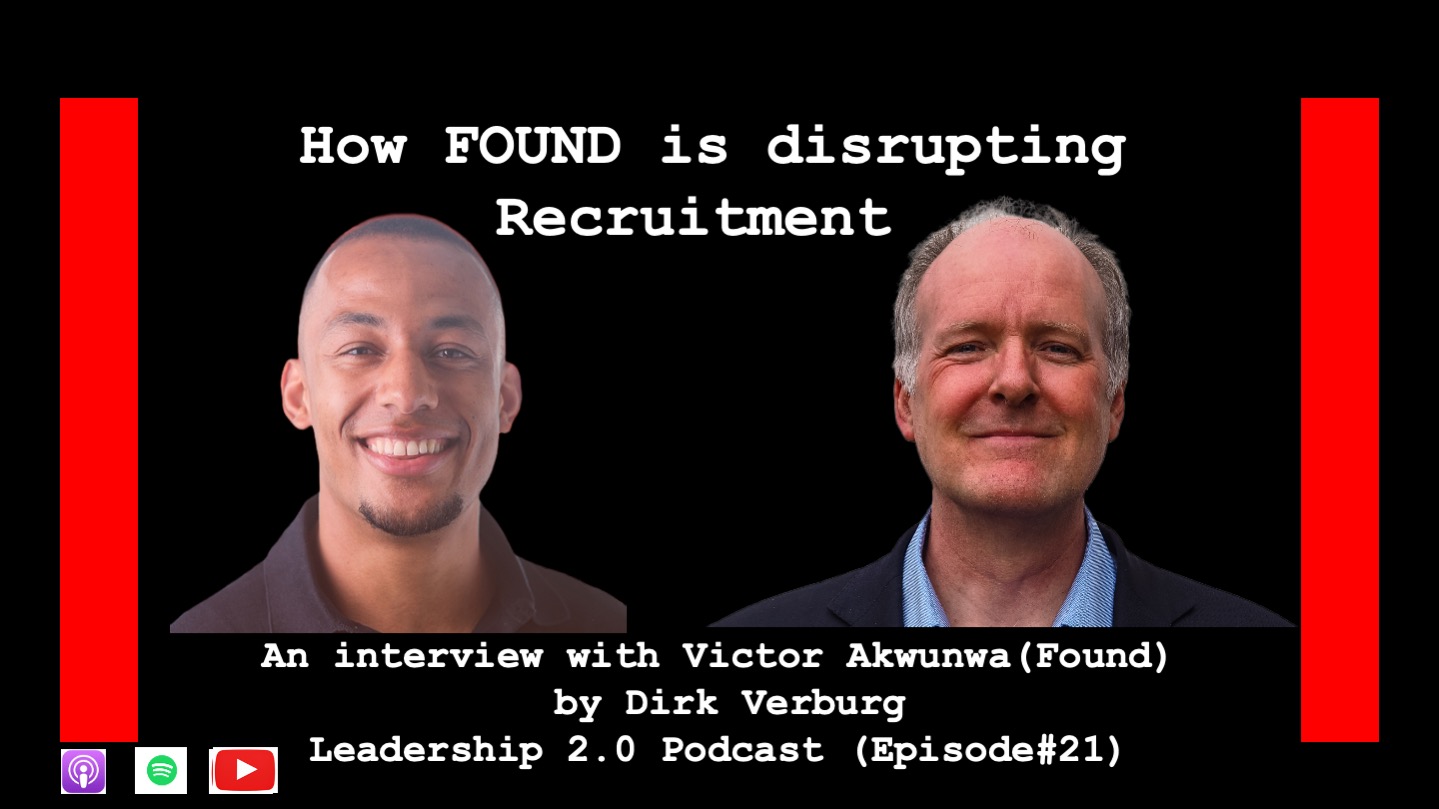
How FOUND is Disrupting Recruitment – Interview with Victor Akwunwa

In many recruitment processes, human beings are reduced to commodities, and human dignity has become an afterthought.

More often than not, recruitment has become a volume-driven exercise, where metrics like ‘time to fill’ have replaced the craftsmanship essential for identifying the best candidate for the role. As a result, candidates often find these processes unsatisfactory, as their potential unique contributions and value to organizations are not adequately recognized.

FOUND, a Swiss-based start-up company, wants to disrupt this traditional approach to recruitment. I recently interviewed Victor Akwunwa, the Chief Sales Officer of FOUND for my Leadership 2.0 podcast.

During our conversation, we discussed the following topics:

Continue reading

The Company Culture of On – An interview with Alessandra Del Pino

There are some companies I deeply admire, and On, the Swiss sports and apparel brand is definitely one of them! Not only do they make amazing products and have an extremely powerful brand, they also have a unique company culture.

For this reason, I was thrilled to sit down with Alessandra Del Pino, Head of Engagement & Talent Growth at On, to discuss the company culture of On, or, as Alessandra describes it, their ‘secret sauce’.

During our conversation, we covered the following topics:

Continue reading
‘Understanding organizations…Finally’ – An interview with Interview with Henry Mintzberg

‘We live in a world of organizations – and we do not understand them’

This is one of the statements Henry Mintzberg, one of the leading thinkers in the field of Management, made when I interviewed him for my Leadership 2.0 Podcast about his latest book ‘Understanding Organizations…Finally’.

During our conversation, we discussed the following topics:

0️⃣1️⃣ The importance for organizations to get their structure ‘right’
0️⃣2️⃣ The evolvement of Henry’s thinking about organizations
0️⃣3️⃣ ‘Every (organization) form contains the seeds of its own destruction’
0️⃣4️⃣ ‘Emergent structures’ versus large-scale reorganizations
0️⃣5️⃣ The fit between the leader and the structure of the organization
0️⃣6️⃣ The structures of Apple and Tesla and the personalities of their founders
0️⃣7️⃣ The complementary role of conflict and culture in organizations
0️⃣8️⃣ The relationship between the structure and the culture of an organization
0️⃣9️⃣ The gap between formulators and implementers of corporate strategies
1️⃣0️⃣ The interest in structuring organizations in academia and business

You can watch or listen to this podcast episode on:

▶ YouTube https://youtu.be/sDWnSgQNmKs

▶ Apple Podcasts https://podcasts.apple.com/ch/podcast/henry-mintzberg-understanding-organizations-finally/id1511327057?i=1000656746374

▶ Spotify https://open.spotify.com/episode/0npqef0iZdAvrOeTiRLyfV?si=VIJT0CjrRF6Zhm6379JIHg

Continue reading

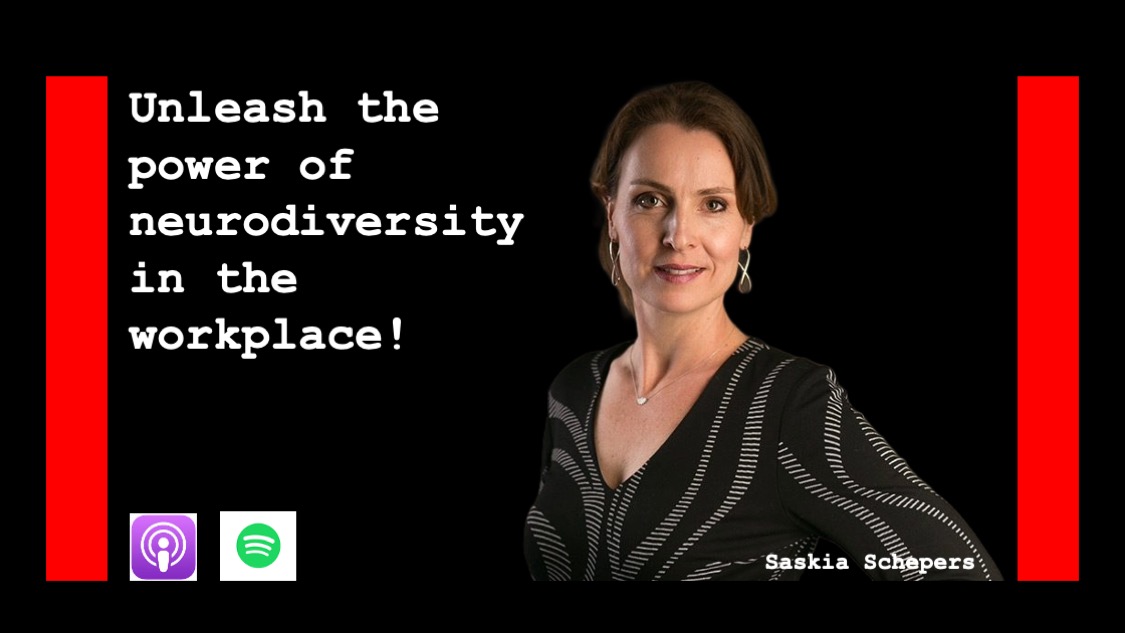
Unleash the power of neurodiversity in the workplace! – An interview with Saskia Schepers

Recently I had a conversation with Saskia Schepers about her book on Neurodiversity in the workplace with the title ‘Als alle breinen werken – Waarom ruimte voor neurodiversiteit op het werk goed is voor iedereen’ (‘When all brains are switched on – Why space for neurodiversity in the workplace benefits everyone’).

Around 80% of mankind is neurotypical, and 20% is neurodivergent. We tend to ‘equip’ people in the latter category with labels like ADD, DHD, bipolar, autistic, etc.

Most leaders find it hard to integrate neurodivergent people in their teams.

The reason is that most of us have preconceived ideas about the way people in the workplace should behave. For instance, we expect people to like attending and participating in meetings, do their work in teams, be productive in open-plan offices, and socialize with their colleagues after work.

People who do not fit this mold are seen as bad ‘team players’, and are often criticized for this behavior, e.g. during annual performance review meetings.

In her book, Saskia Schepers describes what neurodiversity is, what the strong points of different types of neurodivergent people are, and how, as an organization, you can integrate neurodivergent people and capitalize on their strengths.

The book almost immediately reached the number 1 position in the Dutch bestseller list of management books, was quickly sold out, and is now in its third printed edition.

An English translation is in the making and will be published in 2024.

During our conversation, we discussed the following topics:

Continue reading

Why leadership has become more difficult and why this matters

I spent a significant part of my working life developing leaders in organizations. What strikes me is that during COVID-19 the demand for this type of work has not decreased; if anything, the demand for leadership development has increased. That is remarkable. During the financial crisis in 2007-2008, for instance, most companies tried to save money, and one of the first things they considered was decreasing the out-of-pocket costs associated with these, and other kind of developmental activities.

Recently I was asked why companies continue to invest in the quality of their leadership at all levels of the organizations, despite the economic uncertainty they are facing.

In my opinion, the reason is that companies have come to realize the growing importance of the quality of leadership at all levels of the organization. I believe that this is a good thing, especially because leadership roles have become more demanding in the last couple of decades, not only for senior leaders, but also for first, and second-level leaders in organizations. 

Continue reading

Wunderlist RIP – Why ToDo is pushing me outside Microsoft’s ecosystem

Why the decision to eliminate a key feature of Wunderlist is hard for me to understand

By Dirk Verburg

I am very interested in personal effectiveness and am using a number of apps to ‘hack’ my personal productivity level:

  • Grammarly – Unbeatable to spell check anything I type in a brower. Great integration with Google Chrome
  • Small Pdf – A small Swiss gem, shrinks pdf’s to manageable sizes, and does so much more
  • Google keep – Great for keeping notes. Again: available on all platforms I am using. Not the best (Evernote has much more features but useful version are not freeware; OneNote is clumsy if you write entries in more than one language)
  • Wunderlist – Great activity tracker. Available on all platforms I am using: Apple, Android, and my Chrome Web browser

The core of my IT set-up, however, is Microsoft Office. Both on my Windows PC at work, as well as on my Mac for private use. There are programs in Microsoft Office I love (Powerpoint and Excel), programs that are good (Outlook), and again others I consider to be ‘ok’ (I find Word for instance hopelessly complicated).

Ecosystems

Strangely enough, my ideal is the same as that of tech giants like Microsoft, Apple, and Google: stay within a single ecosystem. 

Continue reading

Three imperatives for Talent Management in a VUCA world

Talent management originates from the late 1960s. Since then the business environment has changed dramatically. However, talent management practices in many organizations have not been adapted to cope effectively with these changes. This makes these organizations vulnerable to disruptions in their environment. Talent managers should therefore do three things to ensure their businesses have the necessary adaptive and innovative capabilities to cope with disruptions.

Almost 50 years ago, in 1968, Paul S. Ostrowski published an article with the title “Prerequisites for Effective Succession Planning”. This article is often seen as the starting point for Talent Management. The business environment at that time looked completely different from today:

Continue reading

When do you need to think different?

By Dirk Verburg

One of the most inspirational videos I have ever seen is the Apple commercial ‘Think Different’. This video shows footage of several leaders from the worlds of business, arts, politics, sports and science, such as Richard Branson, Pablo Picasso, Albert Einstein, Martin Luther King, Mohammed Ali and Mahatma Ghandi. The key message of the commercial is that these people were able to change the world, because they were thinking differently. The suggestion is, of course, that people who purchase Apple products also ‘Think Different’.

The ability to ‘Think different’ is extremely important, but unfortunately not something that comes ‘naturally’ to us as human beings. There are several reasons for this. The most important ones are our ‘Bounded Rationality’, reliance on ‘Heuristics’ and ‘Theory-Induced Blindness’. Continue reading