From”I Have To” to “I Choose To”: A High-Achiever’s Two-Step Guide to prevent Burnout

Many high performers are inclined to take on too much responsibility. These people are often a dream for the companies they work for: in addition to being dedicated and hardworking, they are always willing to go the extra mile. However, as a result, a number of them experience serious work-life balance issues, and some even suffer from mental and/or physical health problems.

These issues do not stem from the content of their work; they all like their work. Instead, these issues stem from the fact that they assume responsibility for elements in their work that they cannot control.

A Blast from the Past: Stephen Covey

Continue reading

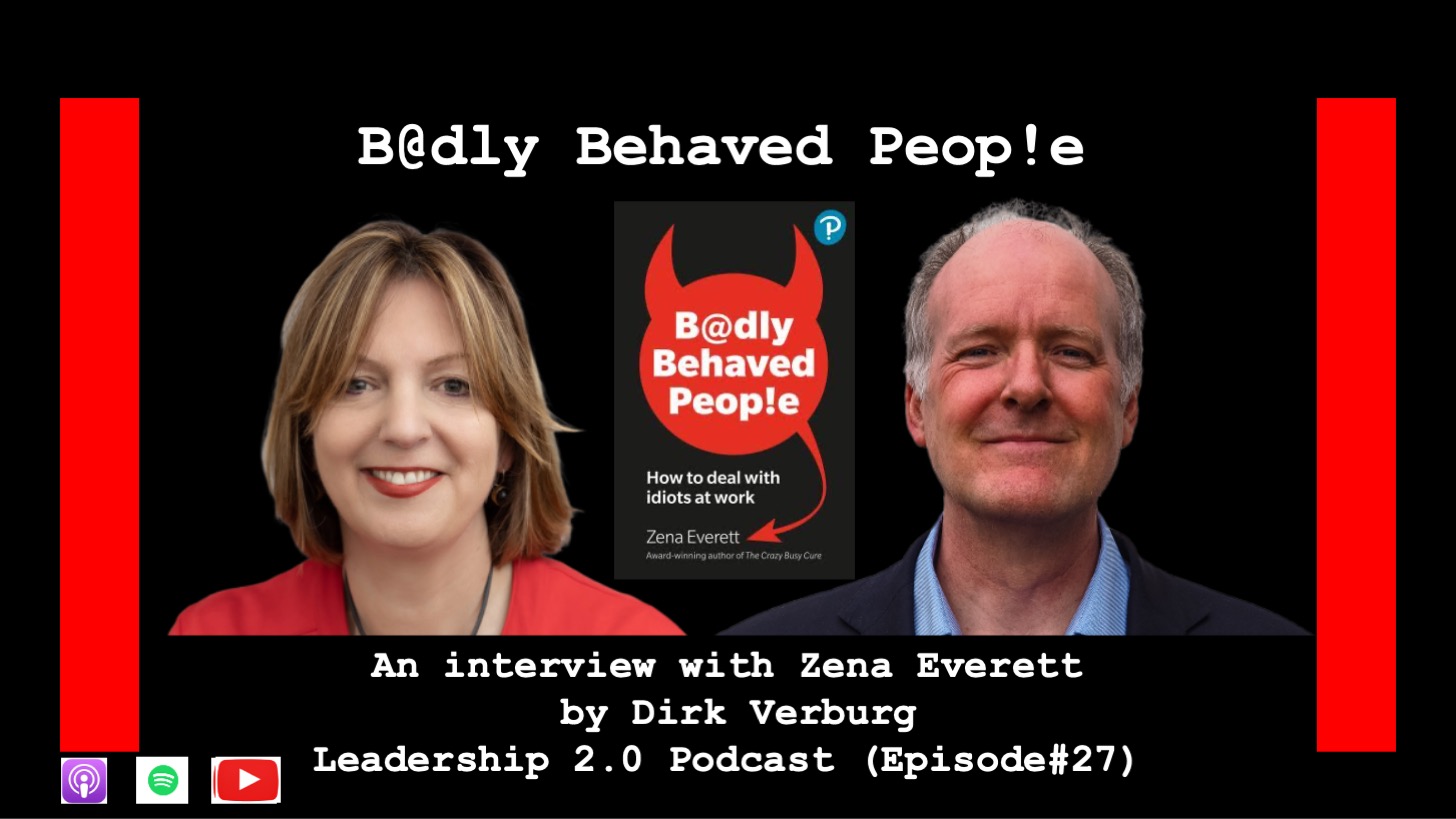
Coaching in the workplace – An interview with Zena Everett

Most of us are acutely aware of the gap between how organizations aspire to operate and the everyday reality of working within them.

This discrepancy often has a negative impact on the motivation and well-being of employees, ranging from a decrease in employee engagement, to mental health issues,

In her book ‘Badly Behaved People’, my fellow executive coach Zena Everett describes a number of real-world cases about how this discrepancy can manifest itself, and, perhaps more importantly, how we can address them

What I particularly like about about this book is how Zena makes complex psychological concepts (for instance, Transactional Analysis) accessible without oversimplifying them, and demonstrates how they can be applied in the workplace.

In our conversation about her book, Zena and I discussed the following topics:

Continue reading

Jungian analytical psychology in the Workplace – An Interview with Murray Stein

I am a big fan of the work of Carl Jung, and in my opinion the business world could really benefit from his insights. Therefore, I was pleased to have the opportunity to have a conversation with Murray Stein about applying Jungian Analytical Psychology in the workplace.

Murray Stein is a graduate of Yale University (B.A. and M.Div.), the University of Chicago (Ph.D.), and the C.G. Jung Institut-Zurich (Diploma). He is a founding member of the Inter-Regional Society of Jungian Analysts and of the Chicago Society of Jungian Analysts. He has been the president of the International Association for Analytical Psychology (2001-4), and President of The International School of Analytical Psychology (ISAP)in Zurich (2008-2012).

He published tens of books about Carl Jung and analytical psychology, including for instance ‘Jung’s Treatment of Christianity’ and ‘Jung’s Map of the Soul’.

The focus of our conversation was a book Murray edited with John Hollwitz called ‘The Psyche at work – Workplace Applications of Jungian Analytical Psychology’.

We discussed a number of topics, including:

Continue reading

Adopting a growth mindset requires critical self-reflection from leaders

HC Gage Skidmore

Critical self-reflection is difficult to acquire, but extremely important for leaders

By Dirk Verburg

For several reasons I love reading autobiographies of leaders in business and politics. The first reason is plain curiosity: the possibility to take a look behind the stage of well-known events. The second reason is because these autobiographies provide a unique opportunity to understand decision making processes from the perspective of the decision makers. Why did they take certain decisions in specific situations? Were they aware of certain developments? From whom did they obtain advice? What was the role of important stakeholders? etc. Continue reading