‘Guys, I will always have your back’, she said when she became our leader … until she did not.
We all know the stories about how notorious dictators like Joseph Stalin, Mao Zedong, and Saddam Hussein, not only ruled their countries with an iron fist, but had an inner circle of followers that were on the one hand attracted to them and craving for their approval, and on the other hand continuously on their toes, out of fear of falling out of favor and being ‘purged’ as a result. A contemporary example of such a dictator is Kim Jong Un.
Nowadays, we would say these dictators had a ‘dark triad’.
‘You need to provide recyclable note paper to demonstrate the commitment of our company to sustainability’, I was told when I co-organized a meeting where the vast majority of participants arrived by airplane, most of them on intercontinental flights…
I have always been quite cynical about ESG (Environmental, Social, and Governance) and CSR (Corporate Social Responsibility) initiatives from public companies.
Some of my favorite examples include:
A “Big Oil” company using the “greenness” of suppliers as a selection criterion in the purchasing process
A Financial Services company that directly contributed to the Euro crisis but gave its employees an afternoon off to paint schools in derelict areas to “give back to society”
ESG leaders flying en masse to conferences in New York to discuss how to make the world a more sustainable place
Companies that started “recalibrating” their DEI efforts in the aftermath of the last US presidential election.
The behavior of most pubic companies in the ESG and CSR space always strikes me as ‘Do as I say, not what I do’. Not because the leaders of these companies are inherently ‘evil’ or ‘immoral’, but simply because, when push comes to shove (most often under pressure from their supervisory boards, or activist shareholders), they do not seem to have an alternative but to let Shareholder Value prevail in their decision-making process.
‘People, Planet, and Profit. But the greatest of these is Profit…’
🎙️ ‘A big conversation with big questions’, that is how Sander Tideman characterized the conversation I had with him about ESG and CSR.
Sander is a researcher, author, entrepreneur and executive coach in sustainable leadership. He works with leaders to build flourishing organizations equipped to address the unprecedented challenges of today. He has worked for and consulted with leading organizations on three continents, and is publicly known for his work with top leaders in, for instance, Unilever.
In the 31th episode of the Leadership 2.0 podcast, I interview Sander about the question if and how pubic companies and our society should adopt ESG and CSR concepts.
During our conversation, we discussed the following topics:
Many people in the workplace wrestle with combining their ethical and spiritual convictions on the one hand, with what they feel is required of them to progress their careers, or simply to stay in their roles, on the other.
For people who want to address this tension, ‘Heroic Leadership – Best Practices from a 450-Year-Old Company That Changed the World’ by Chris Lowney. ‘ will be a great read!
Chris Lowney, is a one-time Jesuit seminarian, who currently chairs the board of CommonSpirit Health, America’s largest not-for-profit healthcare system with 140 hospitals and more than 150,000 employees. Previously, he served as a Managing Director of J.P. Morgan & Co. in Tokyo, Singapore, London and New York.
In the 28th episode of the Leadership 2.0 podcast, I interview Chris Lowney about Heroic Leadership. During our conversation, we discussed the following topics:
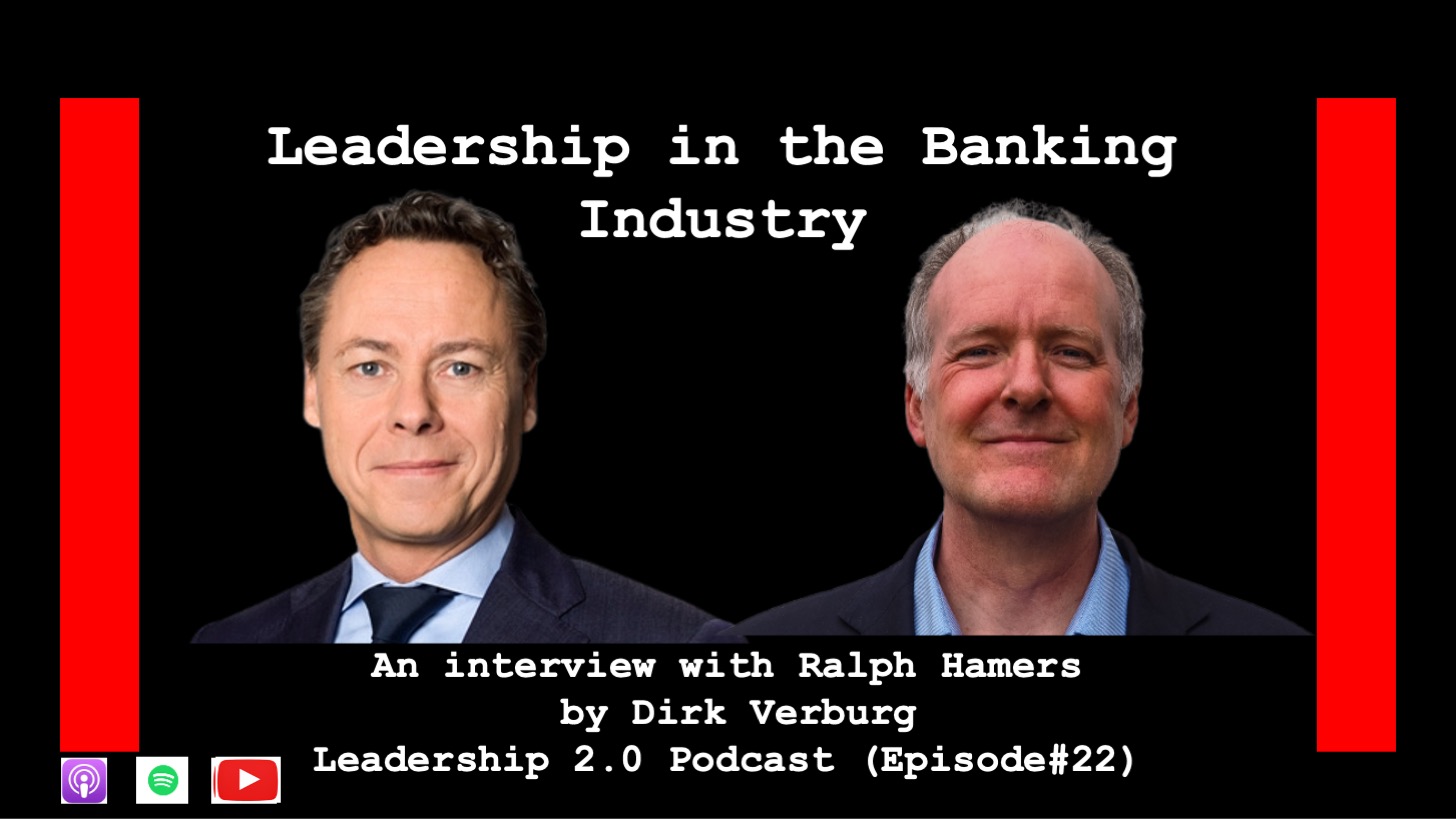
The image of the banking industry has been severely tarnished by the financial crisis (2007-2008), which led to increasing regulatory and compliance demands. At the same time, the industry is experiencing emerging competition from FinTechs, evolving business models, and disruptive technologies.
In light of these challenges, I recently spoke with Ralph Hamers, to explore his views on what effective leadership in the banking sector entails.
In our conversation, we touched on the following topics:
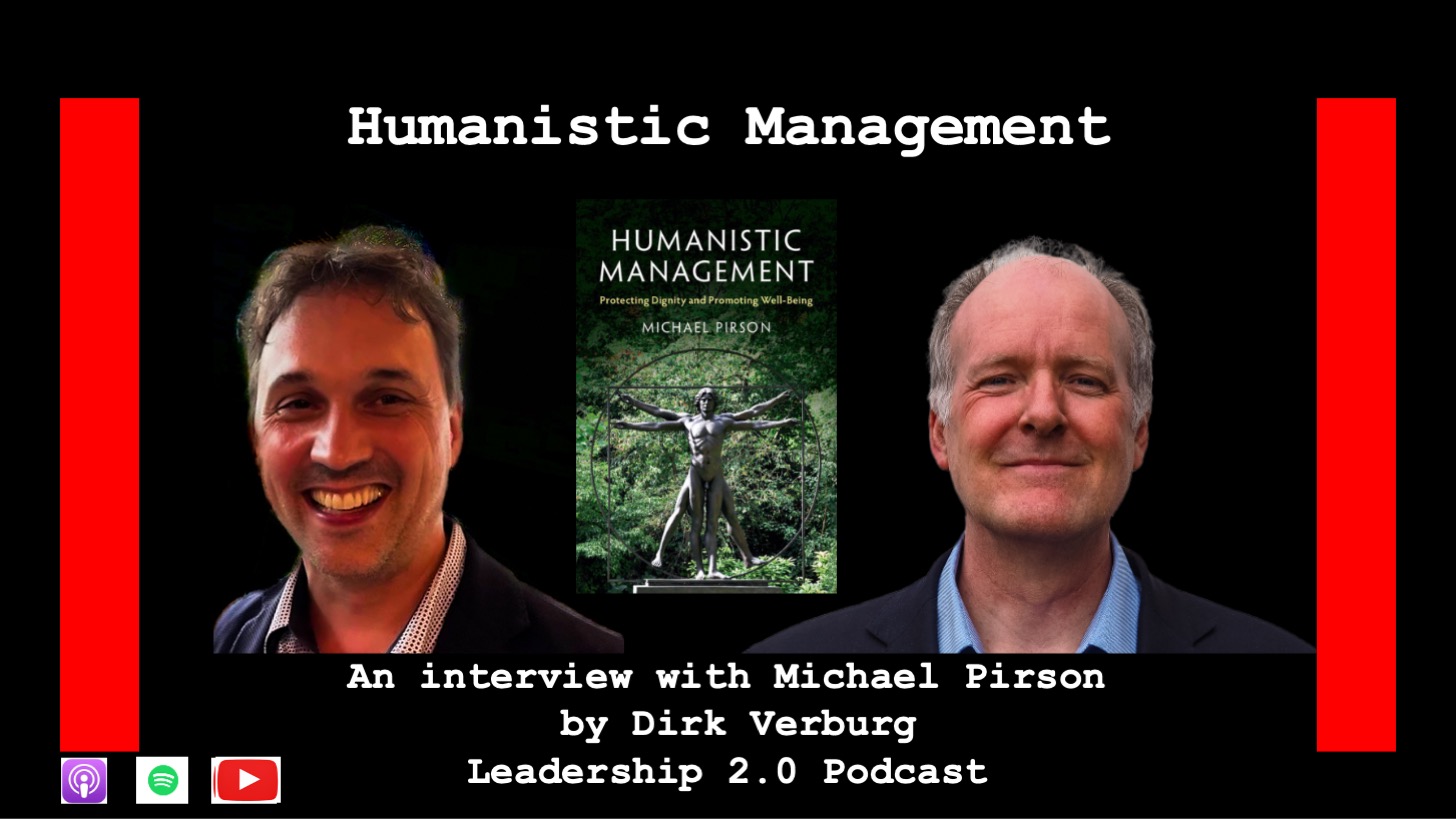
‘Everyone who wins nowadays is challenging the Shareholder Value Maximization doctrine’
This is just one of the powerful and thought-provoking statements Professor Michael Pirson (Fordham University – Gabelli School of Business) made when I interviewed him about ‘Humanistic Management’.
In the last decades, the shortcomings of the neo-liberal economic order in our society have become clearer than ever (e.g. the credit crunch, climate change, and wars). An increasing number of people want to move away from a system that commoditizes human beings, and the natural environment in which they live.
They seek, amongst others, dignity, a sense of purpose, and attention to well-being, instead of material prosperity only.
Humanistic Management is a relatively young academic movement that seeks to create a more balanced relationship between those things that can be exchanged on markets and those that are not but make life worthwhile.
Michael Pirson is an active member of this movement, and in this episode of the Leadership 2.0 podcast, I discuss with him
1️⃣ What Humanistic Management is 2️⃣ How Michael discovered Humanistic Management 3️⃣ What we as mankind can learn from the Covid 19 Pandemic 4️⃣ Measuring Wealth versus Wellbeing 5️⃣ Will Shareholder Value (Economistic Management) not always prevail? 6️⃣ Is Humanistic Management industry agnostic? 7️⃣ Resources on Humanistic Management 8️⃣ Final Thoughts
👇 You can watch or listen to this podcast episode on
Our society is more complex than ever. For the first time since WWII two nations find themselves at war on the European continent. At the same time our economy is slowing down, inflation is on the rise, whilst technological developments in the AI space are more unpredictable than ever, and we are still trying to find out if these will be our friend or foe…
In times like these ethics, and a sense of purpose are more important than ever. Therefore I was glad to have the opportunity to have a conversation on these topics with John Hollwitz.
John Hollwitz is a University Professor of psychology and rhetoric. Before coming to Fordham, he was the A.F. Jacobson Professor of Communications at Creighton University and dean of arts and sciences at Loyola College in Maryland. He also has been the vice president of academic affairs at Fordham.
Our interview was focused on the why and how of corporate ethics. During our conversation, we discussed, amongst others, the following topics:
Our expectations of leaders and ideas about leadership have changed dramatically in the last couple of years.
Recently I was introduced to Sophia Town, Ph.D. , an assistant professor of organizational behavior at the Gabelli School of Business of Fordham University, who is at the forefront of academic research in this area.
In the classroom, Professor Town’s curriculum is guided by the question: “How can we develop compassionate leaders in service of a flourishing world?”
SophiaTown leads Fordham’s Human Flourishing Project (FHFP), a mixed-methods, interdisciplinary research lab that explores behavioral, psychological, communicative, and spiritual development in business education. Related to this project, Dr. Town serves as a Research Affiliate and Advisory Board Member for the Human Flourishing Program at Harvard University.
During our conversation, we discussed, amongst others, the following topics:
I am a big fan of the work of Carl Jung, and in my opinion the business world could really benefit from his insights. Therefore, I was pleased to have the opportunity to have a conversation with Murray Stein about applying Jungian Analytical Psychology in the workplace.
Murray Stein is a graduate of Yale University (B.A. and M.Div.), the University of Chicago (Ph.D.), and the C.G. Jung Institut-Zurich (Diploma). He is a founding member of the Inter-Regional Society of Jungian Analysts and of the Chicago Society of Jungian Analysts. He has been the president of the International Association for Analytical Psychology (2001-4), and President of The International School of Analytical Psychology (ISAP)in Zurich (2008-2012).
He published tens of books about Carl Jung and analytical psychology, including for instance ‘Jung’s Treatment of Christianity’ and ‘Jung’s Map of the Soul’.
The focus of our conversation was a book Murray edited with John Hollwitz called ‘The Psyche at work – Workplace Applications of Jungian Analytical Psychology’.
Ethics deal with what makes something morally right or wrong.
Almost any sizeable company nowadays has a code of ethics. The main catalysts for these were the corporate scandals in the early 2000s (Enron, Worldcom, Tyco, and others). Also, in the last couple of years having a sense of purpose has become pretty much en vogue.
As a result, every year millions of employees now dutifully complete e-learning modules and sign declarations (‘To the best of my knowledge…’).
If you think about this on a philosophical level, it is actually quite sad. Apparently, companies need to invest millions of dollars each year because a shared understanding of what is morally right or wrong to do on behalf of the company, is not a given.
Obviously, from a pragmatic point of view, companies have no choice but to invest in this type of training. First of all, it helps individuals to avoid taking decisions that can create reputational and compliance-related problems for the company. The second reason is the need to demonstrate institutional compliance to governments, regulatory bodies and other stakeholders.
The invention of the printing press proved to be a pivotal point in the development of our society because it enabled the dissemination of ideas and information at an unprecedented pace. It is unlikely that, without the printing press, the Reformation in the 16th century would have had such a huge impact, so quickly.
In the 20th century, radio and television increased the speed of information even more. It is likely that the public opinion about the war in Vietnam (the first television war) changed significantly as a result of the coverage of this war on television.
Social media emerges
No wonder that many governments tried to control these media, either in the form of censorship, or by creating monopolies for news dissemination (e.g in the former Soviet Union).
At the end of the 1990s, social media platforms started to emerge, disrupting the traditional media landscape of newspaper, radio, and television organizations.
A couple of days ago my bible app opened with this verse of the day: ‘To do righteousness and justice is more acceptable to the LORD than sacrifice’ (Proverbs 21:3).
This text reminded me of the way some companies deal with Corporate Social Responsibility (CSR). Rather than doing the right thing, they do the wrong thing and compensate for this by deploying CSR initiatives. There is even a special term describing this phenomenon: ‘Greenwashing’. In this context, it is no wonder that two professors from IMD (a leading Swiss Business School) published an article in 2018 with the provocative title: ‘Why nobody takes corporate social responsibility seriously’.
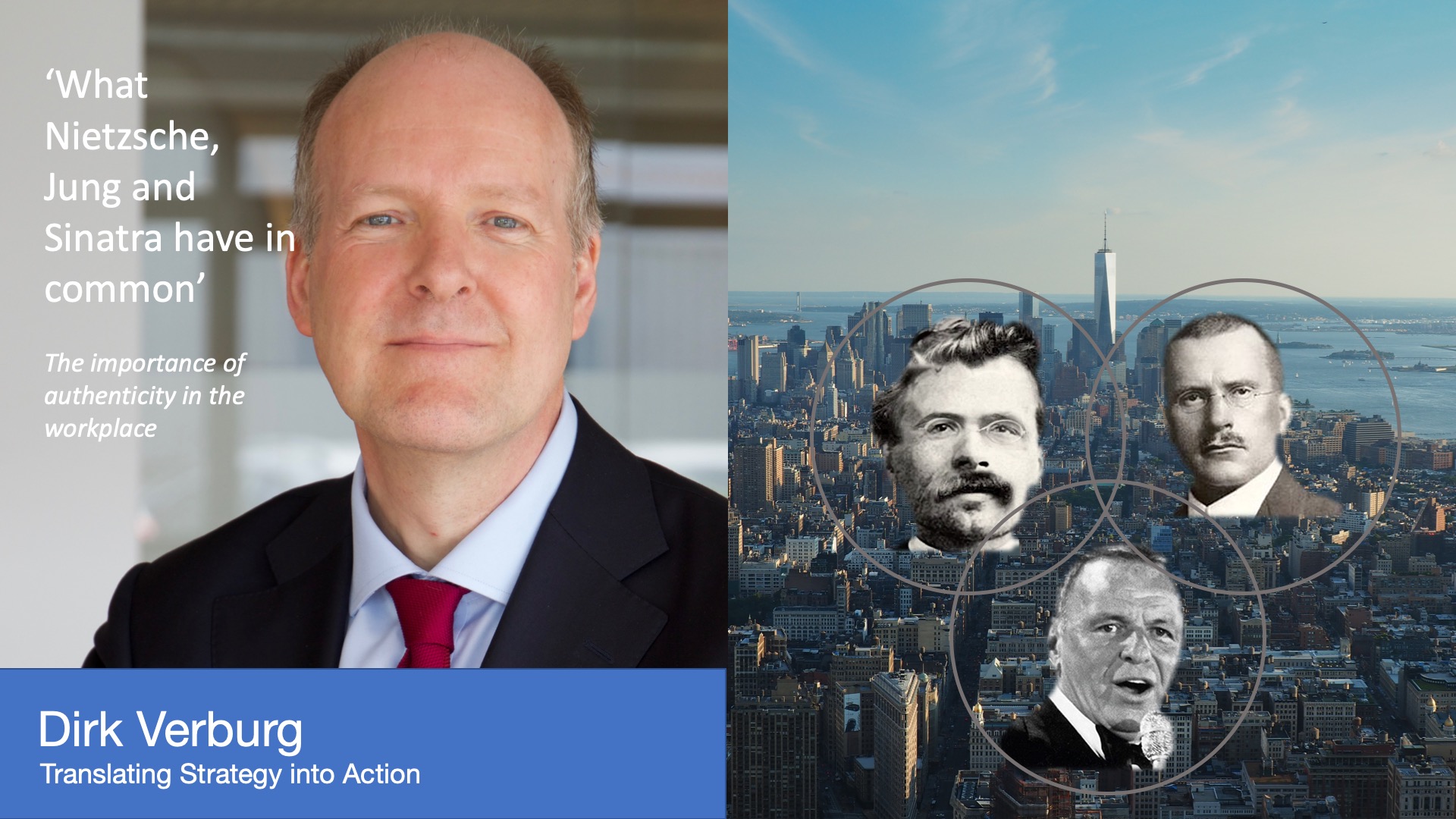
In the 1970s and 1980s, authenticity and self-development in the workplace were considered to be important by many middle and senior managers in the Western world. Perhaps too important: organizations were sometimes seen as narcissistic vehicles for self-development, instead of entities that should serve the interests of their shareholders and/or other stakeholders.
This orientation changed dramatically in the first half of the 1990s. Two popular business books that were published during that time perfectly illustrate this change. The first one was ‘Valuation’ (1990), a book written by Copeland, Koller and Murrin (three McKinsey consultants), the second one ‘Emotional intelligence’ by David Goleman (1995).
According to Professor of Psychology Kip Williams, the human race ows its success to the fact that we learned to collaborate in groups. We learned that through organizing ourselves in tribes, we hugely increased our chances to survive in a hostile environment. The tribe enabled us to protect ourselves from wild animals, other tribes and food shortages.
The prospect of people who were being ‘ostracized’ (forced to leave the tribe) looked bleak. In pre-historic times, ostracism did not only result in social, but also in a certain physical death. People, who were kicked out of their ‘tribe’ and left to their own devices, were doomed to die, because they could not defend themselves effectively against predators, other tribes and could no longer collect sufficient food.
Because of the latent fears of ostracism that human beings have, managing human behavior by using this threat requires surprisingly little effort. Setting an example by ostracizing just a handful of individuals in a visible manner is enough to instill a sense of fear in a complete community.Continue reading →






 Dirk Verburg