The 70% Failure Rate: Why are most Business Transformations STILL getting ‘Lost’? – Interview Rupert Brown

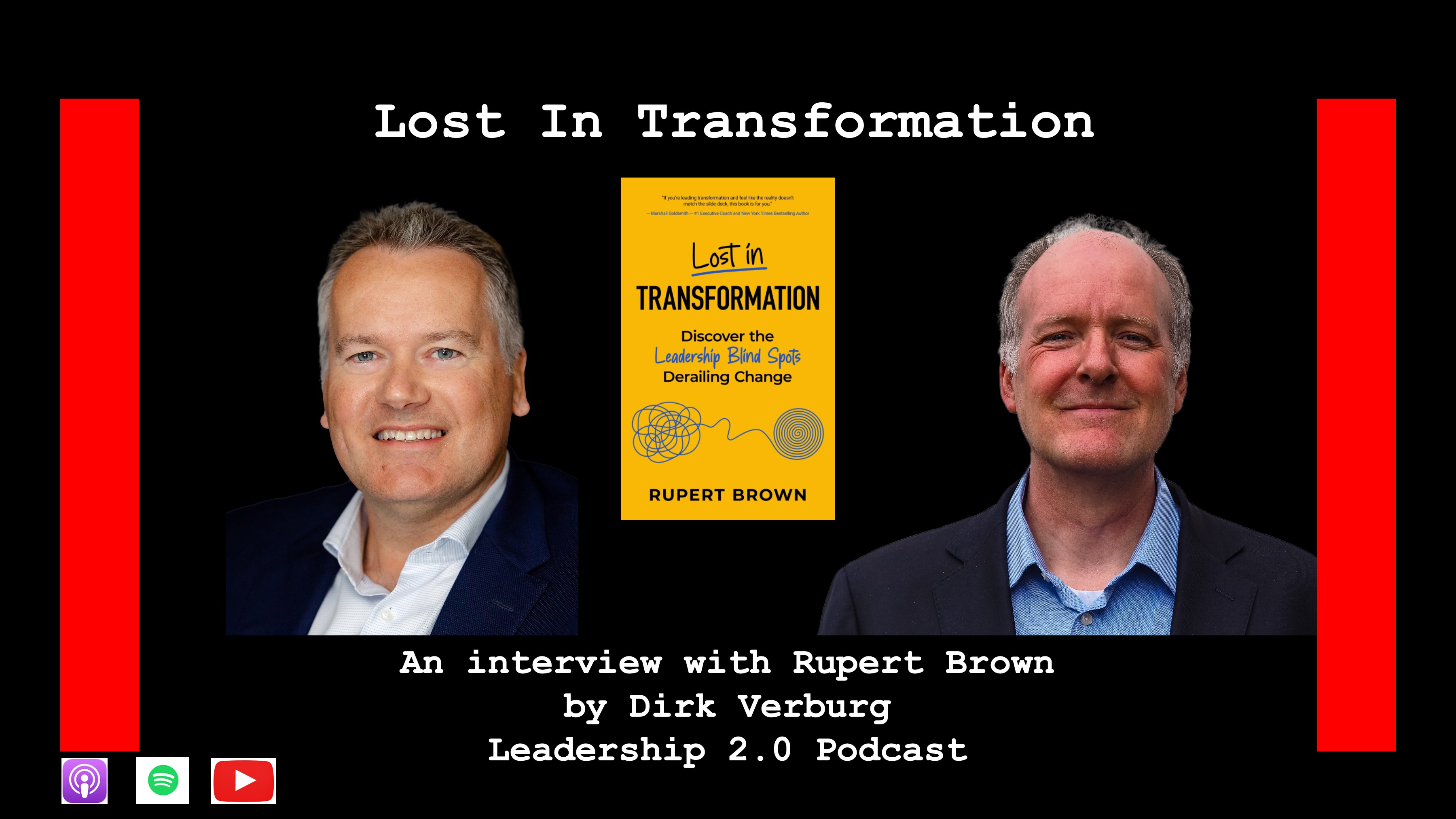
McKinsey’s infamous stat haunts every executive: 70% of all change management efforts fail. Despite decades of expertise, this number seems frozen in time. Why?

In the 35th episode of the Leadership 2.0 podcast, I sat down with a true transformation veteran, Rupert Brown, author of the eye-opening book, ‘Lost in Transformation’.

Rupert is an experienced Chief People Officer and change management specialist with deep expertise in M&A, digital transformation, and turnarounds, having advised giants like Procter & Gamble and Maersk.

This wasn’t just a discussion of tactics; it was a candid, emotionally intelligent discussion on how Transformations can be handled better.

Tune in to learn about:

  • Why Transformation projects continue to fail
  • The difference between Change and Transformation
  • The Bad Reputation of the word ‘Transformation’
  • Why we still struggle with Change Management  
  • In-Groups and Out-Groups in Change Management Processes  
  • Chief Acceleration Officers
  • Trust is Energy
  • Crises as Catalysts for Change
  • The impact of our Permacrisis on Change Management 
  • Behavioral Skills to cope with the BANI world’
  • Change Management and AI

If you’re leading a transformation—or struggling to survive one—you can’t afford to miss this. Rupert delivers the hard truths and the practical guidance needed to shift from ‘being Lost’ to becoming ‘the Leader of change’.

► You can watch or listen to a podcast with our conversation on:

Continue reading

Have you ever considered taking a stimuli-rich holiday?

For a number of people, the summer holidays represent the mental equivalent of an oasis in a desert: a perfect opportunity to temporarily escape their daily grind and the stress of their work.

Although holidays are a fairly new invention in the history of mankind, and actually only a privilege for a, largely Western Europe-based, minority of the workforce, we ascribe almost magical powers to them. The most important ‘super’ power is the one that suggests that if we take one or more weeks off and label this ‘a holiday’, we are fully relaxed and ready to face our challenges in the workplace again.

Switching off?

However, many people find it hard to mentally switch off from their work during their holidays. Usually, they spend the first days of the holidays decompressing from their work, and they switch back on a couple of days before their work starts again.

I firmly belonged to this category as well.

Continue reading

Coaching in the workplace – An interview with Zena Everett

Most of us are acutely aware of the gap between how organizations aspire to operate and the everyday reality of working within them.

This discrepancy often has a negative impact on the motivation and well-being of employees, ranging from a decrease in employee engagement, to mental health issues,

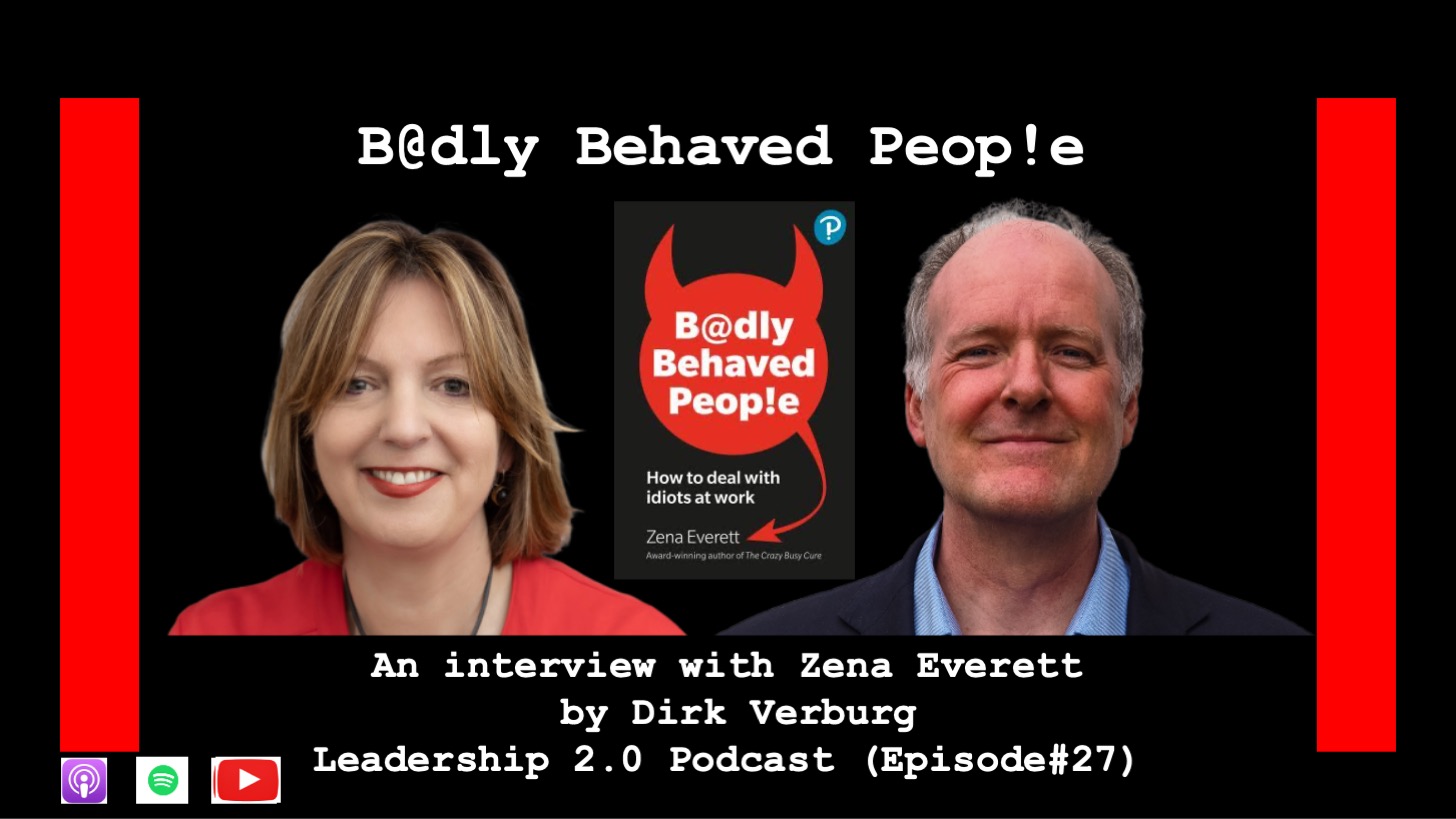
In her book ‘Badly Behaved People’, my fellow executive coach Zena Everett describes a number of real-world cases about how this discrepancy can manifest itself, and, perhaps more importantly, how we can address them

What I particularly like about about this book is how Zena makes complex psychological concepts (for instance, Transactional Analysis) accessible without oversimplifying them, and demonstrates how they can be applied in the workplace.

In our conversation about her book, Zena and I discussed the following topics:

Continue reading

How to ensure successful leadership transitions – An interview with Michael Watkins

The statistics are sobering: not only do 49% of external executive hires end in failure within 18 months, but internal moves prove to be challenging as well. For instance, 40% of internal job moves involving high potentials also end in failure.

Besides the fact that these failures often have a traumatic impact on the individuals involved, the costs for the organisations are huge. Not only in terms of image and hiring costs but, more importantly, in terms of opportunity costs.

To find out why leadership transitions prove to be so hard, and what companies and individuals can do about it, I interviewed Michael Watkins for my Leadership 2.0 podcast.

Continue reading

Jungian analytical psychology in the Workplace – An Interview with Murray Stein

I am a big fan of the work of Carl Jung, and in my opinion the business world could really benefit from his insights. Therefore, I was pleased to have the opportunity to have a conversation with Murray Stein about applying Jungian Analytical Psychology in the workplace.

Murray Stein is a graduate of Yale University (B.A. and M.Div.), the University of Chicago (Ph.D.), and the C.G. Jung Institut-Zurich (Diploma). He is a founding member of the Inter-Regional Society of Jungian Analysts and of the Chicago Society of Jungian Analysts. He has been the president of the International Association for Analytical Psychology (2001-4), and President of The International School of Analytical Psychology (ISAP)in Zurich (2008-2012).

He published tens of books about Carl Jung and analytical psychology, including for instance ‘Jung’s Treatment of Christianity’ and ‘Jung’s Map of the Soul’.

The focus of our conversation was a book Murray edited with John Hollwitz called ‘The Psyche at work – Workplace Applications of Jungian Analytical Psychology’.

We discussed a number of topics, including:

Continue reading

Resilience training is not enough to combat stress in the workplace

For those who have never experienced it firsthand, or witnessed it from nearby, scientific research has shown that work can be a considerable source of stress. 

This stress can manifest itself in the form of emotions (e.g. anxiety and depression), cognitive performance (e.g. in decision-making), negative behaviors (e.g. unhealthy eating habits, alcohol and drug abuse, aggression), and physical symptoms (e.g. high blood pressure, neck-, head- and shoulder pain).

Not only does stress have a negative impact on individual employees, absenteeism and low engagement for instance can seriously impact the performance of their organizations as well.

Resilience training

The popularity of resilience training in the workplace has dramatically increased in the last couple of years (particularly as a result of the COVID-19 pandemic), and there is evidence that, if done in the right format, this training can help individuals in certain target groups to deal with stress.

Positioning

The problem is that resilience training is almost always only a part of the solution, and that is almost meaningless if offered in isolation to mitigate work-related stress. 

Continue reading

Why you are a micro-manager and what you can do about it (Stop adding value)

One of the big temptations we as leaders face is our urge to add value to the work of our staff. Typically, we add this value in the form of change or additional requests.

There are three reasons why adding value is tempting for us:

  • Accountability – We are accountable for the work of our staff. If something goes wrong, we as leaders suffer the consequences (‘It happened on your watch’)
  • Know-how – We know it better than our staff. Seriously. That is most often the reason why we were appointed
  • We like it – As leaders it is often tempting to take a break from the daily grind of budgets and office politics, to dive back into the content we love(d) so much (‘Let me show you how it is done’)

As with every temptation in life, we need to fight this one as well. There are fivereasons for this:

Continue reading

Your wellbeing: why a personal mission is more important than a position

What do the notorious former marketing director of American Apparel, Ryan Holiday, and renowned Dutch reformed theologian Bram van de Beek have in common? They both have written a book about the danger of egocentricity. 

Social media…are not to blame

Social media offers endless possibilities to promote ourselves and serve as outlets for our vanity. It enables us to humble brag about our professional achievements on LinkedIn, share evidence of our successful ‘friends & family’ life on Facebook, and demonstrate our cutting-edge lifestyle on Instagram. 

However, looking at our current society and world history, it seems we as human beings always have been prone to self-centeredness and self-promotion. Social media therefore merely enables us to express something that is already deeply rooted in us.

Continue reading

Improve your decision-making skills: time to get back to the gym!

Something I struggled with for a long time is chronic neck and shoulder pain when working with my computer. For the largest part of my life, I sat behind my computer like the hunchback of Notre Dame.

Well meant ergonomic advice, a standing desk, and using the mouse with my left hand only gave temporary relief.

The only thing that solves the problem structurally is going to the gym.

The problem is that I experienced being in the gym as exciting as watching grass grow. Besides, I always took the words of the apostle Paul “For bodily exercise profiteth little” (1 Tim 4:8) perhaps a little too close to heart. 

If getting back in shape is part of your past summer holiday intentions – here are three things that got me back in the gym earlier this year!

Continue reading

For when I am weak, then I am strong – Authentic Self-Confidence

‘We read to know we’re not alone’ said actor Anthony Hopkins, playing the character of author C.S. Lewis, in the movie ‘Shadowlands’. 

People suffering from the imposter syndrome doubt their abilities and feel like a fraud at work.I personally suffered quite a bit from the ‘imposter’ syndrome in the past, and at times experience serious relapses. 

Fortunately, it turns out I am not the only one!

After reading ‘Authentic Self-Confidence’ by Jacqueline Brassey, Nick van Dam and Arjen van Witteloostduijn, I realize I am part of a large community that includes successful (and sometimes well-known) academics, surgeons, management consultants and senior executives.

Lack of Authentic Self-Confidence can lead to sub-optimal performance (e.g. because individuals feel constrained to bring the best version of themselves at work), which can have negative emotional impact on themselves, their families, teams and organizations. Therefore a high-quality publication on this topic is extremely welcome.

There are three reasons why I full-heartedly recommend this book.

Continue reading

The Negative Feedback Paradox

Let me start with a confession:I never liked receiving negative feedback, and have spent the largest part of my professional life ignoring it.

I found ignoring negative (or perhaps I should euphemistically say ‘corrective’) feedback to be quite easy. Depending on the situation, I either did not take the person who gave me feedback seriously (‘that is rich – from him?’), comforted myself that the feedback concerned only a minor issue in the grand scheme of my behavior (and that other aspects of my behavior would compensate this), or convinced myself that the person giving me feedback did not understand the context in which I acted the way I did or said the things I said.

It was not until I hit a serious roadblock in my career, that I started to see the fact that systematically ignoring feedback was not necessarily a great idea. 

Continue reading

Decision making for a new Decade

Every year millions of people around the world make New Year’s resolutions. Given that we are currently starting the 2020’s, we have the exciting opportunity to make resolutions for a whole new decade!

I decided to make mine around decision making. The reason for this was the fact that I had the opportunity to read ‘Unlocking Leadership Mindtraps – How to thrive in complexity’ by Jennifer Garvey Berger during the Christmas vacation.

One of the key notions in this book is that the world has become much more interconnected and therefore more complex. Unfortunately, our decision-making skills are ‘brilliantly designed – for an older, less connected, and more predictable version of the world’. In this context, Jennifer Garvey Berger mentions five mind traps we can find ourselves in, one of them being trapped in ‘Simple stories.

Continue reading

Building an authentic personal brand starts with ‘why?

Two weeks ago, I was asked to participate in an event about personal branding. The organizer asked me to focus specifically on the link between creating a personal brand and remaining authentic.

Because I have been irritated by the majority of the publications on this topic in the last 5+ years, I was excited to speak about it. Why? Because these articles often suggest people need a partial, or even full, make-over, in order to fit the mold of the specific environment they seek employment in. If that does not feel natural to them, the second piece of advice most publications give them is: ‘Fake it until you make it’.

Continue reading

Starting your day with this simple habit will exponentially increase your personal effectiveness

Make your responsibilities your priority

For many business leaders, their day in the office resembles drinking from a fire hose. Not only do they need to attend a large number of meetings (often back to back), they are also hit with a continuous stream of ad-hoc questions from their staff, peers, customers, and line managers which require their attention and action.

A couple of years ago I started to get really worried about my personal effectiveness. Despite the outrageous number of hours I spent at work, I found it increasingly difficult to complete my tasks and finish my projects.

In order to address this, I decided to analyze my workload to find out what I could do to change this.

Continue reading

Adopting a growth mindset requires critical self-reflection from leaders

HC Gage Skidmore

Critical self-reflection is difficult to acquire, but extremely important for leaders

By Dirk Verburg

For several reasons I love reading autobiographies of leaders in business and politics. The first reason is plain curiosity: the possibility to take a look behind the stage of well-known events. The second reason is because these autobiographies provide a unique opportunity to understand decision making processes from the perspective of the decision makers. Why did they take certain decisions in specific situations? Were they aware of certain developments? From whom did they obtain advice? What was the role of important stakeholders? etc. Continue reading