Almost 90% of senior HR leaders agree that transitions into new roles are the most challenging periods in a leader’s professional life. However, organizational appetite to invest in these transitions remains minimal.
As business leaders, we seem to accept a 40% failure rate among newly appointed executives as an unavoidable risk.
The consequences of these failures are significant for both the individual and their organization.
For the individual, a failed transition damages their professional reputation and potentially their livelihood. For their organization, it results in direct financial costs (recruitment), opportunity costs, diminished employee engagement, and a degraded Employer Value Proposition (EVP).
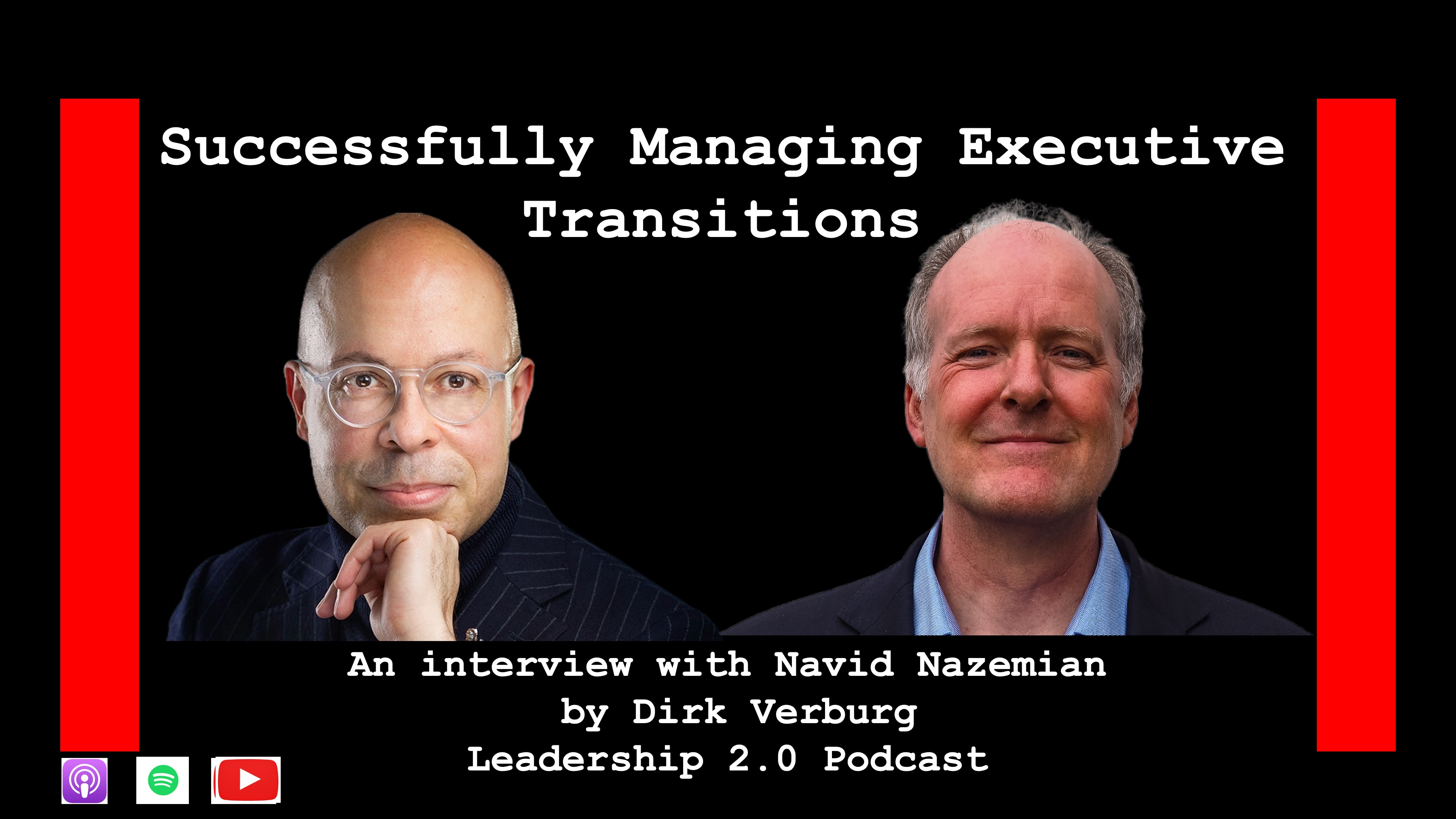
In the 37th episode of the Leadership 2.0 podcast, I speak with Navid Nazemian—my brother-in-arms in the Executive Transition Coaching space—about how organizations can mitigate the risks of executive appointments by engaging an executive coach.
McKinsey’s infamous stat haunts every executive: 70% of all change management efforts fail. Despite decades of expertise, this number seems frozen in time. Why?
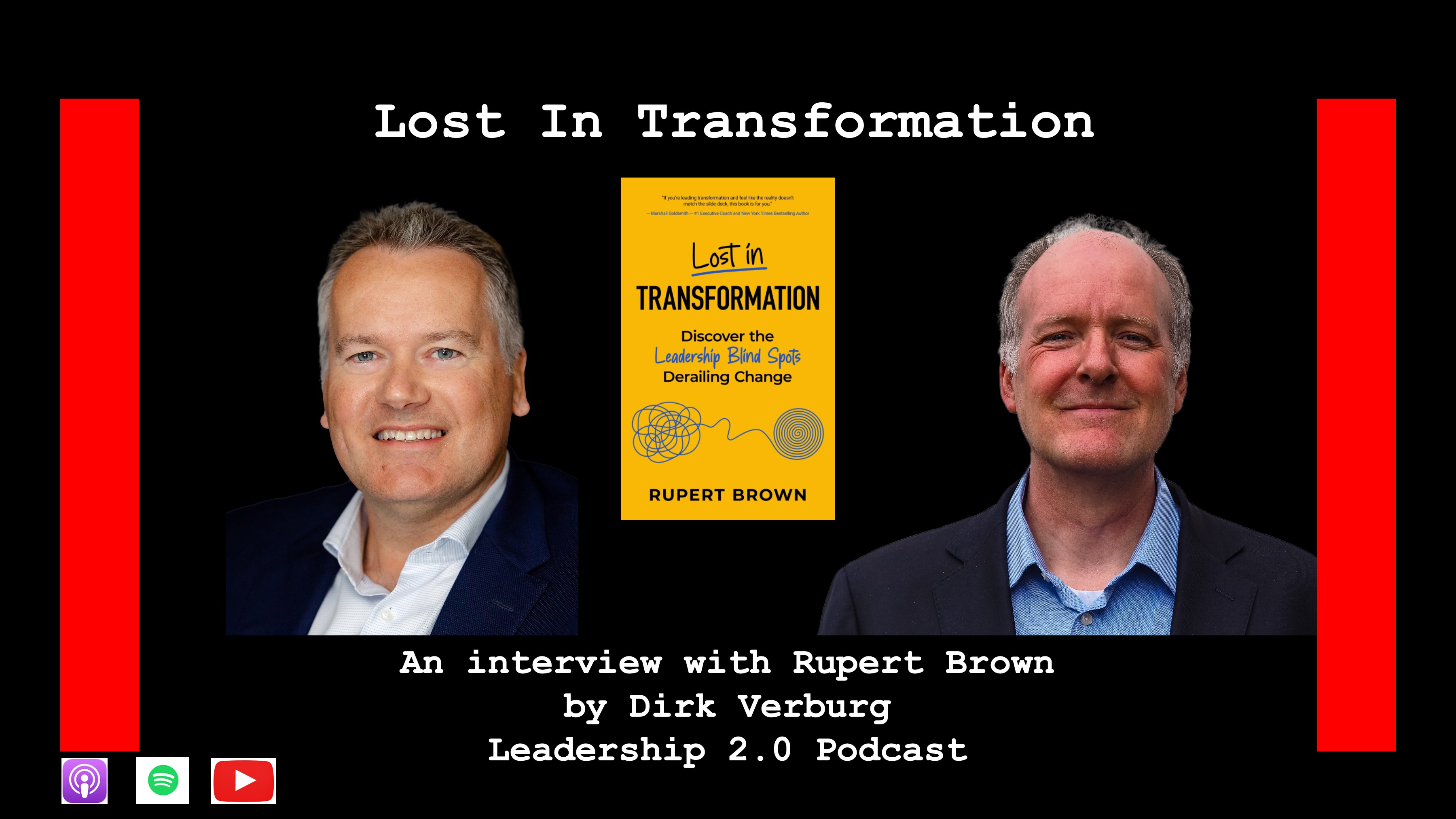
In the 35th episode of the Leadership 2.0 podcast, I sat down with a true transformation veteran, Rupert Brown, author of the eye-opening book, ‘Lost in Transformation’.
Rupert is an experienced Chief People Officer and change management specialist with deep expertise in M&A, digital transformation, and turnarounds, having advised giants like Procter & Gamble and Maersk.
This wasn’t just a discussion of tactics; it was a candid, emotionally intelligent discussion on how Transformations can be handled better.
Tune in to learn about:
Why Transformation projects continue to fail
The difference between Change and Transformation
The Bad Reputation of the word ‘Transformation’
Why we still struggle with Change Management
In-Groups and Out-Groups in Change Management Processes
Chief Acceleration Officers
Trust is Energy
Crises as Catalysts for Change
The impact of our Permacrisis on Change Management
Behavioral Skills to cope with the BANI world’
Change Management and AI
If you’re leading a transformation—or struggling to survive one—you can’t afford to miss this. Rupert delivers the hard truths and the practical guidance needed to shift from ‘being Lost’ to becoming ‘the Leader of change’.
► You can watch or listen to a podcast with our conversation on:
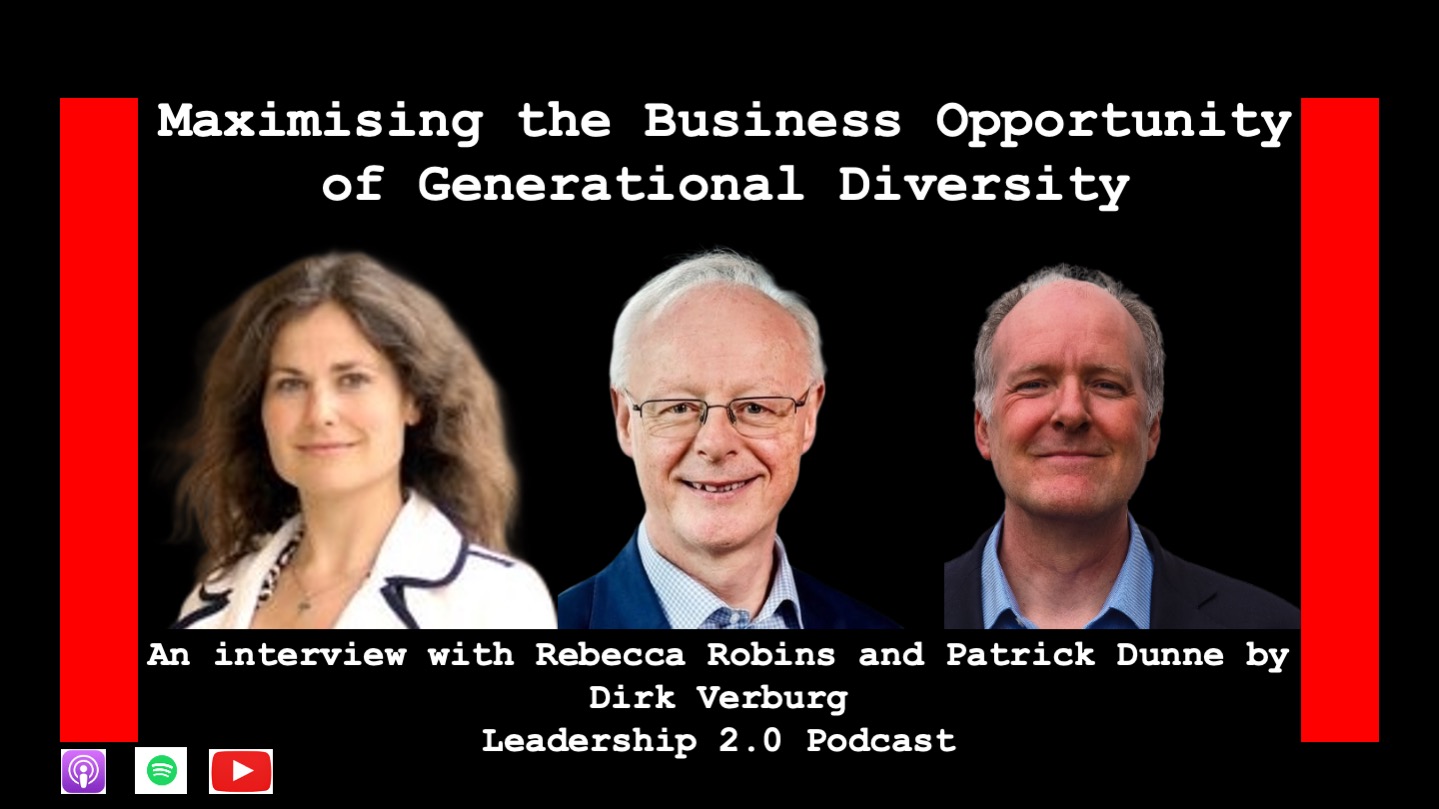
🎙️ In the 30th episode of the Leadership 2.0 podcast, I interview Rebecca Robins CMgr CCMI and Patrick Dunne about ‘Maximising the business opportunity of generational diversity’
During our conversation, we discussed the following topics:
Most of us are acutely aware of the gap between how organizations aspire to operate and the everyday reality of working within them.
This discrepancy often has a negative impact on the motivation and well-being of employees, ranging from a decrease in employee engagement, to mental health issues,
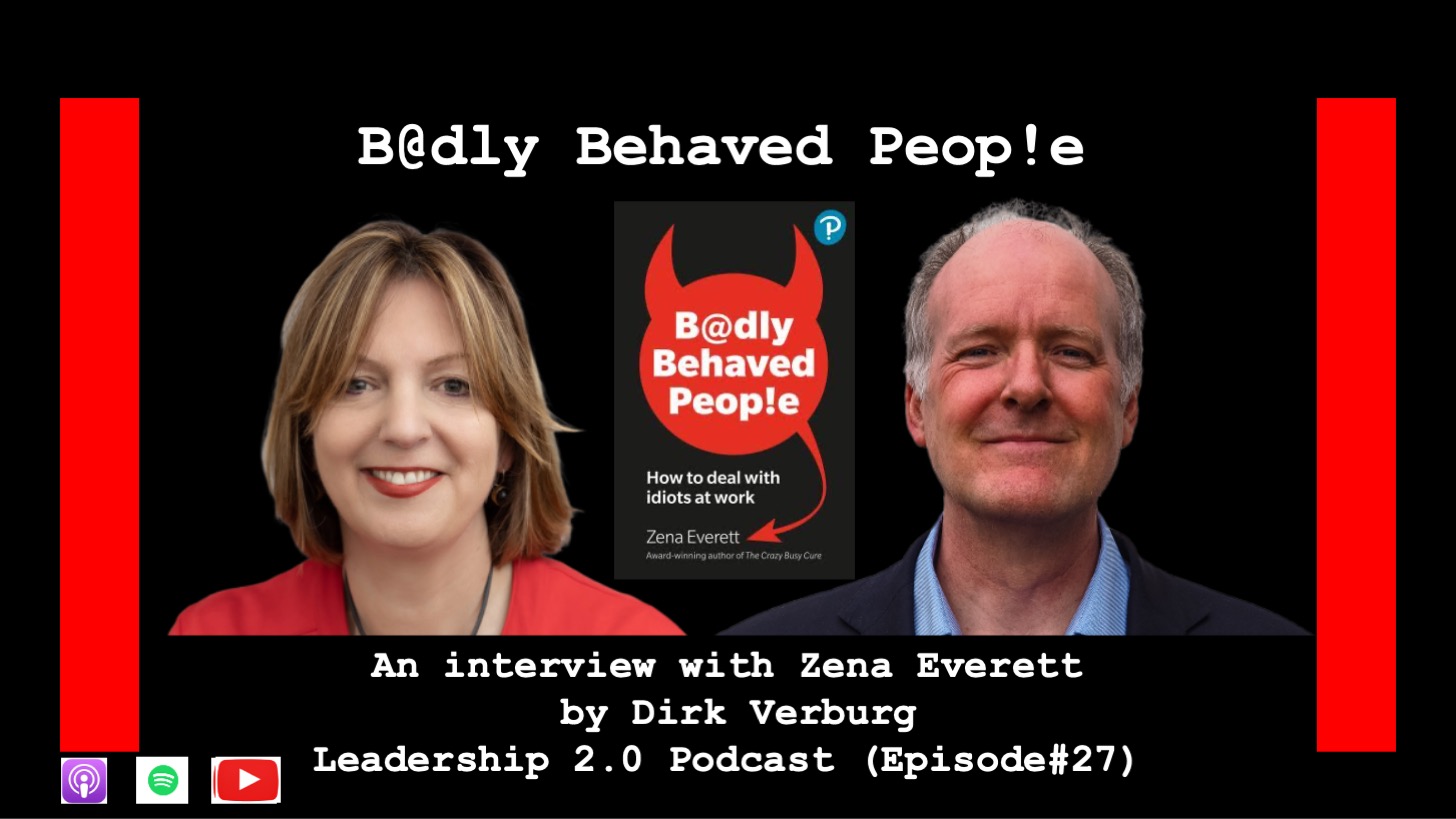
In her book ‘Badly Behaved People’, my fellow executive coach Zena Everett describes a number of real-world cases about how this discrepancy can manifest itself, and, perhaps more importantly, how we can address them
What I particularly like about about this book is how Zena makes complex psychological concepts (for instance, Transactional Analysis) accessible without oversimplifying them, and demonstrates how they can be applied in the workplace.
In our conversation about her book, Zena and I discussed the following topics:
🎙️ Even though we have a vast array of change management theories and methodologies at our disposal (John Kotter, Kurt Lewin, Elisabeth Kübler-Ross, William Bridges, ADKAR, etc.), it still proves to be very hard for us as leaders and consultants to implement real, sustainable change (transformation).
🚫 The harsh reality is that most change projects fail (the famous 70% of McKinsey), or end with a superficial victory declaration, after which the organization often falls back to ‘the way we DID things here’.
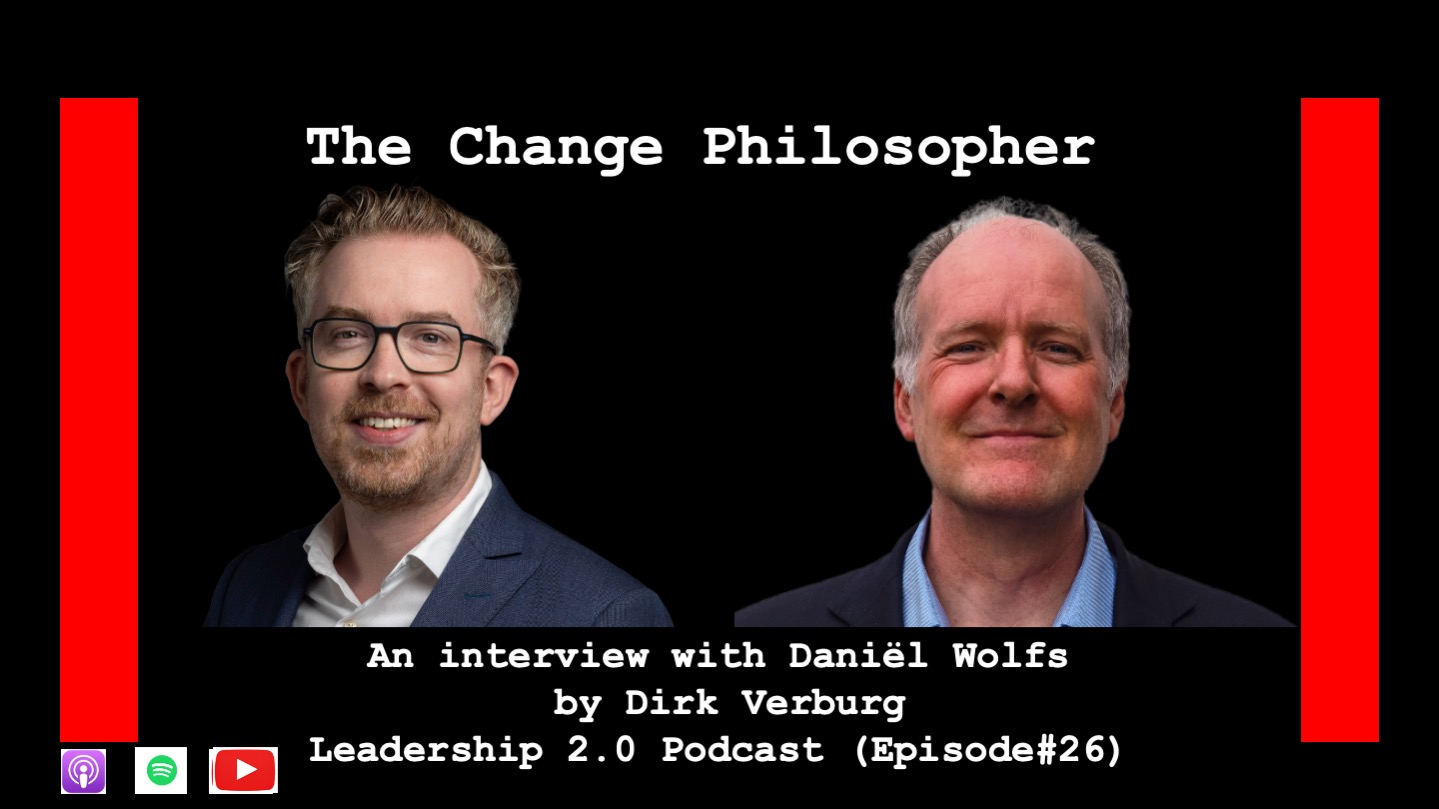
⁉️ ‘Why is that?’ That very question drove Daniël Wolfs, experienced change consultant and co-founder of The Change Studio (Netherlands), to write his thought-provoking book ‘De Veranderfilosoof’ (The Change Philosopher) on how we can approach transformation in a deeper, more human, and more sustainable way.’
► In our conversation about this book, we discussed the following topics:
In many recruitment processes, human beings are reduced to commodities, and human dignity has become an afterthought.
More often than not, recruitment has become a volume-driven exercise, where metrics like ‘time to fill’ have replaced the craftsmanship essential for identifying the best candidate for the role. As a result, candidates often find these processes unsatisfactory, as their potential unique contributions and value to organizations are not adequately recognized.
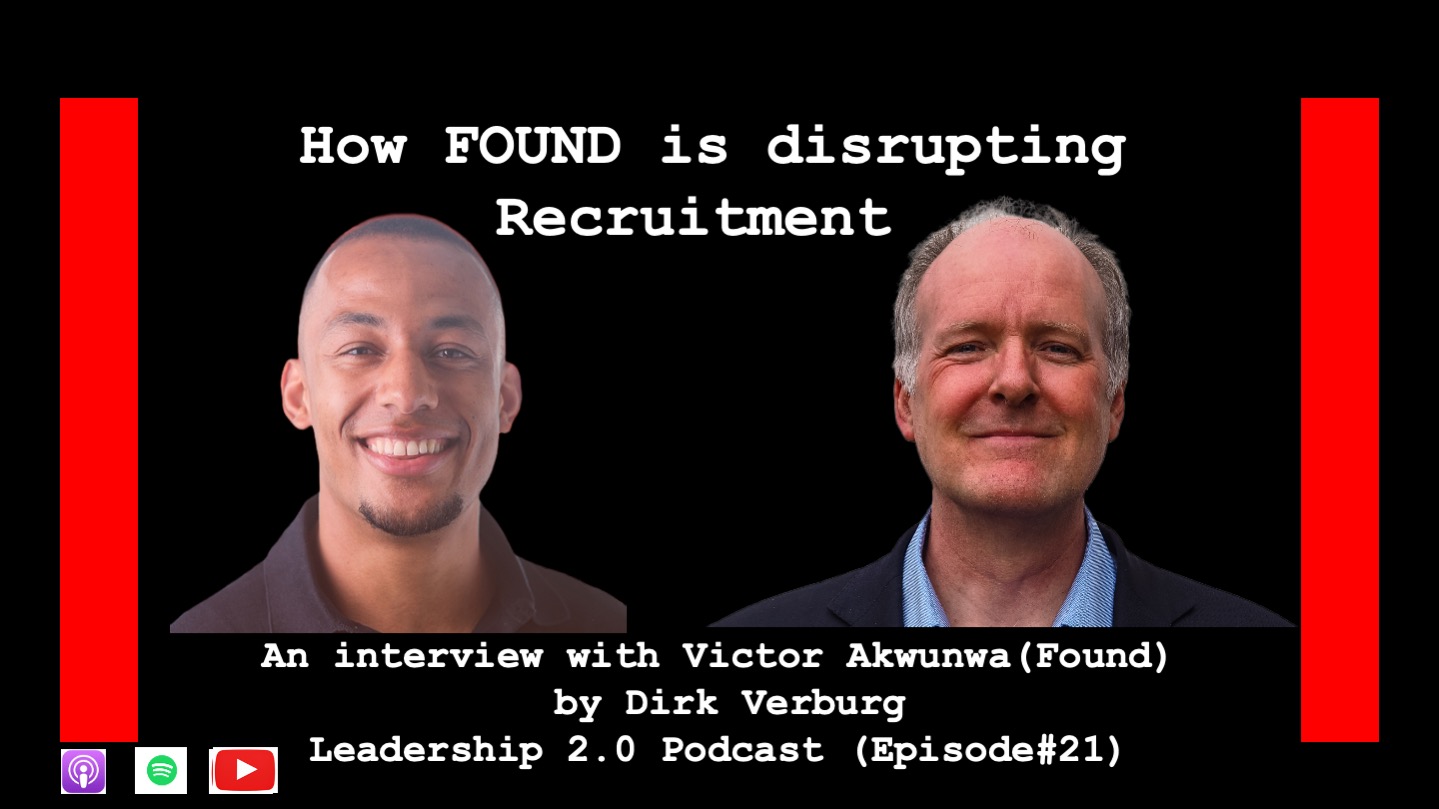
FOUND, a Swiss-based start-up company, wants to disrupt this traditional approach to recruitment. I recently interviewed Victor Akwunwa, the Chief Sales Officer of FOUND for my Leadership 2.0 podcast.
During our conversation, we discussed the following topics:
There are some companies I deeply admire, and On, the Swiss sports and apparel brand is definitely one of them! Not only do they make amazing products and have an extremely powerful brand, they also have a unique company culture.
For this reason, I was thrilled to sit down with Alessandra Del Pino, Head of Engagement & Talent Growth at On, to discuss the company culture of On, or, as Alessandra describes it, their ‘secret sauce’.
During our conversation, we covered the following topics:
‘I defy anybody to be energized by most appraisal systems I have seen in my career’ – Sally Bibb
As HR professionals and line managers (present company included!), we tend to take the strengths of our staff for granted and focus most of our attention on their ‘development areas’ (a euphemism for weaknesses).
The question is, however, how effective this is, and which business opportunities we miss, by following this approach.
Sally Bibb, partner at PA Consulting, leader and author in the field of strengths-based approaches to people and organisations, proposes a radically different approach and advocates focusing on strengths instead of weaknesses.
To find out what Strength Management is, and how we can implement it, I interviewed her for my Leadership 2.0 podcast.
During our conversation, Sally and I discussed the following topics:
0️⃣1️⃣ What Strength Management is
0️⃣2️⃣ How Sally became interested in the topic
0️⃣3️⃣ Is Strength Management incompatible with a Growth Mindset?
0️⃣4️⃣ Why most HR professionals remain focused on Development Areas
0️⃣5️⃣ Implementing Strength Management in HR Processes
0️⃣6️⃣ How can appraisals be improved?
0️⃣7️⃣ Is strength management a generational phenomenon?
0️⃣8️⃣ Will AI support Strength Management?
0️⃣9️⃣ Issues Sally is asked to address by her clients
➡️ No time to watch or listen to podcast now? Here is a short summary of our conversation ⤵
Dirk Verburg: I was classically trained as a line manager to focus on development areas to create “all-round” people. What are the advantages of focusing on a person’s strengths instead?
Sally Bibb: A strength is something you are naturally drawn to, that energizes you, and that you’re good at. Twenty years of neurobiological evidence shows that when people use their strengths, they are happier, more resilient, and perform better. Football managers, for example, know each player’s strengths and don’t try to make them all-rounders. While a team can be good at everything, an individual cannot. Focusing on strengths is not about ignoring weaknesses, but about intentionally using what you’re great at. Spending too much time on things you’re not good at will cause your motivation to drop, and your performance will be good at best—not great.
Dirk Verburg: Where does your personal interest in strengths come from? Did you have an experience that inspired you to focus on this topic?
Sally Bibb: My interest stems from an early experience in my career. I was promoted from a job I loved, which involved crewing ships, to one that required doing research for trade union negotiations. I was good at the first job because it leveraged my strengths in connecting with people and problem-solving. The second job, however, was a poor fit. I felt a loss of confidence and didn’t understand why until years later at a conference. A Harvard professor spoke about the emerging field of positive psychology and focusing on what’s right with people. That was a lightbulb moment for me. I realized there was nothing wrong with me; I was just a square peg in a round hole. This experience inspired me to study what makes great salespeople so successful, which was my first foray into applying strengths to the workplace.
Dirk Verburg: How do you see the relationship between strengths management and the desire to adopt a “growth mindset”? Are they contradictory, or do they strengthen each other?
Sally Bibb: I think they are highly complementary. A growth mindset—the belief that you can learn and grow—is important whether you are playing to your strengths or working on something you’re not good at. The growth mindset is not about being good at everything, but about being open to learning. For example, I worked with an executive who had never been in an innovative environment before. By having a growth mindset, he discovered a new strength in “joining the dots” and making connections. Had he not been open to this, he might have boxed himself in, assuming he wasn’t an innovative person. A growth mindset helps you discover new strengths and apply existing ones to new challenges.
Dirk Verburg: Why do you think many people in HR and talent management still focus so much on areas of development, even though the thinking has moved on?
Sally Bibb: I think a lot of it is organizational inertia. Organizations tend to do what they’ve always done, like using traditional competency frameworks and appraisal systems, even when they know these systems don’t energize people or get the best results. The organizations I work with that adopt a strengths-based approach do so because they want different outcomes, like improved performance and morale. Adopting this approach is a gradual process that requires a leader with a clear focus and determination to change things. I hope that in the next ten years, a strengths-based approach will be the norm, with new generations of leaders recognizing the benefits of this way of thinking.
Dirk Verburg: How would you practically conduct a strengths-based interview?
Sally Bibb: First, you have to know what strengths are needed for the role. For example, we studied the strengths of exemplary midwives in charge of labor wards. We found that the best ones share certain strengths beyond their clinical competencies, like a strong sense of doing the right thing. In a strengths-based interview, you ask candidates about those specific strengths. For example, “Tell me about a time when you had to ensure the right thing was done.” If it is a genuine strength, you can see their face light up and they can easily provide examples. In contrast, if you don’t know what “great” looks like for that role, a strengths interview is difficult to do effectively. The key is to match the candidate’s natural inclinations with the specific strengths that you know are critical for success in that job.
Dirk Verburg: What can we do to make classic performance interviews more meaningful by applying a strengths-based approach?
Sally Bibb: A strengths-based performance discussion should be an ongoing conversation throughout the year, not just a one-off event. It should focus on three things: the strengths you’re using regularly, the strengths you have that you might not be using, and the “weaknesses that matter”—the ones that are really getting in your way. Instead of criticizing, you can have a collaborative conversation about how to mitigate those weaknesses. This could involve using your strengths to compensate, getting help from colleagues, or finding ways to avoid the task altogether. This approach makes people feel relaxed and authentic because they don’t have to pretend to be perfect. The conversation becomes focused on potential and how to make the person even better at what they already do well.
Dirk Verburg: I have the impression that focusing on strengths comes more naturally to younger generations than to baby boomers or millennials. Would you agree with that observation?
Sally Bibb: That’s an interesting observation, and I’m not aware of any specific research on it. However, people in their 20s and 30s were raised in an era of “positive parenting” and a greater focus on self-esteem. They are often less modest and more willing to talk about their strengths. In contrast, older generations can be more modest. This is also culturally influenced. In the United States, people are generally more comfortable discussing their strengths, whereas in the UK and Switzerland, modesty can be a national sport. I see modesty as being a bit overrated, as not talking about your strengths can inhibit your ability to serve others and be overlooked for opportunities.
Dirk Verburg: You work with very big clients. What are the starting points for you in those conversations when a client wants to think about a strengths-based approach?
Sally Bibb: Clients rarely ask for a strengths-based approach directly. They come with business problems like: “We need to improve our performance,” “We need to improve our safety,” or “We need to improve staff morale and engagement.” These are the real-world problems that a strengths-based approach can solve. When clients see the impact of this approach, they like it because it connects with people and makes common sense. It’s not just a psychometric tool; it translates into hard returns and measurable outcomes. The private equity sector, for example, has been a leader in this thinking because they know that having the right combination of strengths in a leadership team is critical to a successful investment.
Dirk Verburg: We’ve discussed a lot of elements around strengths. Is there anything we haven’t touched on that you would like to mention?
Sally Bibb: There’s just one thing that’s very dear to my heart. From women in prison to senior executives, people often don’t really know their strengths or their value. The strengths-based approach makes people feel good about themselves and the contribution they make. This is the best starting point for helping people realize their potential. If we could bring this thinking into the public and political arena, there would be less burnout, less imposter syndrome, and more satisfaction and engagement at work. It’s a win-win-win for individuals, employers, and society as a whole.
▶ About Sally Bibb
She started her career working for BT International and then moved into an international role at The Economist Group before founding the strengths consultancy Engaging Minds in 2012. In 2021, she joined PA Consulting as a partner to advance her vision of bringing strengths to many more employers worldwide.
In this role, she leads strengths-based organizational change work in Europe, the USA, and Asia, and has built a track record of achieving transformational results for a number of high-profile clients in both the private, as well as in the public sector.
Sally has an MSc in organizational change from the University of Surrey and has (co-)authored eight books. A full list can be found here: https://sallybibb.com/my-books/
She is a fellow of the RSA (Royal Society of Arts) and a member of the steering committee of The Daedalus Trust, a charity founded by Lord David Owen to promote research into hubris syndrome in business.
reflect on their own role and behaviors to prevent self-fulfilling prophecies,
release control if they want to make things happen, and
consider creating ‘a sense of belonging’ instead of ‘burning platforms’
if they want to implement deep and sustainable behavioral change in their organizations…
These were just some of the topics I discussed with the management consultant and change management guru (although he would reject that classification!) Arend Ardon.
Arend wrote a number of bestsellers in the area of change management and leadership, and is the co-founder and co-owner of the Change Studio, a consultancy firm specializing in change management and leadership.
During our conversation, Arend and I discussed the following topics:
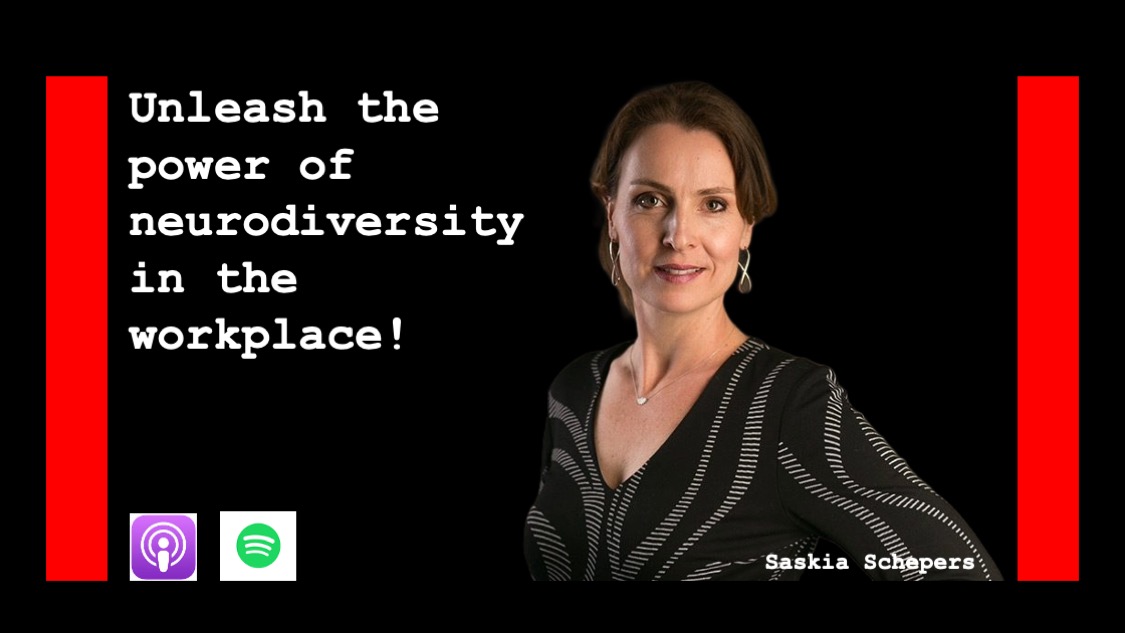
Recently I had a conversation with Saskia Schepers about her book on Neurodiversity in the workplace with the title ‘Als alle breinen werken – Waarom ruimte voor neurodiversiteit op het werk goed is voor iedereen’ (‘When all brains are switched on – Why space for neurodiversity in the workplace benefits everyone’).
Around 80% of mankind is neurotypical, and 20% is neurodivergent. We tend to ‘equip’ people in the latter category with labels like ADD, DHD, bipolar, autistic, etc.
Most leaders find it hard to integrate neurodivergent people in their teams.
The reason is that most of us have preconceived ideas about the way people in the workplace should behave. For instance, we expect people to like attending and participating in meetings, do their work in teams, be productive in open-plan offices, and socialize with their colleagues after work.
People who do not fit this mold are seen as bad ‘team players’, and are often criticized for this behavior, e.g. during annual performance review meetings.
The book almost immediately reached the number 1 position in the Dutch bestseller list of management books, was quickly sold out, and is now in its third printed edition.
An English translation is in the making and will be published in 2024.
During our conversation, we discussed the following topics:
For those who have never experienced it firsthand, or witnessed it from nearby, scientific research has shown that work can be a considerable source of stress.
This stress can manifest itself in the form of emotions (e.g. anxiety and depression), cognitive performance (e.g. in decision-making), negative behaviors (e.g. unhealthy eating habits, alcohol and drug abuse, aggression), and physical symptoms (e.g. high blood pressure, neck-, head- and shoulder pain).
Not only does stress have a negative impact on individual employees, absenteeism and low engagement for instance can seriously impact the performance of their organizations as well.
Resilience training
The popularity of resilience training in the workplace has dramatically increased in the last couple of years (particularly as a result of the COVID-19 pandemic), and there is evidence that, if done in the right format, this training can help individuals in certain target groups to deal with stress.
Positioning
The problem is that resilience training is almost always only a part of the solution, and that is almost meaningless if offered in isolation to mitigate work-related stress.
Last week I attended an interesting Webinar from Gartner about change fatigue.
According to data collected by Gartner, change fatigue is quickly becoming the number 1 priority for most HR organizations in 2023.
The reason is that the number of change initiatives in organizations is increasing exponentially; simultaneously, the enthusiasm of the workforce to embrace, or at least support these changes, is plummeting.
As a result, many organizations are currently looking for resources to address this, for instance in the form of change management methodologies (e.g. ADKAR), or by asking for support from specialized consulting boutiques.
The why of change
However, as valuable as these resources might be, it is important not to jump to the ‘how’, without paying attention to the ‘why’, the ‘what’ and ‘the team’.
In my personal experience, most people do not resist change if they understand the ‘why’, the ‘what’, and if they recognize ‘the team’.
One of the big temptations we as leaders face is our urge to add value to the work of our staff. Typically, we add this value in the form of change or additional requests.
There are three reasons why adding value is tempting for us:
Accountability – We are accountable for the work of our staff. If something goes wrong, we as leaders suffer the consequences (‘It happened on your watch’)
Know-how – We know it better than our staff. Seriously. That is most often the reason why we were appointed
We like it – As leaders it is often tempting to take a break from the daily grind of budgets and office politics, to dive back into the content we love(d) so much (‘Let me show you how it is done’)
As with every temptation in life, we need to fight this one as well. There are fivereasons for this:
When I had just been appointed in my first proper line management role, I decided to organize an offsite with my team. The purpose of this offsite was to finalize the development of a number of HR policies and processes.
Around 11 o’clock in the first morning, in a characterless conference room in the basement of the conference center, we completed our first round of brainstorming. When the time came to write up the output of our first session in a flow chart format, I said I wanted to use a specific methodology I had used as a management consultant, and would be happy to do the write-up.
One of my direct reports looked disappointed, because she wanted to create the flowcharts herself, but a colleague of hers consoled her, and said: ‘Sure, if Dirk knows how to do it and has a strong passion for it, why do we not let him do so?’ The others agreed, and they left the room to leave me to it.
I spend the next 1.5 hours working on my own in the aforementioned characterless conference room in the basement. When I was ready I went upstairs to look for my team. I found them on the terrace, enjoying the sun, cappuccinos, orange juice, and each other’s company.
Fortunately enough they thought my work was ok…
Do it yourself?
A lot of leaders frequently want to do the work of their direct reports. They have a variety of reasons for this, including
Three things to avoid if you want to make sure people understand you
‘This is a very noisy world, so we have to be very clear what we want them to know about us’
Steve Jobs
In 1920 Vladimir Lenin already recognized the power of controlling the printing press. A century later, in today’s social media world, the real battle ground is our everyday language.
Language is the ultimate tool to inspire people to take action. Unfortunately, we frequently squander its impact by making three mistakes:
I spent a significant part of my working life developing leaders in organizations. What strikes me is that during COVID-19 the demand for this type of work has not decreased; if anything, the demand for leadership development has increased. That is remarkable. During the financial crisis in 2007-2008, for instance, most companies tried to save money, and one of the first things they considered was decreasing the out-of-pocket costs associated with these, and other kind of developmental activities.
Recently I was asked why companies continue to invest in the quality of their leadership at all levels of the organizations, despite the economic uncertainty they are facing.
In my opinion, the reason is that companies have come to realize the growing importance of the quality of leadership at all levels of the organization. I believe that this is a good thing, especially because leadership roles have become more demanding in the last couple of decades, not only for senior leaders, but also for first, and second-level leaders in organizations.
A couple of days ago my bible app opened with this verse of the day: ‘To do righteousness and justice is more acceptable to the LORD than sacrifice’ (Proverbs 21:3).
This text reminded me of the way some companies deal with Corporate Social Responsibility (CSR). Rather than doing the right thing, they do the wrong thing and compensate for this by deploying CSR initiatives. There is even a special term describing this phenomenon: ‘Greenwashing’. In this context, it is no wonder that two professors from IMD (a leading Swiss Business School) published an article in 2018 with the provocative title: ‘Why nobody takes corporate social responsibility seriously’.
Employee engagement is a topic close to my heart. In the past two decades I have designed, managed and implemented the findings of engagement surveys multiple times, and also managed to write an article with my point of view on how to make them ‘work’.
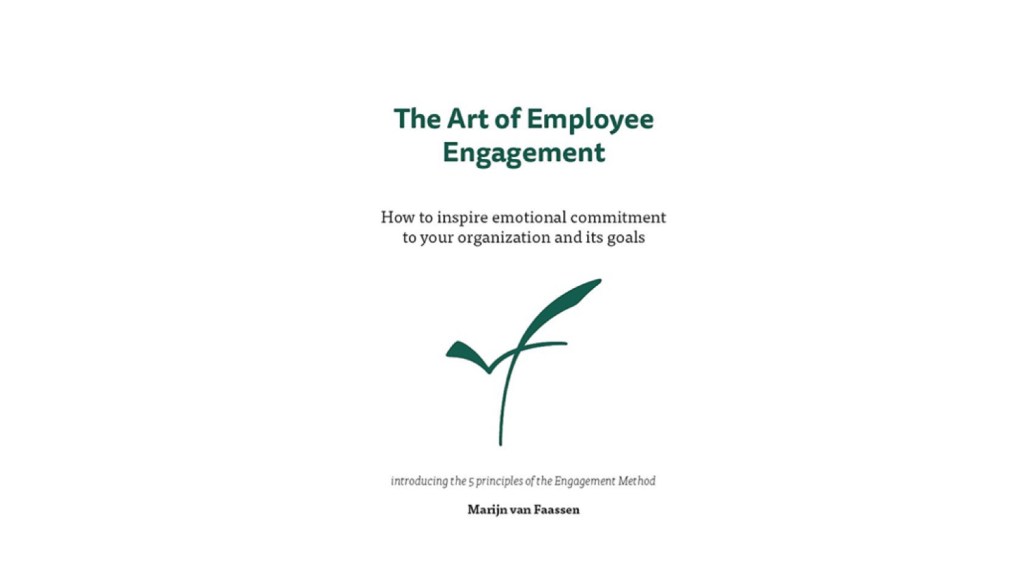
Given my interest in this topic, I was very pleased to receive a copy of ‘The Art of Employee Engagement’ by Marijn Faassen. I read it in one go, because I found it a fascinating read, for a number of reasons:
Despite the importance of employee engagement, more and more organizations decide to cancel their employee engagement surveys due to a perceived lack of ROI. Leaders can make engagement surveys work however, by applying three simple principles.Continue reading →







 Dirk Verburg