The 70% Failure Rate: Why are most Business Transformations STILL getting ‘Lost’? – Interview Rupert Brown

McKinsey’s infamous stat haunts every executive: 70% of all change management efforts fail. Despite decades of expertise, this number seems frozen in time. Why?

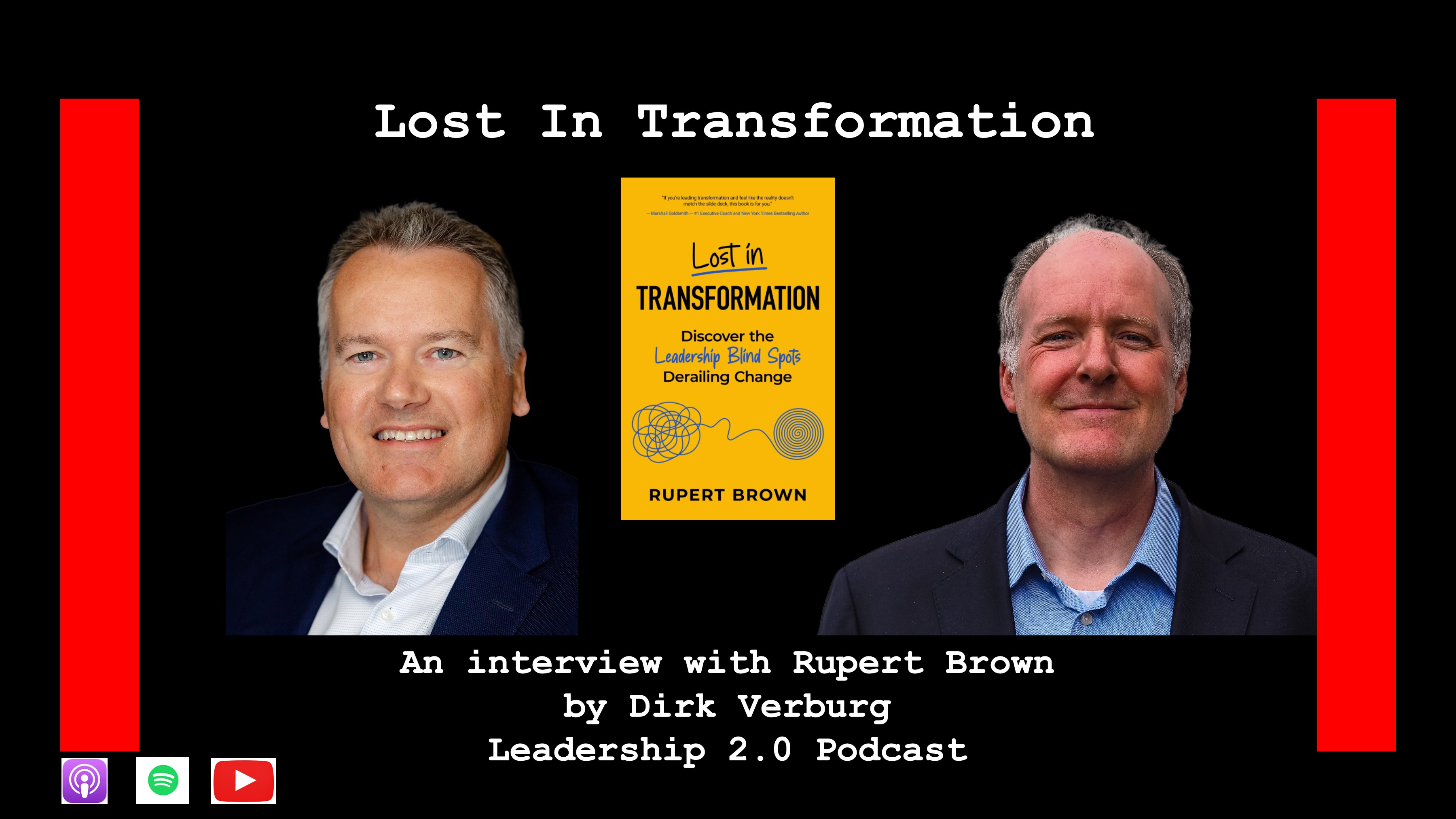
In the 35th episode of the Leadership 2.0 podcast, I sat down with a true transformation veteran, Rupert Brown, author of the eye-opening book, ‘Lost in Transformation’.

Rupert is an experienced Chief People Officer and change management specialist with deep expertise in M&A, digital transformation, and turnarounds, having advised giants like Procter & Gamble and Maersk.

This wasn’t just a discussion of tactics; it was a candid, emotionally intelligent discussion on how Transformations can be handled better.

Tune in to learn about:

  • Why Transformation projects continue to fail
  • The difference between Change and Transformation
  • The Bad Reputation of the word ‘Transformation’
  • Why we still struggle with Change Management  
  • In-Groups and Out-Groups in Change Management Processes  
  • Chief Acceleration Officers
  • Trust is Energy
  • Crises as Catalysts for Change
  • The impact of our Permacrisis on Change Management 
  • Behavioral Skills to cope with the BANI world’
  • Change Management and AI

If you’re leading a transformation—or struggling to survive one—you can’t afford to miss this. Rupert delivers the hard truths and the practical guidance needed to shift from ‘being Lost’ to becoming ‘the Leader of change’.

► You can watch or listen to a podcast with our conversation on:

Continue reading

‘ESG: Farce of Force for Good?’ – An Interview with Sander Tideman (‘Triple Value Leadership’)

‘You need to provide recyclable note paper to demonstrate the commitment of our company to sustainability’, I was told when I co-organized a meeting where the vast majority of participants arrived by airplane, most of them on intercontinental flights…

I have always been quite cynical about ESG (Environmental, Social, and Governance) and CSR (Corporate Social Responsibility) initiatives from public companies.

Some of my favorite examples include:

  • A “Big Oil” company using the “greenness” of suppliers as a selection criterion in the purchasing process
  • A Financial Services company that directly contributed to the Euro crisis but gave its employees an afternoon off to paint schools in derelict areas to “give back to society”
  • ESG leaders flying en masse to conferences in New York to discuss how to make the world a more sustainable place
  • Companies that started “recalibrating” their DEI efforts in the aftermath of the last US presidential election.

The behavior of most pubic companies in the ESG and CSR space always strikes me as ‘Do as I say, not what I do’. Not because the leaders of these companies are inherently ‘evil’ or ‘immoral’, but simply because, when push comes to shove (most often under pressure from their supervisory boards, or activist shareholders), they do not seem to have an alternative but to let Shareholder Value prevail in their decision-making process.


‘People, Planet, and Profit. But the greatest of these is Profit…’


🎙️ ‘A big conversation with big questions’, that is how Sander Tideman characterized the conversation I had with him about ESG and CSR.

Sander is a researcher, author, entrepreneur and executive coach in sustainable leadership. He works with leaders to build flourishing organizations equipped to address the unprecedented challenges of today. He has worked for and consulted with leading organizations on three continents, and is publicly known for his work with top leaders in, for instance, Unilever.

In the 31th episode of the Leadership 2.0 podcast, I interview Sander about the question if and how pubic companies and our society should adopt ESG and CSR concepts.

During our conversation, we discussed the following topics:

Continue reading

The Strategic Value of Learning & Development – An interview with Nick van Dam

🚫 Many organizations mistakenly relegate Learning & Development (L&D) to a “nice-to-have” status. It’s seen as something every HR organization needs to have (if only for the optics), but often the prevailing attitude is that, while great L&D is a pleasant surprise, if it falls short, there’s no serious harm done to the organization.

❗This is often reflected in bland L&D offerings, which, more often than not, are so generic, that they fail to address the strategic issues organizations need to address

⁉️ However, what would happen if organizations truly would treat Learning & Development as a strategic instrument?

🎙️ In the 29th episode of the Leadership 2.0 podcast, I interview Nick van Dam about ‘The Strategic Value of Learning & Development’. Nick van Dam is an internationally recognized thought leader, advisor, executive coach, researcher, facilitator, and best-selling (co-) author of more than 29 books on Leadership, Organizational Behavior, and Corporate Learning & Talent Management.

► During our conversation, we discussed the following topics:

Continue reading

‘Trust You Gut – Decision Making and Intuition’ – An interview with Eugene Sadler-Smith

We are always informed by our intuition when it comes to making decisions. More often than not our intuition is ‘right’, but there are also situations when we should definitely not rely on our intuition.

Being able to determine when to use our intuition and when not, often means the difference between our success and failure.

In my second interview with Professor Eugene Sadler-Smith for the Leadership 2.0 Podcast, we discussed the role of intuition in decision-making processes.

During our conversation, we touched on the following topics:

Continue reading

Coaching in the workplace – An interview with Zena Everett

Most of us are acutely aware of the gap between how organizations aspire to operate and the everyday reality of working within them.

This discrepancy often has a negative impact on the motivation and well-being of employees, ranging from a decrease in employee engagement, to mental health issues,

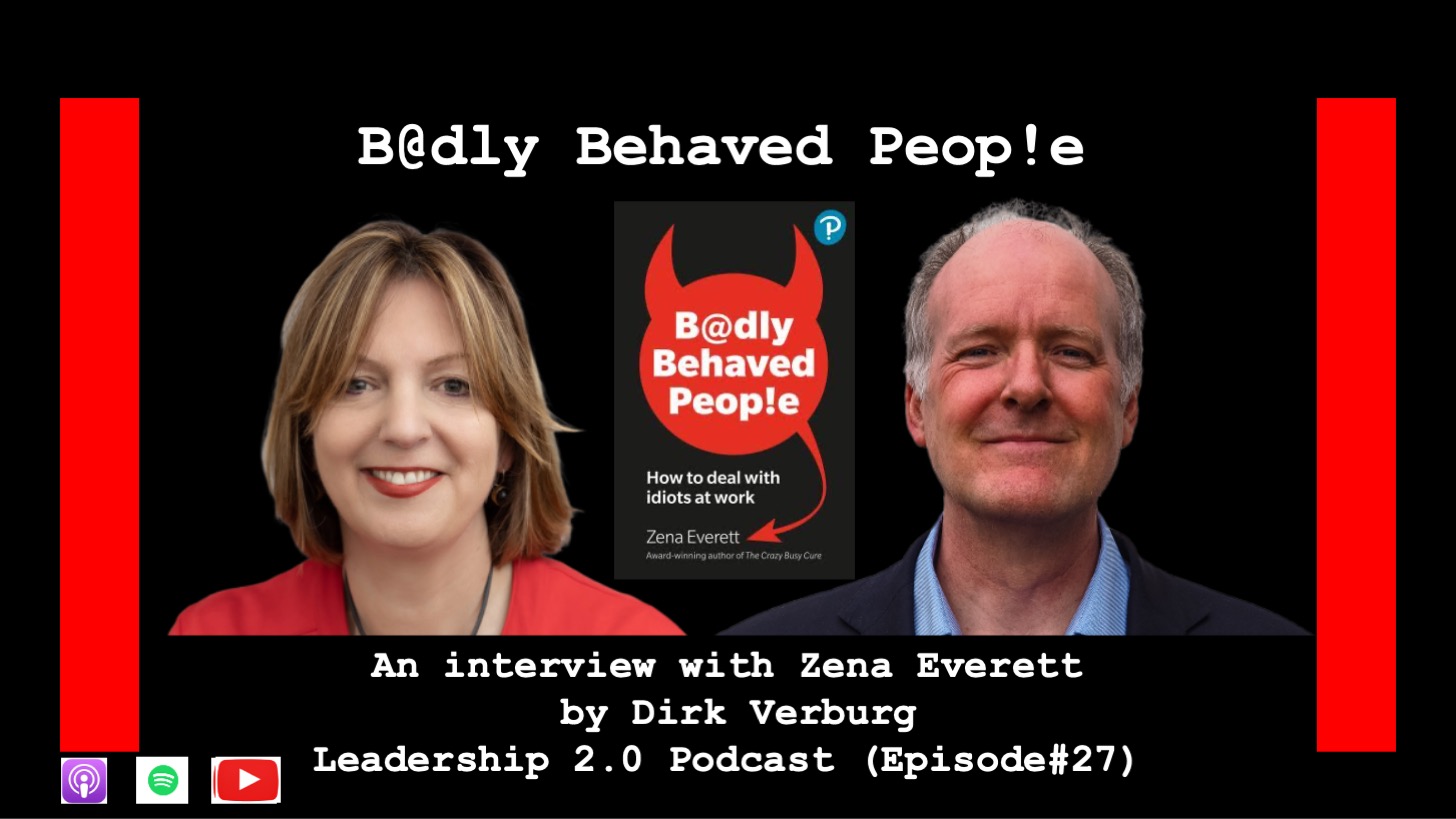
In her book ‘Badly Behaved People’, my fellow executive coach Zena Everett describes a number of real-world cases about how this discrepancy can manifest itself, and, perhaps more importantly, how we can address them

What I particularly like about about this book is how Zena makes complex psychological concepts (for instance, Transactional Analysis) accessible without oversimplifying them, and demonstrates how they can be applied in the workplace.

In our conversation about her book, Zena and I discussed the following topics:

Continue reading

How FOUND is Disrupting Recruitment – Interview with Victor Akwunwa

In many recruitment processes, human beings are reduced to commodities, and human dignity has become an afterthought.

More often than not, recruitment has become a volume-driven exercise, where metrics like ‘time to fill’ have replaced the craftsmanship essential for identifying the best candidate for the role. As a result, candidates often find these processes unsatisfactory, as their potential unique contributions and value to organizations are not adequately recognized.

FOUND, a Swiss-based start-up company, wants to disrupt this traditional approach to recruitment. I recently interviewed Victor Akwunwa, the Chief Sales Officer of FOUND for my Leadership 2.0 podcast.

During our conversation, we discussed the following topics:

Continue reading

Why reducing corporate overhead costs is not a ‘Get Out of Jail Free card’

It is tempting for CEOs to try to appease their shareholders by reducing corporate overhead costs. It seems to be the corporate equivalent of a ‘Get Out of Jail Free card’ in Monopoly: it is free and can get a CEO out of a tricky situation.

The reason is that everyone loves the notion of lowering corporate overhead costs, and especially reducing the number of people in corporate roles.

Whereas the supervisory board occasionally might call for caution, you will never hear shareholders or analysts complain and Business Unit leaders usually love the perspective of lower corporate charges and more independence. Most often, corporate functions cannot count on a lot of sympathy from the rest of the workforce either. They are seen as overpaid ‘bureaucrats’, ‘paper pushers’, and ‘PowerPoint wizards’ in ‘back-office’ roles.

Reducing overhead is also not very difficult. Usually, there are plenty of young runners-up in large organizations dying to prove themselves to corporate leaders. If not, consulting firms are happy to line up for beauty parades to show off their capabilities in this area.

It is also not that hard – at least, I have never seen a corporate cost savings initiative not achieving its short-term financial objectives.

So eliminating or reducing these corporate functions is a great idea, right?

Unfortunately, it depends…

Eliminating or reducing corporate functions poses risks for CEOs in three areas:

  • Compliance
  • Shareholder activism
  • Boardroom dynamics
Continue reading

The Company Culture of On – An interview with Alessandra Del Pino

There are some companies I deeply admire, and On, the Swiss sports and apparel brand is definitely one of them! Not only do they make amazing products and have an extremely powerful brand, they also have a unique company culture.

For this reason, I was thrilled to sit down with Alessandra Del Pino, Head of Engagement & Talent Growth at On, to discuss the company culture of On, or, as Alessandra describes it, their ‘secret sauce’.

During our conversation, we covered the following topics:

Continue reading

How to ensure successful leadership transitions – An interview with Michael Watkins

The statistics are sobering: not only do 49% of external executive hires end in failure within 18 months, but internal moves prove to be challenging as well. For instance, 40% of internal job moves involving high potentials also end in failure.

Besides the fact that these failures often have a traumatic impact on the individuals involved, the costs for the organisations are huge. Not only in terms of image and hiring costs but, more importantly, in terms of opportunity costs.

To find out why leadership transitions prove to be so hard, and what companies and individuals can do about it, I interviewed Michael Watkins for my Leadership 2.0 podcast.

Continue reading

‘The advantages and limitations of intuition in decision-making’ – An interview with Eugene Sadler-Smith

We are always informed by our intuition when it comes to making decisions. More often than not our intuition is ‘right’, but there are also situations when we should definitely not rely on our intuition.

Being able to determine when to use our intuition and when not, often means the difference between our success and failure.

In my second interview with Professor Eugene Sadler-Smith for the Leadership 2.0 Podcast, we discussed the role of intuition in decision-making processes.

During our conversation, we touched on the following topics:

0️⃣1️⃣ What intuition is and what it is not
0️⃣2️⃣ The two types of intuition
0️⃣3️⃣ Adopting an Ambidextrous Mindset
0️⃣4️⃣ How to take important decisions in business
0️⃣5️⃣ Carl Jung and Intuition
0️⃣6️⃣ Why the intuitive mind is a slow learner
0️⃣7️⃣ Values and ethics in decision-making processes
0️⃣8️⃣ Final Thoughts – AI and intuition

You can watch or listen to this podcast episode on:

▶ YouTube https://youtu.be/yaSpG5UtAis

▶ Apple Podcasts https://podcasts.apple.com/ch/podcast/the-advantages-and-limitations-of-intuition/id1511327057?i=1000654506560

▶ Spotify https://open.spotify.com/episode/6mCsVQCSuQ7XzYtQjvdem1?si=UiEy1VZlR0q1GB6XLyJPlA

Continue reading

‘Scenario Thinking and Leadership’ – An interview with Jeremy Bentham

Scenario thinking enables organizations to establish possible visions of the future in the form of scenarios.

These scenarios enable decision-makers to think through the different ways in which the environment of their organizations could evolve, based on different sets of assumptions. It enables leaders to ‘think through ‘a wide range of what if questions’: ‘What if the dollar…’, ‘What if China…’, ‘What if scientific developments make it possible in the near future to…’, etc. This enables them to mentally prepare themselves for possible ‘Black Swans’, and review the ability of their organization to cope with, or, iedeally, benefit from these.

One of the companies that is best known for its scenario-thinking activity is Shell. For decades, Shell’s scenarios have supported the decision-making of Shell leaders, academics, governments, and businesses.

Jeremy Bentham led this activity in Shell between 2006 and his retirement in 2022 as Shell Scenarios & strategy Leader and VP Global Business Environment.
In this episode of the Leadership 2.0 podcast, I am interviewing Jeremy Bentham about scenario thinking and leadership.

During our conversation, Jeremy and I discussed the following topics:

Continue reading

‘From Crisis to Innovation: A Mental Health Entrepreneur’s journey’ – An interview with Vlad Gheorghiu

The World Health Organization estimates that 12 billion working days are lost every year due to depression and anxiety. This costs $1 trillion in lost productivity.

McKinsey research showed that ‘60 % of employees have experienced at least one mental-health challenge at some point in their lives’. According to the same study ‘Failing to address the effects of mental health and well-being challenges is a missed opportunity for employers’.

Employees dealing with mental health issues are 4x more likely to say they intend to leave, 3x more likely to report low job satisfaction, 3x more likely to experience toxic workplace behavior, and 2x more likely to report low engagement.

At the same time, classic Employee Assistance Programs do not seem to work…

Vlad Gheorghiu experienced mental health issues firsthand, whilst working for McKinsey. 

This experience inspired him to design solutions. First for McKinsey, and later by co-finding a start-up company called Kyan Health.

In my conversation with Vlad, we covered the following topics:

1️⃣ Vlad’s background

2️⃣ Vlad’s engagement with mental health

3️⃣ The gap in the workplace between the mental health support employees need and receive

4️⃣ The concept of Kyan Health

5️⃣ Measuring impact

6️⃣ Creating a start-up company: Three Dos

7️⃣ Creating a start-up company: Three Dont’s

8️⃣ Vlad’s role models as an entrepreneur

If you are interested, you can watch our conversation on YouTube.


You can also listen to it Apple Podcasts or Spotify

Continue reading