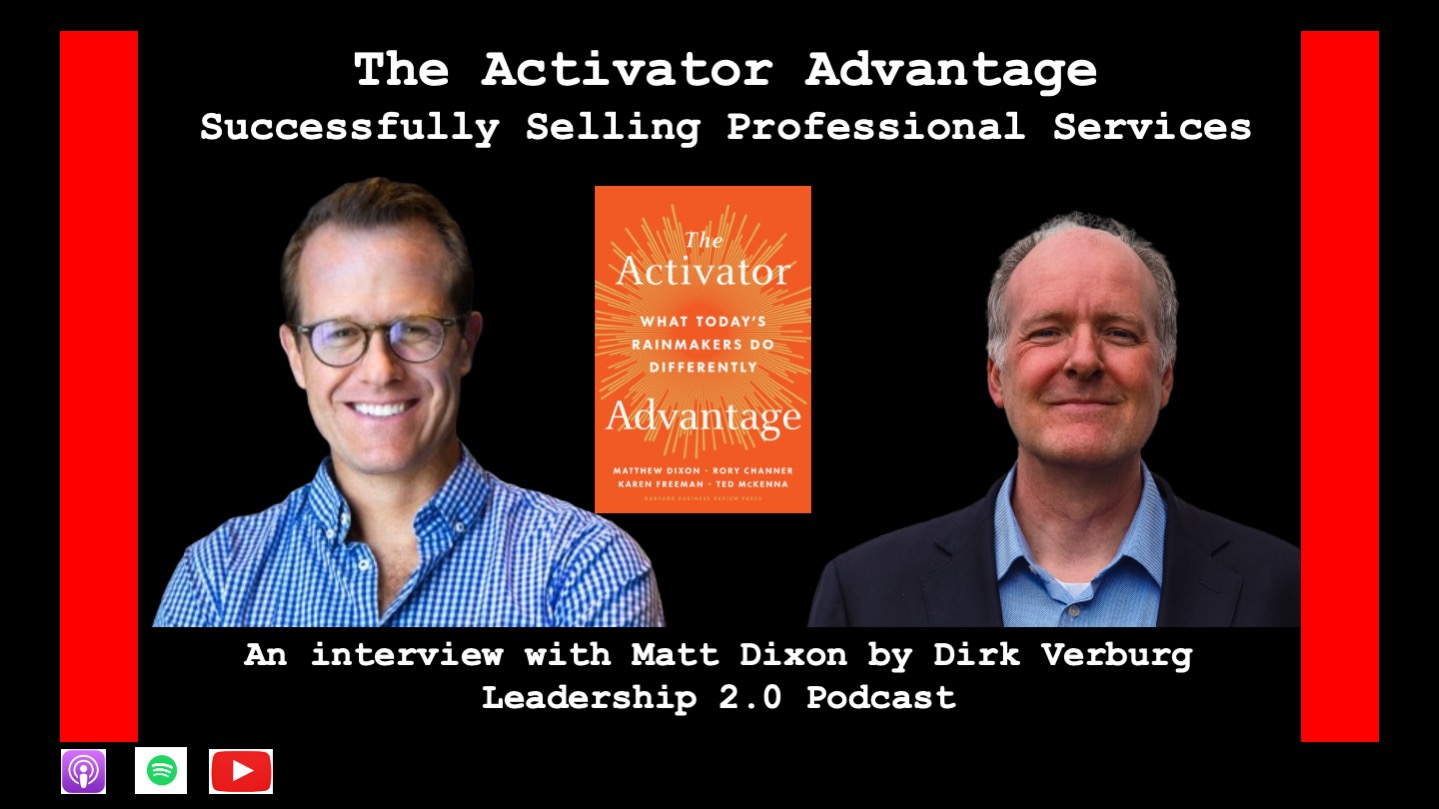
That is how, according to Matt Dixon, many ‘doer-sellers’ experience selling their services.
People do not become management consultants, executive coaches, accountants, lawyers, or engineers to sell. However, for those working in professional service firms or independently, selling is an integral part of their role.
At the same time, professional sales processes are changing. More and more professional services are sourced through RFPs, and buying committees are replacing traditional client relationships. This means that doer-sellers need to change their approach to sales in order to stay relevant.
Based on an extensive quantitative study of nearly three thousand partners across industries such as law, accounting, consulting, investment banking, executive search, and public relations, five distinct seller types within professional service industries were identified; however only one of them, the Activator, consistently drives growth.
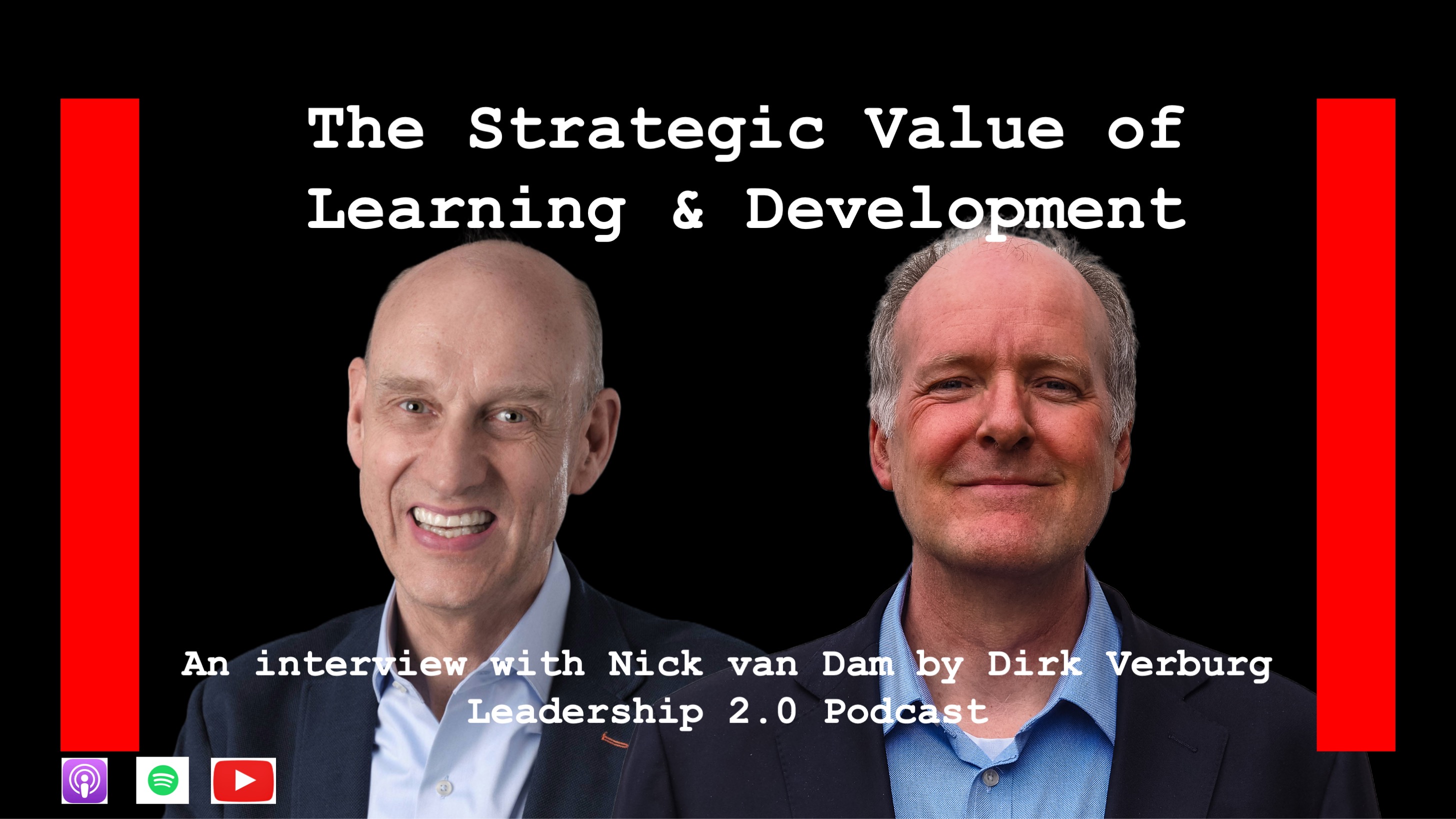
🚫 Many organizations mistakenly relegate Learning & Development (L&D) to a “nice-to-have” status. It’s seen as something every HR organization needs to have (if only for the optics), but often the prevailing attitude is that, while great L&D is a pleasant surprise, if it falls short, there’s no serious harm done to the organization.
❗This is often reflected in bland L&D offerings, which, more often than not, are so generic, that they fail to address the strategic issues organizations need to address
⁉️ However, what would happen if organizations truly would treat Learning & Development as a strategic instrument?
🎙️ In the 29th episode of the Leadership 2.0 podcast, I interview Nick van Dam about ‘The Strategic Value of Learning & Development’. Nick van Dam is an internationally recognized thought leader, advisor, executive coach, researcher, facilitator, and best-selling (co-) author of more than 29 books on Leadership, Organizational Behavior, and Corporate Learning & Talent Management.
► During our conversation, we discussed the following topics:
Many people in the workplace wrestle with combining their ethical and spiritual convictions on the one hand, with what they feel is required of them to progress their careers, or simply to stay in their roles, on the other.
For people who want to address this tension, ‘Heroic Leadership – Best Practices from a 450-Year-Old Company That Changed the World’ by Chris Lowney. ‘ will be a great read!
Chris Lowney, is a one-time Jesuit seminarian, who currently chairs the board of CommonSpirit Health, America’s largest not-for-profit healthcare system with 140 hospitals and more than 150,000 employees. Previously, he served as a Managing Director of J.P. Morgan & Co. in Tokyo, Singapore, London and New York.
In the 28th episode of the Leadership 2.0 podcast, I interview Chris Lowney about Heroic Leadership. During our conversation, we discussed the following topics:
Most of us are acutely aware of the gap between how organizations aspire to operate and the everyday reality of working within them.
This discrepancy often has a negative impact on the motivation and well-being of employees, ranging from a decrease in employee engagement, to mental health issues,
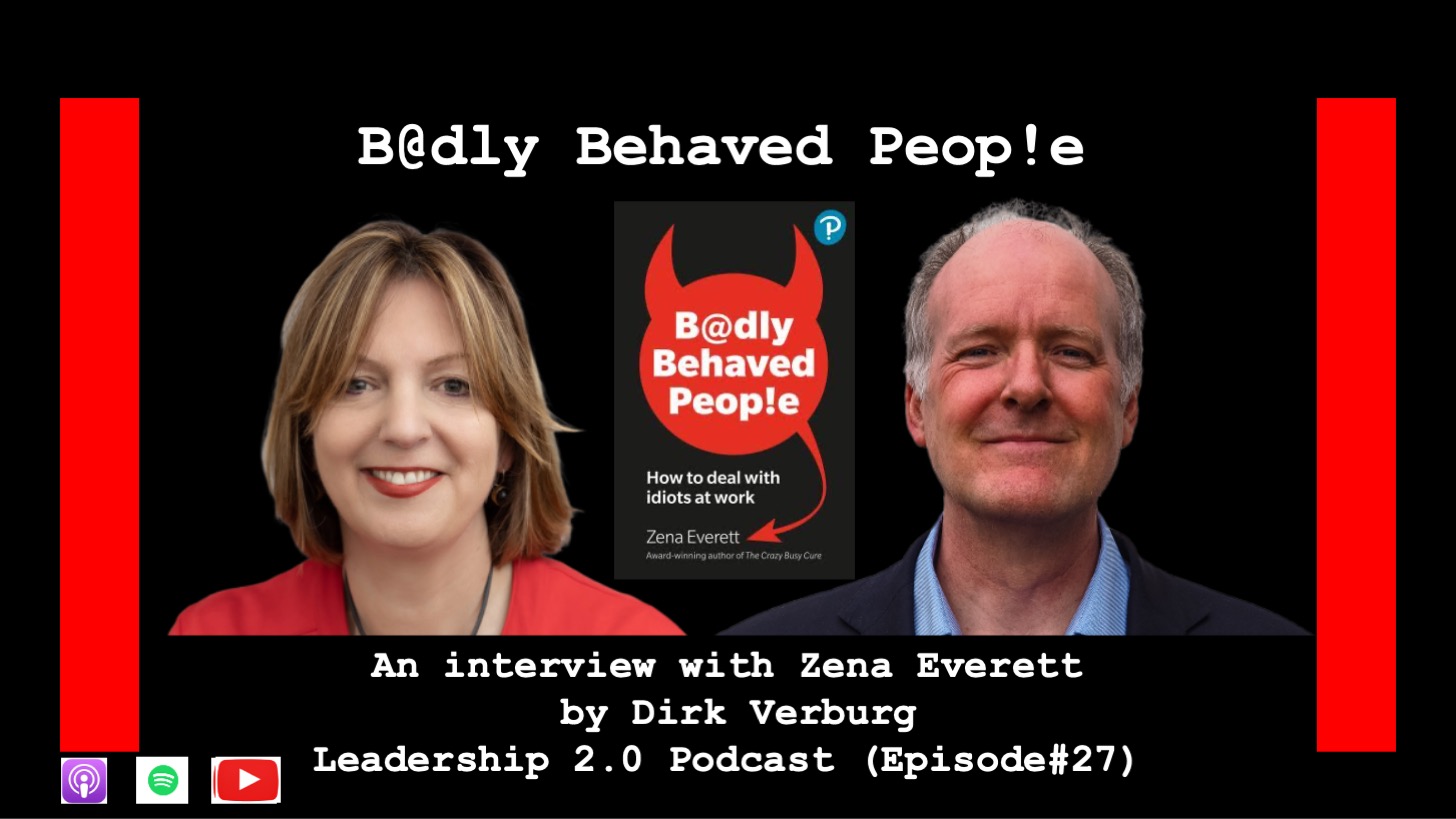
In her book ‘Badly Behaved People’, my fellow executive coach Zena Everett describes a number of real-world cases about how this discrepancy can manifest itself, and, perhaps more importantly, how we can address them
What I particularly like about about this book is how Zena makes complex psychological concepts (for instance, Transactional Analysis) accessible without oversimplifying them, and demonstrates how they can be applied in the workplace.
In our conversation about her book, Zena and I discussed the following topics:
Most leaders leave the composition and agendas of their leadership teams to chance. This is a waste of time, energy, and focus.
Almost all senior leaders choose the members of their leadership teams almost by default: all their direct reports, as well as a selection of participants from staffing and back-office roles ‘in the matrix’ (Finance, HR, IT, Regulatory, Affairs, Communications, Quality Assurance, etc.).
The advantages of composing leadership teams in this way are that:
✅ Representatives of all functions are aware of every topic that is discussed (information and awareness)
✅ Participants from staffing and back-office functions feel they (and their functions) are taken seriously as true ‘business partners’
✅ The leader avoids difficult discussions about the composition of their leadership team
Although this sounds great, this typically results in:
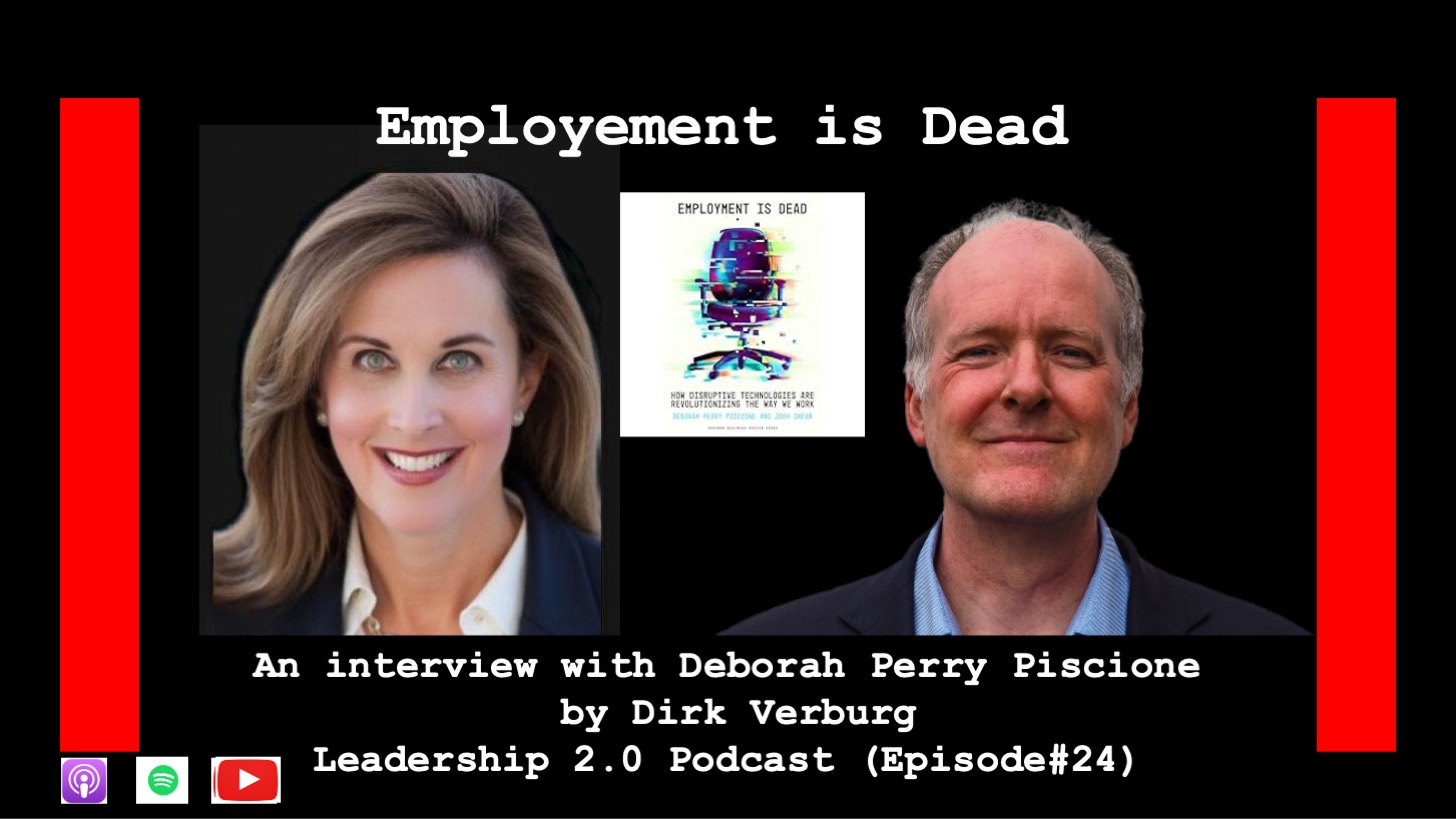
Earlier this week, one of the most important business books on the Future of Work was published by Harvard Business Review Press: ‘Employment Is Dead: How Disruptive Technologies Are Revolutionizing the Way We Work’ by Deborah Perry Piscione and Josh Drean.
The central theme of this book is that traditional employment models are becoming outdated due to the evolving needs and expectations of the modern workforce, in combination with, and enabled by, disruptive technologies.
This will lead to the end of the traditional employment model, as well as the traditional form of companies, as we know them today.
Monday, just hours before the book was released, I had the chance to interview Deborah Perry Piscione for my Leadership 2.0 Podcast.
► In our conversation, we touched on the following topics:
The image of the banking industry has been severely tarnished by the financial crisis (2007-2008), which led to increasing regulatory and compliance demands. At the same time, the industry is experiencing emerging competition from FinTechs, evolving business models, and disruptive technologies.
In light of these challenges, I recently spoke with Ralph Hamers, to explore his views on what effective leadership in the banking sector entails.
In our conversation, we touched on the following topics:
In many recruitment processes, human beings are reduced to commodities, and human dignity has become an afterthought.
More often than not, recruitment has become a volume-driven exercise, where metrics like ‘time to fill’ have replaced the craftsmanship essential for identifying the best candidate for the role. As a result, candidates often find these processes unsatisfactory, as their potential unique contributions and value to organizations are not adequately recognized.
FOUND, a Swiss-based start-up company, wants to disrupt this traditional approach to recruitment. I recently interviewed Victor Akwunwa, the Chief Sales Officer of FOUND for my Leadership 2.0 podcast.
During our conversation, we discussed the following topics:
There are some companies I deeply admire, and On, the Swiss sports and apparel brand is definitely one of them! Not only do they make amazing products and have an extremely powerful brand, they also have a unique company culture.
For this reason, I was thrilled to sit down with Alessandra Del Pino, Head of Engagement & Talent Growth at On, to discuss the company culture of On, or, as Alessandra describes it, their ‘secret sauce’.
During our conversation, we covered the following topics:
‘Everyone who wins nowadays is challenging the Shareholder Value Maximization doctrine’
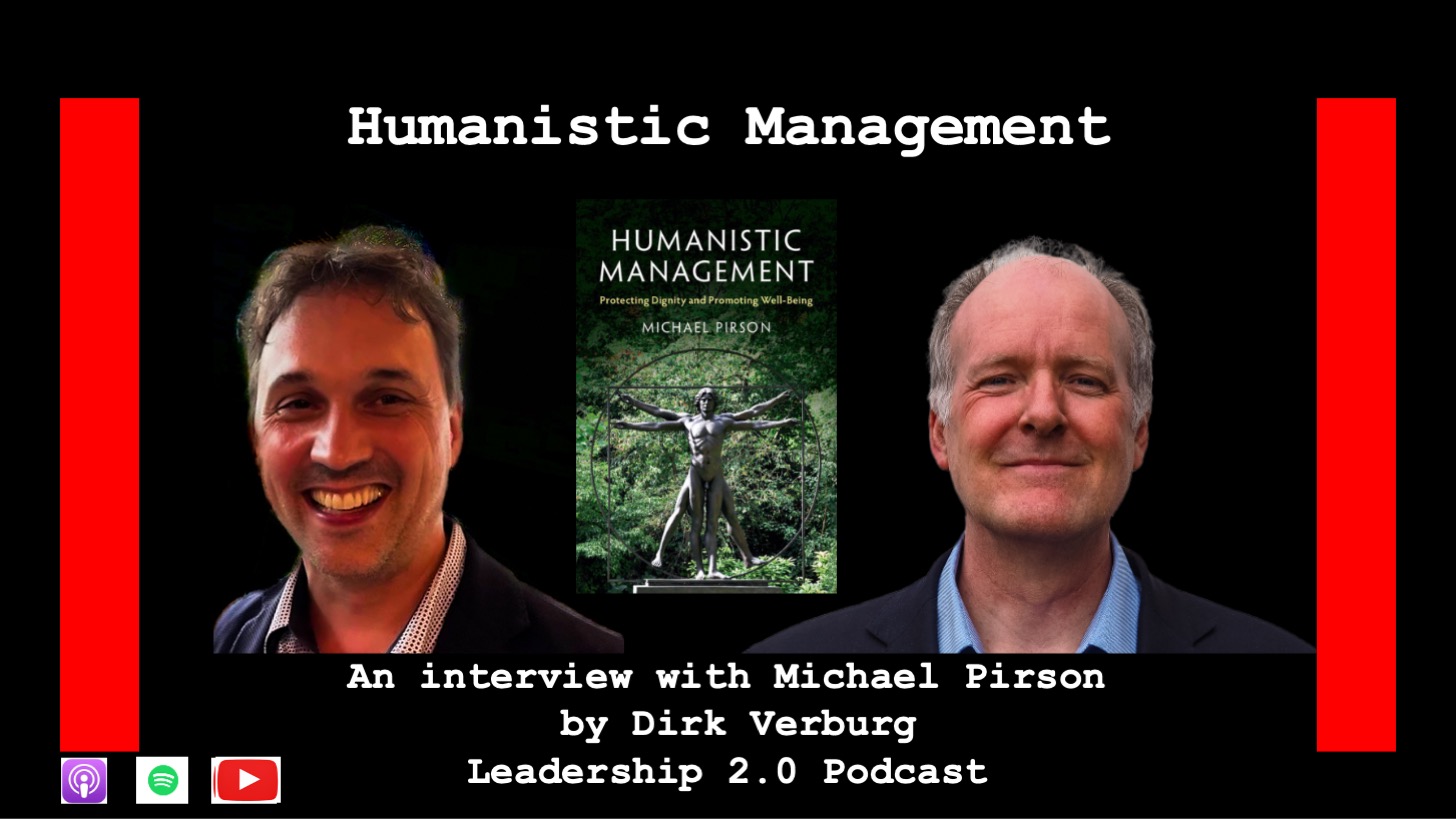
This is just one of the powerful and thought-provoking statements Professor Michael Pirson (Fordham University – Gabelli School of Business) made when I interviewed him about ‘Humanistic Management’.
In the last decades, the shortcomings of the neo-liberal economic order in our society have become clearer than ever (e.g. the credit crunch, climate change, and wars). An increasing number of people want to move away from a system that commoditizes human beings, and the natural environment in which they live.
They seek, amongst others, dignity, a sense of purpose, and attention to well-being, instead of material prosperity only.
Humanistic Management is a relatively young academic movement that seeks to create a more balanced relationship between those things that can be exchanged on markets and those that are not but make life worthwhile.
Michael Pirson is an active member of this movement, and in this episode of the Leadership 2.0 podcast, I discuss with him
1️⃣ What Humanistic Management is 2️⃣ How Michael discovered Humanistic Management 3️⃣ What we as mankind can learn from the Covid 19 Pandemic 4️⃣ Measuring Wealth versus Wellbeing 5️⃣ Will Shareholder Value (Economistic Management) not always prevail? 6️⃣ Is Humanistic Management industry agnostic? 7️⃣ Resources on Humanistic Management 8️⃣ Final Thoughts
👇 You can watch or listen to this podcast episode on
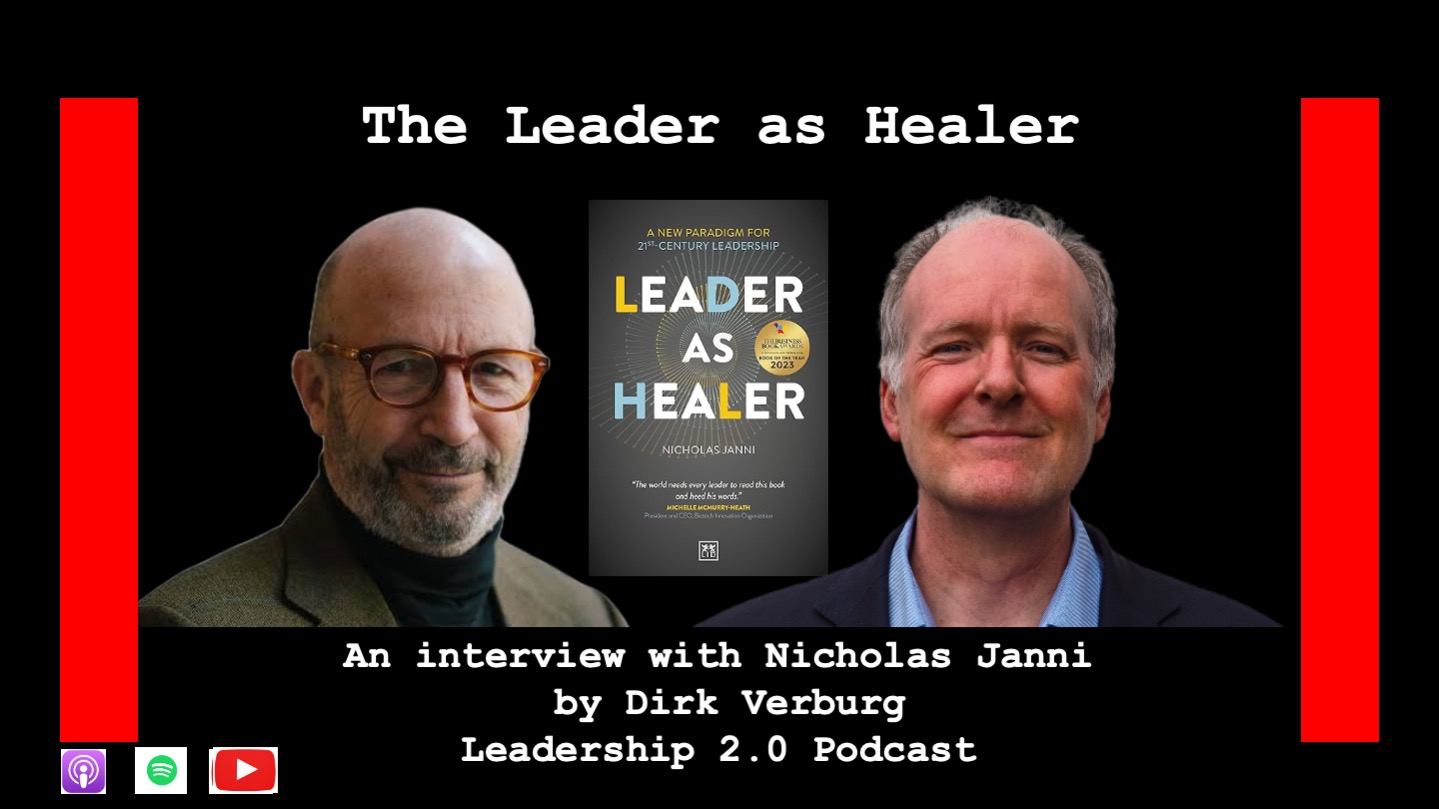
‘A transformational read that every leader of today needs’.
These were the words Head Judge, Jacq Burns used when she announced that ‘Leader As Healer’, written by Nicholas Janni was selected as the overall winner for the 2023 Business Book Awards.
In his book, Nicolas Janni argues that we need a new leadership model to address the challenges our society faces.
Our current leadership model is one where we see great leaders as warriors ‘on the battlefield of relentless competition’, who drive action, pursue instrumental (shareholder value related) goals, and maintain transactional relationships.
Instead, Nicholas Janni pleads for leaders who are empathetic, intuitive, present, skilled in mindfulness and deep listening, and who can inspire colleagues to engage and collaborate.
In this episode of the Leadership 2.0 podcast, I discuss with Nicholas:
I am an avid consumer of business books and love books about corporate history (e.g. ‘The Smartest Guys in the Room’ about ENRON by Bethany McLean and Peter Elkind or ‘Losing the Signal’ about Blackberry by Jacquie McNish and Sean Silcoff – to mention two of my favorites!).
Last week I read ‘Battle for the Bird’ by Kurt Wagner about the takeover of Twitter by Elon Musk.
If you want to know
Why Twitter has always been struggling with sufficiently monetizing its business model and why it might be hard for Elon Musk to change this,
Why content moderation is incredibly difficult for social media companies (defining and interpreting criteria), why they can never get it right for everyone all the time, which massive and contradictory pressures they face from all kinds of different interest groups, and
How ‘casual’ billion-dollar business decisions are sometimes taken in the investment community,
then I can highly recommend this book to you!
Kurt Wagner’s writing style is quick-paced and witty (but not too!). Cherry on the cake are some new personal anecdotes about Elon Musk (e.g. taking his mother with him to business meetings, and taking his son ‘X’ with a nanny in tow during the time he stayed in Twitter’s offices during the first period after the takeover).
So, if you have not packed your books for the holidays yet – consider taking this one with you! If you have been on holiday already, I hope you enjoyed it, and don’t worry: this books remains a great read!
‘I defy anybody to be energized by most appraisal systems I have seen in my career’ – Sally Bibb
As HR professionals and line managers (present company included!), we tend to take the strengths of our staff for granted and focus most of our attention on their ‘development areas’ (a euphemism for weaknesses).
The question is, however, how effective this is, and which business opportunities we miss, by following this approach.
Sally Bibb, partner at PA Consulting, leader and author in the field of strengths-based approaches to people and organisations, proposes a radically different approach and advocates focusing on strengths instead of weaknesses.
To find out what Strength Management is, and how we can implement it, I interviewed her for my Leadership 2.0 podcast.
During our conversation, Sally and I discussed the following topics:
0️⃣1️⃣ What Strength Management is
0️⃣2️⃣ How Sally became interested in the topic
0️⃣3️⃣ Is Strength Management incompatible with a Growth Mindset?
0️⃣4️⃣ Why most HR professionals remain focused on Development Areas
0️⃣5️⃣ Implementing Strength Management in HR Processes
0️⃣6️⃣ How can appraisals be improved?
0️⃣7️⃣ Is strength management a generational phenomenon?
0️⃣8️⃣ Will AI support Strength Management?
0️⃣9️⃣ Issues Sally is asked to address by her clients
➡️ No time to watch or listen to podcast now? Here is a short summary of our conversation ⤵
Dirk Verburg: I was classically trained as a line manager to focus on development areas to create “all-round” people. What are the advantages of focusing on a person’s strengths instead?
Sally Bibb: A strength is something you are naturally drawn to, that energizes you, and that you’re good at. Twenty years of neurobiological evidence shows that when people use their strengths, they are happier, more resilient, and perform better. Football managers, for example, know each player’s strengths and don’t try to make them all-rounders. While a team can be good at everything, an individual cannot. Focusing on strengths is not about ignoring weaknesses, but about intentionally using what you’re great at. Spending too much time on things you’re not good at will cause your motivation to drop, and your performance will be good at best—not great.
Dirk Verburg: Where does your personal interest in strengths come from? Did you have an experience that inspired you to focus on this topic?
Sally Bibb: My interest stems from an early experience in my career. I was promoted from a job I loved, which involved crewing ships, to one that required doing research for trade union negotiations. I was good at the first job because it leveraged my strengths in connecting with people and problem-solving. The second job, however, was a poor fit. I felt a loss of confidence and didn’t understand why until years later at a conference. A Harvard professor spoke about the emerging field of positive psychology and focusing on what’s right with people. That was a lightbulb moment for me. I realized there was nothing wrong with me; I was just a square peg in a round hole. This experience inspired me to study what makes great salespeople so successful, which was my first foray into applying strengths to the workplace.
Dirk Verburg: How do you see the relationship between strengths management and the desire to adopt a “growth mindset”? Are they contradictory, or do they strengthen each other?
Sally Bibb: I think they are highly complementary. A growth mindset—the belief that you can learn and grow—is important whether you are playing to your strengths or working on something you’re not good at. The growth mindset is not about being good at everything, but about being open to learning. For example, I worked with an executive who had never been in an innovative environment before. By having a growth mindset, he discovered a new strength in “joining the dots” and making connections. Had he not been open to this, he might have boxed himself in, assuming he wasn’t an innovative person. A growth mindset helps you discover new strengths and apply existing ones to new challenges.
Dirk Verburg: Why do you think many people in HR and talent management still focus so much on areas of development, even though the thinking has moved on?
Sally Bibb: I think a lot of it is organizational inertia. Organizations tend to do what they’ve always done, like using traditional competency frameworks and appraisal systems, even when they know these systems don’t energize people or get the best results. The organizations I work with that adopt a strengths-based approach do so because they want different outcomes, like improved performance and morale. Adopting this approach is a gradual process that requires a leader with a clear focus and determination to change things. I hope that in the next ten years, a strengths-based approach will be the norm, with new generations of leaders recognizing the benefits of this way of thinking.
Dirk Verburg: How would you practically conduct a strengths-based interview?
Sally Bibb: First, you have to know what strengths are needed for the role. For example, we studied the strengths of exemplary midwives in charge of labor wards. We found that the best ones share certain strengths beyond their clinical competencies, like a strong sense of doing the right thing. In a strengths-based interview, you ask candidates about those specific strengths. For example, “Tell me about a time when you had to ensure the right thing was done.” If it is a genuine strength, you can see their face light up and they can easily provide examples. In contrast, if you don’t know what “great” looks like for that role, a strengths interview is difficult to do effectively. The key is to match the candidate’s natural inclinations with the specific strengths that you know are critical for success in that job.
Dirk Verburg: What can we do to make classic performance interviews more meaningful by applying a strengths-based approach?
Sally Bibb: A strengths-based performance discussion should be an ongoing conversation throughout the year, not just a one-off event. It should focus on three things: the strengths you’re using regularly, the strengths you have that you might not be using, and the “weaknesses that matter”—the ones that are really getting in your way. Instead of criticizing, you can have a collaborative conversation about how to mitigate those weaknesses. This could involve using your strengths to compensate, getting help from colleagues, or finding ways to avoid the task altogether. This approach makes people feel relaxed and authentic because they don’t have to pretend to be perfect. The conversation becomes focused on potential and how to make the person even better at what they already do well.
Dirk Verburg: I have the impression that focusing on strengths comes more naturally to younger generations than to baby boomers or millennials. Would you agree with that observation?
Sally Bibb: That’s an interesting observation, and I’m not aware of any specific research on it. However, people in their 20s and 30s were raised in an era of “positive parenting” and a greater focus on self-esteem. They are often less modest and more willing to talk about their strengths. In contrast, older generations can be more modest. This is also culturally influenced. In the United States, people are generally more comfortable discussing their strengths, whereas in the UK and Switzerland, modesty can be a national sport. I see modesty as being a bit overrated, as not talking about your strengths can inhibit your ability to serve others and be overlooked for opportunities.
Dirk Verburg: You work with very big clients. What are the starting points for you in those conversations when a client wants to think about a strengths-based approach?
Sally Bibb: Clients rarely ask for a strengths-based approach directly. They come with business problems like: “We need to improve our performance,” “We need to improve our safety,” or “We need to improve staff morale and engagement.” These are the real-world problems that a strengths-based approach can solve. When clients see the impact of this approach, they like it because it connects with people and makes common sense. It’s not just a psychometric tool; it translates into hard returns and measurable outcomes. The private equity sector, for example, has been a leader in this thinking because they know that having the right combination of strengths in a leadership team is critical to a successful investment.
Dirk Verburg: We’ve discussed a lot of elements around strengths. Is there anything we haven’t touched on that you would like to mention?
Sally Bibb: There’s just one thing that’s very dear to my heart. From women in prison to senior executives, people often don’t really know their strengths or their value. The strengths-based approach makes people feel good about themselves and the contribution they make. This is the best starting point for helping people realize their potential. If we could bring this thinking into the public and political arena, there would be less burnout, less imposter syndrome, and more satisfaction and engagement at work. It’s a win-win-win for individuals, employers, and society as a whole.
▶ About Sally Bibb
She started her career working for BT International and then moved into an international role at The Economist Group before founding the strengths consultancy Engaging Minds in 2012. In 2021, she joined PA Consulting as a partner to advance her vision of bringing strengths to many more employers worldwide.
In this role, she leads strengths-based organizational change work in Europe, the USA, and Asia, and has built a track record of achieving transformational results for a number of high-profile clients in both the private, as well as in the public sector.
Sally has an MSc in organizational change from the University of Surrey and has (co-)authored eight books. A full list can be found here: https://sallybibb.com/my-books/
She is a fellow of the RSA (Royal Society of Arts) and a member of the steering committee of The Daedalus Trust, a charity founded by Lord David Owen to promote research into hubris syndrome in business.
Besides the fact that these failures often have a traumatic impact on the individuals involved, the costs for the organisations are huge. Not only in terms of image and hiring costs but, more importantly, in terms of opportunity costs.
To find out why leadership transitions prove to be so hard, and what companies and individuals can do about it, I interviewed Michael Watkins for my Leadership 2.0 podcast.
‘We live in a world of organizations – and we do not understand them’
This is one of the statements Henry Mintzberg, one of the leading thinkers in the field of Management, made when I interviewed him for my Leadership 2.0 Podcast about his latest book ‘Understanding Organizations…Finally’.
During our conversation, we discussed the following topics:
0️⃣1️⃣ The importance for organizations to get their structure ‘right’ 0️⃣2️⃣ The evolvement of Henry’s thinking about organizations 0️⃣3️⃣ ‘Every (organization) form contains the seeds of its own destruction’ 0️⃣4️⃣ ‘Emergent structures’ versus large-scale reorganizations 0️⃣5️⃣ The fit between the leader and the structure of the organization 0️⃣6️⃣ The structures of Apple and Tesla and the personalities of their founders 0️⃣7️⃣ The complementary role of conflict and culture in organizations 0️⃣8️⃣ The relationship between the structure and the culture of an organization 0️⃣9️⃣ The gap between formulators and implementers of corporate strategies 1️⃣0️⃣ The interest in structuring organizations in academia and business
You can watch or listen to this podcast episode on:
Karl Marx famously said, ‘A specter is haunting Europe—the specter of Communism’. Nowadays we can say ‘A specter is haunting the business world – the specter of AI’.
Everyone seems to be riding on the AI bandwagon nowadays, and, as a result, many business leaders are suffering from corporate FOMO.
One thing is clear though, all business leaders need to reflect on the impact AI will have on their organizations. Too many organizations have disappeared because of technological disruptions, including the likes of Kodak, Polaroid, DEC, Motorola, Blackberry, SUN Microsystems, and Blockbuster, to name a few.
Of course, it is tempting to have an intellectual debate about which technologies are disruptive and which ones are not. This is especially the case if technologies are built on other technologies (which is almost often the case). Without the transistor, the modern computer would not have existed, does that mean that microchips are not disruptive?
For this reason, I like this definition in Investopedia:
A disruptive technology is an innovation that significantly alters the way that consumers, industries, or businesses operate. A disruptive technology sweeps away the systems or habits it replaces because it has attributes that are recognizably superior.
Based on this definition, I think AI definitely qualifies as a disruptive technology.
When it comes to dealing with disruptive technologies, business leaders need to ask themselves four questions:
The vast majority of global companies have regional leadership teams. These teams are often uncomfortably situated between the corporate executive team, and their own national (sales) organizations(s).
They usually have a tough job.
Typical challenges for regional leadership teams
Regional leadership teams often find themselves being caught in a sandwich.
On the one hand, they are being kept responsible for realizing the revenue and profit targets for their geographic area (’their’ business), whilst also ensuring ‘compliance’ in all relevant areas.
Everyone who ever worked in a large organization, can probably relate to at least one of the following examples of conflicts that regularly occur in organizations:
A sales leader wants to close a deal with a low margin to meet her targets and to safeguard the relationship with the customer. The product manager does not want to sign off on the deal, because she wants to protect the margin of the product in the longer term
A business leader wants to hire a star performer working for another company, and is prepared to pay her more than the maximum of the corporate salary band for these types of roles. The HR Business Partner tries to prevent this because he does not want to create a precedent that can create upward pressure on the salary costs of the company
The head of a shared service department wants to hire an independent contractor for a project for USD 1.200 a day. The Purchasing department forces him to work with a consultant from a well-established firm on the preferred supplier list, for a fee rate that is 3 times as high as the one of the independent contractor
These, and other types of conflicts, seem to be an inevitable part of life in large organizations. The question is: why we have those types of conflicts, and if and how we can prevent them?
What do the notorious former marketing director of American Apparel, Ryan Holiday, and renowned Dutch reformed theologian Bram van de Beek have in common? They both have written a book about the danger of egocentricity.
Social media…are not to blame
Social media offers endless possibilities to promote ourselves and serve as outlets for our vanity. It enables us to humble brag about our professional achievements on LinkedIn, share evidence of our successful ‘friends & family’ life on Facebook, and demonstrate our cutting-edge lifestyle on Instagram.
However, looking at our current society and world history, it seems we as human beings always have been prone to self-centeredness and self-promotion. Social media therefore merely enables us to express something that is already deeply rooted in us.
In all walks of life, there are people who have deeply held convictions about how the world works, and act accordingly. The business world is no exception.
Examples I encountered during my career were business leaders that held and acted according to the following convictions:
The only way you gain respect by ‘the business’ as a staff department, is by reducing your headcount to the absolute minimum
Partnering with other vendors to deliver an integrated solution for clients is unnecessarily complex and has a negative impact on the margin
Teams perform at their best if the annual bonus of individual members is linked to individual financial targets
Customizing services for individual clients equals to sub-optimization
Strong convictions usually stem from the successes they brought us in the past. They also tend to become stronger over time: every time we successfully act in accordance with one of our convictions, our inclination to use it in similar situations increases.
Strong convictions offer several advantages
Strong convictions help us to make sense of the world around us and to simplify our decision-making processes. They save us time and effort. When we are confronted with an issue on which we have a strong conviction, our mental muscle memory immediately kicks in to prescribe the decision we need to take.
Another advantage of strong convictions is the potential it offers to persuade others. Because we feel strongly about a topic and have an active ‘personal repository’ of evidence (previous cases in which a particular course of action worked for us), we can speak convincingly to others about it.
In the last three decades, the business world has become more complex than ever before. This complexity is mainly driven by two factors:
Globalization – Never before in the history of mankind have materials, capital and people moved faster and more freely across our planet
Technology – The amount of data we have at our disposal for decision-making is dramatically increasing each year, and AI is providing us with the tools to do this faster and more effective than ever.
As a result, our world has become more interconnected and interdependent than ever. A case in point are the supply chain issues businesses experienced in the initial stage of the COVID-19 pandemic.
This interconnectedness and interdependence has huge implications for the way organizations need to operate, both externally as well as internally.
Ethics deal with what makes something morally right or wrong.
Almost any sizeable company nowadays has a code of ethics. The main catalysts for these were the corporate scandals in the early 2000s (Enron, Worldcom, Tyco, and others). Also, in the last couple of years having a sense of purpose has become pretty much en vogue.
As a result, every year millions of employees now dutifully complete e-learning modules and sign declarations (‘To the best of my knowledge…’).
If you think about this on a philosophical level, it is actually quite sad. Apparently, companies need to invest millions of dollars each year because a shared understanding of what is morally right or wrong to do on behalf of the company, is not a given.
Obviously, from a pragmatic point of view, companies have no choice but to invest in this type of training. First of all, it helps individuals to avoid taking decisions that can create reputational and compliance-related problems for the company. The second reason is the need to demonstrate institutional compliance to governments, regulatory bodies and other stakeholders.
I always felt sorry for the many famous artists in the Renaissance, who needed to compromise the quality of their work and their artistic integrity, in order to make sure their art suited the requirements of their patrons.
Passion
Because my work provides me with an opportunity to express and develop myself, I have always been passionate about it. I loved studying organizational sociology, business administration, and executive coaching. To this day I enjoy reading business books, magazines, and blogs about the area where people, organizations, and business objectives meet.
As a management consultant, this passion drives me to define and implement the best possible solutions for my clients. I have very clear ideas about what my clients need, and what the ideal solution to satisfy this need should look like.
Unfortunately, most of my clients also have pretty strong ideas about what their needs are, and what their ideal solution should look like…
For this reason, I used to literally cringe when my clients told me they wanted to adapt the recommended solutions I had in mind for them.
Artistic integrity?
I used to find these situations very difficult to deal with because I had the idea that the intrinsic quality of my advice was affected. Not hindered by any sense of false modesty, I compared myself to the aforementioned renaissance artists who needed to compromise their artistic integrity.
This feeling became so strong, that, at a certain moment in my career, I was considering returning an assignment back to my customer, because I felt I could not put enough of my thinking into the product and felt a loss of engagement.
One question
This all changed when I discussed my sentiments regarding a specific project with an executive coach. She patiently listened to my venting, and then asked one question that really hit home to me.
When I had just been appointed in my first proper line management role, I decided to organize an offsite with my team. The purpose of this offsite was to finalize the development of a number of HR policies and processes.
Around 11 o’clock in the first morning, in a characterless conference room in the basement of the conference center, we completed our first round of brainstorming. When the time came to write up the output of our first session in a flow chart format, I said I wanted to use a specific methodology I had used as a management consultant, and would be happy to do the write-up.
One of my direct reports looked disappointed, because she wanted to create the flowcharts herself, but a colleague of hers consoled her, and said: ‘Sure, if Dirk knows how to do it and has a strong passion for it, why do we not let him do so?’ The others agreed, and they left the room to leave me to it.
I spend the next 1.5 hours working on my own in the aforementioned characterless conference room in the basement. When I was ready I went upstairs to look for my team. I found them on the terrace, enjoying the sun, cappuccinos, orange juice, and each other’s company.
Fortunately enough they thought my work was ok…
Do it yourself?
A lot of leaders frequently want to do the work of their direct reports. They have a variety of reasons for this, including
‘We read to know we’re not alone’ said actor Anthony Hopkins, playing the character of author C.S. Lewis, in the movie ‘Shadowlands’.
People suffering from the imposter syndrome doubt their abilities and feel like a fraud at work.I personally suffered quite a bit from the ‘imposter’ syndrome in the past, and at times experience serious relapses.
Fortunately, it turns out I am not the only one!
After reading ‘Authentic Self-Confidence’ by Jacqueline Brassey, Nick van Dam and Arjen van Witteloostduijn, I realize I am part of a large community that includes successful (and sometimes well-known) academics, surgeons, management consultants and senior executives.
Lack of Authentic Self-Confidence can lead to sub-optimal performance (e.g. because individuals feel constrained to bring the best version of themselves at work), which can have negative emotional impact on themselves, their families, teams and organizations. Therefore a high-quality publication on this topic is extremely welcome.
There are three reasons why I full-heartedly recommend this book.
In short, self management simply means ‘no bosses’. That’s it (Geoff Roberts)
Thinking back on your highschool school days, do you remember the popular child with its entourage deciding which music, movies and influences were in, or out; whose parties everyone wanted to be invited to? Did you also have a bully at school who terrorized the schoolyard with his accomplices, when no supervising adults were around? Perhaps you also remember the importance of being ‘befriended’ with children in the class whose parents had a swimming pool; and I am sure you also had someone in class whose homework you and everybody else wanted to copy.
YouTube
I thought the concept of self-managing teams had already died a well deserved death, until I recently saw a clip on YouTube. The clip advocates the concept of self-managing teams by comparing the productivity of self-managing teams with the traffic flow through a roundabout. Different scenarios are compared to ensure the most effective flow to cross an intersection: with or without human supervision, with traffic lights and finally with the creation of a roundabout. Spoiler alert: the roundabout wins. Moral of the story is that in the absence of central control participants will self-regulate the responsibility to cross the intersection, and that by doing so productivity and safety will increase.
I am stunned by the enthusiasm for this clip, because I think the parallel between teamwork and crossing an intersection is incredibly weak. I would even go so far as to say it is non-existent.
2021 will be a very interesting year! If all prognoses are correct, sometime in the next six months we should have developed a grip on COVID19.
For 2021, I foresee three trends in the workplace. Although none of these trends is initiated by COVID19, the pandemic will definitely act as a catalyst.
The most important part of leadership is making decisions. Decisions about products and markets to invest in, people to hire and to promote, IT-systems to select, to continue or terminate projects plagued by setbacks, mergers & acquisitions, etc. These decisions determine the success or failure of organizations, projects and individuals.
Ever since my graduation in the field of Sociology, I have always been very interested in the topic of decision making in organizations. At university, I loved the lectures of Professor Lawler about concepts like bounded rationality. I also loved reading books on this topic, including ‘Essence of Decision’ (about decision making in the Kennedy administration during the Cuban missile crisis) and Barbara W. Tuchman’s classic ‘March of Folly’.
Do we really need another book on this topic?
Against this background, I was a bit concerned when my friend and former PA Consulting Group colleague Wim van Hennekeler, told me that he was writing a book about decision making. This was mainly due to my concern about whether he could possibly add value to the vast body of work that was already published on this topic.
Time-efficient alternatives for reading business books
During my years in college, one of the first rap songs that became extremely popular was ‘Paid in full’ from Eric B & Rakim in the Coldcut mix. Its signature ingredients contained the soundbite ‘Pump up the volume’.
‘Pump up the volume’ also was the phrase that resounded in my head when I recently read ‘Rebel Talent – Why it Pays to Break the Rules at Work and in Life’, a bestseller written by Francesca Gino, a well-known Harvard Business School professor. The entire book is based on a single concept that could easily have been explained on one single page.
Instead, the author used more than 230 pages, which cost me the better part of a Sunday to read…
Why I like reading business books
I like reading business books for four reasons:
To satisfy my intellectual curiosity
To help me to make sense of what I personally observe about the way organizations ‘work’ (or not!)
To enhance my skills
To keep me ‘current’
Why I am often disappointed after reading them
However, more often than not, I feel reading them is not the most efficient use of my time. The reason why is that (like the example mentioned at the beginning of this post), business books often try to expand ideas and concepts that could be explained in a couple of pages to the size of a book. This almost always means they need to cross the magical border of 200 pages.
I think this phenomenon is caused by the fact that business books mean ‘business’. Although it is not easy to gain insight into the market for business books, creatively extrapolating existing statistics indicate that each year more than tens of millions of business books are sold across the world. Therefore, the market for business books might be around one billion dollar. NB: This estimate excludes the sales of textbooks for higher education.
One of my core beliefs as a management consultant is that the root cause of why change projects fail is the lack of a clear and convincing business case. In my experience, the vast majority of people are willing to change (even if this change has negative implications for them), as long as they understand the rationale behind the change and have the means (resources) to change.
However, I also have come across a number of people who did not want to change, even when there was a clear need to do so, and they had all the required capabilities and resources at their disposal.
In 2018, the Cambridge Analytica scandal shocked the world. It became clear that Cambridge Analytica had used data from tens of million Facebook users, to influence the elections in the US, and the Brexit referendum.
A couple of days ago my bible app opened with this verse of the day: ‘To do righteousness and justice is more acceptable to the LORD than sacrifice’ (Proverbs 21:3).
This text reminded me of the way some companies deal with Corporate Social Responsibility (CSR). Rather than doing the right thing, they do the wrong thing and compensate for this by deploying CSR initiatives. There is even a special term describing this phenomenon: ‘Greenwashing’. In this context, it is no wonder that two professors from IMD (a leading Swiss Business School) published an article in 2018 with the provocative title: ‘Why nobody takes corporate social responsibility seriously’.
The world will fundamentally change in the next decade
Whether you are listening to McKinsey, the IMF or the Economist, all modern-day prophets of doom agree that COVID-19 is having a devastating impact on our society and the economy. This impact will be felt long after this pandemic has passed.
Although I am not an incarnation of Alvin Toffler, the famous futurist and author of ‘Megatrends’, merely by observing the news and talking to clients and colleagues, I see a couple of clear trends and tipping points, which lead me to believe that the ‘new normal’ will look different than the ‘old normal’.
Let me start with a confession:I never liked receiving negative feedback, and have spent the largest part of my professional life ignoring it.
I found ignoring negative (or perhaps I should euphemistically say ‘corrective’) feedback to be quite easy. Depending on the situation, I either did not take the person who gave me feedback seriously (‘that is rich – from him?’), comforted myself that the feedback concerned only a minor issue in the grand scheme of my behavior (and that other aspects of my behavior would compensate this), or convinced myself that the person giving me feedback did not understand the context in which I acted the way I did or said the things I said.
It was not until I hit a serious roadblock in my career, that I started to see the fact that systematically ignoring feedback was not necessarily a great idea.
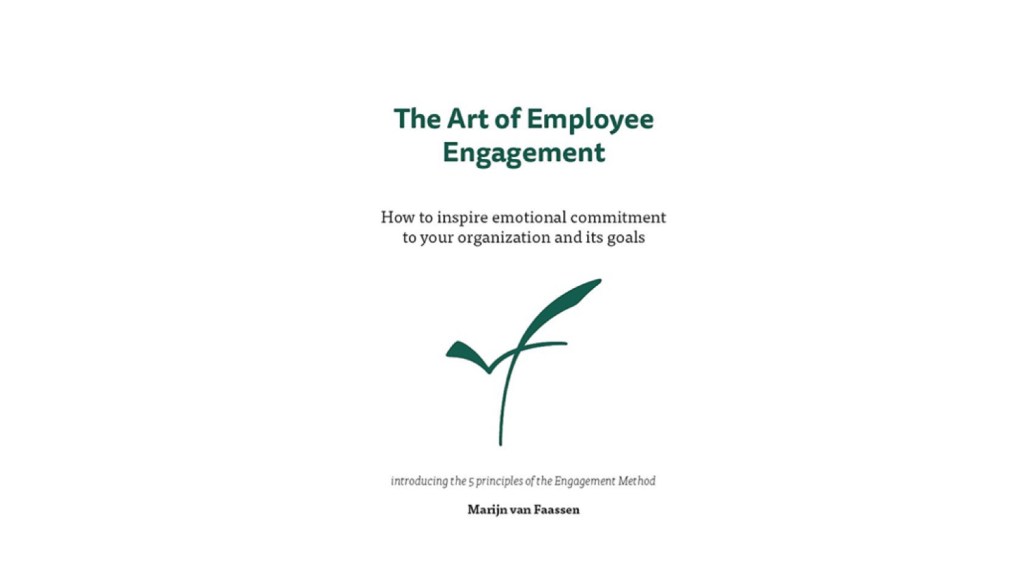
Employee engagement is a topic close to my heart. In the past two decades I have designed, managed and implemented the findings of engagement surveys multiple times, and also managed to write an article with my point of view on how to make them ‘work’.
Given my interest in this topic, I was very pleased to receive a copy of ‘The Art of Employee Engagement’ by Marijn Faassen. I read it in one go, because I found it a fascinating read, for a number of reasons:
Every year millions of people around the world make New Year’s resolutions. Given that we are currently starting the 2020’s, we have the exciting opportunity to make resolutions for a whole new decade!
One of the key notions in this book is that the world has become much more interconnected and therefore more complex. Unfortunately, our decision-making skills are ‘brilliantly designed – for an older, less connected, and more predictable version of the world’. In this context, Jennifer Garvey Berger mentions five mind traps we can find ourselves in, one of them being trapped in ‘Simple stories.
Two weeks ago, I was asked to participate in an event about personal branding. The organizer asked me to focus specifically on the link between creating a personal brand and remaining authentic.
Because I have been irritated by the majority of the publications on this topic in the last 5+ years, I was excited to speak about it. Why? Because these articles often suggest people need a partial, or even full, make-over, in order to fit the mold of the specific environment they seek employment in. If that does not feel natural to them, the second piece of advice most publications give them is: ‘Fake it until you make it’.






















 Dirk Verburg